Best Drywall Sanders (2026): 7 Pole and Handheld Picks Compared

The best drywall sander for a homeowner turns the worst part of a drywall job, hours of overhead hand-sanding in a cloud of white dust, into something closer to vacuuming. Powered drywall sanders spin a 9-inch hook-and-loop disc on a long pole or a handheld body and pull dust through a hose into a bag or shop vacuum. They make sense for a finished basement, a garage conversion, a run of patched walls after a plumbing repair, or skim-coating a room before paint. They make less sense for one small patch, where a sanding sponge is faster. Below are seven picks matched to specific jobs, then a buying guide on dust control, weight and the asbestos question that comes with older ceilings.
Part of our Structure & Exterior guide — start there for the full picture →
As an Amazon Associate we earn from qualifying purchases.
How we compared: we compared 13 current Amazon listings for powered drywall sanders, 11 pole-style units and two compact short-body sanders, on what each listing states: motor rating, speed range, pole reach, weight, dust collection setup, head design and warranty. Two compact Skil orbital and detail sanders that appeared in the same searches were set aside because they are general woodworking sanders, not drywall sanders. We did not lab-test these sanders or use them hands-on. Prices and availability change, so check the current listing before buying.
Quick picks: the best drywall sanders by job
| Product | Best for | Key features | Price | Buy |
|---|---|---|---|---|
| WEN DW5084 | Best overall for DIY drywall |
| $154.36as of Oct 19, 2026 8:37 pm GMT+0000 | Buy now →Check current price |
| Gioventù SZB-225FV-2 | Ceiling sanding |
| $179.97as of Oct 19, 2026 8:37 pm GMT+0000 | Buy now →Check current price |
| KUPERIA KU1Y | Lightest pole sander |
| $129.99as of Oct 19, 2026 8:37 pm GMT+0000 | Buy now →Check current price |
| VEVOR 1150W | Most power for big rooms |
| $115.90as of Oct 19, 2026 8:57 pm GMT+0000 | Buy now →Check current price |
| Protmex 225FT | Long reach plus safety kit |
| $159.99as of Oct 19, 2026 8:57 pm GMT+0000 | Buy now →Check current price |
| VEVOR 800W Compact | Compact with shop-vac hookup |
| $69.90as of Oct 19, 2026 8:57 pm GMT+0000 | Buy now →Check current price |
| MAXXT R7503 | Handheld wall patches |
| $72.99as of Oct 19, 2026 8:55 pm GMT+0000 | Buy now →Check current price |
Prices are Amazon’s listed prices as of the time shown and change often; check Amazon for today’s price. As an Amazon Associate we earn from qualifying purchases.
The seven picks, compared listing by listing
1. WEN DW5084 — Best Overall Drywall Sander for DIY

5-amp dual-head drywall sander with round and triangular pads, 600–1500 RPM, 15 ft dust hose and a 2-year warranty.
Check price on Amazon$154.36 as of Oct 19, 2026 8:37 pm GMT+0000 — prices change; see Amazon for current price.Why we like it
- Swappable round and triangular heads, no tools needed
- Triangle head reaches into inside corners
- Longest dust hose included on the shelf
- Collapsible body and 2-year warranty
| Specification | Details |
|---|---|
| Motor | 5 amp, head-mounted |
| Speed | Variable, 600–1500 RPM |
| Heads | 9 in round and 11-1/4 in triangular hook-and-loop |
| Dust collection | 15 ft dust hose; improved hole layout per listing |
| Included paper | Six 9 in discs and six triangular sheets, assorted grits |
| Weight / warranty | About 16.3 lb as packaged; 2-year warranty |
WEN DW5084 — 5A, 600–1500 RPM, round + triangular heads, 15 ft hose, collapsible, 2-yr warranty
The Only Sander on the Shelf With a Triangular Head for Corners
Every other pole sander here uses a single round head, and most handle corners with a detachable edge ring that exposes the disc. The WEN is the only one that ships a second, triangular head, which you swap in without tools. Inside corners are where round heads either miss joint compound or gouge the adjoining wall, so a dedicated corner head is a practical advantage for a homeowner finishing a basement.
It also comes with the longest dust hose of any listing that gives a length, at 15 ft, enough to leave the vacuum in the middle of the room. Its speed range, 600 to 1500 RPM, is the lowest top speed on the shelf, which favors control on fresh joint compound over raw stock removal.
What the listing does not have: it is the only one of the 13 on-topic listings that does not mention an LED work light, it does not give a pole length or a dust capture percentage, and the round head takes WEN’s own replacement paper. The 16.3 lb figure appears to be the packed weight.
Pros
- Dedicated triangular corner head
- 15 ft dust hose included
- Established brand with a 2-year warranty
Cons
- No LED light
- Round head needs WEN replacement paper
- Pole length not stated
Check WEN DW5084 price on Amazon
2. Gioventù SZB-225FV-2 — Best for Ceiling Sanding

780W vacuum sander with a head-leveling ceiling fixture, extra 14 ft shop-vac hose, 26 ft cord and 3-year warranty.
Check price on Amazon$179.97 as of Oct 19, 2026 8:37 pm GMT+0000 — prices change; see Amazon for current price.Why we like it
- Fixture holds the head level for overhead work
- Extra 14 ft hose for connecting a shop vac
- Longest stated cord at 26 ft
- Longest stated warranty at 3 years
- Goggles, earplugs and mask included
| Specification | Details |
|---|---|
| Motor | 780 W copper |
| Speed | 7 settings, 900–1800 RPM |
| Reach | Aluminum pole extends to about 6.2 ft |
| Dust collection | Built-in vacuum, 7 ft hose and bag, plus 14 ft retractable hose for a shop vac |
| Cord / weight | 26 ft cord; about 11.7 lb |
| Warranty | 3-year factory warranty |
Gioventù SZB-225FV-2 — 780W, 900–1800 RPM, ceiling-leveling fixture, 6.2 ft pole, 7 + 14 ft hoses, 26 ft cord, 3-yr warranty
The Only Listing With a Locking Fixture That Keeps the Head Level Overhead
Pole sanders are hardest to control on ceilings, where the head wants to flop and dig an edge into the compound. This Gioventù listing describes a patented fixing lock that keeps the head in a vertical-pole, level-pad position for ceiling work. No other listing on the shelf describes anything similar except Gioventù’s own sibling model, the SZL-225V-2.
It is also the only listing that includes a second, longer hose specifically for connecting a shop vacuum, which is the better dust setup than the small bag most sanders ship with. Its 26 ft cord is the longest stated, and its 3-year warranty ties with the SZL-225V-2 for the longest on the shelf. Three listings include a disposable mask, goggles and earplugs, and this is one of them.
The 95.5% dust capture figure is the manufacturer’s claim, not a measured result, and a basic mask does not replace a proper respirator for long sanding sessions.
Pros
- Ceiling-leveling fixture
- Shop-vac hose included
- 3-year warranty and 26 ft cord
Cons
- Heavier than the lightest pole sanders
- Dust figure is an unverified claim
- Lesser-known brand for parts
Check Gioventù SZB-225FV-2 price on Amazon
3. KUPERIA KU1Y 8.5 Amp — Best Lightweight Pole Sander

8.5 amp vacuum drywall sander at about 8.5 lb, 800–1800 RPM, dual-channel dust design and grid sandpaper included.
Check price on Amazon$129.99 as of Oct 19, 2026 8:37 pm GMT+0000 — prices change; see Amazon for current price.Why we like it
- Lightest pole sander with a stated weight
- Dual-channel vacuum design
- Includes longer-lasting grid sandpaper
- Collapsible handle stores in a carry bag
| Specification | Details |
|---|---|
| Motor | 8.5 amp copper |
| Speed | 7 settings, 800–1800 RPM |
| Reach | Pole extends from about 3.9 to 5.5 ft |
| Dust collection | Dual-channel built-in vacuum, hose and bag |
| Paper included | 6 basic and 6 grid sandpapers (100, 180, 240) |
| Weight | About 8.5 lb sander |
KUPERIA KU1Y — 8.5A, 800–1800 RPM, 3.9–5.5 ft pole, dual-channel vacuum, grid paper, 8.5 lb
The Lightest Pole Sander, With the Highest Amp Rating Among Amp-Rated Units
Weight is what wears you out on a drywall sander, especially overhead. Of the pole sanders that list a weight, KUPERIA’s 8.5 lb is the lightest, just under the near-identical IMQUALI at 8.59 lb and well under the 13 to 16 lb of the VEVOR 1150W, POPULO, MYTOL and WEN. Four pole listings give an amp rating rather than watts (WEN 5 A, MYTOL 7.2 A, IMQUALI 8 A and KUPERIA 8.5 A), and KUPERIA’s is the highest of the four.
It is also one of only two listings that include grid (mesh) sandpaper, which clogs less with joint compound dust; Gioventù’s FV-2 is the other. The listing gives a dust capture claim of 97 to 99 percent, with the honest note that you must keep the disc flat to the wall to get it.
The trade-off is reach. Its pole tops out at about 5.5 ft, shorter than the roughly 6.2 ft of the Protmex and Gioventù, so 9-ft basement ceilings or vaulted rooms may need a step. The listing does not state a warranty term.
Pros
- Lightest pole sander listed
- Grid sandpaper included
- Compact folding storage
Cons
- Shorter pole reach
- Warranty term not stated
- Dust claim depends on technique
Check KUPERIA KU1Y price on Amazon
4. VEVOR 1150W — Best for Big Rooms and Heavy Removal
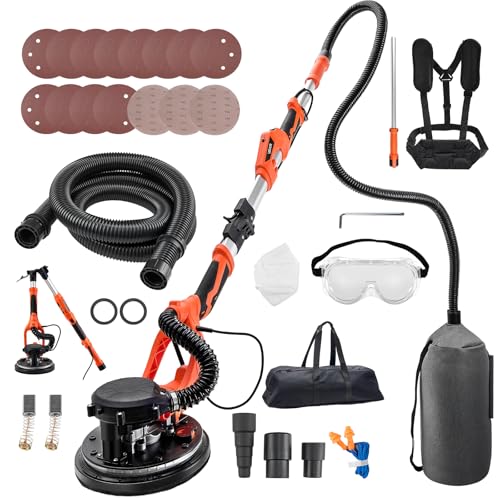
1150W drywall sander, 5 speeds from 800–1700 RPM, 360° disc, 90° swivel handle, detachable base and shoulder strap.
Check price on Amazon$115.90 as of Oct 19, 2026 8:57 pm GMT+0000 — prices change; see Amazon for current price.Why we like it
- Highest wattage on the shelf
- Shoulder strap to share the weight overhead
- Swivel handle and rotating disc for corners
- Folds down for storage
| Specification | Details |
|---|---|
| Motor | 1150 W (listed as 1.5 HP) |
| Speed | 5 settings, 800–1700 RPM |
| Head | 360° rotating disc, 90° swivel handle, detachable base |
| Reach | Pole adjusts from about 4.6 to 5.9 ft |
| Extras | Shoulder strap; LED ring; 15 sanding discs |
| Weight / warranty | About 13.5 lb; warranty not stated |
VEVOR ZL225-MCL — 1150W, 800–1700 RPM, 4.6–5.9 ft pole, swivel head, shoulder strap, 13.5 lb
The Most Powerful Motor and the Only Shoulder Strap
Watt ratings on the shelf run from 780 W (Gioventù) to 1150 W, and this VEVOR is at the top. More power helps when you are flattening heavy skim coats, sanding over old paint or working a whole room in one session, where a smaller motor slows down under pressure.
It is the only listing on the shelf that includes a shoulder strap, which VEVOR suggests for ceiling sessions longer than about five minutes. At about 13.5 lb, that strap is more than a gimmick. The 90 degree swivel handle and detachable base help with edges and corners.
The listing describes an internal vacuum but does not include a dust capture figure or mention a hose length, and no warranty is stated. Its five speed settings are fewer than the six or seven most others offer.
Pros
- Most motor power listed
- Shoulder strap for overhead work
- Swivel handle and detachable base
Cons
- Heavy at about 13.5 lb
- No dust figure, hose length or warranty stated
- Fewer speed settings
Check VEVOR 1150W price on Amazon
5. Protmex 225FT 1000W — Best for Long Reach With a Safety Kit

1000W vacuum sander, 6 speeds 800–2200 RPM, 4.9–6.2 ft pole, 360° head, 6.5 ft hose, vacuum converters and safety kit.
Check price on Amazon$159.99 as of Oct 19, 2026 8:57 pm GMT+0000 — prices change; see Amazon for current price.Why we like it
- Pole reaches about 6.2 ft, among the longest
- Highest top speed of the pole sanders
- Three vacuum hose converters included
- Goggles, earplugs and mask in the box
| Specification | Details |
|---|---|
| Motor | 1000 W copper |
| Speed | 6 settings, 800–2200 RPM |
| Reach | Aluminum pole, about 4.9 to 6.2 ft; 120° swing |
| Dust collection | Built-in vacuum, 6.5 ft hose, bag, three hose converters |
| Extras | Double LED ring, removable edge, 15 discs, spare brushes, safety kit |
| Weight / warranty | Not stated in listing |
Protmex 225FT — 1000W, 800–2200 RPM, 4.9–6.2 ft pole, 360° head, 6.5 ft hose + converters, safety kit
The Fastest Pole Sander, With Adapters for Your Own Vacuum
Among the 11 pole sanders, Protmex lists the highest top speed at 2200 RPM; the Borsstyne is next at 2100, and most others stop at 1700 to 1800. Higher speed removes material faster on cured compound but needs a lighter touch on fresh joints. Its pole, at about 6.2 ft fully extended, ties with Gioventù’s FV-2 for the longest stated in feet.
The kit includes three vacuum hose converters, which makes it easier to connect a shop vacuum or HEPA vacuum than relying on the small bag. Along with Gioventù and Borsstyne, it is one of three listings that include goggles, earplugs and a mask.
The listing does not state weight or warranty, and its 98.5% dust capture figure is a manufacturer claim. The listing is also sold under a slightly different brand spelling in its own copy, so check the seller before buying.
Pros
- Long pole reach
- Highest top speed among pole sanders
- Vacuum converters and safety kit included
Cons
- Weight not stated
- No warranty listed
- High speed demands a light touch
Check Protmex 225FT price on Amazon
6. VEVOR 800W Compact — Best Compact Sander With a Shop-Vac Hookup

Compact 800W wall sander, 1200–2300 RPM, 180 mm self-adhesive pad, auxiliary handle and a hose that fits most vacuums.
Check price on Amazon$69.90 as of Oct 19, 2026 8:57 pm GMT+0000 — prices change; see Amazon for current price.Why we like it
- Compact body at about 7.4 lb
- Hose connector fits most vacuum cleaners
- Auxiliary handle mounts on either side
- Double LED strip and detachable edge
| Specification | Details |
|---|---|
| Motor | 800 W brushed |
| Speed | Stepless, 1200–2300 RPM |
| Pad | 180 mm self-adhesive sanding pad |
| Dust collection | Automatic vacuum system; hose with 35 mm connector fits most vacuums |
| Handles | Rubber auxiliary handle, either side; no long pole described |
| Weight / warranty | About 7.4 lb; warranty not stated |
VEVOR 800W — compact wall sander, 1200–2300 RPM, 180 mm pad, aux handle, 35 mm vac connector, 7.4 lb
A Short-Body Sander Built Around Your Own Vacuum
Most of the shelf is long-pole sanders. This VEVOR is a compact body with an auxiliary handle instead, and its listing describes no extension pole. That makes it easier to control on walls at chest height, in closets, stairwells and small bathrooms where a 6-ft pole gets in the way.
Its listing is the most explicit about pairing with a household or shop vacuum, saying the dust pipe connector is compatible with most vacuum cleaners on the market. Its 2300 RPM top speed is higher than any pole sander here; only the handheld MAXXT goes faster. The smaller 180 mm pad covers less area per pass than the 9-inch (about 225 mm) heads on most pole units.
It is not a ceiling tool without a pole, and the listing does not state a warranty or a hose length. Its “more than 90%” dust claim is a manufacturer figure.
Pros
- Compact and lighter than most pole units
- Vacuum connector fits most vacuums
- Two-sided auxiliary handle
Cons
- No pole for ceilings
- Smaller pad covers less area
- Warranty not stated
Check VEVOR 800W Compact price on Amazon
7. MAXXT R7503 Handheld — Best for Wall Patches

Handheld 810W drywall sander, 1500–2800 RPM, rough and fine modes, adjustable suction, LED and aluminum base plate.
Check price on Amazon$72.99 as of Oct 19, 2026 8:55 pm GMT+0000 — prices change; see Amazon for current price.Why we like it
- Lightest sander on the shelf at about 5.1 lb
- Separate rough and fine sanding modes
- Adjustable suction
- Partially detachable head for corners
| Specification | Details |
|---|---|
| Type | Handheld drywall sander, 120 V |
| Motor / speed | 810 W; variable, 1500–2800 RPM |
| Modes | Rough sanding and fine sanding |
| Dust | Self-extraction with adjustable suction; motor air vents sealed from dust |
| Build | Softer one-piece pad; aluminum base plate; LED |
| Weight / warranty | About 5.1 lb; warranty not stated |
MAXXT R7503 — handheld 810W, 1500–2800 RPM, rough/fine modes, adjustable suction, LED, 5.1 lb
The Lightest and Fastest Sander, and the Only One With Adjustable Suction
At about 5.1 lb, the MAXXT is the lightest drywall sander on the shelf, and its 2800 RPM top speed is the highest. It is also the only listing that describes adjustable suction, which helps keep the pad from grabbing the wall on a fresh, soft patch, and the only one with distinct rough and fine sanding modes.
For a homeowner patching a few holes after a plumbing repair or a TV remount, a handheld like this is easier to manage than a pole sander and quicker than hand-sanding. Our best oscillating tool roundup covers the tool most people use to cut out the damaged section first.
The listing does not include a pole, a hose length, a dust capture figure or a warranty. For ceilings or a whole basement, a pole sander is the better choice.
Pros
- Lightest sander on the shelf
- Adjustable suction and two modes
- Easy to control on walls
Cons
- No pole for ceilings
- Warranty not stated
- Dust capture not quantified
Check MAXXT R7503 price on Amazon
How to read drywall sander specs
Motor and speed
Listings mix amps and watts, which makes direct comparison awkward. More important than peak power is a wide, adjustable speed range. Start slow on fresh joint compound and feathered edges, where high speed can burn through to the paper face of the drywall. Higher speeds suit cured, heavy coats and old paint. Most pole units here range from about 800 to 1800 RPM.
Weight and reach
Pole sanders on this shelf run from about 8.5 lb to over 16 lb. That difference is what you feel after twenty minutes overhead. Check pole reach against your ceiling height: an adjustable pole of about 5.5 ft suits standard 8-ft ceilings for most adults, while 9-ft basement ceilings and stairwells benefit from 6 ft or more.
Dust collection claims
Seven listings quote a dust capture percentage, from 80% to 99%. These are manufacturer claims, not independent tests, and most come with the caveat that the disc must stay flat against the surface. The small cloth bags that ship with most units fill quickly and leak fine dust. Connecting the sander to a shop vacuum with a fine-dust filter, or to a HEPA vacuum, is the more reliable setup. Our roundups of the best shop vacs and the best HEPA vacuums cover which filters handle drywall dust.
Head design and paper
Most pole sanders use a 9-inch hook-and-loop disc on a pivoting head with a detachable edge ring for corners. Grid or mesh paper resists clogging with joint compound. Use 120 to 150 grit for most drywall finishing and save coarser 80 grit for heavy removal; going too coarse leaves scratches that show through paint.
Popcorn ceilings, asbestos and lead: test before you sand
Six listings on this shelf, nearly half, market themselves as popcorn ceiling removal tools. That is the claim to take most seriously, because textured ceilings in older homes are exactly where asbestos can hide. The EPA lists textured paint and patching compounds used on walls and ceilings among the materials that may contain asbestos, and warns homeowners not to saw, sand, scrape or drill asbestos-containing materials. The EPA also says you generally cannot tell whether a material contains asbestos by looking at it, and that a trained, accredited professional should take samples.
Many older Front Range homes still have their original textured ceilings and joint compound. Before any sanding or scraping, read our guide to asbestos in popcorn ceilings and consider a lab test; our comparison of popcorn ceiling asbestos test kits explains how mail-in sampling works and when professional sampling is the safer route. If the result is positive, sanding is off the table and removal should be handled by trained asbestos professionals.
Lead is the other concern. Walls and trim in pre-1978 homes may have lead paint under later coats, and power-sanding painted surfaces creates fine lead dust. The EPA’s DIY lead-safe guidance calls for containing the area with plastic sheeting, turning off forced-air HVAC and covering vents, wearing an N-100 respirator, and using power tools with HEPA-filtered vacuum attachments. Our guide to sanding lead paint goes into detail.
Using a drywall sander safely at home
Even ordinary joint compound dust is irritating and gets everywhere. Seal doorways with plastic, turn off the furnace fan and cover return vents so dust does not circulate through the ductwork, and wear a well-fitted respirator rather than a loose dust mask. Wear eye and hearing protection. OSHA’s basic power tool rules apply: inspect the tool and cord before use, keep cords away from sharp edges, follow the manufacturer’s instructions, and unplug the sander before changing discs or clearing the head.
Colorado’s dry air makes joint compound set and dry quickly, which is good for schedules but means you should sand within the window recommended for your compound and not wait days for thin finish coats to harden excessively. Change discs as soon as they load up; a clogged disc heats the surface and scratches it.
When to call a professional
A powered sander will not fix cracked joints that keep returning, sagging ceiling board, nail pops across a whole ceiling or water stains, all of which can point to framing movement, roof leaks or plumbing problems. Large textured ceilings in older homes, or any material that tests positive for asbestos, belong with licensed abatement professionals. If you are buying or selling and want walls, ceilings and possible asbestos or lead materials checked, our structure and exterior hub explains what an inspection covers, and Front Range homeowners can contact us to connect with a vetted local inspector or testing professional.
Frequently asked questions
Is a powered drywall sander worth it for a homeowner?
For a finished basement, a whole room of new drywall or skim coating, a powered sander with dust extraction saves hours of overhead hand sanding and reduces airborne dust. For one or two small patches, a sanding sponge or a handheld sander is usually faster. Rental is an option for a single large project.
Do vacuum drywall sanders really eliminate dust?
They reduce dust substantially but do not eliminate it. Listed capture figures of 80 to 99 percent are manufacturer claims and depend on keeping the disc flat against the surface. Connecting the sander to a shop vac with a fine-dust filter or a HEPA vacuum, sealing doorways and wearing a respirator are still recommended.
Can I use a drywall sander to remove a popcorn ceiling?
Only after testing confirms the texture does not contain asbestos. The EPA lists textured paints and patching compounds used on ceilings as possible asbestos sources and advises against sanding or scraping asbestos-containing materials. If the test is positive, have trained asbestos professionals handle removal.
What grit sandpaper is best for drywall?
Most drywall finishing uses 120 to 150 grit for smoothing joint compound, with 180 to 220 for a final light pass. Coarser 80 to 100 grit is for heavy high spots and can leave visible scratches. Mesh or grid paper resists clogging with compound dust.
Should I buy a pole drywall sander or a handheld one?
Choose a pole sander for ceilings, tall walls and large rooms, since it lets you work from the floor. A handheld sander is lighter and easier to control for wall patches and smaller areas. Check pole reach against your ceiling height and the sander's weight before buying.
References
- Learn About Asbestos — U.S. Environmental Protection Agency
- Protect Your Family from Exposures to Asbestos — U.S. Environmental Protection Agency
- Lead-Safe Renovations for DIYers — U.S. Environmental Protection Agency
- Hand and Power Tools (OSHA 3080) — Occupational Safety and Health Administration