Best At-Home Radon Test Kit: A 2026 Buyer Guide

An at-home radon test kit is the cheapest way to find out whether the air in your lowest living space carries more radon than it should. Most first tests are short-term: a small detector sits in the house for a few days, goes back to a lab in the mail, and the lab sends a number in picocuries per liter (pCi/L). The kits below differ less in what they measure than in the details around the measurement: whether lab analysis is included, how fast results come back, which credential the lab names and whether you get one detector or two. This roundup focuses on short-term mail-in kits for homeowners, with one long-term follow-up kit and one no-lab digital alternative for comparison.
Part of our Radon Levels guide — start there for the full picture →
As an Amazon Associate we earn from qualifying purchases.
How we compared: we compared 16 current Amazon listings for at-home radon testing (7 mail-in lab kits and 9 digital monitor listings, two of which are color variants of the same AEGTEST model) on what each listing actually states: test window, whether lab analysis is included, stated turnaround, named credentials and what comes in the box. We did not lab-test any of these kits or use them hands-on. Prices, lab fees and availability change, so check the current listing before buying.
Quick picks: the best at-home radon test kits by use case
| Product | Best for | Key features | Price | Buy |
|---|---|---|---|---|
| First Alert RD1 | All-in first test |
| $17.95as of Nov 3, 2026 10:05 pm GMT+0000 | Buy now →Check current price |
| PRO-LAB RA155 (1 kit) | Single 48-hour screen |
| $32.99as of Nov 3, 2026 6:45 am GMT+0000 | Buy now →Check current price |
| PRO-LAB RA100 (2 kits) | Side-by-side or real estate testing |
| $9.99as of Nov 3, 2026 12:36 pm GMT+0000 | Buy now →Check current price |
| empowerDX Radon Test Kit | Named NRPP lab credential |
| $19.95as of Nov 3, 2026 6:45 am GMT+0000 | Buy now →Check current price |
| PRO-LAB RL416 | Long-term follow-up test |
| $32.99as of Nov 3, 2026 6:45 am GMT+0000 | Buy now →Check current price |
| X-Sense XR0A-SR | No-lab digital alternative |
| $53.98as of Nov 3, 2026 11:29 pm GMT+0000 | Buy now →Check current price |
Prices are Amazon’s listed prices as of the time shown and change often; check Amazon for today’s price. As an Amazon Associate we earn from qualifying purchases.
The six picks, compared listing by listing
1. First Alert RD1 — Best All-In At-Home Radon Test Kit
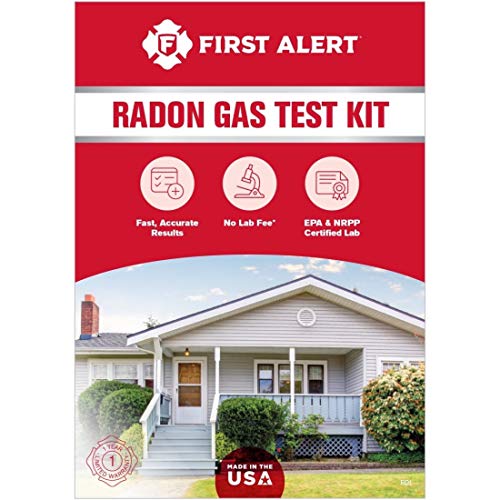
Mail-in radon test kit with lab fees included and results emailed within 72 hours of the lab receiving it.
Check price on Amazon$17.95 as of Nov 3, 2026 10:05 pm GMT+0000 — prices change; see Amazon for current price.| Specification | Details |
|---|---|
| Test type | Mail-in lab kit; detector type not stated in listing |
| Test window | Not stated in listing; follow the instructions printed on the kit |
| Lab analysis | Test materials and lab fees included (New Jersey state fee excluded) |
| Turnaround | Results emailed within 72 hours after the lab receives the kit |
| Credential named | Listed under the EPA radon gas measurement proficiency program |
| Model / size | RD1; about 8.4 x 8.4 x 6.7 in package, 0.2 lb |
First Alert RD1 — mail-in kit, lab fees included, emailed results within 72 hours of lab receipt, US use only
The Only Kit Here That States Its Turnaround in Hours, With the Lab Fee Included
Seven of the 16 listings are mail-in lab kits. Only three of those seven state a turnaround at all: the RD1 (within 72 hours of lab receipt), the PRO-LAB two-pack (within a standard work week) and empowerDX (3–5 business days). The RD1 is the only one that pairs a stated turnaround with an explicit statement that lab fees are included, so there is no second charge between mailing the detector and seeing a number.
That makes it the simplest first test for a homeowner who has never measured radon. Four of the seven lab-kit listings say lab analysis is included in the purchase (RD1, PRO-LAB RA155, PRO-LAB RL416 and the RSSI long-term kit), two state a separate per-detector lab fee, and one does not say either way.
The listing is thin on technical detail. It does not state the detector type, the exposure period or a credential beyond EPA proficiency-program listing; it does not name NRPP or NRSB, the two national proficiency programs the EPA currently points consumers toward. Read the printed instructions for the required test length before you start, and note that the listing recommends use only within the United States.
Pros
- Lab fees included in the kit
- Fastest stated turnaround among the lab kits
- Results arrive by email
- Light, simple single-detector kit
Cons
- Test length not stated in listing
- Detector type not stated
- Does not name NRPP or NRSB
Check First Alert RD1 price on Amazon
2. PRO-LAB RA155 (1 Kit) — Best Single 48-Hour Short-Term Screen

One short-term radon detector that can test in as little as 48 hours, with lab analysis included.
Check price on Amazon$32.99 as of Nov 3, 2026 6:45 am GMT+0000 — prices change; see Amazon for current price.| Specification | Details |
|---|---|
| Test type | Short-term mail-in detector; detector type not stated |
| Test window | As little as 48 hours |
| Lab analysis | Included in the purchase; listing says no separate fees after purchase |
| Updates | Email and text notifications from lab receipt through results |
| Turnaround | Not stated in listing |
| Model | RA155; one detector per box |
PRO-LAB RA155 — 1 short-term detector, 48-hour minimum, lab analysis included, email/text status updates
The Only Short-Term Kit That States Both a 48-Hour Window and Included Lab Analysis
Two of the lab kits on the shelf state a 48-hour minimum test: this RA155 and the PRO-LAB RA100 two-pack. The difference is the fee. The RA100 listing says a lab analysis fee is charged per detector on top of the kit, while the RA155 listing says lab analysis is included and there are no separate fees to pay after purchase. For a homeowner who wants one quick screen with a known total cost, that is the cleaner deal.
A 48-hour test fits the EPA’s two-day minimum for short-term tests, and the EPA’s Citizen’s Guide says a short-term test lasting just two or three days needs windows and outside doors closed for at least 12 hours before it starts, and kept closed during the test. A short window is convenient but also more sensitive to weather, so avoid starting it during a severe storm or unusually high winds.
What the listing leaves out: it does not give a turnaround time, a detector type or a named NRPP/NRSB credential beyond the “EPA approved” wording in the title. The status notifications are a useful substitute for a stated turnaround, since you can see when the lab has the detector.
Pros
- 48-hour minimum test window stated
- Lab analysis included, no add-on fee
- Email and text status notifications
Cons
- No turnaround time stated
- Only one detector, so no side-by-side test
- No NRPP or NRSB credential named
Check PRO-LAB RA155 price on Amazon
3. PRO-LAB RA100 (2 Kits) — Best for Side-by-Side and Real Estate Testing

Two short-term detectors in one box for paired testing; separate per-detector lab fee; results within a work week.
Check price on Amazon$9.99 as of Nov 3, 2026 12:36 pm GMT+0000 — prices change; see Amazon for current price.| Specification | Details |
|---|---|
| Test type | Two short-term mail-in detectors |
| Test window | As little as 48 hours |
| Lab analysis | Separate lab analysis fee charged per detector (see listing for amount) |
| Turnaround | Standard results within a work week of lab receipt |
| Intended use | Listing says the two detectors meet real estate transaction requirements |
| Model | RA100; listed weight 0.2 lb |
PRO-LAB RA100 — 2 short-term detectors, 48-hour minimum, per-detector lab fee, results within a work week
The Only Lab Kit on the Shelf That Ships Two Detectors in One Box
Each of the other six lab-kit listings is a single detector. The RA100 is the only one with two, which matters because the EPA’s Citizen’s Guide says the results of two short-term tests done side by side, about four inches apart, can be used to decide whether to fix a home. Two detectors deployed together also give a check on each other: if they disagree widely, something about placement or handling went wrong.
The listing pitches the pair for real estate transactions, which is the most common reason Front Range buyers test on a deadline. The EPA also recommends hiring a qualified tester when buying or selling, and buyers often want testing done by someone not involved in the sale, so a seller-run kit may not satisfy the other side.
The trade-off is cost structure. This is one of two lab-kit listings that state a separate per-detector lab fee, so the box price is not the total. The listing does not name NRPP or NRSB and does not state the detector type.
Pros
- Two detectors for side-by-side testing
- 48-hour minimum test window
- Stated turnaround within a work week
- Email/text status notifications
Cons
- Lab fee charged per detector on top of the kit
- No named NRPP or NRSB credential
- Seller-run tests may not satisfy a buyer
Check PRO-LAB RA100 2-pack price on Amazon
4. empowerDX Radon Test Kit — Best for a Named NRPP-Certified Lab

Mail-in radon kit analyzed by a lab the listing says is NRPP certified and EPA listed; results in 3–5 business days.
Check price on Amazon$19.95 as of Nov 3, 2026 6:45 am GMT+0000 — prices change; see Amazon for current price.| Specification | Details |
|---|---|
| Test type | Mail-in lab kit; detector type not stated |
| Test window | Not stated in listing |
| Credential named | Lab certified by the National Radon Proficiency Program (NRPP); EPA listed |
| Turnaround | Results within 3–5 business days after the lab receives the sample |
| Return shipping | Customer returns the sample using any carrier; prepaid postage not stated |
| Restrictions | Lab only accepts samples from U.S. residents; New Jersey state fee applies |
empowerDX — mail-in kit, NRPP-certified lab named, 3–5 business day results, U.S. residents only
One of Only Two Kits That Names NRPP Certification
The EPA’s guidance on finding radon testers says states receiving radon grants must list providers credentialed either by a state process or by one of two national programs: the National Radon Proficiency Program (NRPP) or the National Radon Safety Board (NRSB). Of the seven lab kits on the shelf, only two name NRPP: empowerDX and the RSSI long-term alpha-track kit. None names NRSB. Four PRO-LAB listings use “EPA approved” wording instead, which is less specific than a named proficiency credential.
That makes empowerDX the short-term-oriented choice for a buyer who wants the credential spelled out. Its stated 3–5 business day turnaround sits between the RD1’s 72 hours and the PRO-LAB two-pack’s work week.
There are gaps. The listing does not say how long the test runs, what kind of detector it uses, or whether return postage is prepaid; it says to return the sample with any carrier you choose, which suggests postage is on you. It also does not state whether the lab fee is included, beyond noting a state fee for New Jersey residents.
Pros
- Names NRPP certification for its lab
- Stated 3–5 business day turnaround
- Simple three-step order, collect, return process
Cons
- Test length not stated in listing
- Return postage appears to be on the buyer
- Lab-fee inclusion not spelled out
Check empowerDX Radon Test Kit price on Amazon
5. PRO-LAB RL416 — Best Long-Term Follow-Up Kit

Long-term alpha-track kit with lab analysis, a prepaid return envelope and expert consultation included.
Check price on Amazon$32.99 as of Nov 3, 2026 6:45 am GMT+0000 — prices change; see Amazon for current price.| Specification | Details |
|---|---|
| Test type | Long-term mail-in kit |
| Detector technology | Alpha track |
| Test window | Not stated in listing (EPA defines long-term as more than 90 days) |
| Lab analysis | Lab analysis fee and expert consultation included |
| Return shipping | Prepaid first-class return envelope included |
| Model | RL416; one detector |
PRO-LAB RL416 — 1 long-term alpha-track detector, lab fee + consultation + prepaid return envelope included
The Only Kit Listing That Bundles an Expert Consultation With the Lab Fee
The EPA’s testing steps say that if a first short-term result is 4 pCi/L or higher, the next step is a follow-up test: a long-term test for a better picture of the year-round average, or a second short-term test if you need results quickly. Three listings on the shelf are long-term alpha-track kits (PRO-LAB RL416, PRO-LAB RL116 and RSSI AT-101). Of those three, only the RL416 and RSSI list a prepaid return, and only the RL416 says expert consultation is included alongside lab analysis.
That consultation is the reason it sits on a short-term list. A homeowner whose first kit came back near the action level will usually want help reading the next number, and this listing is the only one to promise a conversation about the result.
What the listing leaves out is the exposure period. Its sibling RL116 states a 3–12 month window; the RL416 listing does not, so check the instructions. It also gives no turnaround and names no NRPP or NRSB credential.
Pros
- Alpha-track detector for long-term averaging
- Lab fee included
- Prepaid return envelope
- Expert consultation included
Cons
- Exposure period not stated in listing
- No turnaround time stated
- Months-long wait for a result
Check PRO-LAB RL416 price on Amazon
6. X-Sense XR0A-SR — Best No-Lab Digital Alternative to a Kit
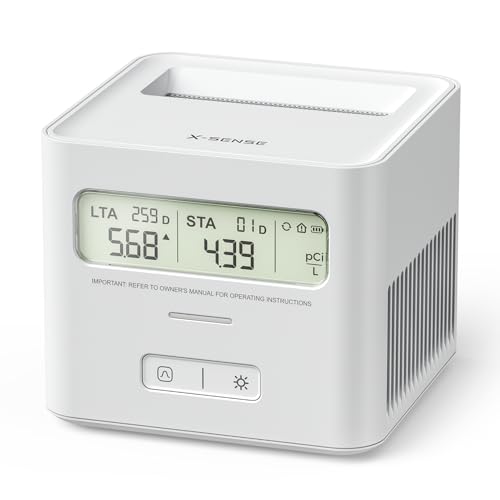
Battery radon monitor with no lab fees; screen shows 1, 7, 30 and 90-day averages plus a long-term average.
Check price on Amazon$53.98 as of Nov 3, 2026 11:29 pm GMT+0000 — prices change; see Amazon for current price.| Specification | Details |
|---|---|
| Test type | Continuous digital monitor; no lab or mailing |
| First data | Within 24 hours |
| Stated accuracy | 90% consistency with reference results after 7 days of continuous operation |
| Display | LCD with short-term (1/7/30/90-day) and long-term cumulative averages; backlight button |
| Power | Battery, up to 24 months under typical use; keeps data through a battery swap if restored within 4 hours |
| Alerts / warranty | No lights or audible alerts by design; 5-year quality warranty |
X-Sense XR0A-SR — battery monitor, 24-hr first data, 1/7/30/90-day + long-term averages, silent, 5-yr warranty
The Only Monitor Here With a 90-Day Average on Its Own Screen
Nine of the 16 listings are digital monitors, and four of them say outright that there are no lab fees (this XR0A-SR, the X-Sense XR0B-SR, and the Airthings Corentium Home 2 and Wave Radon). The XR0A-SR is the only monitor listing that names a 90-day average view on the device screen. Ninety days is the line the EPA and CDC draw between short-term and long-term testing, so a unit that shows that average directly makes the comparison to a long-term kit easy.
It is also the only monitor on the shelf that is silent by design: the listing says no flashing lights and no audible alerts, with readings on demand. That suits a bedroom or finished basement better than an alarm unit, though it means nothing will warn you if levels jump.
The limits of any consumer monitor apply. The listing’s accuracy claim is a manufacturer statement, not a third-party certification, and it does not name NRPP or NRSB device listing. For a home sale, a lab kit or a credentialed tester is still the usual route. Our guide to whether digital radon detectors are accurate covers how to sanity-check one against a lab kit.
Pros
- No lab fees or mailing
- 90-day and long-term averages on screen
- Battery stated to last up to 24 months
- 5-year quality warranty
Cons
- No alarm if levels rise
- No app or data export
- Accuracy is a manufacturer claim only
Check X-Sense XR0A-SR price on Amazon
What separates a good at-home radon test kit from a weak one
Every kit on this list ends in the same unit, pCi/L, and the EPA’s action level is the same for all of them: fix the home at 4 pCi/L or more, and consider fixing between 2 and 4 pCi/L, because there is no known safe level of radon exposure. The kit choice affects how confident you can be in the number and how much hassle it takes to get it. Before buying, check these points on the listing or the packaging.
Test window
The EPA defines short-term tests as staying in the home from two to 90 days, and long-term tests as more than 90 days. Short-term kits are faster, but radon varies day to day and season to season, so a short-term result is less likely to reflect the year-round average. Four of the seven lab kits here state a test window at all; when a listing is silent, the printed instructions control. Do not shorten or stretch the window: the lab calculates concentration from the exposure time.
Detector type
The EPA lists charcoal canisters, alpha track, electret ion chambers, continuous monitors and charcoal liquid scintillation as the detectors most commonly used for short-term testing, and alpha track and electret detectors for long-term testing. None of the short-term kit listings here names its detector type. The three long-term kits all name alpha track. If the technology matters to you, check the package or the lab’s website.
Lab fee and turnaround
A kit with a separate lab fee is not a scam; it is a different price structure. But it means the box price is not the total cost, and lab fees can change. Four of the seven lab-kit listings say the analysis is included, two say a fee is charged per detector, and one is unclear. Stated turnaround ranges from 72 hours after lab receipt to a standard work week, and three listings say nothing. The EPA says to reseal the kit and send it to the lab right away once the test ends, so plan the stop date around a day you can reach a mailbox.
Credentials
The EPA points consumers to state radon programs and to two national proficiency programs, NRPP and NRSB, for credentialed providers. Two lab-kit listings name NRPP; none names NRSB. “EPA approved” in a product title is a marketing phrase, not one of the two proficiency programs the EPA’s own page names.
How to run an at-home radon test correctly
A good kit can still give a misleading number if it is placed badly. The EPA’s Citizen’s Guide gives the basic rules:
- Level: test the lowest lived-in level of the home, such as a basement that is used often, otherwise the first floor.
- Room: a regularly used room like a living room, den, playroom or bedroom, not a kitchen or bathroom.
- Height and position: at least 20 inches above the floor, away from drafts, high heat, high humidity and exterior walls.
- Closed-house conditions: for short-term tests, keep windows and outside doors closed as much as possible; for a two- or three-day test, close them at least 12 hours beforehand. Normal heating and recirculating fans may run; fans that bring in outside air should not.
- Weather: skip two- or three-day tests during unusually severe storms or high winds.
- Finish: leave the kit for as long as the package says, reseal it and send it to the lab right away.
Write the start and stop dates and times on the lab form exactly as the instructions ask, since the lab works from the exposure time you report.
Reading your result and what to do next
The EPA’s steps are straightforward. Take a short-term test first. If the result is 4 pCi/L or higher, follow up with either a long-term test (for a better picture of the year-round average) or a second short-term test (if you need results quickly). The higher the first result, the more reason to choose the quick second short-term test; if it is more than twice the action level, the EPA says to take the second short-term test immediately. Fix the home if the long-term result is 4 pCi/L or more, or consider fixing if the average of two short-term tests is 4 pCi/L or higher.
Results near the line are less certain. The EPA notes that if two short-term tests average 4.1 pCi/L, there is about a 50% chance the year-round average is somewhat below 4. Our guide to what radon levels should be and the radon levels chart walk through the ranges. If you do need a system, how to fix radon in a home covers the options, and the CDC says to retest a few months after the home is fixed.
A result below 2 pCi/L needs no action now, but the CDC recommends testing again before turning a basement into a bedroom or office, after renovations, and when preparing to buy or sell.
Why Colorado Front Range homes should test
On the EPA’s Map of Radon Zones, every Front Range county in our service area, including Denver, Jefferson, Arapahoe, Adams, Douglas, Elbert, Boulder, Broomfield and El Paso, is listed as Zone 1, the category the EPA calls high radon potential. The EPA is clear that the map should not be used to decide whether an individual home needs testing; neighbors on the same street can get very different results. The only way to know is to test, and a short-term at-home kit is the usual first step.
Front Range basements are often finished living space, which makes them the right test location under the EPA’s lowest-lived-in-level rule. Homes with a crawl space or slab-on-grade layout should be tested on the lowest occupied floor. For local context, see our Colorado radon levels by ZIP code and the radon testing pillar.
Short-term kit, long-term kit or digital monitor
For most homeowners the order is simple: a short-term kit first, then a long-term kit or second short-term test if the number is 4 pCi/L or higher. A digital monitor such as the XR0A-SR fits a different job: tracking levels over months, checking several rooms one after another, or confirming that a mitigation system keeps working. It does not replace a lab result in a real estate file. Our broader home radon test kit overview compares the formats in more depth.
When to hire a professional instead
An at-home kit is enough for routine screening of a home you live in. The EPA recommends hiring a qualified tester when you are buying or selling, and buyers often want testing done by someone not involved in the sale. A professional tester can document closed-house conditions and placement for the record, which a mailed-in kit cannot do on its own. If your result is high, a credentialed mitigation contractor should design the fix; the EPA says your state radon program can help find credentialed providers.
A whole-home inspection also catches conditions that affect radon entry, such as open sump pits, cracked slabs and unsealed crawl spaces. If you are under contract or simply want a second set of eyes on a borderline result, contact us to connect with a local inspector.
References
- A Citizen’s Guide to Radon — U.S. Environmental Protection Agency
- What is EPA’s Action Level for Radon and What Does it Mean? — U.S. Environmental Protection Agency
- Find a Radon Test Kit or Measurement and Mitigation Professional — U.S. Environmental Protection Agency
- Testing Your Home for Radon — Centers for Disease Control and Prevention
- The EPA Map of Radon Zones — U.S. Environmental Protection Agency
Frequently asked questions
Are at-home radon test kits accurate?
A properly used kit analyzed by a credentialed lab gives a useful screening number. Accuracy depends heavily on placement and closed-house conditions, so follow the EPA rules: lowest lived-in level, at least 20 inches above the floor, away from drafts and exterior walls. Near the 4 pCi/L action level, a follow-up test adds confidence.
How long does an at-home radon test take?
Short-term kits stay in the home from 2 to 90 days depending on the device, and several kits here state a 48-hour minimum. Long-term kits stay more than 90 days. Add mailing time and the lab's turnaround, which on these listings ranges from 72 hours to a work week after the lab receives the kit.
Do radon test kits include the lab fee?
Some do and some do not. Of the seven lab kits compared here, four listings say analysis is included, two state a separate per-detector lab fee and one is unclear. Read the listing or package before buying so the total cost is not a surprise.
What should I do if my at-home radon test is above 4 pCi/L?
The EPA says to follow up with a second test: a long-term test for a better year-round picture, or a second short-term test if you need results quickly. If the first result is more than twice the action level, take the second short-term test immediately. Fix the home if the follow-up confirms 4 pCi/L or more.
Can I use an at-home kit when buying a house?
You can, but the EPA recommends hiring a qualified tester when buying or selling, and buyers often want testing done by someone not involved in the sale. Two short-term detectors placed side by side can be used to decide whether to mitigate during a transaction.
Buying or selling on the Front Range and need a radon test that will stand up in a transaction? Reach out through our contact page to connect with a vetted local inspector.
Radon test kits we recommend
Short-term charcoal kits are the cheapest way to get a first reading; mail the canister to the lab and results come back in days.
| Product | Why | Buy |
|---|---|---|
 AirChek Charcoal Radon Test Kit | Lab fee usually included; EPA short-term protocol. | Amazon — $21.95 |
| First Alert RD1 Radon Test Kit | Widely stocked; 48-hour charcoal test. | Amazon — $17.95 |
 AccuStar Two-Pack Charcoal Kit | Two-pack option for closed-house testing. | Amazon — $39.97 |