Whole House Surge Protector: How It Works and Costs

Modern homes are full of electronics that never existed when most wiring codes were written: furnace control boards, variable-speed heat pumps, refrigerators with circuit boards, smart thermostats, EV chargers and garage door openers. All of them depend on sensitive components that can be stressed or damaged by brief voltage spikes. A whole house surge protector is designed to divert many of those spikes before they reach the circuits inside the home. It is not a lightning shield and it does not replace good grounding, but it is an inexpensive layer of protection that recent electrical codes now call for on new and replaced services in many places. This guide explains how these devices work, the difference between installation types, how to read the ratings, where the Front Range’s weather fits in, and what installation typically costs. Cost figures are broad industry estimates, not quotes.
Part of our Home Electrical guide — start there for the full picture →
What Does a Whole House Surge Protector Do?
A whole house surge protector is a surge protective device, often shortened to SPD, mounted at or near the electrical service. When voltage on the incoming lines rises above a set threshold, the device conducts the excess energy to ground for a tiny fraction of a second, then returns to standby. The goal is to limit how much of a surge travels onto the branch circuits that feed appliances, electronics and HVAC equipment.
It works best as one layer in a layered approach. A device at the service handles large surges arriving from outside. Point-of-use surge strips handle smaller residual surges and internal ones near sensitive electronics. Together they reduce risk more than either does alone.
What it does not do is just as important. A whole house surge protector cannot stop a direct lightning strike to the house, which can carry far more energy than any residential device is built to handle. It does not fix missing or poor grounding; in fact, it depends on a sound grounding system to work. And it does not protect against surges that enter through other paths, such as cable, antenna or phone lines, unless those lines also have protection.
Where Surges Come From
Lightning
Lightning does not need to hit a house to cause trouble. A strike on or near utility lines, a nearby tree or the ground can induce surges that travel through wiring. The Colorado Front Range sees frequent summer thunderstorms, especially in the afternoon from late spring into late summer, and many homeowners in Douglas, El Paso and Jefferson counties live in areas where storms build quickly over the foothills. The U.S. Fire Administration’s severe weather fire safety materials list lightning among severe-weather fire hazards and include using surge protectors among their safety messages.
Utility Switching and Grid Events
Utilities switch equipment, clear faults and restore power after outages. Those events can produce brief overvoltages. Power coming back on after a storm or a planned shutoff is a common moment for a spike, which is one reason surge protection is often mentioned alongside outage preparedness.
Surges From Inside the House
Many surges originate inside the home. Large motors and compressors, such as air conditioners, refrigerators, well pumps and furnace blowers, can create small transients when they start and stop. Those surges are usually modest, but repeated exposure may shorten the life of sensitive electronics over time. A device at the panel can help with some internal surges, and point-of-use protection near electronics helps with others.
Best Surge Protectors: our top 3 picks
| Product | Best for | Key features | Price | Buy |
|---|---|---|---|---|
| ALESTOR PS951 | Best overall power strip |
| $16.99as of Oct 29, 2026 4:11 pm GMT+0000 | Buy now →Check current price |
| Anker 351 Power Strip | Home office with USB-C |
| $28.99as of Oct 29, 2026 1:09 pm GMT+0000 | Buy now →Check current price |
| POWSAV NBW-903 | Most outlets |
| $21.99as of Oct 29, 2026 4:11 pm GMT+0000 | Buy now →Check current price |


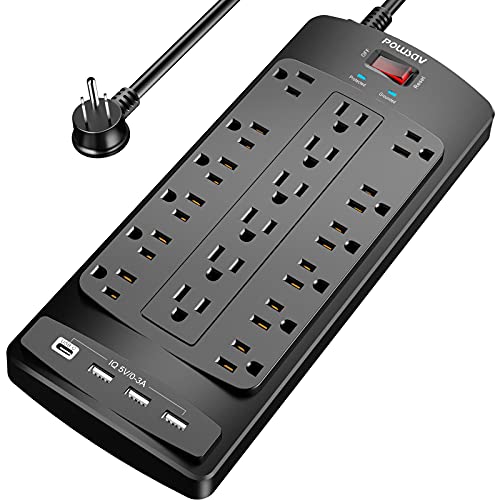
Prices are Amazon’s listed prices as of the time shown and change often; check Amazon for today’s price. As an Amazon Associate we earn from qualifying purchases.
Type 1 vs Type 2 vs Point-of-Use Protection
UL 1449, the safety standard for surge protective devices, sorts them into types largely by where they can be installed.
Type 1: At the Meter or Service Entrance
Type 1 devices are designed to be installed on the line side of the main service disconnect, such as at the meter base or between the meter and the main breaker. They are built to handle surges arriving from the utility before they reach the panel. Some utilities offer meter-base surge devices as a program; others do not allow customers or contractors to touch the meter area. Type 1 devices can usually also be installed on the load side.
Type 2: At the Panel
Type 2 devices install on the load side of the main disconnect, typically at the main panel. This is the most common whole house surge protector in residential work. Many connect to a dedicated two-pole breaker; some are made as plug-in breaker-style units for specific panel brands. Installation is typically quick for an electrician when there is a free space in the panel.
Type 3: Point-of-Use
Type 3 protection includes plug-in surge strips and receptacle-style protectors. They sit close to the equipment they protect and help with residual surges that make it past the panel device, plus surges generated inside the house. The U.S. Fire Administration’s appliance and electrical fire safety guidance advises not overloading power strips and choosing ones with internal overload protection. A surge strip is not a substitute for a panel device, and a panel device does not make good surge strips unnecessary for computers, TVs and networking gear.
Don’t Forget Other Lines
Coaxial cable, satellite, antenna and phone lines can carry surges into equipment. Some whole house products include coaxial or data protection; otherwise, use point-of-use protectors that cover those connections, and make sure the cable or satellite installer bonded their line to the home’s grounding system.
How to Read Surge Protector Ratings
Surge protector packaging is full of numbers. Some are useful for comparison; some are marketing. Here is what the common ones mean, explained without overpromising what any single number can tell you.
UL 1449 Listing
Look for a device listed to UL 1449 by a recognized testing laboratory. The listing indicates the product was evaluated for safety and that its published ratings were tested to a common method. An unlisted device is a poor choice for permanent installation and may not be acceptable to the electrical inspector.
Voltage Protection Rating (VPR)
The VPR describes the voltage the device let through during a standardized test. Lower numbers mean less surge voltage reaches downstream equipment. Residential panel devices commonly list VPRs in the hundreds of volts. Compare VPRs only across products tested under the same standard.
Surge Current (kA) Ratings
Devices are often marketed with a per-phase or total surge current rating in kiloamps, such as 50 kA or 80 kA per phase. A higher number generally suggests more capacity to absorb repeated surges before wearing out, but it is not a promise to survive any particular lightning event. The nominal discharge current (In), often 10 or 20 kA for residential devices, is a separate tested rating that some electricians consider more meaningful for comparison.
Joules
Joule ratings are common on plug-in strips and describe energy absorption capacity. They are less consistently tested than VPR and are not a UL 1449 rating for panel devices. Treat them as a rough guide only.
Status Indicators and Alarms
Most panel-mounted SPDs have indicator lights that show whether protection is active. Some add an audible alarm or a dry contact for remote monitoring. Check them occasionally, especially after a major storm, and replace the device if the lights indicate lost protection.
Warranties
Many manufacturers advertise connected-equipment warranties. Read the terms closely. They often require proof of professional installation, registration and documentation, and they may exclude certain causes or cap payouts. A warranty is not a substitute for good installation and grounding.
What the Electrical Code Says
NFPA 70, the National Electrical Code, is the model code used as the basis for electrical rules across the United States. Starting with the 2020 edition, the NEC added a requirement for surge protection on services supplying dwelling units, including when those services are replaced. Later editions carried that requirement forward and refined it.
Whether the requirement applies to a particular job depends on which NEC edition your city or county enforces and on any local amendments. Colorado adopts electrical codes at the state level, and local jurisdictions may have their own adoption timing and rules, so adoption varies. In practice, many Front Range electricians now include a surge protector on service changes and panel replacements as a matter of course. Homeowners planning an electrical panel upgrade should ask whether surge protection is in the bid, since it is easiest to add while the panel is open.
For existing homes where no electrical work is planned, adding a whole house surge protector is generally optional. That does not mean it lacks value; it simply means the code does not usually force a retrofit.
Installation: Why an Electrician Does It
A panel-mounted SPD connects directly to energized service conductors or bus bars, and its effectiveness depends heavily on details that are easy to get wrong:
- Short leads: long or looped conductors between the device and the panel add impedance and raise the let-through voltage. Electricians try to keep leads as short and straight as practical.
- Correct breaker: many devices require a specific breaker size and type, as stated in the manufacturer’s instructions.
- Grounding and bonding: the device diverts energy to ground, so a sound grounding electrode system and proper bonding are essential.
- Permits: many jurisdictions treat SPD installation as electrical work that requires a permit, particularly when done with other panel work.
Before installation, it helps to know the basic condition of the home’s electrical system. A licensed electrician or a general electrical inspection can confirm grounding, panel condition and available spaces. Homeowners who like to check their own outlets can use simple plug-in testers and non-contact voltage detectors from our electrical tester category to spot open grounds or reversed polarity, though those tools cannot evaluate an SPD’s internal condition and are no substitute for an electrician’s work at the panel.
Older panels can complicate the job. If an inspector has flagged a Federal Pacific panel or another questionable brand, many electricians will recommend addressing the panel first rather than adding a surge device to it.
How Much Does a Whole House Surge Protector Cost?
As broad industry estimates that vary by device and region:
- Device only (Type 2 panel unit): often roughly $75 to $300 for common residential models, with premium units costing more.
- Installed by an electrician as a standalone job: commonly about $250 to $700 or more, depending on the device, panel access, service-call fees and permit costs.
- Added during a panel replacement or service upgrade: often a modest add-on, since the electrician is already working in the panel.
- Type 1 meter-base devices: pricing varies; some utilities offer programs, while others require a licensed electrician and utility coordination.
- Point-of-use strips: anywhere from inexpensive basic models to more expensive units with higher ratings and coaxial or data protection.
Compared with the cost of replacing a furnace control board, an HVAC inverter board or a refrigerator, a panel SPD is inexpensive. That said, no device guarantees protection, and homeowners should be wary of claims that any product will stop all surge damage.
Lifespan and When to Replace
Surge protectors wear out. The metal oxide varistors (MOVs) inside many devices degrade a little with each surge they absorb, and a single very large event can use up much of their capacity. Manufacturers often suggest checking the indicator lights periodically and replacing the device when they show lost protection.
Reasonable times to check or replace include:
- After a nearby lightning strike or a storm that damaged neighboring equipment.
- When indicator lights are off, red or otherwise show a fault.
- After a utility event that damaged electronics in the house.
- During a panel replacement, if the existing device is old or of unknown condition.
Many residential devices last for years under normal conditions, but there is no fixed lifespan that applies to every home. Keep the installation receipt and model number with your home documents so replacement and warranty claims are straightforward.
Equipment That Benefits Most
Not every device in a home is equally vulnerable. Simple resistive loads, such as an old toaster or an incandescent lamp, tolerate small spikes reasonably well. Electronics with circuit boards are a different story.
- Furnaces, heat pumps and air conditioners: modern HVAC equipment relies on control boards and, in variable-speed systems, inverter electronics. These parts can be costly to replace and are often hard to source quickly in a cold snap.
- Major kitchen and laundry appliances: refrigerators, induction ranges, dishwashers and front-load washers increasingly use electronic controls.
- EV chargers: Level 2 chargers sit on large dedicated circuits and contain sensitive electronics. Some manufacturers recommend or require surge protection in their installation instructions.
- Solar and battery systems: inverters and battery systems often have their own surge protection requirements, which the installer should coordinate with any panel device.
- Home networks and security systems: routers, modems, cameras and alarm panels are inexpensive individually but can all fail at once after a surge.
Listing these items does not mean a surge protector guarantees they will survive a surge. It explains why the device tends to be most valuable in newer or recently upgraded homes, which are exactly the homes many Front Range buyers are shopping for.
Is a Whole House Surge Protector Worth It?
For many homes, especially those with modern HVAC equipment, solar inverters, EV chargers and smart appliances, a panel-mounted SPD is a low-cost layer worth considering, particularly when an electrician is already working in the panel. It makes the most sense when paired with good grounding and point-of-use protection on sensitive electronics. It makes less sense as a stand-alone answer to frequent lightning damage, which may call for a professional lightning protection system designed for the structure.
Buyers can ask their home inspector to note whether a surge device is present and whether its indicator shows protection. Our guide to hiring a home inspector covers what the standard inspection includes and when to bring in an electrician for a closer look. NFPA’s home electrical safety guidance also advises having electrical work done by a qualified electrician, which applies to surge devices installed at the panel.
References
- Severe Weather Fire Safety — U.S. Fire Administration
- Appliance and Electrical Fire Safety — U.S. Fire Administration
- NFPA 70, National Electrical Code (NEC) — National Fire Protection Association
- Electrical Safety in the Home — National Fire Protection Association
Frequently asked questions
Does a whole house surge protector protect against lightning?
It can help with surges induced by nearby lightning or traveling on utility lines, but no residential surge protector can stop a direct lightning strike to the house. Direct-strike protection requires a separately designed lightning protection system.
How much does it cost to install a whole house surge protector?
As a rough industry estimate, a standalone installation by an electrician often runs about $250 to $700 or more, including the device. Adding one during a panel replacement or service upgrade is usually a smaller add-on cost.
Do I still need surge protector power strips?
Many electricians recommend it. A panel device handles larger surges arriving from outside, while point-of-use strips help with smaller residual surges and those generated inside the home. Using both creates layered protection for computers, TVs and networking gear.
Is a whole house surge protector required by code?
Recent editions of the National Electrical Code, starting with 2020, require surge protection for dwelling unit services, including replaced services. Whether that applies to your project depends on the code edition your jurisdiction enforces and any local amendments.
How long does a whole house surge protector last?
There is no fixed lifespan. The components degrade as they absorb surges, and one large event can use up much of their capacity. Check the indicator lights periodically and after major storms, and replace the device when it shows lost protection.
Want a second set of eyes on the electrical system in a Front Range home you are considering? Contact us and we can point you to a vetted local inspector.