Pushmatic Breakers: What to Know About These Older Panels
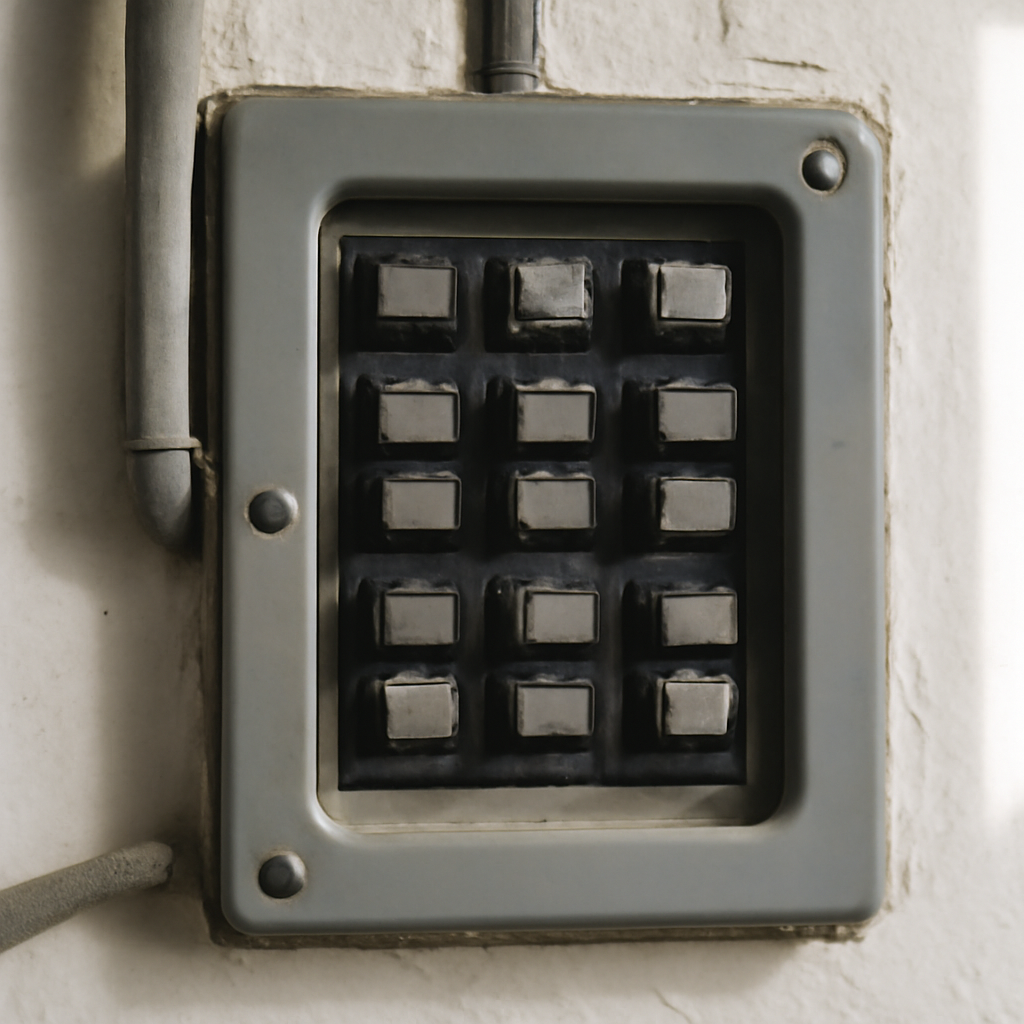
Open the panel door in some mid-century homes and, instead of the familiar row of toggle switches, there is a column of square push buttons. That is a Pushmatic panel, and each button is a Pushmatic breaker. These panels were installed in many houses built roughly from the 1950s into the 1970s, including a share of the older neighborhoods along the Colorado Front Range. They are not the subject of a known federal recall, but home inspectors often call them out because of their age, the way the mechanisms behave after decades of sitting idle and how hard it can be to find parts. This guide explains how the design works, the concerns inspectors raise, how the panel compares with other legacy equipment and what repair or replacement typically involves.
Part of our Home Electrical guide — start there for the full picture →
Electrical problem? Talk to a licensed electrician.
📞 Call (877) 560-2714How a Pushmatic Breaker Works
A standard modern breaker uses a toggle handle that flips between on, off and a middle tripped position. A Pushmatic breaker uses a push button instead. Pressing the button once turns the circuit off, and pressing it again turns it back on. When the breaker trips because of an overload or short circuit, the button pops out to a tripped position, and the user typically presses it to reset.
Inside, the breaker relies on a thermal element that responds to sustained overloads, along with a mechanical linkage that opens the contacts. That general approach is common to many residential breakers. What sets this design apart is the push-button operating mechanism and the way the breakers mount in the panel.
The Bolt-On Design
Pushmatic breakers bolt onto the panel’s bus bars rather than snapping onto them as many plug-on residential breakers do. A bolted connection can be very secure when tightened properly, and some electricians regard that as a point in the design’s favor. The trade-off is that replacing a breaker takes more time and effort, and the replacement must be a compatible bolt-on unit made for that panel.
Identifying the Panel
The push buttons are the giveaway. Most of these panels have a single vertical column of square buttons, often with a separate main section at the top. Many have small windows or labels showing the circuit amperage. If the panel cover includes an older label or schedule, it may also list the original circuits, although those labels are often faded, missing or out of date after decades of remodeling.
Concerns Inspectors Raise
Inspectors rarely call a Pushmatic panel an immediate danger on sight. More often they note it as older equipment that deserves an electrician’s evaluation. The concerns tend to fall into a few groups, and none of them applies to every panel.
Stiff or Seized Mechanisms
The most frequently cited concern is the mechanism itself. These breakers were lubricated with grease at the factory, and over many decades the grease can harden. A breaker that has not been switched in years may become stiff, slow to operate or, in some cases, reluctant to trip. A breaker that does not open when it should is the core worry, because a circuit could then carry more current than its wiring is rated for.
Some electricians “exercise” old breakers by switching them off and on several times to free the mechanism. That is work for an electrician, not a homeowner. Exercising a seized breaker under load can damage it, and the person doing it needs to know how to judge whether a mechanism that finally moves is actually working correctly.
No Clear Trip Indicator on Some Units
On some Pushmatic breakers, the difference between the on, off and tripped positions is subtle. In a dim basement it can be hard to tell which breaker has tripped. Owners sometimes press buttons at random until the lights come back, which is not ideal on a panel that may have stiff mechanisms. Good labeling helps, and our guide to electrical panel labeling explains how to map circuits clearly.
Limited Replacement Parts
The panels have been out of production for decades. Replacement breakers can still be found through specialty suppliers and reconditioned stock, but availability and price vary, and some electricians prefer not to install used or reconditioned breakers at all. When a single breaker fails, the difficulty of finding a proper replacement can push the decision toward replacing the whole panel.
Capacity and Modern Protection
Many of these panels were installed with service ratings that suited mid-century loads. A house that has since added central air, an electric range upgrade, a hot tub or an electric vehicle charger may be near the limit of what the panel can handle. Older panels also may not accept modern arc-fault or ground-fault breakers, which limits how easily a homeowner can add those protections without a panel change.
What Is Not Claimed
It is worth being precise. Concerns about Pushmatic panels come mainly from age, wear and parts availability. That is different from legacy panels whose breakers have been the subject of widely reported performance concerns. Owners who see claims of a recall should check the Consumer Product Safety Commission’s recall database directly rather than relying on secondhand sources.
Pushmatic Panels Compared With Other Legacy Equipment
Several older panel types show up in inspection reports, and each draws attention for different reasons. Our guide to the older panel type with widely reported breaker concerns covers a design that inspectors usually treat more seriously than a Pushmatic panel. A fuse box raises its own issues around over-fusing and insurance. The table below gives a general comparison. It is a simplification, and an electrician’s evaluation of the specific panel matters more than its type.
| Equipment | Main concerns typically raised | Common recommendation |
|---|---|---|
| Pushmatic panel | Age, hardened grease, stiff mechanisms, scarce parts, limited capacity | Electrician evaluation; often planned replacement |
| Legacy panel with reported breaker concerns | Questions about breakers tripping reliably under fault conditions | Evaluation and replacement often advised promptly |
| Fuse box | Over-fusing, bypassed fuses, small service, insurance questions | Correct fuse sizes or replace with a breaker panel |
| Modern breaker panel with defects | Double taps, missing covers, overheating, incorrect breakers | Targeted repairs by an electrician |
Aluminum Branch Wiring From the Same Era
Some homes built in the years when Pushmatic panels were common also had single-strand aluminum branch wiring installed, particularly during a period when copper prices were high. Aluminum wiring has its own connection concerns at receptacles, switches and splices, and an older panel combined with aluminum branch circuits usually prompts a broader evaluation. Our guide to aluminum wiring explains the issues and the repair methods electricians use.
Warning Signs and Everyday Safety
Most electrical warning signs are the same regardless of the panel type. The National Fire Protection Association advises calling a qualified electrician for frequent problems with blowing fuses or tripping circuit breakers, a tingling feeling when touching an appliance, discolored or warm wall outlets, a burning or rubbery smell from an appliance, flickering or dimming lights and sparks from an outlet. The Consumer Product Safety Commission’s electrical safety guidance adds sizzling or buzzing sounds, hot switch plates and outlet covers and the odor of overheated plastic to its list of hazard warning signs.
A breaker that trips repeatedly in a Pushmatic panel is giving the same message as one in a modern panel: something on that circuit is drawing too much current or has a fault. The guide to a breaker that keeps tripping walks through likely causes. With an older panel there is one more possibility to consider: a breaker that never trips is not necessarily a sign of a healthy circuit, which is part of why inspectors suggest an electrician look at aging equipment.
Everyday habits also reduce load on older circuits. The U.S. Fire Administration advises plugging major appliances such as refrigerators, stoves, washers and dryers directly into a wall outlet, never using an extension cord with a major appliance, not overloading outlets or power strips and replacing worn or damaged extension cords right away.
What a Home Inspector Reports on a Pushmatic Panel
A home inspection is visual and does not include testing breakers to see whether they trip at their rated current. Under the ASHI Standard of Practice, the inspector inspects the service equipment and main disconnects, the interior components of service panels and subpanels, conductors and overcurrent protection devices, as well as ground-fault and arc-fault circuit interrupters. The inspector describes the amperage rating of the service, the location of the main disconnect and subpanels and the predominant branch circuit wiring method. The standard states that the inspector is not required to measure amperage, voltage or impedance.
In practice, a report on a Pushmatic panel usually includes:
- The panel type and its apparent service rating.
- Visible conditions such as rust, scorching, loose or missing parts and open knockouts.
- Any breakers that appear mismatched, double tapped or damaged.
- The branch wiring method observed, including any aluminum or older cloth-insulated cable.
- A recommendation for evaluation by a licensed electrician, often noting the age of the equipment and parts availability.
Most inspectors will not operate the push buttons. Switching circuits off in an occupied home can interrupt computers, medical equipment or freezers, and a stiff breaker that sticks in the off position creates its own problem. For a broader look at what electrical reviews cover, see the electrical inspection guide.
Where Infrared Scanning Fits
Some inspectors and electricians add an infrared camera scan of the panel while the house is under normal load. A thermal image can highlight a breaker, connection or conductor running noticeably warmer than its neighbors, which may point to a loose connection or an overloaded circuit. It does not prove that a breaker will trip correctly, but it is a useful, non-invasive screening step for older equipment. Our guide to infrared thermography in electrical inspections explains what the images can and cannot show.
Repair or Replace: Options and Hedged Costs
Once an electrician has evaluated a Pushmatic panel, the options usually fall into three groups.
Keep the Panel and Address Specific Issues
If the panel is in good condition, the loads are modest and the electrician is comfortable with how the breakers operate, the recommendation may be to leave it in place while correcting specific defects, replacing any failed breakers with compatible units and improving the circuit directory. This is the lowest-cost path in the short term. Because parts are scarce, owners on this path often set money aside for a future replacement.
Replace the Panel at the Same Service Size
Replacing the panel with a modern breaker panel at the same service rating removes the age and parts concerns and makes it easier to add arc-fault and ground-fault breakers where the local code calls for them. The new panel will typically include a main breaker as the single shutoff for the house. The work usually requires a permit, a utility disconnect and a final inspection by the local building department.
Upgrade the Panel and Service
Homes that have added significant loads, or owners planning a heat pump, electric vehicle charger or major remodel, may choose to increase the service rating at the same time. That can involve a new meter base, new service entrance conductors and grounding improvements, and it may require coordination with the utility. Our guide to an electrical panel upgrade covers the steps involved.
What the Work May Cost
Costs vary widely with service size, panel location, how much branch wiring needs to be extended or reconnected, local permit fees and the condition of the service entrance. As a rough and hedged guide, a same-size panel replacement has often cost in the low thousands of dollars, and a full service upgrade can add several thousand more. Replacing a single breaker with a compatible part is usually much cheaper, but sourcing time and the electrician’s comfort with reconditioned parts can affect both price and feasibility. Written local quotes are the only reliable figure.
Living With the Panel While Planning
Many owners keep a Pushmatic panel in service for a while after an evaluation, especially when the electrician finds it in reasonable condition. A few sensible habits make that interim period safer:
- Keep the panel cover closed and the area in front of it clear, dry and easy to reach.
- Update the circuit directory so the right breaker can be found quickly without pressing buttons at random.
- Spread heavy loads, such as space heaters, microwaves and hair dryers, across different circuits.
- Note any breaker that trips often, feels warm or makes noise, and report it to the electrician rather than resetting it repeatedly.
- Avoid adding major new loads until the panel and service have been evaluated for them.
The Consumer Product Safety Commission’s electrical safety guidance suggests having a licensed electrician check the home’s electrical system if it has been more than ten years since the last inspection or if warning signs appear. For equipment of this age, many owners schedule that check soon after moving in.
Buying or Selling a Home With a Pushmatic Panel
For buyers, the usual approach is to treat a Pushmatic panel as a known item that needs a professional opinion within the inspection period. Schedule an electrician to evaluate the panel and the visible wiring, ask for a written estimate covering both repair and replacement and contact the insurance carrier early. Some insurers ask about panel type on applications, and practices vary, so a quick call can prevent a late surprise.
With an estimate in hand, buyers commonly negotiate a credit, a price reduction or a seller-completed replacement with permits and final inspection. Sellers who already know they have an older panel can reduce friction by getting an electrician’s evaluation before listing. The hiring process section explains how inspections and specialist evaluations fit into a transaction, and the electrical hiring hub collects our guides on panels, wiring and electrical specialists.
Whatever the outcome, the National Fire Protection Association’s general advice applies: have all electrical work done by a qualified electrician, and when buying or remodeling a home, have it inspected by a qualified private inspector or in accordance with local requirements.
More Questions About Pushmatic Breakers
How old is a Pushmatic panel?
Most Pushmatic panels in homes today date from roughly the 1950s through the 1970s, with some installed later. That means many are well over 50 years old. Age alone does not prove a panel is unsafe, but older equipment is more likely to have worn mechanisms, corrosion, heat damage and undersized service for modern loads. The panel label, the house’s construction date and any electrical permit records help pin down its age. A licensed electrician can evaluate condition, not just age.
Can you still buy replacement Pushmatic breakers?
Replacement Pushmatic breakers are still available, but supply is limited and prices are usually higher than modern breakers. Many on the market are reconditioned or old stock. An electrician should confirm that any replacement matches the panel, carries proper ratings and comes from a reputable source, since counterfeit and mismatched breakers are a known problem with legacy equipment. When several breakers need replacing, or a reliable supply is hard to find, replacing the panel is often the more practical path.
Can a Pushmatic panel be upgraded to 200 amps?
A Pushmatic panel cannot simply be upgraded to 200 amps. Increasing capacity usually means replacing the panel and often the service entrance, meter base and service conductors, coordinated with the electric utility and permitted by the local building department. That is a larger project than swapping a panel at the same amperage. Homes adding a heat pump, EV charger, electric range or major addition often need this upgrade, so an electrician should run a load calculation before quoting.
How do you reset a tripped Pushmatic breaker?
A tripped Pushmatic breaker is usually reset by pressing its button fully in until it latches, which returns it to the on position. On many units the tripped button sits partway out or in a different position than its neighbors, but some give no clear indication, so check each button carefully. Unplug devices on the circuit first. A breaker that trips again immediately, feels hot, smells burnt or will not latch points to a fault that a licensed electrician should investigate.
Do you have to replace a Pushmatic panel to sell a house?
No law generally requires replacing a Pushmatic panel to sell a house, but the panel can still affect the sale. Buyers’ inspectors commonly flag Pushmatic panels for evaluation, and some insurers ask about or decline older panels. That can lead to repair requests, price credits or delays. Sellers can get an electrician’s evaluation ahead of listing, replace the panel themselves, or price the home to reflect the panel. Disclosure requirements still apply to known defects.
References
- Electrical Safety in the Home — National Fire Protection Association
- Appliance and Electrical Fire Safety — U.S. Fire Administration
- Electrical Safety — U.S. Consumer Product Safety Commission
- ASHI Standard of Practice for Home Inspections — American Society of Home Inspectors
Frequently asked questions
Are Pushmatic breakers dangerous?
Not automatically. The main concerns are age, hardened grease that can stiffen mechanisms, unclear trip indication on some units and scarce replacement parts. An electrician's evaluation is the usual way to judge a specific panel.
Has there been a recall on Pushmatic breakers?
Concerns about these panels generally relate to age and parts availability rather than a known recall. Anyone who sees recall claims should check the Consumer Product Safety Commission's recall database directly.
Can a homeowner exercise old Pushmatic breakers?
It is better left to an electrician. Operating a stiff or seized breaker can damage it, and judging whether it now works correctly takes training and test equipment.
How much does it cost to replace a Pushmatic panel?
It depends on service size, panel location, permits and wiring condition. A same-size replacement has often cost in the low thousands, and a service upgrade can add several thousand more. Local quotes give the real number.
Will a Pushmatic panel affect homeowners insurance?
It can. Some carriers ask about panel type and may request an electrician's evaluation or replacement, while others do not. Buyers usually check with their insurer early in the contract period.
How long does replacing a Pushmatic panel take?
Replacing a Pushmatic panel typically takes an electrician about one day, often four to eight hours of work, with the power off for much of that time. Permit scheduling, utility disconnects and final inspection can add days to the overall timeline, especially for a service upgrade.
Can a new circuit be added to a Pushmatic panel?
Adding a new circuit to a Pushmatic panel is often difficult because these panels have few spaces and limited breaker options. An electrician may advise against it if the panel is full or in poor condition. A new major circuit is often what prompts a panel replacement.
Does replacing a Pushmatic panel need a permit?
Replacing a Pushmatic panel typically requires an electrical permit and a final inspection by the local building department. The electrician usually pulls the permit. A permitted replacement gives buyers and insurers documentation that the work was done to code.
Seeing push-button breakers in a home you are considering? Contact us and we can connect you with a Front Range inspector familiar with older electrical panels.