Moisture Meters for Wood: A Practical Use Guide
Wood is a living material long after it leaves the tree. It swells when humidity rises and shrinks when the air dries, and the amount of water locked inside the cell walls drives almost every problem a woodworker, flooring installer, or home inspector ever chases. Moisture meters for wood put a number on that hidden water before it turns into cupped floors, split furniture joints, or a stack of firewood that hisses instead of burning. Getting an accurate reading depends on choosing the right meter, correcting for species, and knowing what moisture content the wood should hold for its end use.
Part of our Moisture Meters & Water Damage Detection guide — start there for the full picture →
What do moisture meters for wood actually measure?
A wood moisture meter reports moisture content (MC), expressed as a percentage of the wood’s oven-dry weight. A reading of 12% means the water in the board weighs about 12% as much as the wood fiber itself would if every trace of moisture were driven off in a lab oven. That oven-dry method remains the reference standard, but it is destructive and slow, so handheld meters estimate MC indirectly instead.
Two physical properties make that estimate possible. Wood’s electrical resistance falls sharply as it gets wetter, and its dielectric constant changes with water content. Pin meters exploit the first property; pinless meters exploit the second. Neither reads water directly, which is why correction factors and a basic understanding of the wood matter as much as the device in your hand.
Pin vs pinless: which design fits the wood you handle?
The split between pin and pinless meters is the first decision, and each style earns its place. A deeper breakdown lives in the full pin versus pinless moisture meter comparison, but the short version follows.
Pin (resistance) meters
Pin meters drive two electrodes into the wood and measure the electrical resistance between them. The current follows the wettest path, so the reading reflects moisture at the depth the pins reach. Insulated pins that contact wood only at their tips let you map moisture at different depths, a real advantage when you suspect a wet core under a dry surface. The trade-off is obvious: the pins leave small holes, which matters on finished flooring or visible furniture faces. Pin meters typically read a usable range from about 6% up to fiber saturation near 28% to 30%.
Pinless (capacitance) meters
Pinless meters press a flat sensor pad against the surface and read a field that penetrates roughly 0.25 to 0.75 inch into the wood, depending on the model. They scan large areas fast and leave no marks, which makes them popular for flooring surveys and quality control on finished stock. They are sensitive to surface contact, board thickness, and any metal behind the wood, and they average moisture across the whole sensing depth rather than pinpointing a wet layer. Many professionals carry both, or a combination meter such as the Protimeter MMS3 that switches between modes.
Why species correction changes the number on the screen
Most meters are calibrated to a reference species, usually Douglas fir. Because different species have different densities and electrical behavior, a reading taken on oak or walnut without correction can be off by several points. Pin meters need a species correction (often tied to a wood-group number in the manual), and pinless meters need a specific-gravity setting because density drives the capacitance response.
Skipping correction is the most common error among casual users. A meter showing 9% on dense hickory might actually represent 11% or 12% true MC once the species table is applied. For framing lumber that margin rarely matters, but for cabinet-grade hardwood or a flooring acclimation check, two points can be the difference between a stable installation and a failed one. Always look up the species in the meter’s chart or app and set the correction before trusting the value.
Target moisture content by end use
There is no single “dry enough” number. The right MC depends on what the wood will become and the climate it will live in. Along Colorado’s Front Range, where indoor relative humidity often runs low through winter, equilibrium moisture content tends to sit lower than in humid coastal regions, so targets skew toward the dry end of these ranges.
Flooring
Solid hardwood flooring is generally installed somewhere between 6% and 9% MC, with the subfloor within about 2% to 4% of the flooring (manufacturers publish the exact gap). The point is to install at the moisture content the wood will hold in service, so it neither cups from later swelling nor gaps from later shrinking. A dedicated flooring moisture meter often includes both wood and subfloor settings to make that comparison straightforward.
Furniture and millwork
Interior furniture, cabinetry, and trim are typically built at 6% to 8% MC for most heated North American interiors. Wood machined and joined wetter than that will shrink as it equilibrates, opening glue lines and loosening joints. Letting boards acclimate in the shop until the meter stabilizes is the practical safeguard.
Framing lumber
Construction framing is more forgiving. Kiln-dried lumber stamped “KD-19” or “S-DRY” is at or below 19% MC, the common benchmark for dimensional framing. Building inspectors and the model codes referenced by the International Code Council watch this threshold because wood installed wetter than 19% is more prone to mold, fastener corrosion, and dimensional movement after the wall is closed.
Firewood
Firewood should burn at 20% MC or below, and well-seasoned wood often reaches the mid-teens. Above roughly 20%, energy that should heat the room goes into boiling off water instead, producing more smoke, more creosote, and less usable heat. Splitting a piece and reading the freshly exposed interior gives a truer number than testing the weathered outer face.
Named meters worth knowing
Several meters appear repeatedly in flooring, woodworking, and inspection circles. The Wagner Orion line and Lignomat Ligno-Scanner represent capable pinless options with species and specific-gravity settings. Delmhorst pin meters, including the J-2000 and BD-2100, are long-standing resistance instruments common in lumber and flooring work. The Protimeter MMS3 is a dual-function inspection meter. Budget tools such as the General MM7 or a Harbor Freight wood moisture meter can be useful for ballpark checks, though they often offer fewer correction settings. Match the meter to the stakes: a quick firewood check tolerates a basic pin meter, while a flooring warranty claim deserves a corrected, calibrated instrument.
Equilibrium moisture content and why it matters
The reason any target number works is a principle called equilibrium moisture content (EMC). Wood constantly exchanges moisture with the surrounding air until it reaches a balance point set by the air’s temperature and relative humidity. At that point the wood is neither gaining nor losing water, and its dimensions stabilize. The whole goal of acclimation and target-MC setting is to install wood at the moisture content it will naturally settle to in service.
EMC charts map relative humidity to the moisture content wood will hold. At a typical heated interior of 30% to 40% relative humidity, wood equilibrates somewhere around 6% to 8% MC, which is exactly why interior furniture and flooring targets cluster there. In a humid summer the same wood may climb several points; in a dry Colorado winter it may drop. This is why a board installed at 12% in a heated home will shrink and potentially crack, and why a board installed at 4% may swell and cup. A moisture meter lets you confirm the wood has reached the EMC for its destination rather than gambling on it.
Acclimation is the practical application of this idea. Bringing flooring or millwork into the space where it will live, stacked so air circulates around each piece, and letting the meter readings stabilize over days tells you the wood has reached the local EMC. Manufacturers of solid hardwood flooring publish acclimation guidance precisely because skipping it is a leading cause of post-installation cupping and gapping. The meter turns acclimation from guesswork into a measurable, defensible step.
Pin meter depth readings versus surface scans
One advantage of pin meters deserves its own discussion: depth profiling. Because the current follows the path between the pin tips, insulated pins let you measure moisture at a specific depth rather than averaging it. Driving the pins shallow reads near the surface; driving them deeper reads the core. Comparing the two reveals a moisture gradient, which is diagnostic.
A board that reads dry at the surface but wet at the core is still releasing moisture and is not ready to use, even though a quick pinless scan might call it acceptable. This matters for thick stock, freshly kiln-dried lumber that may have a dry shell over a wet core, and any situation where uniform drying is in question. A pinless meter, by contrast, averages moisture across its whole sensing depth, so it cannot distinguish a wet core from uniform moisture. Knowing which tool reveals what keeps an inspector or woodworker from being fooled by a surface reading.
Common mistakes that ruin readings
Several recurring errors undermine otherwise good equipment. The first is skipping species correction, already covered, which can shift a hardwood reading by several points. The second is testing cold wood without temperature correction; resistance readings in particular are temperature-dependent, and a frigid board brought in from a winter delivery can read inaccurately until it warms.
A third mistake is taking a single reading and trusting it. Moisture is rarely uniform across a board, so a lone measurement near a dry end or a wet edge misrepresents the whole piece. Reading several spots and noting the range is far more reliable. A fourth is poor surface contact with a pinless meter, whether from a rough, uneven face, a gap behind the wood, or hidden metal that throws off the capacitance field. Finally, comparing readings between two different meters without accounting for their calibration references invites confusion; the same wood can legitimately read differently on two instruments calibrated to different species. Recognizing these traps is half the battle in getting numbers you can act on.
How to read a wood moisture meter correctly
Accurate readings come from technique as much as hardware. A few habits make the difference.
Set the species or specific gravity first. Take several readings across the board, not one, because moisture is rarely uniform, and average them or note the highest. With pins, orient the electrodes parallel to the grain for the most consistent contact, and push them to full contact depth. With a pinless meter, press firmly on a flat, clean surface and keep the sensor away from board edges, knots, and any nails or HVAC ductwork behind the wood.
Let cold wood warm to room temperature when possible, since temperature affects resistance readings, and consult the meter’s temperature-correction note for readings far from the calibration baseline. If two meters disagree, suspect surface moisture, a wet core, or a missing correction rather than a broken device. For inspectors documenting findings, recording the meter model, species setting, and location of each reading turns a number into defensible evidence, a practice covered across the broader home inspection tools resources.
More Questions About Wood Moisture Meters
What moisture content is too wet for painting wood?
Wood is generally too wet to paint above about 15 percent moisture content, and many paint manufacturers recommend lower readings, so check the product label. Painting wet wood can trap moisture, leading to blistering, peeling and mildew under the finish. New pressure-treated lumber, siding after rain and wood stored outdoors often read too wet. Take readings on several boards and in shaded areas, which dry more slowly than sunny ones.
Can a wood moisture meter test cork or laminate flooring?
A wood moisture meter does not give accurate readings on cork or laminate flooring, because laminate has a fiberboard core and a plastic wear layer, while cork has very different density from wood. A pinless meter on a reference scale can still show relative wet spots after a leak. For installation, check the subfloor rather than the flooring, and follow the flooring manufacturer’s moisture testing requirements. Wet laminate that has swollen at the seams usually needs replacement rather than drying.
Does the season affect wood moisture readings?
Yes, wood moisture content changes with the seasons as wood adjusts to indoor and outdoor humidity. Indoor wood typically reads lower in winter, when heating dries the air, and higher in humid summer months. Outdoor wood follows rain and humidity patterns. For furniture and flooring, measure moisture in the conditions where the wood will live, and allow for seasonal movement in the design and installation. Recording readings with the date helps show what is normal for each season.
How should firewood be tested with a wood moisture meter?
Firewood should be tested by splitting a piece and taking readings on the freshly split inner face, across the grain, near the middle of the split. The outer surface dries much faster and reads low. Test a few pieces from different parts of the pile. Firewood is generally considered seasoned at about 20 percent moisture content or less, which typically takes several months to a year or more after splitting, depending on species and climate.
References
- International Code Council building code resources — International Code Council
- InterNACHI guidance on moisture intrusion — InterNACHI
- Heating Safety (gas and fuel-burning equipment) — National Fire Protection Association
Frequently asked questions
What is a good moisture content reading for wood?
It depends on the use. Interior furniture and trim usually target 6 to 8 percent, solid hardwood flooring 6 to 9 percent, framing lumber 19 percent or below, and firewood 20 percent or below. Set the meter to the correct species before trusting any of these numbers.
Are pinless wood moisture meters accurate?
Yes, when used correctly. Pinless meters read accurately on flat, clean surfaces with the specific gravity set for the species, but they average moisture across their sensing depth and can be thrown off by metal behind the wood or poor surface contact.
Do I really need to set the species on my moisture meter?
For meaningful results, yes. Meters are calibrated to a reference species, and dense hardwoods can read several points off without correction. For cabinet work or flooring acclimation that error matters; for rough framing checks it matters less.
How do I check the moisture content of firewood?
Split a piece and press or insert the meter into the freshly exposed interior, not the weathered outer surface. Well-seasoned firewood reads 20 percent or below; wetter wood smokes, burns poorly, and builds creosote.
Can a wood moisture meter be used on drywall?
Many wood moisture meters also include a drywall or reference scale, but on wood-only meters drywall readings are relative. Compare suspect areas with known-dry drywall. A clearly higher reading signals a wet spot worth investigating.
Why does wood read wetter near knots?
Wood often reads wetter or less consistently near knots because knots are denser and have a different grain orientation, which affects the electrical reading. Take readings in clear wood away from knots, checks and resin pockets for more representative results.
Is a wood moisture meter useful for buying used furniture?
A wood moisture meter can help when buying used furniture by flagging pieces stored in damp basements or garages. Elevated readings suggest the piece may warp, crack or show mold as it dries. Let damp furniture dry slowly before refinishing.
Moisture meters for home inspection
Pin meters read deep but leave marks; pinless meters scan surfaces non-destructively. Many inspectors carry both.
| Product | Why | Buy |
|---|---|---|
 Klein Tools ET140 Pinless | Non-destructive scanning; affordable. | Amazon — $49.22 |
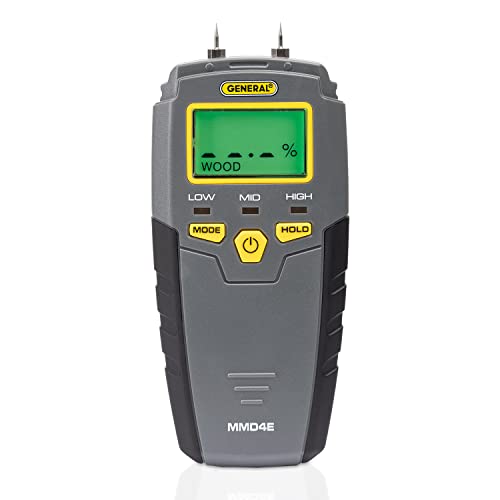 General Tools MMD4E | Best-selling pin meter for drywall/wood. | Amazon — $39.98 |
 Lignomat Mini-Ligno | Trusted by woodworkers; species-calibrated. | Amazon — $83.20 |