Moisture Meter for Wood Reviews: 2026 Buyer’s Guide
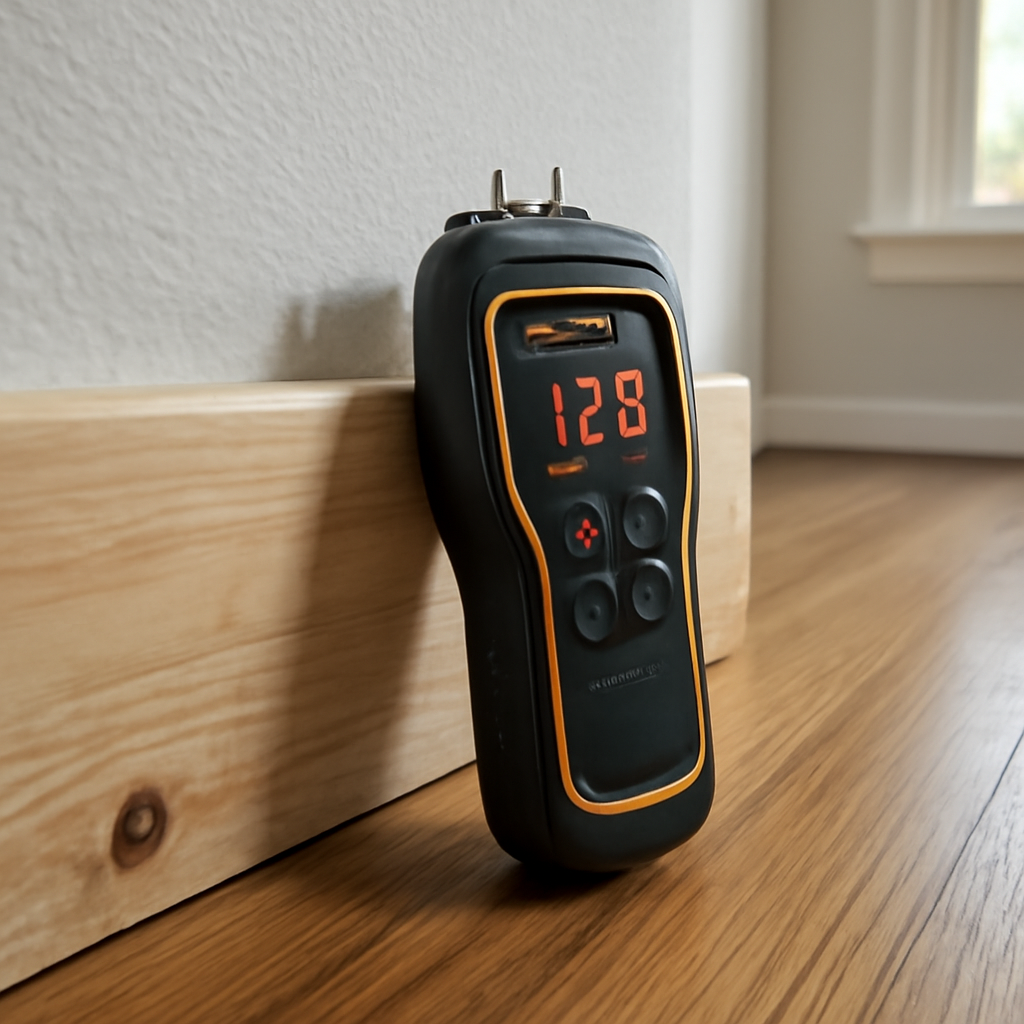
Moisture meters for wood split into two technology camps, and choosing between them is the first decision in any buyer’s review. Pin-type meters drive metal probes into the wood and read electrical resistance between the pins, which varies with moisture content. Pinless meters use a sensor pad on the back that generates an electromagnetic field, reading moisture without surface damage. The 2026 market is mature enough that both camps have clear leaders, defensible accuracy, and overlapping price ranges from $30 to $600. This guide walks through the category honestly, compares the brand families, and flags the situations where each technology earns its price.
Part of our Moisture Meters & Water Damage Detection guide — start there for the full picture →
The fundamental pin-versus-pinless tradeoff
Pin-type meters give point readings at the depth of the pins. They are inexpensive (entry-level models start at $25 to $40), they work on a wide range of materials including drywall and concrete, and they tolerate operator inexperience because the pins must contact the substrate to read at all. The downside is the pin holes themselves: unacceptable on finished hardwood floors, fine furniture, or visible cabinetry.
Pinless meters give a volume-average reading from a sensor pad pressed against the surface. They leave no marks, scan large areas quickly, and produce consistent readings without per-board calibration adjustments. The downside is higher cost (entry-level pinless meters start at $80 to $150, professional pinless meters run $300 to $550) and the need for species correction across hardwood, softwood, and engineered substrates.
Most serious users eventually own one of each: a pinless meter for finished surfaces and a pin-type meter for confirmation at depth or for substrates where pinless will not read reliably.
Pinless leader: Wagner Orion family
Wagner Meters built the pinless category and still leads it in 2026. The Orion 940 ($300 to $450) is the standard inspector and flooring-installer instrument; the Orion 950 ($400 to $550) adds data logging and Bluetooth syncing for users who need defensible documentation. Both meters cover more than 200 wood species through a built-in correction table and read to roughly 3/4 inch depth.
Why the Orion line wins in pinless: the species correction is built in (no manual lookup tables), the calibration is stable over time (a check block is provided), and the warranty is unusually long for the category (7 years on the electronics for the 940 and 950). For a deeper look at the brand, see our Wagner wood moisture meter brand guide.
Pinless alternative: Lignomat scanner line
Lignomat’s Scanner series ($250 to $500) is the European-style pinless alternative. Lignomat-trained woodworkers and instrument makers tend to prefer them for fine-grain accuracy on individual species. The species coverage is smaller than Wagner’s (around 100 species in the standard tables versus 200-plus for Wagner) but the per-species calibration is widely considered more precise on the species that are covered.
Choose Lignomat when you work mostly with a small set of high-value species (instrument tonewoods, fine cabinet stock, exotic veneers). Choose Wagner when you work across a wide range of species and value the broader correction table.
Pin-type leader: Delmhorst line
Delmhorst, founded 1946 in New Jersey, is the pin-type incumbent for contractor and flooring-installer use. The J-2000 ($250 to $350) and the BD-2100 ($150 to $250) are the workhorses, with insulated probe options that read moisture at specific depths rather than averaging across the pin length. Delmhorst meters are rugged, have replaceable pins, and tolerate field abuse in ways that more delicate pinless instruments do not.
Delmhorst’s strength is in pin-specific applications: kiln operators tracking moisture gradients in drying lumber, flooring installers verifying subfloor moisture at multiple depths, and hardwood lumber graders who can accept the pin holes in non-visible faces.
Pin-type alternative: General Tools and Calculated Industries
The accessible pin-type tier from General Tools (MMD4E, $25 to $40) and Calculated Industries (AccuMASTER 7440, $35 to $60) covers casual homeowner and hobbyist use. These meters read 5 to 99 percent moisture content (the high end is more useful as a wet-or-dry indicator than as a precision reading), display reading ranges with simple bar graphs, and run on standard 9-volt batteries. Accuracy is acceptable for confirming whether wood is “dry” or “wet” but is not adequate for precision flooring-installation decisions.
These meters earn their place in homeowner kits because they cost less than a dinner out and pay for themselves the first time they confirm a wet wall or a soaked subfloor. For broader buyer guidance, our moisture meters for drywall overview covers the building-inspection cousins.
Calibration and accuracy: what the spec sheets mean
Most consumer and pro pin-type meters claim plus-or-minus 1 percent accuracy at the dry end (below 10 percent moisture content) and plus-or-minus 2 percent in the higher ranges. Pinless meters typically claim plus-or-minus 0.1 percent at the dry end on calibration species and plus-or-minus 1 percent across the broader range.
Real-world accuracy depends heavily on technique. Pin-type readings vary with pin contact pressure and orientation relative to grain. Pinless readings vary with sensor-pad contact and substrate density. The U.S. Department of Energy notes that moisture control matters more than absolute reading precision for most building applications; a meter that reads 14 percent versus 13 percent is telling you the same thing (wet enough to worry about) regardless of which exact number is right.
Species correction in practice
A meter calibrated for white oak will read incorrectly on Brazilian cherry without species correction because the dielectric constants and electrical resistance of different woods vary by 1 to 4 percentage points at the same actual moisture content. The Wagner Orion line applies correction internally based on the species you select. Lignomat scanners use external lookup charts you cross-reference manually. Pin-type meters generally require manual correction; the Delmhorst J-2000 displays a correction-applied reading once you set the species code.
For users who switch between species frequently, an internal correction table saves time. For users who work primarily on a small set of species, an external chart works fine and saves money.
What to look for at each price tier
Under $50: homeowner screening
Look for: a clear digital display, a reading range that covers 5 to 30 percent moisture content (the band that matters), a hold function, and standard battery (9-volt or AA). Skip: meters with “moisture detection” only and no numeric readout. The General Tools MMD4E and the Klein ET140-style meters dominate this tier.
$50 to $150: serious homeowner and hobbyist
Look for: species correction (even if external), insulated pins (deeper pin-type meters), or basic pinless capability. The Calculated Industries AccuMASTER 7440 and several entry-level Lignomat models live here. Pinless options at this price are limited and usually have narrower species coverage than the pro-tier meters.
$150 to $350: pro entry tier
Look for: documented species correction (built-in tables), calibration check blocks, and warranty terms longer than one year. The Delmhorst BD-2100 (pin) and the entry Lignomat scanners (pinless) compete here. This is the sweet spot for flooring installers who do not need data logging.
$350 to $550: pro full-featured
Look for: data logging, app integration, comprehensive species tables, and 5 to 7 year warranties. The Wagner Orion 940 and 950 dominate this tier; the Delmhorst J-2000 (pin) competes on the resistance side. This is where you land if you need defensible documentation for client reports or insurance claims.
Use cases driving the buying decision
Flooring installation: pinless plus pin-type combination, $400 to $800 total. Acclimatization documentation requires multiple readings over time, so data logging earns its place. Finished hardwood inspection: pinless only, $200 to $500 budget. Pin holes are unacceptable. Subfloor and concrete verification: pin-type with deep insulated probes, $150 to $350. Pinless cannot read reliably below the surface of dense substrates.
General home inspection: a $50 to $100 dual-mode meter handles most of the moisture-survey workflow that comes up during an inspection. Furniture making and luthiery: precision pinless ($300 to $550 Wagner or Lignomat) plus a backup pin meter for hidden faces.
Multi-species correction tables
The depth of the correction table matters less than the species you actually use. A 200-species table sounds impressive but is irrelevant if you work mostly in red oak and white oak. A 100-species table is fine if your species are all covered. Before buying, check that the species you work with are in the meter’s table. The Wagner Orion documentation lists the supported species online; Lignomat publishes its chart in the manual; Delmhorst publishes species correction tables in its application notes.
Common buyer mistakes
Buying a $30 pin-type meter and expecting flooring-grade precision. The cheap meters are screening tools, not precision instruments. Buying a pinless meter without checking species coverage for your stock. A meter that does not cover Sapele or Sipo will guess on those species. Skipping the calibration check block. Long-term calibration drift is real; the block costs $20 and pays for itself the first time it catches a drift.
Confusing meter accuracy with measurement protocol. A perfect meter used badly produces worse data than a mediocre meter used well. Read the manual; check multiple spots on each board; let the meter equilibrate to room temperature before measuring cold stock.
Where to buy in 2026
Woodworking specialty retailers carry the Wagner Orion and Lignomat scanner families. Flooring industry distributors stock the same meters at similar prices. Big-box home-improvement retailers carry the General Tools and Calculated Industries entry tier. Online tool retailers list the full range, including the Delmhorst pin-type family that big-box stores rarely stock. Direct-from-manufacturer purchasing through factory-authorized dealers usually includes a longer warranty and access to the calibration check block as a standard accessory.
The bigger context
Moisture meters for wood live inside a broader home-inspection tool stack. For the full kit, including thermal cameras, borescopes, and gas detectors, our home inspection tools buyer guide covers the categories that complement moisture sensing.
Equilibrium moisture content as a buying consideration
The geography where you use the meter affects which calibration matters most. Indoor EMC in the U.S. typically runs 6 to 12 percent depending on region. Coastal and Gulf states see EMC of 10 to 14 percent in summer; Colorado Front Range sees indoor EMC of 5 to 9 percent year-round. A meter that reads accurately across the dry-end of the range (5 to 9 percent) matters more in Denver than in Houston; a meter that reads accurately at the wet end (10 to 18 percent) matters more on the Gulf Coast.
The Wagner Orion 940 and 950 both spec tight accuracy at the dry end. Most Delmhorst pin-type meters read accurately across the middle of the range with looser tolerances at the extremes. Match the meter spec to the geography where you will use it most.
Battery type and replacement cost
Most pro-tier moisture meters run on standard 9-volt or AA batteries with battery life of 50 to 200 hours of intermittent use. The Wagner Orion 940 uses a 9-volt; the Orion 950 uses three AA cells. Entry-tier meters sometimes use coin cells (CR2032), which provide longer shelf life but shorter total runtime. Verify that the meter’s battery type is widely available before buying; some specialty meters use proprietary battery packs that add ongoing cost.
Display readability in field conditions
The display matters more in field use than the spec sheet suggests. Pro-tier meters typically have backlit LCD displays readable in bright sun and in dark crawlspaces. Entry-tier meters often have monochrome LCDs that wash out in direct sunlight. For inspectors working outdoors or in high-contrast lighting environments, the display upgrade alone is worth the price difference between tiers.
Color screens and touch interfaces have arrived on the Orion 950 and similar high-end meters in 2026. Whether you need them depends on whether you log readings for later export; for one-off field readings, a monochrome display works fine.
Data logging and report integration
Data logging captures readings with timestamps for later export to a client report. The Wagner Orion 950 and a few other pro-tier meters include Bluetooth or USB data export to mobile apps that generate PDF reports. For flooring installers and home inspectors who deliver written reports to clients, the data-logging feature can pay for itself in the first 6 to 12 months of use by eliminating manual transcription of readings.
The trade-off is complexity. Logged data only matters if the workflow actually uses it. Inspectors who handwrite notes during inspections often find the logging feature adds friction without proportionate benefit. Match the feature to the existing report-writing workflow.
Pin replacement and consumables
Pin-type meters require pin replacement over time. Standard pins last 200 to 500 readings depending on the substrate hardness; insulated pins (which read at a specific depth) last longer because they are protected from lateral wear. Replacement pin packs cost $10 to $25 per set. Some high-end pin meters use proprietary replaceable pin assemblies that cost more but install faster.
Pinless meters have no consumables. The sensor pad lasts the life of the instrument under normal use. This is one reason the pro-tier pinless meters are often a better long-term value despite higher upfront cost; the absence of consumables flattens the total cost of ownership over 5 to 10 years.
Warranty terms across brands
Wagner Orion: 7 years on electronics, lifetime on the sensor pad. Delmhorst: 1 to 3 years depending on model, with optional extended coverage available. Lignomat: 1 to 5 years depending on model. Entry-tier brands (General Tools, Klein, Calculated Industries): 1 year standard with some extended-coverage options.
The warranty length correlates roughly with build quality but is not the only signal. A 1-year warranty on a $40 meter is normal; a 1-year warranty on a $400 meter is a warning. Compare warranties when comparing meters at the same price point.
Common buyer mistakes (extended)
Buying a single meter for all use cases when a $400 pinless plus $150 pin combination covers more applications. Skipping the species correction reference when buying. Assuming higher resolution numbers mean higher accuracy (resolution and accuracy are different specs). Buying a meter rated for higher moisture ranges (above FSP) when most actual use falls in the 5 to 25 percent range where the meter design matters most.
References
- A Brief Guide to Mold, Moisture and Your Home — U.S. Environmental Protection Agency
- InterNACHI Moisture Intrusion Inspection — International Association of Certified Home Inspectors
- ASHRAE Standards and Guidelines — American Society of Heating, Refrigerating and Air-Conditioning Engineers
- Mold and Moisture Control — U.S. Environmental Protection Agency
Frequently asked questions
What is the most accurate moisture meter for wood in 2026?
At the pro tier, the Wagner Orion 950 (pinless) and the Delmhorst J-2000 (pin) compete for the title. Accuracy depends on technique and species correction more than on brand. Either meter, used properly, produces flooring-installer-grade results.
Pin-type or pinless: which should homeowners buy first?
For most homeowner use cases (finding wet walls, checking subfloors, verifying firewood dryness), an entry-level pin-type meter at $30 to $60 covers 90 percent of the workflow. Pinless meters earn their price when you cannot accept pin holes — finished floors, fine furniture, visible cabinetry.
How long do wood moisture meters last?
Pro-grade meters from Wagner, Lignomat, and Delmhorst typically last 7 to 15 years with normal use, often with one or two battery and sensor replacements along the way. Entry-tier meters at $30 to $50 are usually treated as disposable after 3 to 5 years.
Do I need a calibration check block?
Yes if you rely on the meter for client reports or insurance documentation. A $15 to $25 check block lets you verify the meter still reads accurately and catches drift before it produces bad data. Many pro-tier meters ship with a check block included.
Moisture meters for home inspection
Pin meters read deep but leave marks; pinless meters scan surfaces non-destructively. Many inspectors carry both.
| Product | Why | Buy |
|---|---|---|
 Klein Tools ET140 Pinless Klein Tools ET140 Pinless | Non-destructive scanning; affordable. | Amazon — $49.14 |
 General Tools MMD4E General Tools MMD4E | Best-selling pin meter for drywall/wood. | Amazon — $39.98 |
 Lignomat Mini-Ligno Lignomat Mini-Ligno | Trusted by woodworkers; species-calibrated. | Amazon — $99.00 |