Lumber Moisture Meter: Targets, Pins, and Species

A lumber moisture meter earns its keep the first time it stops a finished project from cupping, splitting, or opening gaps months after the work is done. Boards arrive at wildly different moisture content depending on how they were dried, how long they sat at the yard, and how much rain they caught in the driveway after delivery. Install wood at the wrong moisture content and you lock in dimensional change that resurfaces later as gapped flooring, popped cabinet joints, or cracked tile over a flexing subfloor. A usable meter costs under $50 and removes the guessing.
Part of our Moisture Meters & Water Damage Detection guide — start there for the full picture →
What the reading actually means
The number on the display is moisture content as a percentage of the wood’s oven-dry weight. A board reading 12 percent holds water equal to 12 percent of what it would weigh bone dry. The scale runs from oven-dry (0 percent) to fiber saturation, which lands around 28 to 30 percent for most species. Above fiber saturation, extra water sits loose in the cell cavities; below it, water is bound in the cell walls, and the wood swells or shrinks in near-lockstep with the reading. That below-saturation zone is where installed lumber lives, which is why the exact percentage matters so much.
Framing lumber leaves the kiln at 19 percent or below — that is the threshold behind the “S-DRY” or “KD” stamp defined in the U.S. Department of Commerce voluntary product standard PS 20 for softwood lumber. Furniture-grade hardwood is milled far drier, often 6 to 8 percent for climate-controlled interiors. Air-dried mill lumber floats anywhere from 14 to 25 percent depending on storage and weather. A meter sorts those grades in seconds and confirms what the stamp claims after the wood has traveled.
Pin or pinless — and why yards keep both
Two technologies dominate. Pin meters drive metal probes into the wood and read the electrical resistance between them, converting it to moisture content through a stored calibration. Pinless meters press a flat sensor pad against the surface and read via radio-frequency or capacitance sensing.
Pin meters own lumberyards and framing jobs because they read at a chosen depth. Short probes read the outer shell; longer insulated pins read the core. That shell-versus-core split is the whole point, because lumber dries from the outside in. A board showing 8 percent on the shell but 14 percent at the core has not finished drying and will keep shrinking after it goes in. Pin meters also hold up better at the extremes — most pinless models lose accuracy below roughly 5 percent and above 30 percent, while resistance-based pin meters track the full range.
The catch on pin meters is the holes. They are tiny, about 1/16 inch, but visible on planed hardwood, cabinet stock, or a finished floor. For yard grading and framing, nobody cares. For finished work, a pinless meter — or pin readings taken on a concealed face — keeps the surface clean. Pinless meters also scan area far faster and read deeper than short pins, which makes them the tool for sweeping a flooring delivery or checking a completed install. Serious shops own both: a pinless for fast area scans, a pin meter to confirm depth and settle marginal readings.
If you are still deciding on the format, the pinless moisture meter overview and the broader explainer on what a moisture meter measures cover the trade-offs in plainer terms.
Target readings by job
Different work tolerates different numbers.
| Application | Target moisture content | Note |
|---|---|---|
| Framing lumber | Under 19% at install | Air-dry indoors if it reads higher before closing walls |
| Subfloor plywood | Under 14% | Above this it keeps feeding moisture into the flooring above |
| Solid hardwood flooring | Within 2–4% of subfloor | Both acclimated to the home’s lived-in conditions |
| Cabinet / furniture stock | 6–8% interior | Re-acclimate a week before milling |
| Before paint or stain | Under 15–18% | Wetter wood traps moisture and blisters the finish |
Framing that arrives above 19 percent should dry indoors before it is buried in a wall or floor; the shrinkage that happens as it dries cracks drywall, pops nails, and racks joinery. Flooring is fussier: the National Wood Flooring Association calls for installing solid hardwood within 2 to 4 percentage points of the subfloor’s moisture content, with both acclimated to the home’s normal humidity. Colorado Front Range interiors, where winter indoor relative humidity often sits in the teens, tend to equilibrate hardwood near 6 to 8 percent — drier than the 8 to 11 percent common on the East Coast or in the Pacific Northwest. Floors set without that acclimation gap or cup when the seasons turn.
Why species and temperature shift the number
Wood species differ in density and electrical behavior, so a meter calibrated to Douglas fir reads a little off on oak, maple, walnut, or pine. Most quality meters carry a species-correction table or a built-in species selector. Skip the correction and a reading of 8 percent on a fir-calibrated meter might really be about 9.5 percent on red oak or 7 percent on white pine — a 1 to 2 point swing that is irrelevant for framing but decisive for flooring, furniture, or exterior trim. Pick the species, then apply it consistently across every reading in the project.
Temperature moves readings too. Cold lumber reads slightly drier than the same board at room temperature, and hot lumber reads slightly wetter. Most professional meters compensate automatically or with a manual setting; even so, bring stored material up to indoor temperature for at least an hour before you trust a reading, which matters most in a Front Range winter when lumber has been sitting in a cold garage.
Keeping the meter honest
Meters drift. Pin meters usually include a built-in check that reads a fixed resistance as a known value when you press a calibration button; pinless meters often ship with a dense plastic reference block that should return a specific number. Run the check before any reading you care about, especially on a meter that has been idle or bounced around a truck.
For a hard reference you can verify at home, use the oven-dry method on a scrap from the same batch: weigh the piece, dry it at about 215°F for 24 hours, weigh it again, then compute (wet weight − dry weight) ÷ dry weight as a percentage. It is overkill for casual work but the honest way to vet an unfamiliar meter or one that took a drop. Storage matters as well — meters left in hot cabs, damp basements, or freezing garages drift faster, so treat the thing like $100 of test gear, not a hammer.
Buying without overspending
For occasional homeowner use, a pinless meter in the $40 to $80 range covers most jobs: look for stated accuracy of ±1 to 2 percentage points, an included or available calibration block, and a 5 to 35 percent range. For real project work — flooring, furniture, fine carpentry — a $80 to $200 combo meter with both pin and pinless modes handles every case in one tool; Wagner, Delmhorst, Lignomat, and Klein all build respected units in that band. Professional $300 to $600 meters add durability and edge accuracy most homeowners never need. For framing and yard grading, a $30 to $50 pin meter is enough, as long as you buy a named brand rather than a generic unit with untrustworthy calibration. If you would rather not own one, the where-to-buy guide and the meter rental options lay out the alternatives, and the full home inspection tools library places moisture metering in the wider kit.
More Questions About Lumber Moisture Meters
Can a lumber moisture meter check drywall or walls for leaks?
A lumber moisture meter can flag wet drywall, but only as a relative comparison, not a true moisture percentage. Wood-calibrated scales assume wood density, so a reading on gypsum board means little on its own. The useful method is to scan a dry reference area of the same wall first, then move toward the suspected leak and watch for readings that climb well above that baseline. Many pinless meters include a separate reference or drywall mode for exactly this job. A consistently elevated patch around a tub, window or ceiling stain is a reason to look for the water source rather than proof of mold.
Can you use a lumber moisture meter on firewood?
Yes, a lumber moisture meter works on firewood, and well-seasoned firewood generally reads about 20 percent moisture content or lower. For an honest number, split a piece and press the pins into the freshly exposed face across the grain, because the outer bark side dries much faster than the core. Check several splits from different parts of the stack. Wood reading above roughly 25 percent usually needs more drying time, burns smoky and builds creosote in the chimney faster. Dedicated firewood meters are simply basic pin meters with a firewood-oriented scale.
What moisture content should wood be before building furniture?
Wood for indoor furniture is typically dried to roughly 6 to 9 percent moisture content, matching the equilibrium the wood will reach inside a heated home. Kiln-dried hardwood often arrives in that range, but boards stored in a damp garage or shop can pick moisture back up. Let the lumber sit in the room where it will be worked for a week or more, then confirm several boards read within a point or two of each other before cutting joinery. Building with wetter stock invites cracked panels, loose joints and doors that stick as the wood shrinks.
Does a lumber moisture meter detect mold?
No, a lumber moisture meter does not detect mold; it measures moisture, which is the condition mold needs. Wood that stays above roughly 19 to 20 percent moisture content for an extended period is at risk of mold growth and, at higher levels, decay fungi. That makes the meter a good screening tool on attic sheathing, subfloors and framing around past leaks. Visible growth, a musty odor or readings that stay high after the source is fixed are reasons to bring in a qualified mold inspector, who can assess the extent of growth and recommend remediation.
How deep does a lumber moisture meter read?
Most pinless lumber meters read roughly 1/4 to 3/4 inch deep, while a pin meter reads only as deep as its pins are pushed. Standard short pins measure the outer shell of a board, which can be drier than the core after surface drying. For thick timbers, slabs or beams, insulated hammer-electrode pins driven to about one quarter of the thickness give a better picture of the core. A pinless reading also averages everything in its sensing zone, so a knot, a nail or a hollow behind thin stock can skew the number.
Frequently asked questions
What moisture content should framing lumber read?
Under 19 percent at installation. The standard S-DRY or kiln-dried stamp, defined in U.S. Department of Commerce standard PS 20, means the lumber left the kiln at 19 percent or below. Anything reading higher at delivery should air-dry indoors before it is closed inside walls or floors.
Do I have to acclimate hardwood flooring?
Yes. The National Wood Flooring Association recommends installing solid hardwood within 2 to 4 percentage points of the subfloor's moisture content, with both acclimated to the home's normal humidity. In dry Front Range interiors that usually lands near 6 to 8 percent, and acclimation typically runs 5 to 14 days depending on the starting moisture.
Pin or pinless — which should I buy?
Pin meters are more accurate at the extremes and read at a chosen depth; pinless meters scan area faster and leave no marks. For occasional use a single pinless meter is plenty. For serious projects, a combo meter around $80 to $200 with both modes gives the most flexibility.
How accurate are lumber moisture meters?
Quality meters claim about ±1 to 2 percentage points within their range. Accuracy drops on chemically treated wood, near embedded fasteners, or on species read without correction, so apply the species-correction setting for hardwoods and unusual softwoods.
Should I check moisture before painting or staining?
Yes. Most finish makers specify wood below roughly 15 to 18 percent moisture content for proper adhesion. Coating wet wood traps moisture underneath and leads to peeling and blistering.
Is a soil moisture meter the same as a lumber moisture meter?
No, a soil moisture meter is a different instrument and cannot substitute for a lumber moisture meter. Soil probes give a rough wet-to-dry index for watering plants, while lumber meters are calibrated to report wood moisture content as a percentage of dry weight. Using a garden probe on boards gives meaningless results.
Why do two lumber moisture meters give different readings on the same board?
Two lumber moisture meters often disagree because they use different sensing methods, depths and species or density settings. A pin meter reads between its pins, while a pinless meter averages a zone below the surface. Match the species setting, read the same spot, and compare against a calibration block before deciding which meter is off.
What moisture content is too high for framing lumber before drywall?
Framing lumber reading above roughly 19 percent moisture content is generally too wet to close in with drywall. Many builders prefer studs at or below about 15 percent before hanging board, because wetter framing shrinks as it dries, which can cause nail pops, cracked tape joints and trapped moisture in insulated wall cavities.
Sources
- U.S. Department of Energy — moisture control basics
- EPA — mold, moisture, and your home
- InterNACHI — moisture meters for inspectors
This page summarizes DOE and EPA moisture guidance alongside published lumber-drying standards for general education; follow your meter’s manual and species-correction tables for project decisions.
Moisture meters for home inspection
Pin meters read deep but leave marks; pinless meters scan surfaces non-destructively. Many inspectors carry both.
| Product | Why | Buy |
|---|---|---|
 Klein Tools ET140 Pinless | Non-destructive scanning; affordable. | Amazon — $49.22 |
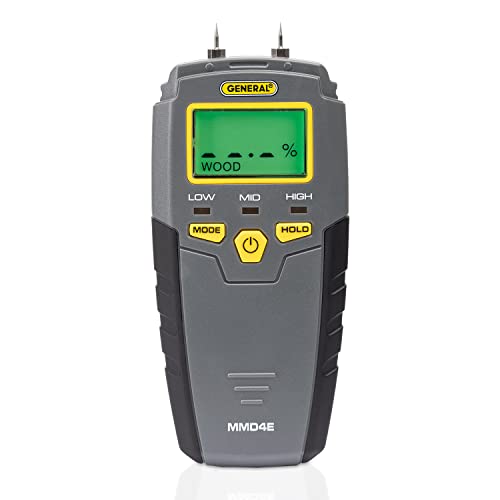 General Tools MMD4E | Best-selling pin meter for drywall/wood. | Amazon — $39.98 |
 Lignomat Mini-Ligno | Trusted by woodworkers; species-calibrated. | Amazon — $83.20 |