Moisture Meter Lumber: A Plain-Language Guide

A moisture meter for lumber answers one question that drives almost every woodworking and framing decision: is this board stable enough to use today, or will it shrink, warp, or crack after installation? Equilibrium moisture content (EMC) in interior Colorado spaces sits between 6% and 8%, while green softwood from the mill can read above 25%. A reliable handheld meter, used with species correction, closes that gap. This guide explains how the technology works, what readings actually mean, and where the common errors come from.
Part of our Moisture Meters & Water Damage Detection guide — start there for the full picture →
The role of moisture meters in modern building
Modern residential construction depends on lumber that moves predictably. Engineered I-joists, oriented strand board sheathing, and dimensional framing each have published moisture tolerances at installation and after enclosure. The moisture meter is the only practical field tool that confirms compliance. ICC building-code language references a 19% maximum moisture content for framing lumber at the time of enclosure, and the meter is how that limit is verified on site. Beyond code compliance, moisture readings inform decisions about kiln-drying additional time, separating wet boards from a stack, or scheduling installation after a wet period.
What a moisture meter for lumber measures
Wood moisture content is expressed as a percentage of the water weight relative to the oven-dry weight of the same board. A reading of 12% on a kiln-dried 2×10 means the board carries 12 grams of water for every 100 grams of dry wood fiber. The meter does not weigh the lumber. It infers moisture from electrical properties that change predictably as water content shifts inside the wood structure.
Pin meters: resistance through electrodes
Pin meters drive two metal pins into the surface of the board and run a small current between them. Water conducts electricity far better than dry wood fiber, so the meter measures resistance and converts that value to a moisture-content percentage. Pin meters give a localized reading wherever the pins land, which is useful for hunting wet pockets in a stack. The pins leave small holes, so finish carpenters often avoid them on visible faces.
Pinless meters: capacitance through a sensor pad
Pinless meters press a flat sensor pad against the board and read changes in capacitance across the field that pad creates inside the wood. Nothing punctures the surface, which preserves finish-grade stock and lets the operator scan square feet of board per minute. The trade-off is depth and averaging — most pinless meters read the top quarter-inch or so and report a single value across the sensor footprint. Density of the wood affects the field, so species correction matters more than with pin meters.
Why species correction matters
Different wood species hold water differently because cell structure and density vary. A pin meter calibrated to Douglas fir will read low on dense oak and high on light pine if no correction is applied. Quality meters either accept a manual species code or include lookup tables for common North American hardwoods and softwoods. For framing lumber the operator selects SPF or Douglas-fir-Larch. For furniture work the operator picks the exact species — white oak, walnut, maple, cherry — because the correction factor can shift readings by two or three percentage points.
EMC targets by application
Equilibrium moisture content is the value lumber will eventually settle at when exposed to a given temperature and relative humidity. Interior conditioned spaces along the Front Range run dry. The Department of Energy and InterNACHI publish EMC tables that guide installers to target the right value before installation rather than after. Hardwood flooring should be installed between 6% and 9% in most Colorado interiors. Interior trim sits in the same band. Framing lumber is acceptable up to 19% under common building codes, with most kiln-dried stock arriving at 15% to 18%.
Kiln-dried versus green lumber
Kiln-dried lumber leaves the mill at a documented moisture content, usually marked KD-19 or KD-15 on the grade stamp. The number after KD is the maximum moisture content of the batch when it left the kiln. Green lumber carries whatever water the tree held at felling, often 30% or more, and shrinks substantially as it dries in place. Builders working with green framing in covered structures plan for shrinkage at connection points. Furniture makers buying rough hardwood from a regional sawyer often air-dry stock to roughly 12% to 14% outdoors before bringing it into a conditioned shop to finish acclimating.
How to take an accurate reading
Place the meter flush against a clean, smooth area of the board, well away from knots, checks, and the end grain. End grain reads high because moisture migrates fastest along the long axis of the wood, and the last few inches of a board lag behind the middle. Take three to five readings across the length and average them. On stacked lumber, pull boards from the middle of the pile when possible — the perimeter dries faster than the core, and a meter check of only the outer board misleads the buyer about the bundle as a whole.
Surface moisture versus core moisture
Pinless meters and short-pin meters report surface or near-surface moisture. After a board is brought from an unheated barn into a warm shop, the surface equilibrates first while the core lags. A reading taken the same afternoon may read drier than the wood actually is. Deep-prong pin meters with insulated pins are designed to read at controlled depths and are the tool of choice for furniture makers who need to know the moisture gradient through a 6/4 or 8/4 board. Many woodworkers wait a week after delivery and re-measure before milling.
Temperature correction
Resistance changes with temperature as well as moisture. Most meters assume the lumber is at roughly 70 degrees Fahrenheit. Lumber pulled from a cold trailer in January reads low until it warms to shop temperature, and lumber sitting in summer direct sun reads high. Higher-end meters include a thermometer probe and apply correction automatically. Field carpenters working outside in Front Range winter conditions either bring the board indoors before measuring or apply the manual correction printed in the meter’s manual.
What readings tell a homeowner
A homeowner using a meter on visible structural lumber, deck boards, or trim is usually trying to confirm whether installation is safe today or whether the wood needs more drying time. Three reference points cover most cases. Framing and deck boards: under 19% before enclosing or finishing. Interior trim and cabinets: 6% to 9% before installation. Hardwood flooring: matched to the subfloor within two percentage points, with both pieces sitting in the conditioned space for the acclimation period the flooring manufacturer specifies, usually three to seven days.
Meter price tiers
Entry-level pinless meters for general home use sit in the $30 to $70 range and read accurately enough for deck and framing decisions. Mid-tier handheld pin meters with species correction and digital displays run $80 to $200 and serve most serious woodworkers. Professional moisture meters used by flooring installers, hardwood importers, and forensic moisture investigators include calibrated insulated pins, temperature compensation, and data logging, and range from $300 to $800. The cost-to-value cutoff for most homeowners lands at the $80 to $150 band — accurate enough, species-aware, and durable for a decade of occasional use.
Calibration and verification
Reliable meters ship with a calibration check block — typically a small plastic resistor or a piece of reference wood with a known moisture target. Verify the meter against the block monthly during heavy use, annually for occasional use. Replace pin tips when they show wear or corrosion. Pinless meters should be checked for sensor-pad damage and cleaned of resin and pitch buildup that can mimic moisture under the capacitance field. For homeowners using a meter to clear lumber before a renovation, the InterNACHI standard practice document on moisture measurement walks through the basics in plain language. Anyone shopping for a meter alongside other diagnostic tools can review the broader home inspection tools buyer’s guide for context on how moisture meters fit beside thermal imagers, borescopes, and air-quality sensors.
Common errors and how to avoid them
Several mistakes recur. Reading only the end grain reports the wettest section of the board, not the working portion. Using the wrong species setting on a pin meter introduces a systematic error of one to three percentage points. Skipping temperature correction on cold or hot stock produces readings off by several points. Trusting a single reading on a stack of lumber misses interior wet boards. And reading kiln-dried stock the day it arrives in a humid space — say, a basement shop without dehumidification — captures a moment that does not represent where the wood will be in two weeks. Woodworkers building furniture in the Front Range usually maintain shop humidity in the 30% to 45% range year-round and re-measure stock after acclimation.
Acclimation: the missing step many homeowners skip
Acclimation is the period during which lumber adjusts to the temperature and humidity of the space where it will live permanently. Skipping acclimation produces some of the most common failure modes in residential construction: gaps between flooring boards in winter, cupping in summer, and split trim around windows. The Department of Energy moisture-control guidance for residential buildings emphasizes that wood moves with humidity throughout its life and that installation moisture content needs to match the average operating conditions of the space, not the conditions on installation day. Practical implementation looks like this: deliver hardwood flooring at least seven days before installation, stack it loose with stickers, run the HVAC at normal operating conditions during the acclimation window, and verify with a meter that the flooring and subfloor have converged before installation begins. Front Range homeowners working with engineered hardwood or solid oak should account for the dry winter humidity that drives EMC to the low end of the band.
Reading wet framing after a leak
When a roof leak, plumbing failure, or basement seepage event saturates framing, a moisture meter answers two questions: is the wood still wet, and is it drying or holding? A baseline reading taken within 24 hours of the event documents the saturation level. Follow-up readings every two to three days track the drying trajectory. Framing that is not steadily losing moisture over a 10-day window suggests trapped moisture behind a finish, inadequate ventilation, or a continuing leak. EPA mold-remediation guidance notes that wet building materials should be dried within 24 to 48 hours to prevent biological growth, and meter readings provide the documentation insurance adjusters and remediation contractors rely on to confirm a dry-out has succeeded.
When to call a professional
Most lumber moisture decisions are within reach of a $100 meter and an afternoon of practice. The cases that warrant a professional are different: confirming the moisture history of a flooring claim, evaluating subfloor moisture before installing engineered floor, or investigating wet framing inside a finished wall cavity after a leak. Those situations call for an inspector with both a high-end pin meter and a thermal camera, and for homeowners weighing whether to bring one in, the moisture meter buyer guide covers the consumer-grade options first.
References
- A Brief Guide to Mold, Moisture and Your Home — U.S. Environmental Protection Agency
- Moisture Meters for Home Inspectors — InterNACHI
- International Residential Code Wood Framing — ICC
- Mold Course: Why and Where Mold Grows — EPA
Frequently asked questions
What is a good moisture content for lumber before installation?
Framing and deck boards should read under 19% before being enclosed. Interior trim and cabinet stock should sit between 6% and 9%. Hardwood flooring should match the subfloor moisture within two percentage points after acclimating in the conditioned space.
Pin or pinless moisture meter for woodworking?
Pinless meters are faster, leave no marks, and suit finish-grade lumber scanning. Pin meters give localized readings and work well for hunting wet pockets in stacks or measuring deep moisture with insulated pins. Most furniture makers own both.
Why does my meter read different values on the same board?
End grain reads high because moisture moves faster along the long axis. Surface readings lag behind core readings after a temperature change. Species, density, and temperature corrections also shift readings. Take three to five points and average them.
How much should a homeowner spend on a moisture meter?
Entry-level pinless meters run $30 to $70 and handle deck and framing decisions. Mid-tier pin meters with species correction at $80 to $200 cover most serious woodworking. Spending above $300 makes sense only for professionals or flooring contractors.
Moisture meters for home inspection
Pin meters read deep but leave marks; pinless meters scan surfaces non-destructively. Many inspectors carry both.
| Product | Why | Buy |
|---|---|---|
 Klein Tools ET140 Pinless | Non-destructive scanning; affordable. | Amazon — $49.97 |
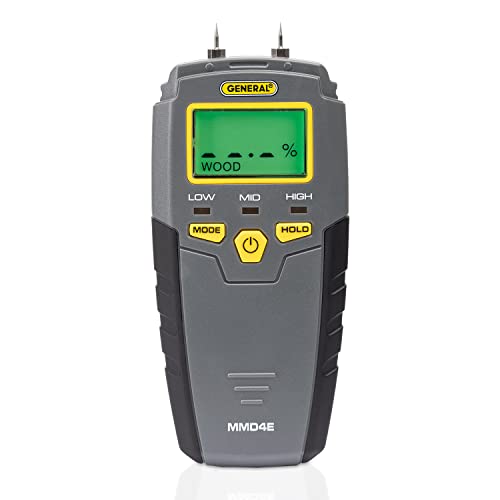 General Tools MMD4E | Best-selling pin meter for drywall/wood. | Amazon — $39.98 |
 Lignomat Mini-Ligno | Trusted by woodworkers; species-calibrated. | Amazon — $99.00 |