Where Can I Buy a Moisture Meter: A Plain-Language Guide
A moisture meter is widely available from several retailer categories, each with different strengths. Choosing the right retailer matters because the moisture meter market spans a wide quality range — from sub-$20 pen-style consumer units to $300 professional pinless and pin-type meters used by certified inspectors. This guide walks through the retailer categories, what each category offers, and how to match a buyer’s situation to the right source. It does not name or link specific retailers, and it does not endorse specific brands. The goal is to help the buyer think through where to shop based on what they need.
Part of our Moisture Meters & Water Damage Detection guide — start there for the full picture →
What kind of moisture meter are you actually buying
The first decision is which moisture meter category fits the use case, because different categories are stocked by different retailers.
Consumer pin-type meters
Two-pin probes pressed into wood, drywall, or other materials. Read electrical resistance between the pins, calibrated to wood-moisture-equivalent. Useful for hobby woodworking, occasional DIY building diagnostics, and basic moisture verification. Price range: $15 to $60.
Consumer pinless meters
Non-destructive capacitive sensors that press against a surface. Useful for finished surfaces (hardwood floors, drywall, painted wood) where puncture holes are unacceptable. Less precise than pin-type but more convenient. Price range: $40 to $150.
Professional combo meters
Both pin and pinless modes in one unit, with calibrated readings for multiple material categories (softwood, hardwood, drywall, masonry). Used by certified home inspectors, water-damage restoration technicians, and flooring contractors. Price range: $200 to $500.
Specialty industrial moisture meters
Highly specialized units for concrete (relative humidity probes), grain and agricultural products, or specific building materials. Used by industrial labs and specialized contractors. Price range: $500 to $3,000.
Plant care moisture probes
Soil moisture probes designed for houseplants and gardens. Different sensor design, different scale, not interchangeable with building meters. Price range: $10 to $80.
For the building-side category, readers can review the building moisture meter buyer guide and the home inspection tools hub for broader category context.
Retailer category 1: specialty professional supply
Specialty professional suppliers sell to contractors, certified inspectors, and trade-specific buyers. They carry the full range of professional moisture meters, calibration certificates, and replacement parts (pins, probe extensions, batteries, cases). Staff at these suppliers typically know the products technically and can match a specific meter to a specific use case.
Strengths:
- Full inventory of professional and prosumer meters.
- Knowledgeable staff for technical questions.
- Calibration services available.
- Stock of consumables and replacement parts.
- Trade pricing for contractors and inspectors.
Weaknesses:
- Higher prices on consumer-tier units than mass-market alternatives.
- Limited consumer-oriented inventory in some specialty shops.
- May require business credentials for some pricing or product access.
Best fit: certified home inspectors, restoration contractors, flooring contractors, and any buyer who values technical expertise and a long-term equipment relationship.
Retailer category 2: big-box home improvement stores
Large home improvement retailers stock consumer-tier and entry-prosumer moisture meters. The selection focuses on pin-type units, basic pinless units, and a few combination meters that target serious DIY users. Pricing is competitive, returns are easy, and the units are available immediately.
Strengths:
- Competitive pricing on consumer-tier units.
- Easy in-person comparison of available models.
- Same-day pickup and straightforward returns.
- Adequate selection for most DIY applications.
Weaknesses:
- Limited selection in professional and specialty categories.
- Staff knowledge varies; sometimes thin on technical questions.
- Display models may not match exactly what is stocked.
- Calibration services and replacement parts are usually not available.
Best fit: DIY homeowners, light-duty professional use, and buyers who prefer to see units in person before purchase.
Retailer category 3: online specialty retailers
Online specialty retailers focus on inspection tools, restoration equipment, and trade-specific gear. They carry the broadest selection, including specialty units that big-box stores do not stock, and often include technical specifications, comparison charts, and customer reviews from actual trade users.
Strengths:
- Widest selection across consumer, prosumer, and professional categories.
- Detailed technical specifications and comparison resources.
- Often the best pricing on prosumer and professional units.
- Stock of accessories, calibration kits, and replacement parts.
- User reviews from trade buyers rather than general consumers.
Weaknesses:
- Cannot inspect or test the unit in person before purchase.
- Shipping time and cost vary.
- Returns can be more complicated than in-person purchases.
- Some specialty retailers require trade account creation for full access.
Best fit: serious DIY homeowners willing to research before purchase, working inspectors and contractors who know what they want, and buyers in markets where local professional supply houses are limited.
Retailer category 4: general online marketplaces
General online marketplaces stock a very wide selection but with mixed-quality listings, variable customer service, and the risk of counterfeit or relabeled units. Prices are sometimes the lowest available, but the buyer takes on the risk of authenticity and warranty support.
Strengths:
- Lowest prices on commodity consumer units.
- Fast shipping for most products.
- Convenience for buyers already using these platforms.
Weaknesses:
- Counterfeit and relabeled units are present in the marketplace.
- Warranty support varies and is often weaker than buying from a brand-authorized retailer.
- Listings can be misleading; specifications may not match the actual unit shipped.
- Trade-specific support is rare.
Best fit: low-stakes consumer purchases where authenticity verification is feasible (brand-authorized seller listings) and warranty support is not critical.
Retailer category 5: direct from manufacturer
Some moisture meter manufacturers sell directly through their own websites. This category is most common for professional-tier brands. Direct purchase provides full warranty support, manufacturer training resources, and access to the complete product line.
Strengths:
- Full warranty and technical support from the manufacturer.
- Access to the complete product line including specialty units.
- Training resources and certification programs.
- Direct manufacturer-supplied calibration services.
Weaknesses:
- Pricing is usually not competitive with specialty retailers running promotions.
- Shipping and return logistics depend on the manufacturer’s capabilities.
- Limited to one brand’s product line.
Best fit: buyers committed to a specific brand, professional buyers building a tool kit around an integrated product family, and buyers in jurisdictions where authorized dealers are limited.
Decision framework: which retailer to choose
A simple framework helps narrow the options.
- If buying a sub-$50 consumer meter for occasional use: big-box stores or general online marketplaces are usually adequate.
- If buying a $100 to $200 prosumer meter for regular DIY or hobbyist use: online specialty retailers offer the best combination of selection and pricing.
- If buying a $200 to $500 professional combo meter for inspection or restoration work: specialty professional supply or direct-from-manufacturer offers the support and warranty depth that the price point warrants.
- If buying $500 and above specialty equipment: specialty professional supply or direct-from-manufacturer is essentially the only option that includes the calibration, training, and warranty support these tools require.
- If buying a houseplant or garden soil probe: general retail or online marketplaces are adequate; these are commodity items.
Things to verify before purchase regardless of retailer
- Calibration documentation. Professional meters should ship with a calibration certificate. Consumer meters generally do not.
- Battery type. Some specialty meters use uncommon batteries that are inconvenient to replace. Check before committing.
- Pin replacement availability. Pin-type meters wear out pins over time. Replacement pin availability matters for long-term ownership.
- Warranty terms. Length, transferability, what failures are covered, and what voids coverage.
- Software and updates. Some meters connect to phone apps for data logging. App ecosystem longevity matters if the meter is being purchased for years of use.
What not to do
Buying a moisture meter based solely on price tends to produce disappointment. The $15 pen-style meters work for the simplest applications but fail at the level of precision and consistency that even moderate DIY work needs. Buying the most expensive meter available without matching it to the use case is also wasteful — a $400 combo meter is overkill for a homeowner who only checks firewood moisture seasonally.
Match the meter to the use case first; choose the retailer based on the meter category second.
Used and refurbished options
Used and refurbished moisture meters appear on secondhand markets and through some specialty retailers’ refurbished programs. For consumer-tier meters, the price savings are usually modest and the absence of warranty often outweighs them. For professional-tier meters, refurbished units through manufacturer-authorized programs can offer meaningful savings with abbreviated warranties intact.
Caution applies for secondhand units of unknown provenance. Moisture meters are calibration-sensitive instruments, and a used unit may have drifted from accurate readings without obvious external indication. A used meter from a reputable trade-supply company that has been recalibrated is a different proposition from a generic listing on a marketplace.
Battery condition matters on used meters. Some older units use uncommon batteries that are inconvenient to source. Some used units have battery corrosion damage that affects electronics. Inspect carefully or buy through a return-friendly channel.
Buying for a specific application
Two common application-specific buying scenarios deserve their own treatment.
Firewood moisture meter. Pin-type entry meters are standard for firewood. Pin penetration into split firewood reaches the interior where the moisture is highest. Pinless meters read surface moisture only and may underread internally wet wood. A $25 to $60 pin-type meter handles firewood checking adequately. Big-box stores and online marketplaces stock the right category at reasonable prices.
Building inspection moisture meter. A combo meter with both pin and pinless modes, calibrated for multiple substrate categories, is the appropriate choice. The price range is $150 to $400 for a unit suitable for occasional building diagnostic work; professional inspectors often pay $300 to $600 for higher-grade units. Specialty professional supply or online specialty retailers are the right channels. Big-box stores rarely stock this category in the appropriate quality.
Hardwood floor installation. Floor installers checking subfloor and acclimation conditions need a pinless or pin meter rated for hardwood species. Pin meters with hammer-probe accessories reach into thicker materials but leave visible holes. Most installers use a combination: a pinless meter for finished surfaces and a hammer-probe pin meter for subfloor and exposed framing.
Concrete moisture testing. This is a specialty category beyond the scope of typical building moisture meters. Concrete moisture testing for flooring installations uses relative-humidity probes embedded in test holes (ASTM F2170 method) or anhydrous calcium chloride tests (ASTM F1869). Hardware stores stock test kits for the calcium chloride method; the RH probe equipment is professional-only.
What to expect during the purchase process
The retailer experience varies meaningfully across the categories described above. Knowing what to expect helps buyers anticipate the right questions.
Specialty professional supply purchase. Expect a sales conversation that begins with the use case rather than the product. A knowledgeable salesperson will ask what materials will be tested, how often the meter will be used, and what the operating environment looks like. The recommendations should match the answers. Pricing is typically firm; trade discounts are negotiated for established account customers. Delivery may be in-stock or special-order depending on the brand and model.
Big-box store purchase. Expect a self-service experience with limited technical guidance. The available meters are displayed with their packaging, which provides specifications but not comparative context. Returns are usually straightforward within a window. Inventory turns regularly, so models on the shelf reflect current stock rather than historical recommendations.
Online specialty retailer purchase. Expect detailed product pages with specifications, comparison charts, and customer reviews from trade users. Live chat or phone support is usually available for technical questions. Shipping takes a few days; returns require coordination but are honored by reputable retailers. Some retailers require trade account creation for full pricing access.
General online marketplace purchase. Expect the broadest variety and the most variable quality. Listing accuracy varies. Some sellers are authorized brand dealers; others are resellers or grey-market importers. Customer service quality is highly variable. Returns are usually possible but logistically inconvenient.
Direct from manufacturer purchase. Expect access to the complete product line, including specialty units not stocked elsewhere. Warranty terms are at their most comprehensive. Pricing is rarely competitive with promotional pricing from specialty retailers, but the warranty and support depth offset the price premium for buyers who value those factors.
More Questions About Buying and Using a Moisture Meter
What moisture meter reading means drywall or wood is too wet?
Wood framing and trim indoors usually read about 6 to 12 percent moisture content when dry. Readings above about 16 to 20 percent suggest the wood is wet enough to support mold or decay if it stays that way.
Drywall has a much lower normal reading, often under 1 percent on a drywall scale, and many meters show a relative scale for it instead. The most useful method is comparing a suspect area with a known dry area of the same material in the same house. A large difference points to a moisture source.
Can a moisture meter detect mold?
No, a moisture meter cannot detect mold directly. It measures how wet a material is, which shows where conditions favor mold growth.
That still makes it one of the most useful mold investigation tools, since mold needs moisture. Elevated readings behind a stain, around a tub or near a window help pinpoint hidden water problems before growth spreads. To confirm mold itself, look for visible growth, smell, or have a professional take samples for lab analysis.
Can a moisture meter check concrete floors?
Standard pin and pinless moisture meters give only rough readings on concrete. They are useful for comparing areas, such as a wet spot near a foundation wall versus the middle of a slab, but not for flooring installation decisions.
Flooring manufacturers typically require specific tests, such as in-slab relative humidity probes or calcium chloride tests, before installing wood, vinyl or laminate over concrete. Some meters include a concrete mode for screening. Check the flooring warranty for the required method.
Is a thermal camera better than a moisture meter?
A thermal camera and a moisture meter do different jobs, and inspectors often use both. A thermal camera shows temperature differences across a wall or ceiling, which can reveal a wet area quickly over a large surface. It does not measure moisture.
A moisture meter confirms whether the cool spot is actually wet. For most homeowners, a moisture meter is the better first purchase because it is cheaper and gives a direct answer. Phone-attached thermal cameras are an affordable add-on for those tracking leaks.
How can you check whether a moisture meter is accurate?
Many moisture meters come with a calibration check, either a built-in test mode or a reference block that should read a set value. Running that check before important readings confirms the meter is working.
Other simple checks include comparing readings on a dry piece of kiln-dried lumber, which should read in the single digits to low teens, and testing in several spots. Replace weak batteries, since low power can cause erratic readings. Professional meters can be sent to the manufacturer for calibration service.
References
- Moisture Meter Reference — InterNACHI
- A Brief Guide to Mold, Moisture and Your Home — U.S. Environmental Protection Agency
- Building Science Resources — ASHRAE
Frequently asked questions
Where do professional inspectors buy moisture meters?
Most professional inspectors buy from specialty professional supply houses, direct from manufacturers, or from online specialty retailers focused on inspection and restoration tools. These channels provide warranty support, calibration services, and replacement parts that big-box stores do not.
Are big-box store moisture meters good enough?
For occasional DIY use, yes. Big-box selection focuses on consumer-tier units that work adequately for hobby woodworking, basic firewood checks, and simple moisture verification. Professional inspection work needs better calibrated meters than typical big-box stock.
Should I buy a moisture meter on a general online marketplace?
Caution is warranted. Counterfeit and relabeled units appear in these marketplaces. If buying online, prefer brand-authorized sellers and specialty retailers over generic third-party listings.
What is the difference between a building moisture meter and a houseplant probe?
Building moisture meters measure moisture content in wood, drywall, and other building materials, often on a wood-moisture-equivalent scale. Houseplant probes measure relative soil moisture on a simpler scale. They are not interchangeable.
How much should a DIY homeowner spend on a moisture meter?
For occasional use, $40 to $80 buys a reliable consumer-tier pin or pinless meter. For regular DIY building work, $100 to $200 covers a prosumer combo meter that handles most household applications well.
How long do moisture meter batteries last?
Moisture meter batteries usually last months to a year or more with occasional home use, since most meters draw little power and shut off automatically. Weak batteries cause unstable or low readings, so swap them when the low-battery icon appears.
Do phone app moisture meters work?
No, a phone app on its own cannot measure moisture in building materials. Phones lack the sensors needed. Some meters connect to a phone app by Bluetooth to log readings, which is different. A separate meter is required.
Can a moisture meter check firewood?
Yes, a pin-type moisture meter works well for firewood. Split a piece and test the fresh face; well-seasoned firewood generally reads below about 20 percent. Burning wetter wood produces more smoke and creosote in the chimney.
Moisture meters for home inspection
Pin meters read deep but leave marks; pinless meters scan surfaces non-destructively. Many inspectors carry both.
| Product | Why | Buy |
|---|---|---|
 Klein Tools ET140 Pinless | Non-destructive scanning; affordable. | Amazon — $49.22 |
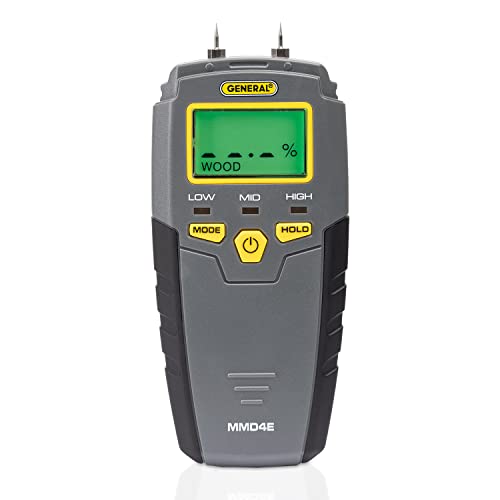 General Tools MMD4E | Best-selling pin meter for drywall/wood. | Amazon — $39.98 |
 Lignomat Mini-Ligno | Trusted by woodworkers; species-calibrated. | Amazon — $83.20 |