Does Lysol Kill Black Mold? What the Label and EPA Say
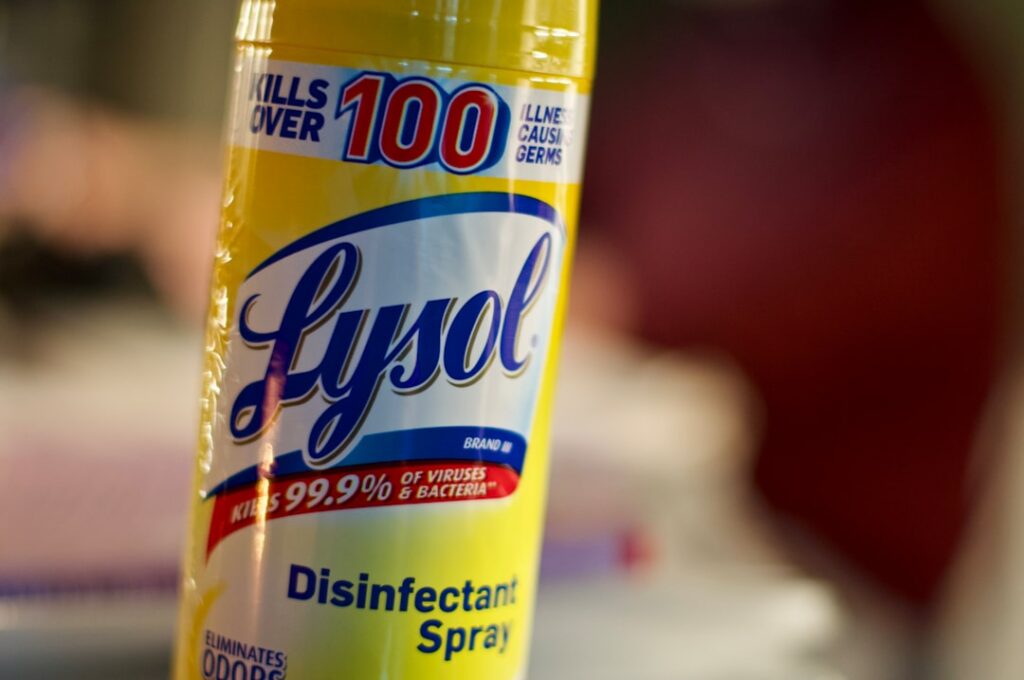
Does Lysol kill black mold? The honest answer has two parts. Some Lysol products list mold or mildew on their labels, and an EPA-registered product used exactly as its label directs can be expected to act on the organisms that label names. But killing mold is not the same as getting rid of it. The EPA states plainly that dead mold is still allergenic and must be removed, and it does not recommend biocides as a routine part of mold cleanup. For most small patches on hard surfaces, scrubbing with detergent and water, drying the area, and fixing the moisture source does more good than any spray. This guide explains what Lysol can and cannot do, how it compares with bleach, vinegar, and plain detergent, how hard and porous surfaces differ, when a patch is too big to handle yourself, and which chemical combinations to avoid.
Part of our Black Mold & Your Health guide — start there for the full picture →
Is this mold, asbestos, or water damage? Get a free instant screen
Upload a clear photo of the suspect area. You'll get an instant AI screening opinion and what to do next. This is screening guidance, not a professional determination.
Screening guidance only. AI can be wrong. Confirm asbestos, mold type, or lead with lab testing or a licensed professional before acting.
Does Lysol Kill Black Mold? Reading the Label First
Lysol is a brand, not a single formula. The name covers disinfectant sprays, wipes, multi-surface cleaners, bathroom cleaners, toilet bowl cleaners, and laundry sanitizers, each with different active ingredients and different label claims. Many of these products are registered with the EPA as disinfectants, which means the manufacturer has submitted data supporting specific claims against specific organisms, mostly bacteria and viruses. The registration number on the label ties the product to those approved claims.
Some Lysol products also list mold or mildew on the label, sometimes as a claim to kill or inhibit mold and mildew growth on certain hard, nonporous surfaces. Other Lysol products do not mention mold at all. Formulas, claims, and directions also change over time. The only reliable way to know what a particular bottle or can is approved to do is to read its label, including:
- The organisms listed. Look for mold or mildew specifically. A product that kills household germs is not automatically labeled for mold.
- The surfaces listed. Mold and mildew claims, where they exist, typically apply to hard, nonporous surfaces. Drywall, wood, grout, fabric, and carpet are a different story.
- The contact time. Disinfectant claims generally depend on the surface staying visibly wet for a set number of minutes. A quick mist that dries in seconds may not meet the label’s conditions.
- Pre-cleaning directions. Many disinfectant labels call for removing heavy soil before the disinfecting step. Visible mold growth counts as heavy soil.
- Ventilation and safety warnings. Read these before using any product in a small bathroom or closet.
“Black mold” is a household term, not a lab result. Many species can look dark green or black, and color does not tell you which mold you have or how risky it is. The cleanup approach is the same regardless of species: remove the growth and fix the moisture. Our black mold hub explains what the term usually refers to and why identification by color is unreliable.
Why Killing Mold Is Not the Same as Removing It
The EPA’s mold course addresses this directly in its lesson on biocides. It defines biocides as substances that can destroy living organisms and states that using a biocide or a chemical that kills organisms such as mold (chlorine bleach is its example) is not recommended as a routine practice during mold cleanup. It notes there may be cases where professional judgment indicates their use, such as when immune-compromised people are present. It also explains that in most cases it is not possible or desirable to sterilize an area, because a background level of mold spores will remain, and those spores will not grow if the moisture problem has been resolved.
Then comes the key line for anyone reaching for a spray can: the EPA says dead mold is allergenic and may cause allergic reactions and other health effects in some people, so it is not enough to simply kill the mold. It must also be removed.
That has practical consequences:
- Spraying and walking away leaves the problem. Even if a product kills surface growth, the dead mold, spores, and fragments remain on the surface and can be disturbed into the air later.
- Discoloration often stays. Mold can stain grout, caulk, and paint. A disinfectant may kill growth without removing the stain, which can make people think it did not work and spray more.
- The moisture is still there. Mold returns if the leak, condensation, or humidity that fed it is not fixed. No surface product changes that.
The CDC’s mold guidance makes the same point in simpler terms: if mold is growing in your home, you need to clean up the mold and fix the moisture problem. The CDC also notes that for some people mold can cause a stuffy nose, sore throat, coughing or wheezing, burning eyes, or skin rash, and that people with asthma or mold allergies may have severe reactions. Those reactions do not depend on whether the mold is alive, which is why removal matters.
Hard Surfaces vs Porous Materials
Where the mold is growing matters more than which product you pick.
Hard, nonporous surfaces
Glazed tile, glass, sealed countertops, metal, fiberglass tubs, and plastic are the surfaces where cleaning works best. The EPA’s guidance for homeowners says to scrub mold off hard surfaces with detergent and water and dry completely. If you choose to use a Lysol product that is labeled for mold or mildew on hard surfaces, use it after the growth has been scrubbed off, follow the label’s contact time, and then wipe and dry the surface. The cleaning step is the part that removes the mold; the disinfecting step is optional. For shower-specific tips, see our guide on black mold in the shower.
Semi-porous surfaces
Grout, unsealed stone, and painted drywall sit in between. Surface growth can sometimes be scrubbed off, but mold can work into pores, cracks, and the paper face of drywall. Repeat growth in the same grout lines after cleaning often signals a moisture or ventilation problem, or failed caulk and grout that need replacing.
Porous and absorbent materials
The EPA notes that absorbent or porous materials, such as ceiling tiles and carpet, may have to be thrown away if they become moldy, because mold can grow on or fill in the empty spaces and crevices of porous materials and may be difficult or impossible to remove completely. That logic extends to moldy drywall, insulation, upholstered furniture, and mattresses. Spraying Lysol on moldy drywall does not reach growth inside the paper or behind the wall. Our guide to black mold on drywall covers when a section should be cut out and replaced.
Wood is a special case. Solid lumber is porous, but surface growth on framing can often be cleaned, dried, and assessed, and structural members are not discarded casually. If the wood is soft or crumbling, that is rot, not just mold.
Lysol vs Bleach vs Vinegar vs Detergent and Water
The table below compares four common choices for household mold. It describes general behavior, not specific product claims; always check the label of the product you have.
| Option | Hard, nonporous surfaces | Porous materials (drywall, carpet, ceiling tile) | Residual allergen after use | Key cautions |
|---|---|---|---|---|
| Lysol product labeled for mold or mildew | May kill surface growth if used per label, including contact time; still requires wiping away debris | Not a fix; cannot reach growth inside material | Dead mold remains unless physically removed | Product-specific; read label; ventilate; never mix with bleach, ammonia, or other cleaners |
| Chlorine bleach solution | Can kill surface growth and lighten stains; still requires scrubbing and rinsing | Not a fix; does not remove growth from inside materials | Dead mold remains unless removed | EPA does not recommend biocides routinely; never mix with ammonia or other cleaners; strong fumes; damages fabrics and some finishes |
| White vinegar | Mild acid; often used for light mildew; scrubbing does most of the work | Not a fix | Dead mold and residue remain unless removed | Not an EPA-registered disinfectant; can etch natural stone; do not mix with bleach |
| Detergent and water (EPA’s recommended starting point) | Physically removes growth when scrubbed, then dry completely | Cleaning surfaces only; moldy porous items may need to be discarded | Lowest, because growth is removed rather than left in place | Wear gloves and eye protection; dry the area quickly |
For more detail on each alternative, see our guides on whether bleach kills black mold, whether vinegar kills black mold, and hydrogen peroxide for black mold. Our roundup of the best way to deal with black mold puts them side by side.
Never Mix Lysol With Bleach or Ammonia
The EPA’s mold course warns never to mix chlorine bleach with other cleaning solutions or with detergents that contain ammonia, because toxic fumes could be produced. It also advises that if disinfectants or biocides are used, the area should be ventilated and the air exhausted to the outdoors.
In practice, that means:
- Do not spray Lysol onto a surface that is still wet with bleach, or the other way around. Rinse and dry between products, or better, pick one.
- Do not combine cleaners in a bucket or spray bottle to make a “stronger” solution.
- Be careful with toilet bowl and tub cleaners, which can contain acids or other ingredients that react with bleach.
- Open a window and run the exhaust fan. Small bathrooms trap fumes quickly.
- Keep children and pets out of the room until the area is dry and aired out.
Mixing products is one of the most common ways a simple cleanup becomes a health problem. One product, used as labeled, is the safer choice.
The 10 Square Foot Rule: When to Stop and Call for Help
The EPA’s mold cleanup guidance says that if the moldy area is less than about 10 square feet, roughly a 3 foot by 3 foot patch, in most cases you can handle the job yourself. If there has been a lot of water damage, or mold covers more than 10 square feet, the EPA points to its guidance for larger remediation projects, which calls for a more structured approach. If you hire a contractor, the EPA recommends making sure the contractor has experience cleaning up mold.
Other situations where a spray-and-scrub approach is not enough:
- Mold inside walls or ceilings, suggested by persistent musty odors, staining that keeps coming back, or bubbling paint.
- Mold in HVAC systems or ducts. Running the system can spread spores through the house.
- Contaminated water, such as sewage or floodwater, which brings bacterial hazards as well as mold.
- Health concerns. If anyone in the home has asthma, mold allergies, a weakened immune system, or chronic lung disease, talk to a health care provider and consider professional cleanup.
- Hidden moisture. If you cannot find the water source, a moisture meter or an inspection is the next step, not another round of spray.
Our mold inspection section explains what a mold inspection includes and when testing actually helps.
How to Clean a Small Mold Patch Safely
For a small patch on a hard surface, a simple sequence covers most situations:
- Find and stop the moisture. A dripping supply line, a leaking shower door, condensation on a cold wall, or poor bathroom ventilation. The EPA notes that drying water-damaged areas within 24 to 48 hours helps prevent mold growth.
- Protect yourself. The EPA recommends long gloves that reach mid-forearm and goggles without ventilation holes, and advises against touching mold with bare hands. When using a disinfectant or biocide, it recommends gloves made of natural rubber, neoprene, nitrile, polyurethane, or PVC. An N-95 respirator is a reasonable addition for anything more than a very small area.
- Ventilate. Open a window and run an exhaust fan that vents outdoors.
- Scrub with detergent and water. Use a brush or scrub pad to physically remove the growth.
- Optionally, disinfect. If you choose to use a Lysol product labeled for mold or mildew on that surface, apply it after scrubbing, follow the label’s contact time, and do not combine it with any other product.
- Wipe and dry completely. Use disposable cloths or wash reusable ones in hot water separately.
- Bag waste. Seal moldy cloths, sponges, and small porous items in plastic bags before carrying them through the house.
- Watch the area. If growth returns within weeks, the moisture source has not been fixed.
The EPA also advises against painting or caulking over moldy surfaces. Paint and caulk applied over mold tend to peel, and the growth continues underneath. Primers marketed for stain blocking are a finishing step after cleanup and drying, not a substitute; see our guide on whether Kilz kills black mold.
What “EPA-Registered” Does and Does Not Tell You
An EPA registration number on a disinfectant label is meaningful, but it is narrower than many shoppers assume. Registration covers the specific claims on that specific label: the organisms named, the surfaces named, the dilution, and the contact time. It does not mean the EPA endorses the product for mold remediation in general, and it does not override the EPA’s own mold guidance, which treats biocides as an occasional tool rather than a routine step.
A few practical points follow from that:
- Claims do not transfer between products. A Lysol spray labeled for mildew on bathroom surfaces does not mean a Lysol wipe or laundry product carries the same claim. Check each label.
- “Kills 99.9% of germs” is not a mold claim. Broad germ claims usually refer to bacteria and viruses listed elsewhere on the label.
- “Mildew” on a label usually means surface growth. It does not describe growth inside walls, under flooring, or deep in grout and caulk.
- Off-label use is not recommended. Using a disinfectant on surfaces, at dilutions, or in ways the label does not list removes the basis for any performance expectation and can add safety risks.
Put simply, the label tells you what a product may do under defined conditions. The EPA’s mold guidance tells you what a mold cleanup actually needs: removal, drying, and moisture control.
Lysol on Common Household Surfaces
Here is how the general guidance plays out in the places homeowners most often find dark mold.
- Shower tile and tub surrounds. Scrub glazed tile and fiberglass with detergent and water. A Lysol bathroom product labeled for mold or mildew can be used afterward if you want, following its contact time. Black spots that remain in grout or silicone caulk after scrubbing often mean the material itself is stained or colonized; replacing failed caulk is usually more effective than repeated spraying.
- Window sills and frames. Condensation feeds growth here in winter. Clean vinyl and aluminum like any hard surface. Painted wood sills need cleaning, drying, and checking for soft spots; our guide to black mold on wood covers that in detail.
- Painted walls and ceilings. Light surface spotting on sound, glossy paint can often be cleaned. If the drywall behind it is soft, stained through, or repeatedly wet, cleaning the paint does not address the problem.
- Fabrics, upholstery, and mattresses. Disinfectant sprays are not designed to remove mold from these items. Washable fabrics can be laundered; heavily moldy upholstered items are often not salvageable.
- Under sinks and behind appliances. Fix the leak first, then clean hard surfaces and replace swollen particleboard or wet drywall.
For a broader overview of approaches, our main guide to killing black mold compares cleaning and remediation options across these surfaces.
Preventing Mold From Coming Back
Because mold growth depends on moisture, prevention is mostly about water and humidity. The CDC recommends keeping indoor humidity as low as possible, no higher than 50 percent, using exhaust fans in kitchens and bathrooms that vent outside, making sure clothes dryers vent outside, and fixing leaks in roofs, walls, and plumbing. The EPA advises keeping humidity below 60 percent, ideally between 30 and 50 percent, and acting quickly when condensation appears on windows, walls, or pipes.
Along the Colorado Front Range, indoor air is often dry for much of the year, so recurring mold usually points to a specific moisture source rather than general humidity. Common culprits include bathrooms without working exhaust fans, slow leaks under sinks, condensation on cold exterior walls behind furniture, swamp cooler overflows, and basements or crawlspaces with drainage problems after spring storms. Finding and fixing that source is what keeps a cleaned surface clean.
References
- Mold Cleanup in Your Home — U.S. Environmental Protection Agency
- Mold Course Chapter 1: Introduction to Molds (Lesson 7: Biocides) — U.S. Environmental Protection Agency
- A Brief Guide to Mold, Moisture and Your Home — U.S. Environmental Protection Agency
- About Mold — Centers for Disease Control and Prevention
Frequently asked questions
Does Lysol kill black mold?
Some Lysol products list mold or mildew on the label for certain hard, nonporous surfaces, and they should be used exactly as the label directs. Killing mold is not enough, though: the EPA says dead mold is still allergenic and must be removed, so scrubbing and fixing the moisture source come first.
Can Lysol be used on moldy drywall or carpet?
It is not a fix for porous materials. Mold can grow into drywall paper, carpet, and ceiling tiles where a spray cannot reach it, and the EPA notes such materials may need to be thrown away if they become moldy.
Is it safe to use Lysol and bleach together on mold?
No. The EPA warns never to mix chlorine bleach with other cleaning solutions or with ammonia-containing detergents because toxic fumes can form. Choose one product, ventilate, and rinse and dry the surface before switching to anything else.
What does the EPA recommend for cleaning mold?
For hard surfaces, the EPA recommends scrubbing mold off with detergent and water and drying completely. It does not recommend biocides such as bleach as a routine practice, and it suggests that areas larger than about 10 square feet may need professional help.
Why does mold keep coming back after I spray it?
Usually because the moisture source has not been fixed or the mold has grown into a porous material. Find the leak, condensation, or ventilation problem, remove the growth physically, and replace materials that cannot be cleaned.
Mold keeps coming back no matter what you spray on it? Get in touch with us and we can help you track down the moisture source and decide whether the area needs a professional inspection.
Mold removal & cleanup picks
For a small, contained patch (under ~10 sq ft) these EPA-friendly removers handle surface mold. Larger or recurring growth warrants a professional assessment first.
| Product | Why | Buy |
|---|---|---|
 RMR-86 Instant Mold Stain Remover RMR-86 Instant Mold Stain Remover | Fast-acting on stains; ventilate and wear PPE. | Amazon — $29.99 |
 Concrobium Mold Control Concrobium Mold Control | No-bleach formula that also helps prevent regrowth. | Amazon — $11.26 |
 Mold Armor Mold & Mildew Remover Mold Armor Mold & Mildew Remover | Widely stocked bathroom/surface remover. | Amazon — $22.98 |