Does Black Mold Spread: How and How Fast for Homeowners
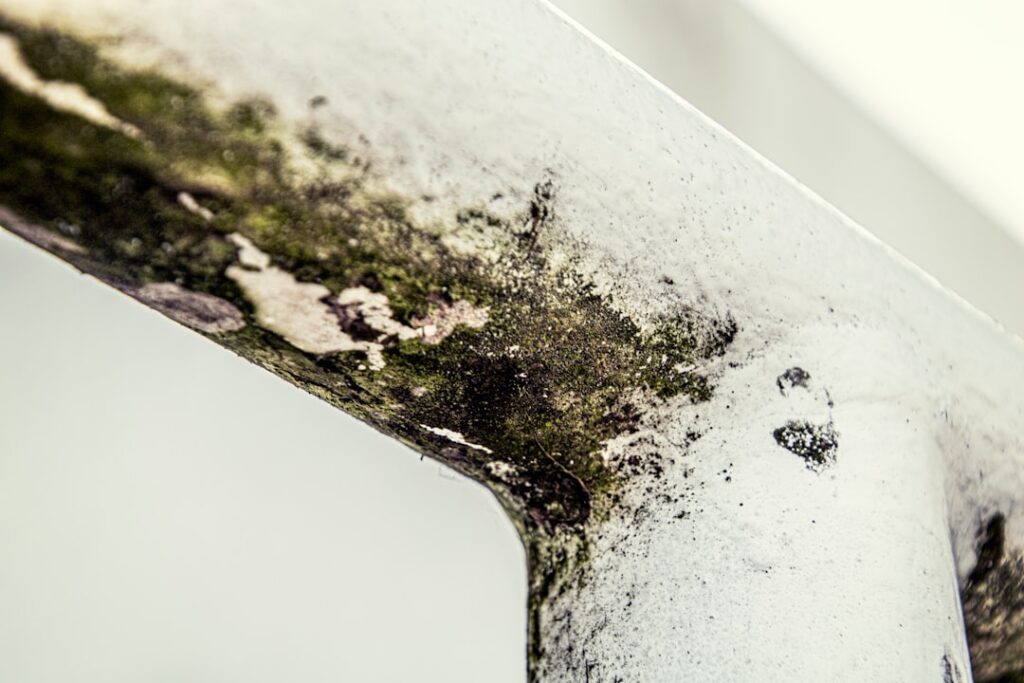
Once a homeowner finds visible mold, the next question is usually whether and how fast it will keep growing. This guide covers how indoor mold actually spreads — through colony expansion and through airborne spore dispersal — drawing on EPA, CDC, and NIEHS guidance. It is not medical advice. Anyone with symptoms that may relate to indoor mold should consult a physician — biology and remediation are home-side topics, but clinical assessment requires clinical training.
Part of our Black Mold & Your Health guide — start there for the full picture →
Is this mold, asbestos, or water damage? Get a free instant screen
Upload a clear photo of the suspect area. You'll get an instant AI screening opinion and what to do next. This is screening guidance, not a professional determination.
Screening guidance only. AI can be wrong. Confirm asbestos, mold type, or lead with lab testing or a licensed professional before acting.
Does Black Mold Spread? Two Different Mechanisms
Indoor mold spreads through two distinct mechanisms. Local colony expansion is the visible growth of existing colonies across a substrate — typically a few centimeters per week under good conditions for the fungus. Airborne dispersal is the production of new spores that travel through the air and can establish new colonies elsewhere in the home wherever they land on moist substrate. Both mechanisms matter for homeowner response, and they require different intervention strategies.
Speed of spread varies by species, substrate moisture, temperature, and air-circulation patterns in the home. Stachybotrys chartarum typically expands slowly on water-damaged drywall — visible growth often takes one to two weeks of sustained wetting to become noticeable. Aspergillus, Cladosporium, and Penicillium can establish faster on similar substrates. Our parent mold inspection hub covers the full response framework.
Mechanism 1: Local Colony Expansion
A visible mold colony expands radially across the substrate as fungal hyphae grow outward into adjacent material. Expansion speed depends on substrate moisture, temperature, and species. On wet drywall paper at typical indoor temperatures, expansion of a few millimeters per day is common. Over weeks, a small initial colony can grow to several square feet if moisture conditions persist.
Substrate matters. On wet cellulose (drywall paper, ceiling tile, wood, paper goods), expansion is typically rapid and aggressive. On non-porous surfaces with organic films (tile, grout, painted surfaces), expansion is usually slower because the organic food source is thinner. On contained materials like carpet or insulation, expansion through the material can outpace what is visible from the surface.
Mechanism 2: Airborne Spore Dispersal
Mold reproduction occurs through spore production. Mature colonies produce fruiting structures (sporangia, conidiophores, or equivalent) that release new spores into the air. Spore release is typically continuous during active growth, with bursts during disturbance (air movement, physical contact, vibration). Released spores travel through air currents in the home — HVAC paths, stack-effect flows, occupant movement — until they land somewhere.
Where spores land matters. On dry surfaces with no organic film, spores remain dormant indefinitely. On moist substrates, spores can germinate and establish new colonies within 24–48 hours. This is how a single mold source in one part of the home can produce satellite colonies elsewhere wherever moisture conditions are similarly favorable.
Speed of Spread by Scenario
Several typical scenarios illustrate spread speed. A small bathroom-ceiling colony, with humidity peaks during showers but drying between uses, often stays small over months — expansion is limited by moisture intermittency. A wet drywall colony from an unresolved leak typically expands several inches in the first month and can cover a wall section within three to six months. A finished-basement colony with sustained high humidity and limited air movement can spread broadly within weeks once established.
The variable that most affects speed is moisture continuity. Intermittent moisture (condensation during cold-weather mornings, bathroom humidity during showers) produces slow or stalled growth. Continuous moisture (active leak, sustained high RH, ongoing condensation) produces aggressive expansion. The early stages of black mold timeline guide covers the progression more deeply.
How HVAC Systems Amplify Spread
Forced-air HVAC systems are efficient spore distribution networks. Returns located near mold sources pull spore-laden air through the air handler and distribute it throughout the home via the supply ducts. If the air handler itself has moisture issues (coil contamination, drip pan growth, internal duct mold), the system becomes both a distribution and a production source.
The practical implication for homeowners with confirmed mold growth: consider whether the HVAC system has been pulling air from the affected area, and consider running the system minimally during active growth periods until remediation is complete. Air handler service and coil cleaning ($150–$400 typical) is worthwhile after extensive remediation to avoid re-distributing settled spores from the system.
Containment During Remediation
The disturbance of removing visible mold during cleanup releases large quantities of spores into the air. EPA cleanup guidance and IICRC remediation standards address this through containment practices. For DIY work under ten square feet on non-porous surfaces, basic containment usually means closing the room and turning off HVAC during work, wearing N95 respirator and protective equipment, and cleaning surfaces and bagging waste promptly.
For larger remediation work, professional containment includes physical barriers (plastic sheeting), negative-air machines that filter exhausted air through HEPA media, full-body protective equipment, and HVAC isolation. The goal is preventing the disturbed spores from establishing new colonies elsewhere in the home or producing acute exposure for occupants.
Spread to Adjacent Rooms
Mold rarely spreads between rooms through wall contact alone. The more common pattern is airborne dispersal — spores released in one room travel through air currents and establish in another room wherever moisture conditions support germination. Open doorways, HVAC paths, and stack-effect flows are the main vectors.
This is why homeowners sometimes find scattered small colonies appearing in rooms distant from a main source. The treatment is not just cleaning the satellite colonies but locating and resolving the source colony and the moisture conditions that allowed satellite establishment. Our mold signs walkthrough guide covers the indicators of distributed growth.
Spread Through Concealed Pathways
Some of the most extensive mold spread happens out of sight. Wall cavities can carry growth between rooms wherever shared cavities allow. Crawl spaces and attics can host extensive growth that distributes spores throughout the home via the air-leakage paths from these spaces into living areas. HVAC ductwork can host internal growth that becomes a continuous source.
Concealed spread is typically discovered through musty odors, persistent symptoms in occupants, or recurrent visible growth in areas that have been repeatedly cleaned. The diagnostic workup involves moisture mapping, sometimes thermal imaging, and occasionally invasive inspection through small drilled holes with borescope. Professional inspectors run these workflows.
How Long Does Mold Survive on Surfaces?
Active mold growth requires moisture, but spores remain viable on dry surfaces for extended periods — months to years depending on species and conditions. This is why simply drying out a previously contaminated area does not eliminate the spore reservoir. The spores survive dormant on surfaces, in dust, in HVAC components, and inside porous materials, waiting for moisture conditions to allow germination.
This is also why cleanup matters in addition to moisture-source correction. Even if the leak is fixed and the area is now dry, residual spore loads in dust and on surfaces can support new colonies if humidity again rises into the growth range. The response action guide covers the cleanup sequence.
Stopping Spread: The Two-Part Intervention
Effective spread-prevention requires both moisture-source correction and physical cleanup. Source correction stops new growth and reduces ongoing spore production from active colonies. Physical cleanup removes existing colonies and reduces the spore reservoir. Together, they break the spread cycle. Either alone usually fails — cleanup without source correction produces rapid regrowth; source correction without cleanup leaves the existing colony to continue producing spores until it eventually dies back.
Air Sampling and Spread Assessment
EPA does not generally recommend routine air-quality testing for assessing mold spread, particularly when visible growth is present. Air-sample numbers vary by season, weather, time of day, and recent activity, and isolated readings without context rarely change appropriate action. The visible growth and moisture mapping typically provide better diagnostic information than air sampling alone.
Testing earns its keep in specific scenarios: when concealed growth is suspected but not located, when documentation is needed for a real-estate transaction, or when a physician requests environmental data tied to a clinical workup. Paired indoor and outdoor reference samples are usually required for the data to be interpretable.
When Spread Becomes a Professional Job
Several patterns indicate that DIY containment will be inadequate. Visible growth larger than roughly ten square feet at any single location. Growth at multiple separated locations suggesting whole-home spread. Confirmed or suspected mold inside wall cavities, HVAC systems, or other concealed locations. Recurrent growth after multiple cleaning attempts. Households with vulnerable members (immunocompromised, asthmatic, young children) where containment quality matters more.
Professional remediation contractors with appropriate certifications (IICRC AMRT or equivalent) bring the containment equipment, negative-air machines, and procedural discipline needed for these scenarios. Cost ranges $1,500–$10,000 for typical residential remediation, with major water-damage cases higher.
Front Range Spread Patterns
Colorado’s dry climate limits the speed and extent of typical mold spread compared with humid coastal markets. Most Front Range cases involve localized growth near specific water events — slab leaks, ice dams, plumbing failures, hailstorm-driven roof damage — rather than whole-home humidity-driven spread. When spread does occur in Front Range homes, it usually involves HVAC distribution of spores from a localized source rather than independent establishment of multiple distant colonies.
Post-Remediation Verification of No Continuing Spread
After major remediation, verification that the spread cycle has been broken matters for both peace of mind and durability of the result. Visual verification confirms no remaining visible growth. Moisture-meter verification confirms substrate dryness across the affected area. Olfactory verification confirms no residual musty odor. For larger jobs done under contract, post-remediation air sampling with paired indoor and outdoor reference is sometimes commissioned to document spore counts within normal ranges.
The IICRC S520 standard, used by professional remediation contractors, frames successful remediation as absence of visible growth, no residual moisture, and air spore counts consistent with normal outdoor reference. Homeowners commissioning professional work should ask the contractor what verification approach they use and what documentation they provide at completion. This documentation matters for insurance claim closure, for real-estate disclosure if the home will be sold, and for medical context if any occupant has symptoms that need clinical evaluation.
References
- Mold Cleanup in Your Home — U.S. Environmental Protection Agency
- Basic Facts About Mold and Dampness — Centers for Disease Control and Prevention
- Mold Health Topic — National Institute of Environmental Health Sciences
- A Brief Guide to Mold, Moisture and Your Home — U.S. Environmental Protection Agency
Frequently asked questions
How fast does black mold spread on drywall?
On sustained-wet drywall paper, visible growth typically expands a few millimeters per day, reaching several inches in a month and potentially covering a wall section over three to six months if moisture continues. Drying the substrate stops local expansion.
Can mold spread through walls?
Direct hyphal growth through wall framing is limited and slow. The more common pattern is airborne spore dispersal through wall cavities or HVAC paths, with new colonies establishing wherever spores land on moist substrate.
Will mold spread if I just leave it alone?
Likely yes, slowly, as long as moisture conditions persist. Even after the initial moisture event ends, mold can continue producing spores from the existing colony until it dries completely and dies back, which can take weeks or months depending on conditions.
Should I seal off a room with mold?
For DIY cleanup, closing doors and turning off HVAC during work helps contain disturbed spores. For larger remediation, professional containment with plastic barriers and negative-air machines is the standard approach to prevent spread during cleanup.
Front Range homeowners concerned about mold spreading beyond a visible source can reach a vetted inspector through our contact page for a moisture mapping and containment assessment.