Black Mold Airborne: What Homeowners Need to Know
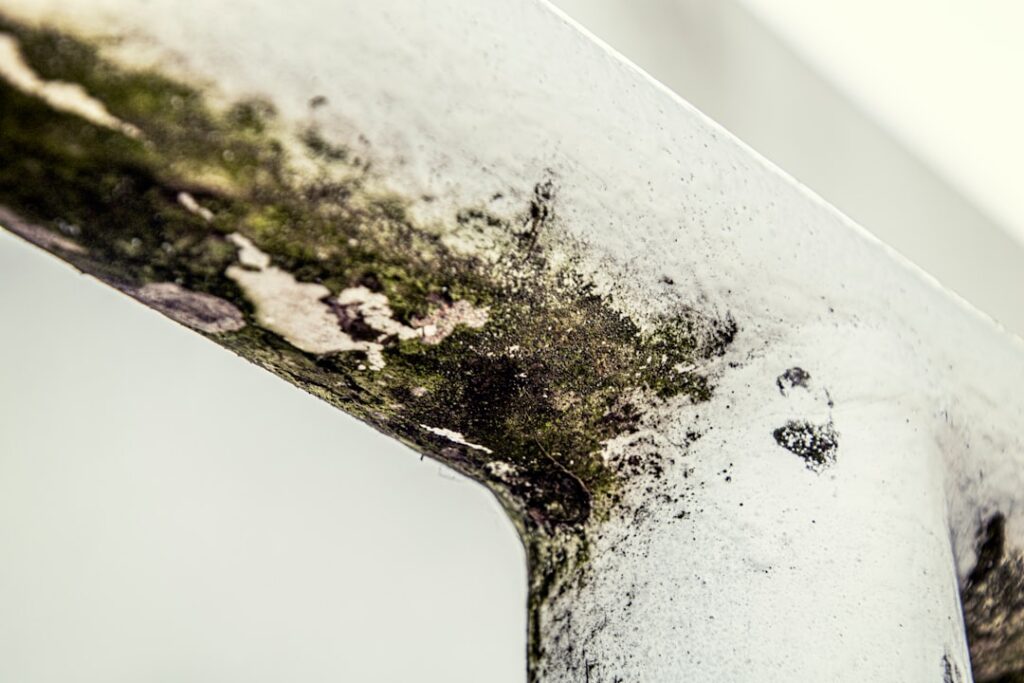
Searches for “black mold airborne” tend to come from homeowners trying to understand whether mold growth they have seen — or suspect — is putting spores into the air the household breathes. The short answer is yes, mold colonies release spores into indoor air as part of their reproduction, and the more relevant questions are how many spores, where they go, and when measuring them is actually useful. This guide summarizes EPA, CDC, and NIEHS guidance on residential mold for homeowners. It is not medical advice. If you are experiencing symptoms you believe may be related to mold exposure, consult a physician. The home-side answer below covers airborne spores, when air sampling matters, and how to interpret the results.
Is this mold, asbestos, or water damage? Get a free instant screen
Upload a clear photo of the suspect area. You'll get an instant AI screening opinion and what to do next. This is screening guidance, not a professional determination.
Screening guidance only. AI can be wrong. Confirm asbestos, mold type, or lead with lab testing or a licensed professional before acting.
How Mold Becomes Airborne
Mold reproduces by releasing spores — microscopic reproductive bodies that drift on air currents, settle on surfaces, and germinate when they encounter sufficient moisture and a suitable substrate. Outdoor air always contains spores; the typical residential background is in the hundreds to thousands of spores per cubic meter, varying by season, weather, and local vegetation. Indoor air also normally contains spores, with concentrations generally lower than outdoors and dominated by species that came in from outside through doors, windows, and HVAC intakes.
When mold colonies grow indoors — on damp drywall, in a leaking HVAC system, in a wet basement — they release spores directly into the indoor environment. Concentrations rise. Species ratios shift. The Centers for Disease Control and Prevention notes that elevated indoor spore concentrations can cause respiratory irritation, allergic symptoms, and asthma exacerbation in sensitized individuals. The Environmental Protection Agency adds that physical disturbance of mold growth — bumping a moldy wall, running an HVAC system that pulls air through contaminated ducts, or starting remediation without proper containment — briefly spikes airborne concentrations to much higher levels than passive release.
What “Black Mold” Actually Releases
The species most popularly called “black mold,” Stachybotrys chartarum, releases relatively heavy spores compared to lighter molds like Aspergillus and Penicillium. Stachybotrys spores often clump and settle relatively quickly rather than staying airborne for long periods. This makes Stachybotrys an under-detector in standard air sampling — air samples sometimes miss Stachybotrys contamination that is obvious on a visible wall, simply because the spores fall out of the air before reaching the sampling pump.
Other species — Aspergillus, Penicillium, Cladosporium — release lighter spores that stay airborne longer and spread further through the home. From a homeowner’s perspective, the practical takeaway is that absence of high airborne Stachybotrys counts on a single air sample does not mean Stachybotrys is not present. Visible inspection plus moisture detection plus, when appropriate, surface sampling typically gives a better picture than air sampling alone.
When Air Sampling Is Worth the Money
Air sampling makes sense in two scenarios, per EPA and American Industrial Hygiene Association guidance. First, when occupants report symptoms consistent with mold exposure but a thorough walk-through finds no visible mold. Hidden contamination behind walls, in HVAC ducts, in crawlspaces, or in attic insulation can drive elevated airborne spore counts without producing a visible signal. Air sampling — comparing multiple indoor locations against an outdoor reference — can detect this pattern.
Second, post-remediation clearance. After a remediation project, air sampling is the standard third-party verification that the work was successful. Indoor spore counts and species ratios after cleaning should fall within or below outdoor reference levels. A failed clearance test means more work is needed before reconstruction. For any remediation job over a few hundred square feet, clearance testing by an independent indoor environmental professional is good practice and is increasingly required by insurance carriers.
When Air Sampling Is Not Worth It
If mold is visible, skip the air sampling and go straight to remediation. The EPA is explicit on this. You already know there is a problem; the species rarely changes the remediation plan; and the money spent on testing is better spent on cleanup. Air sampling is also not very useful for “should we move into this house” decisions without parallel visible inspection — a clean air sample on a sunny day does not rule out hidden contamination, and a single elevated reading may reflect a transient outdoor influence rather than a real indoor problem.
How Air Samples Are Collected
The standard residential approach uses a high-flow air pump drawing a measured volume of air through a sample cassette — typically an Air-O-Cell or similar inertial impactor — that captures particles on an adhesive surface. The cassette ships to a laboratory where a microscopist counts spores by species under microscopy. A common minimum protocol is three indoor samples in different rooms plus one outdoor reference sample collected at the same time. Total cost typically runs $400 to $900 for a basic residential job, varying by region and lab.
The sampling is operator-sensitive. Time of day, recent activity in the home (vacuuming spikes airborne particles), HVAC operation, outdoor weather, and the location of the sample relative to potential sources all influence the result. A credentialed inspector — Council-Certified Indoor Environmental Consultant, certified industrial hygienist, or similar — should explain the sampling plan and the interpretation framework before drawing samples. Discount operators who run a single 5-minute sample with no outdoor reference produce numbers that cannot reliably be interpreted.
How to Read the Results
Air sample reports list spore counts per cubic meter by species. Interpretation focuses on two patterns. Total spore counts well above the outdoor reference suggest an indoor source. Species ratios that differ from outdoor air — for example, indoor air showing high Stachybotrys or Chaetomium counts that are essentially absent from the outdoor reference — strongly suggest indoor growth, since these species are typically associated with water-damaged building materials rather than outdoor sources.
There is no federal regulatory threshold for airborne mold concentrations. The CDC explicitly notes that individual sensitivity varies too widely for a single “safe vs unsafe” number to be meaningful. Interpretation rests on indoor-versus-outdoor comparison, species patterns, and clinical context — not on a single magic number. A credentialed assessor’s report should explain the comparison logic, not just print raw lab numbers.
Practical Steps If You Suspect Airborne Mold
If symptoms persist with no visible source: do a thorough walk-through with a moisture meter first, checking behind appliances, under sinks, around plumbing, on basement perimeters, and at HVAC equipment. Smell test every room for musty odors. Then, if the walk-through finds nothing and symptoms persist, consider hiring a credentialed inspector for air sampling. Our mold inspection hub covers vetting questions for inspectors.
If mold is visible: skip the air sampling, follow EPA remediation guidance, and use a moisture meter to verify the wall cavity is dry before reconstruction. Our moisture meter reader guide covers the wood-moisture-content thresholds that indicate the cavity is ready to seal up.
If symptoms warrant medical attention: see a physician in parallel with the home-side investigation. The medical workup and the home assessment are separate parallel tracks, not sequential steps.
Reducing Airborne Spores During Remediation
Disturbing mold growth — cutting drywall, pulling carpet, removing insulation — temporarily elevates airborne spore counts. EPA guidance recommends containment for any job over 10 square feet: plastic sheeting at openings, closed interior doors, negative-pressure HEPA-filtered air scrubbers, and at minimum N95 respirator, gloves, and eye protection for anyone in the work area. Vulnerable occupants — infants, immunocompromised adults, severe asthmatics — should ideally not be in the home while disturbed mold is being removed, because that disturbance phase is when airborne concentrations are highest.
Why DIY Air Tests Often Mislead
Big-box stores sell DIY mold air-sampling kits that typically use settling-plate methodology — leaving an exposed petri dish of growth medium in a room for an hour, then sealing it and mailing it to a lab. The science behind settling plates is weak for several reasons. The sampling volume is uncontrolled (depends on air movement, which varies). The growth medium favors species that grow well in vitro, biasing the results away from species that grow poorly on artificial media. The result is a list of cultivable species, not a quantified airborne concentration. Comparing two settling plates in different rooms tells you almost nothing useful. Homeowners who want air-quality data should hire a professional with calibrated equipment, not buy a DIY kit.
Air Sampling Limitations for Stachybotrys Specifically
One specific scenario where air sampling can underestimate a problem is Stachybotrys contamination. Stachybotrys spores are relatively heavy and clumpy compared to lighter species; they often settle out of the air quickly rather than staying airborne. An air sample taken in a calm room with a contained Stachybotrys colony may show normal or only mildly elevated counts. The same room sampled while the colony is being disturbed can show dramatically higher counts. This is why visible inspection plus moisture detection plus, when appropriate, surface sampling typically gives a better picture for Stachybotrys-specific contamination than air sampling alone.
What “Clean” Looks Like Post-Remediation
Post-remediation clearance testing typically targets indoor airborne spore counts at or below outdoor reference levels, with species ratios that do not show indoor enrichment of water-damage-associated species (Stachybotrys, Chaetomium, certain Aspergillus and Penicillium species). The interpretation framework treats outdoor air as the baseline that indoor air should approximate after successful remediation. A failed clearance test — counts well above outdoor reference or species ratios suggesting continued indoor source — indicates more work is needed before reconstruction. Some carriers and lenders now require independent third-party clearance before releasing the property for reconstruction.
Building Maintenance That Reduces Background Spore Counts
Several maintenance practices help keep indoor airborne mold counts low even in homes without active contamination. Quality HVAC filtration (MERV 11 or higher) captures airborne spores rather than recirculating them. Regular HVAC duct cleaning every several years removes accumulated dust that supports incidental mold growth. Bathroom and laundry vent fans run long enough after use to clear humid air (timer switches help). Indoor relative humidity kept in the 30–50% range with humidifier or dehumidifier as needed. Prompt response to any plumbing leak, roof leak, or water intrusion. These steps do not eliminate spores (background outdoor counts continue) but prevent the conditions that grow indoor sources. The how do you get black mold guide covers source mechanisms in detail.
References
- CDC: Basic Facts About Mold and Dampness — Centers for Disease Control and Prevention
- EPA: Mold Testing or Sampling — Environmental Protection Agency
- NIEHS: Mold — National Institute of Environmental Health Sciences
- American Lung Association: Mold and Dampness — American Lung Association
Front Range homeowners considering air sampling or remediation can connect with a vetted local inspector through our contact page to discuss whether sampling is worth the cost in their specific situation.