Mold Damage Remediation Service Near Me: Dual-Scope Guide
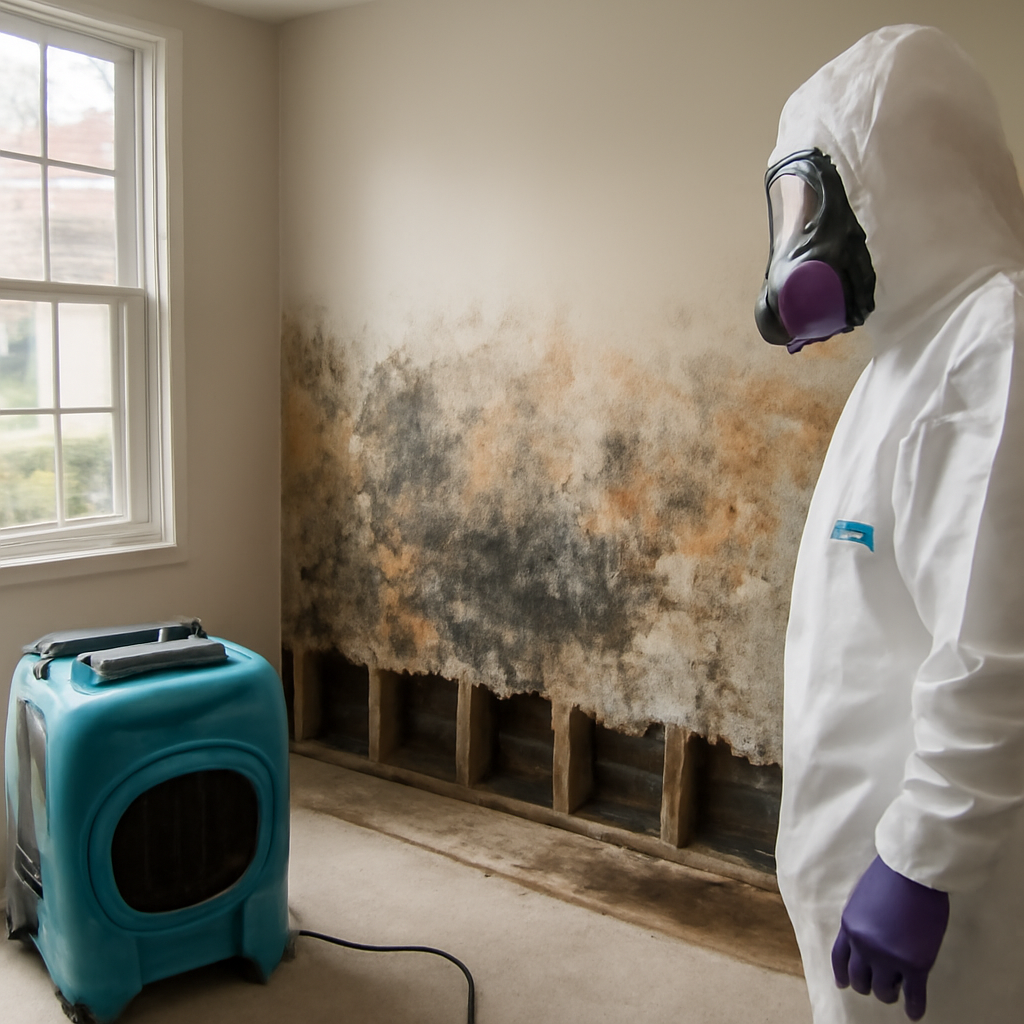
“Mold damage remediation service near me” usually signals a homeowner dealing with both water damage and resulting mold contamination. The two scopes are connected but distinct, and the firms that handle them well operate with dual-track capability: water-damage drying credentialed under IICRC S500 and mold remediation credentialed under IICRC S520. This guide covers the dual-scope vetting framework — how to evaluate firms that handle both, when to separate the scopes, and what insurance considerations apply. The framework draws on EPA, CDC, and HUD guidance current as of 2026.
Part of our Mold Removal & Remediation guide — start there for the full picture →
Is this mold, asbestos, or water damage? Get a free instant screen
Upload a clear photo of the suspect area. You'll get an instant AI screening opinion and what to do next. This is screening guidance, not a professional determination.
Screening guidance only. AI can be wrong. Confirm asbestos, mold type, or lead with lab testing or a licensed professional before acting.
Why Water and Mold Scopes Overlap
Most residential mold problems originate in a water event — a burst pipe, ice damming, basement seepage, a sewage backup. Drying within 24-48 hours often prevents mold growth entirely; drying that extends past 72 hours allows colonization in porous materials. The water event and the mold remediation are sequential phases of one underlying problem, which is why firms market the combined scope.
The two scopes carry different credentials and different equipment. Water-damage drying requires industrial dehumidifiers, air movers, moisture meters, and IICRC Water Damage Restoration Technician (WRT) credentialed labor. Mold remediation requires containment, HEPA filtration, microbial-specific PPE, and AMRT-credentialed labor. The best dual-scope firms maintain both credential tracks.
IICRC S500 vs S520
IICRC S500 is the consensus standard for water-damage restoration. It classifies water by source category (clean, gray, black) and damage by class (1 through 4) based on absorption and evaporation rates. IICRC S520 is the parallel standard for mold remediation, with its own condition levels and containment criteria. A dual-scope service should reference both standards in its scope-of-work documentation.
Firms that handle water damage only and refer mold work, or vice versa, sometimes coordinate poorly across the handoff. Single-firm dual-scope work simplifies handoff but introduces the structural inspection-remediation conflict on the mold side. Each arrangement has trade-offs.
The 24-48-72 Hour Decision Tree
Time matters acutely on water events. Within the first 24 hours, aggressive drying and source correction often prevent mold growth. Between 24-48 hours, drying is still effective but porous materials begin colonization risk. Beyond 72 hours, mold growth is typically established and remediation becomes mandatory. A service that recognizes this timeline scopes accordingly.
The cluster on emergency mold response covers the response-window decision framework in detail. The key practical implication: a firm that arrives quickly with drying equipment may eliminate the need for full mold remediation, which changes both project cost and scope significantly.
Dual-Scope Credential Verification
For combined services, verify both credential tracks. WRT for water-damage technicians and AMRT for mold technicians. Both at the issuing IICRC registry. Confirm that the supervisors on site hold senior credentials — IICRC Master Water Restorer or ACAC CMR — appropriate to the scope. Photocopied certificates from the office are not verification.
Ask which credentialed individuals will be on site during which phases of work. Dual-scope firms sometimes deploy water-damage crews for the drying phase and mold crews for the remediation phase. The handoff matters; confirm it is documented in writing.
Insurance Coverage for Dual-Scope Events
Homeowners insurance typically covers sudden water-damage events (burst pipes, appliance failures, weather-driven leaks) but caps mold coverage tightly. A typical policy might cover unlimited water-damage mitigation but only $5,000-$10,000 of resulting mold remediation. This creates pricing pressure on firms billing insurance to allocate work toward the water-damage side.
Verify your specific policy limits and exclusions before signing. Mold from chronic seepage, condensation, or pre-existing humidity is typically excluded entirely. The carrier’s coverage decision shapes which firm is the right fit and how scope decisions get made.
The Insurance-Driven Scope Risk
When the same firm bills the insurance carrier and writes the scope, the firm has structural incentive to maximize billable work within coverage limits. Insurance-billed dual-scope projects sometimes show scope inflation on the water-damage side (where coverage is unlimited) and minimization on the mold side (where coverage is capped). The homeowner often does not notice because the deductible has already been met.
Apply scope discipline regardless of insurance involvement. Ask the firm to justify each line item against IICRC S500 or S520 criteria. Independent inspection before signing helps catch inflated water-damage scope; independent clearance after work catches under-scoped mold remediation.
Equipment and Response Capacity
Dual-scope services need to mobilize drying equipment quickly. A firm with truck-mounted dehumidification capacity that arrives within four hours produces materially better outcomes than a firm that schedules equipment for the next business day. Ask about typical response times for the homeowner’s zip code, and whether equipment is staged regionally or shipped from a central depot.
Equipment quality matters separately. Industrial dehumidifiers vary in capacity by an order of magnitude. Confirm the firm uses LGR (low-grain refrigerant) or desiccant dehumidifiers appropriate for the climate and project size, not consumer-grade units.
Documentation Across Both Scopes
Dual-scope projects produce more documentation than single-scope work. The water-damage phase generates moisture-meter readings (initial and ongoing), category classification, drying logs, and equipment-run records. The mold phase generates scope, containment plans, demolition photographs, disposal manifests, and clearance results. The complete dual-scope documentation set runs 30-80 pages.
The documentation is the deliverable that survives the project. Insurance claims, future home sales, and any litigation depend on it. Firms that deliver complete documentation justify their premium pricing; firms that deliver invoices alone produce risk that surfaces years later.
Pricing for Dual-Scope Work
Front Range dual-scope projects in 2026 price as follows. Water-damage mitigation runs $1,000-$5,000 for contained events, $5,000-$15,000 for multi-room or category-2 water (gray water), $15,000+ for category-3 water (sewage) or large-area events. Mold remediation following water damage runs $1,500-$12,000 depending on extent. Reconstruction is typically a separate scope.
Total project cost on a typical insurance-driven dual-scope event commonly ranges $5,000-$25,000 across all phases including reconstruction. The variance reflects scope, materials, and how the firm separates or bundles invoicing.
When to Use Separate Firms
Two scenarios favor separate firms. First, when the water-damage event is well-contained and dried quickly, hire only a water-damage firm and skip mold remediation entirely. Second, when occupant health drives the concern and conservative mold scoping matters, hire a separate boutique mold firm rather than rely on the water-damage firm’s mold credential.
The cluster on combined vs separate services covers the trade-offs in operational detail. Single-firm work simplifies scheduling; separate firms allow scope discipline on each phase.
The Inspection-Clearance Independence
Regardless of single-firm or dual-firm structure, third-party clearance testing protects the homeowner. Hire an independent industrial hygienist for post-remediation clearance. The investment runs $400-$800 and routinely catches incomplete work or scope gaps. Firms that resist third-party clearance — through pricing penalties, scheduling friction, or contractual restrictions — are signaling weakness in their own clearance criteria.
Front Range Climate Patterns
Colorado’s freeze-thaw cycling drives a distinctive water-damage profile. Pipe freezes during cold snaps, ice damming during heavy-snow winters, and slab leaks from foundation movement all generate dual-scope work. The Front Range hailstorm season generates roof and window-driven water events with associated attic and wall-cavity moisture.
A service experienced in Front Range work recognizes the seasonal patterns and stages equipment accordingly. Storm-driven volume events stretch response times significantly — confirm response capacity during storm season specifically.
Warranty Considerations
Dual-scope warranties should distinguish water-damage workmanship (typically 1 year) from mold remediation warranty (often 1-5 years). Read each scope’s warranty separately. Strong mold warranties cover regrowth from incomplete removal; reasonable ones exclude regrowth from new moisture events.
Confirm the warranty entity has operated long enough to honor the warranty period offered. A five-year warranty from a recently formed entity carries more risk than the warranty length suggests.
The First Phone Call
The initial call surfaces dual-scope competence. A capable firm asks about the moisture source, when the event occurred, what materials are affected, and whether testing or sampling has been done. They distinguish category-1 (clean) from category-2 (gray) water and ask about sewage involvement. They estimate drying time before quoting remediation.
Firms that immediately quote a price without diagnostic questions are operating as commodity service providers. Site visits within 24 hours, written scope within 48 hours, and clear scope of work are baseline expectations. The general mold inspection workflow lives on the mold inspection hub.
Red Flags Specific to Dual-Scope Work
Disqualifying signals include refusal to break out water-damage and mold scopes separately on the invoice, bundling reconstruction into mitigation without offered separation, scope inflation on the insurance-covered water-damage side, and minimization of the mold scope where coverage is capped. Each signal warrants moving to a different bidder.
Water Category and Project Sequence
IICRC S500 classifies water by source category. Category 1 is clean water from supply lines, melted ice, or appliance overflow. Category 2 is gray water with some contamination — washing-machine discharge, dishwasher discharge, toilet overflow without solids. Category 3 is black water heavily contaminated with sewage, surface flooding, or chronic moisture sources. Each category has different drying and disposal protocols.
Category 3 events almost always require demolition of porous materials and full antimicrobial treatment because pathogen risk is significant. Category 1 events sometimes allow drying-in-place of porous materials when intervention is fast enough. A competent service identifies water category at first contact and scopes accordingly.
Drying Class Classifications
S500 also classifies drying by class — 1 through 4 — based on the porosity and saturation of affected materials. Class 1 is minimal porous material affected and rapid drying possible. Class 4 is deep saturation of dense materials like concrete, hardwood, or masonry requiring specialty drying techniques. Most residential events fall in classes 2-3. The drying class drives equipment selection and timeline.
Service scopes that classify by category and class are operating to professional standards. Scopes that use generic “water damage cleanup” language without classification are bidding generic effort, which often produces under-scoped projects on complex events and over-scoped projects on simple ones.
Equipment Sized to the Project
Drying equipment must be sized to the affected volume. Industrial dehumidifiers come in capacities from 70 to 300+ pints per day. Air movers range from 1,500 to 3,000+ CFM. A typical room-scale residential event uses 1-2 dehumidifiers and 3-5 air movers. Larger events may require 5-10 dehumidifiers and 10-20+ air movers running continuously for 3-7 days.
Ask how many pieces of equipment the service typically deploys for events comparable to the project. Specific numbers indicate operational experience; vague answers signal less depth. Equipment under-sizing is a common reason drying drags on past the optimal window and mold becomes inevitable.
Documentation Requirements for Carriers
Insurance carriers require specific documentation for claim processing. Initial moisture-meter readings at affected locations. Daily readings showing drying progress. Equipment-run logs documenting dehumidifier and air-mover hours. Photographs of affected and remediated areas. Material-disposal records. Final moisture readings confirming drying targets. Each element is standard practice for dual-scope work billed through insurance.
Services that lack documentation discipline create claim problems. Carriers can refuse payment for work that lacks supporting documentation, leaving the homeowner caught between the service and the insurer. Confirm documentation practice during vetting, not after problems arise.
References
- Mold Cleanup in Your Home — U.S. Environmental Protection Agency
- Mold Cleanup Guidance — Centers for Disease Control and Prevention
- Water Damage Inspection Standards — InterNACHI
- Indoor Air Quality and Mold — Colorado Department of Public Health and Environment
- Healthy Homes Reference Guide — U.S. Department of Housing and Urban Development
Frequently asked questions
What is mold damage remediation?
Combined water-damage mitigation and mold remediation services that address both the original moisture event and any resulting microbial contamination. The two scopes carry different IICRC credentials — S500 (WRT) and S520 (AMRT) — that legitimate dual-scope firms hold both of.
How quickly should I respond to water damage?
Within 24-48 hours to prevent mold growth in most cases. EPA guidance notes that drying porous materials within this window typically prevents colonization. Beyond 72 hours, mold remediation usually becomes necessary.
Does insurance cover mold damage remediation?
Coverage varies by policy. Sudden water events are typically covered with high or unlimited mitigation limits. Resulting mold is usually capped at $5,000-$10,000. Mold from chronic seepage or condensation is typically excluded entirely.
Should one company handle water and mold work?
Either approach works. Single-firm dual-scope simplifies scheduling. Separate firms allow scope discipline on each phase. Use independent clearance testing on the mold side regardless of structure.
Front Range homeowners dealing with water damage and resulting mold can reach out through our contact page for a connection to a vetted independent inspector.