Mold Testing in Berthoud, Colorado | InspectandTest
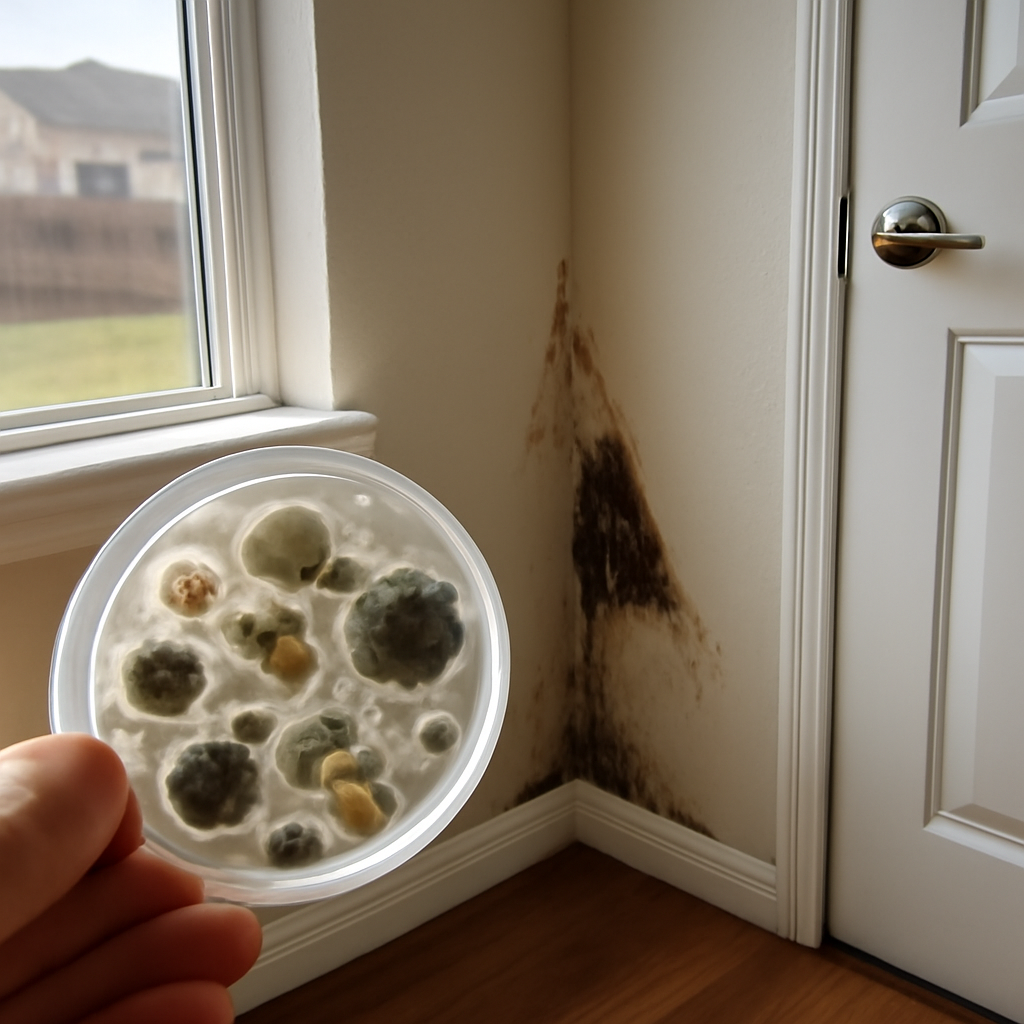
Berthoud, the “Garden Spot of Colorado,” pairs a walkable early-1900s historic downtown with sprawling 2010s-and-2020s subdivisions like Heron Lakes, Prairie Star, and Hammond Farm, set in farm country between Loveland and Longmont in Larimer County. Mold testing, the laboratory side of the mold question, helps Berthoud homeowners confirm whether suspected mold is real, identify what type it is, and document the problem for a remediation plan or a real-estate file. This page explains what mold testing berthoud homeowners should expect, when testing adds value beyond a visual inspection, and what it costs. This summary reflects EPA and CDC guidance current as of 2026; consult a qualified professional for decisions about a specific property.
Is this mold, asbestos, or water damage? Get a free instant screen
Upload a clear photo of the suspect area. You'll get an instant AI screening opinion and what to do next. This is screening guidance, not a professional determination.
Screening guidance only. AI can be wrong. Confirm asbestos, mold type, or lead with lab testing or a licensed professional before acting.
Mold testing in Berthoud: what to know
Mold testing means collecting samples, of the air or of a surface, and sending them to an accredited laboratory that identifies and quantifies the mold present. It answers different questions than a visual inspection: not “is there a leak feeding mold,” which an inspection addresses, but “what is growing, how much, and is the indoor air measurably affected.” The two services work together, an inspection finds the moisture and the visible growth, and testing characterizes it when the cause, extent, or air-quality impact is unclear.
The EPA’s position is worth keeping in mind: if mold is visible, testing is often unnecessary because the response, remove the mold and fix the moisture, is the same regardless of species. Testing earns its cost when mold is suspected but hidden, when occupants have unexplained respiratory symptoms, when a buyer or seller needs documentation, or when a post-remediation clearance is required to confirm the work succeeded. For the broader science, our plain-language mold hub for homeowners explains how sampling fits the overall picture.
Colorado’s dry climate shapes how testing results should be read. Because outdoor humidity is low, indoor mold here usually traces to a specific moisture source rather than ambient conditions, so a well-designed test compares indoor air to an outdoor baseline taken the same day. A spike of indoor spores above the outdoor reference points to an active indoor source, which is exactly the kind of evidence that turns a vague suspicion into an actionable finding in a Berthoud home.
Why Berthoud homes may need mold testing
The town’s two housing types create two testing scenarios. In the historic downtown, early-1900s buildings with aging plumbing, dated roofs, and basements built before modern moisture standards can hide growth behind decades of remodeling. When a downtown homeowner smells must but sees nothing, air sampling can detect elevated spore counts that point to concealed growth, prompting a targeted search rather than tearing open walls at random.
In the new subdivisions, the issue is sealed-envelope humidity. Tight homes in Heron Lakes, Prairie Star, and Hammond Farm trap interior moisture from leaks, weak bathroom ventilation, or even residual construction moisture, and growth can start inside wall cavities or finished basements before it is visible. Testing helps a newer-home owner confirm whether unexplained symptoms or a faint odor reflect a real indoor mold problem or something benign, which is useful precisely because new homes are wrongly assumed to be mold-free.
Local conditions and transactions add reasons to test. Berthoud’s agricultural setting near the Little Thompson River, some rural well-and-septic properties, and the freeze-thaw and Chinook-driven envelope stress all create moisture pathways. And in a market where buyers move between fragile historic homes and new builds, a real-estate transaction often calls for documented testing, either to support a seller’s disclosure of past water damage or to give a buyer confidence that a musty basement is or is not an active problem.
What Berthoud mold testing covers
Testing follows a sampling plan designed around the suspected problem, with indoor results compared against an outdoor baseline.
Air sampling versus surface sampling
Air sampling draws a measured volume of air through a collection cassette to capture and count airborne spores, useful when mold is suspected but not visible. Surface sampling, a swab or tape lift, identifies what is growing on a specific spot of visible discoloration. A thorough Berthoud testing plan often combines both: surface samples to identify visible growth and air samples to gauge whether spores have spread into the breathing space.
Baseline comparison and clearance testing
An outdoor control sample taken the same day anchors the interpretation, since some spores are normal in any air. After remediation, a clearance test confirms that indoor counts have returned to normal relative to outdoors, which protects a homeowner from paying for work that did not actually fix the problem. Testing always pairs naturally with a mold inspection in Berthoud, which finds and addresses the moisture source the testing helps characterize.
Mold testing cost in Berthoud
Mold testing in the Berthoud market is usually priced per sample plus a service or inspection fee. Individual laboratory samples often run about $100 to $200 each, and a typical assessment involving an outdoor baseline plus two or three indoor samples can total $400 to $700 once the professional’s time and lab fees are combined. A larger historic home with multiple suspect areas, or a project requiring post-remediation clearance, sits toward the higher end.
Weigh the cost against the questions testing answers. The CDC and EPA link damp, moldy indoor environments to respiratory irritation and to worsened asthma and allergy symptoms, so for a household with a vulnerable occupant, confirming whether the air is actually affected has real value. Testing also protects buyers and sellers in a transaction by replacing speculation about a musty smell with documented data, which can prevent a deal from stalling over an unverified mold fear.
The practical question is whether to test at all. When mold is plainly visible and the moisture source is identified, the EPA suggests skipping testing and moving straight to remediation and repair, which saves money. Testing is worth its cost when growth is hidden, when symptoms are unexplained, when documentation is needed for a sale or insurance claim, or when clearance is required to verify that remediation succeeded, the situations where data, not assumption, drives the right decision.
Berthoud regulations and disclosure
Colorado does not license mold testers or remediators, so the credibility of a result rests on the professional’s training and the laboratory’s accreditation. Reputable Berthoud providers use accredited labs and follow recognized sampling protocols, including a same-day outdoor baseline, because a sample collected or interpreted poorly can mislead as easily as inform. Colorado’s seller’s property disclosure asks about known water damage and mold, and documented testing supports accurate disclosure on both sides of a transaction.
Because the field is unregulated, a homeowner should be wary of any arrangement where the same company tests, interprets, and then sells the remediation, since that creates an incentive to find a problem. The most trustworthy approach keeps testing independent from remediation, or at minimum uses a credible third-party lab and a clearance test after the work, so the result that justifies the expense comes from an objective source rather than from the company being paid to fix it.
Neighborhoods and areas served
Mold testing demand in Berthoud spans Historic Downtown Berthoud with its early-1900s buildings, the newer subdivisions of Heron Lakes, Prairie Star, Hammond Farm, and Vantage, and rural parcels through the surrounding farmland near the Little Thompson River and toward Carter Lake. Service typically extends to adjacent Loveland, Longmont, Johnstown, Mead, and Campion, which share the same Larimer-area climate and mix of historic and new housing.
Because the testing question differs by housing type, hidden growth behind old downtown finishes versus trapped humidity in sealed new builds, the sampling plan adapts to the neighborhood. The county-wide context, including how testing decisions play out across nearby communities, appears in our guide to mold inspection in Larimer County, which frames the same source-and-sample logic across the region.
How to choose a Berthoud mold testing provider
Choose a provider who uses an accredited laboratory, follows a clear sampling protocol with a same-day outdoor baseline, and explains why each sample is being taken. A credible Berthoud tester designs the sampling around a specific question, confirm hidden growth, document air quality, or verify a remediation, rather than collecting samples indiscriminately and charging per cassette.
Ask how the provider handles the relationship between testing and remediation. The most trustworthy arrangement keeps the two independent, or uses a third-party lab and an honest clearance test, so the homeowner is not paying a company to find work for itself. A good tester is also willing to say when testing is unnecessary, advising a homeowner with obvious visible mold to skip sampling and put the money toward remediation and the moisture repair instead.
Finally, confirm the deliverable: a written report with the laboratory results, the indoor-versus-outdoor comparison, and a plain-language interpretation of what the numbers mean for the home. In Berthoud’s mixed market of historic and new properties, that documented, lab-backed result is what supports an honest disclosure, justifies a remediation scope, or reassures a buyer that a musty basement is not the problem they feared.
Reading Berthoud mold test results
A mold report can look intimidating, but its logic is straightforward once a homeowner knows what to look for. The laboratory lists the types of mold found and their concentrations in each sample, and the meaningful comparison is between the indoor samples and the same-day outdoor baseline. When indoor spore counts and types roughly track the outdoor reference, the indoor air is behaving normally. When an indoor sample shows markedly higher counts, or species associated with chronic water damage that are scarce outdoors, that pattern points to an active indoor source worth investigating.
Species matter less than the overall picture for most decisions. Homeowners sometimes fixate on whether a “toxic black mold” was named, but the EPA’s position is that the response to indoor mold, remove it and fix the moisture, does not change with species, and that no specific spore count cleanly separates safe from unsafe across all homes. A credible Berthoud report interprets the numbers in context rather than reducing the question to a single alarming label, and it ties any elevated indoor finding back to a likely moisture source the homeowner can address.
The most useful report ends with a clear recommendation. For a Berthoud home, that might be: no action beyond normal moisture control, investigate a specific area where indoor counts spiked, or proceed with remediation of a documented source followed by a clearance test. A report that simply dumps lab numbers without interpretation leaves a homeowner no better informed than before. The interpretation, translating spore counts into a plain-language next step, is the part of testing that actually justifies its cost, and it is what a homeowner should expect from a competent provider.
Testing also has a role in protecting a transaction’s timeline. In Berthoud’s active market, a musty smell discovered during a buyer’s inspection can stall a deal as both sides speculate about its severity. A targeted air-and-surface test, with results read against an outdoor baseline, replaces that speculation with data, often showing that a faint basement odor reflects normal conditions rather than active growth, or pinpointing a contained source that a modest repair resolves. Either outcome lets buyer and seller move forward on facts. For a downtown home with a damp-smelling cellar or a new build where an occupant reports symptoms, that documented result frequently keeps a sale on track that vague worry would otherwise have derailed.
References
- When to test or sample for mold — U.S. Environmental Protection Agency
- Mold and your health — Centers for Disease Control and Prevention
- Mold and indoor health research — National Institute of Environmental Health Sciences
When a Berthoud home’s mold question can’t be answered by eye alone, lab-backed testing turns suspicion into documented data. To connect with a vetted Front Range mold professional, reach out through our contact page.