Mold Inspection in Larimer County, CO | InspectandTest
Larimer County stretches from the plains around Fort Collins and Loveland up into the foothills and mountain communities of Estes Park, and its moisture story is shaped by the Cache la Poudre and Big Thompson rivers, cold sealed winters, and a range of housing from historic Old Town Fort Collins brick to fast 1990s-to-2010s growth. The 2013 Big Thompson flood left a lasting basement-moisture legacy along the Loveland-to-Estes corridor, which is part of why mold inspection matters here. This page explains what a mold inspection larimer county homeowners should expect, why the local conditions drive mold, and what it costs. This guidance reflects EPA and CDC standards current as of 2026 and is educational; a qualified inspector should assess your specific property, and we do not diagnose health effects.
Part of our Mold Testing & Inspection guide — start there for the full picture →
Is this mold, asbestos, or water damage? Get a free instant screen
Upload a clear photo of the suspect area. You'll get an instant AI screening opinion and what to do next. This is screening guidance, not a professional determination.
Screening guidance only. AI can be wrong. Confirm asbestos, mold type, or lead with lab testing or a licensed professional before acting.
Mold inspection in Larimer County: what to know
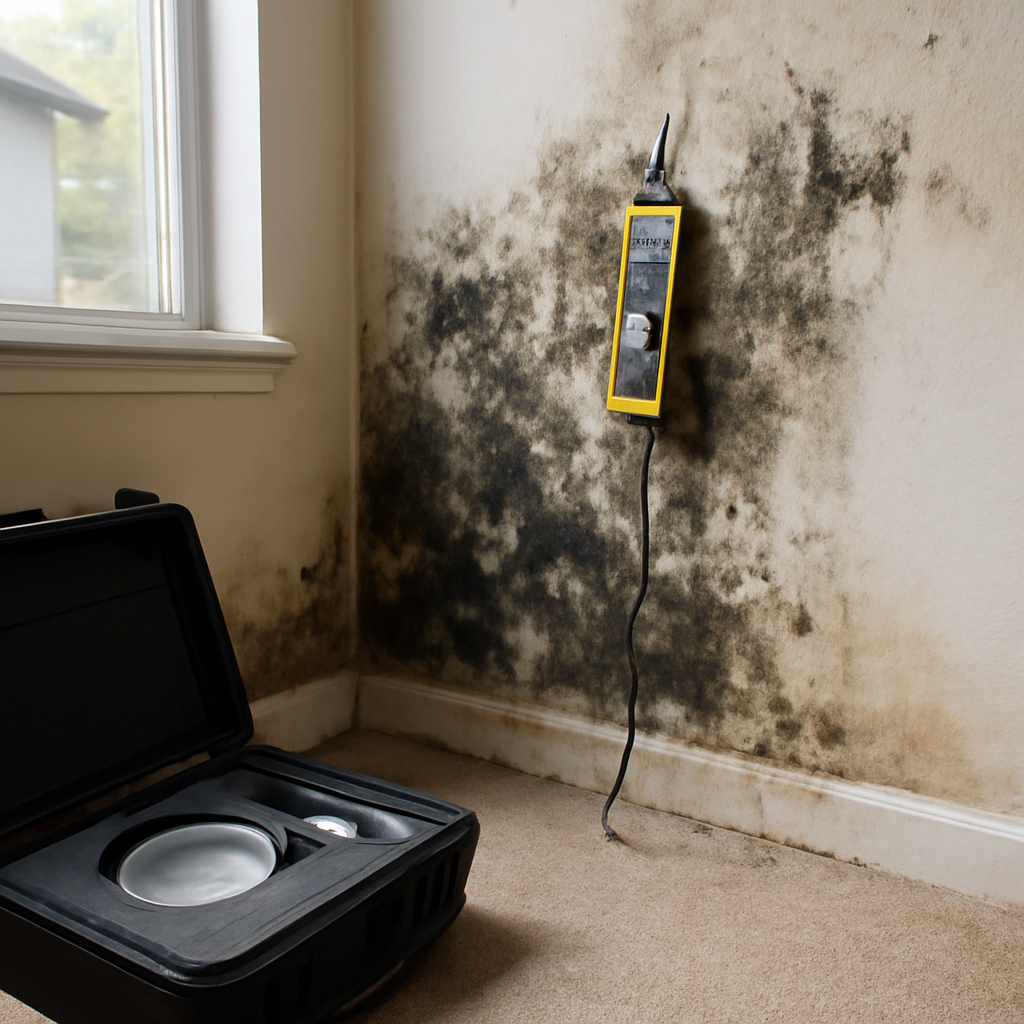
A mold inspection is a visual and moisture-focused evaluation aimed at finding mold growth and, more importantly, the moisture source feeding it. An inspector examines basements, crawl spaces, bathrooms, around windows, and behind appliances, using moisture meters and sometimes infrared to locate damp materials and active or past water intrusion. The EPA’s central message guides the work: controlling moisture controls mold, so finding the water source is the priority, not just the visible patch.
Inspection and testing are different steps. A mold inspection documents what is visible and where moisture is present; mold testing collects air or surface samples for lab analysis to identify and quantify spores. Many Larimer County situations are resolved by inspection alone, since visible mold plus a found moisture source rarely needs a lab to justify cleanup. Our plain-language mold inspection hub explains when testing adds value and when it does not.
Context shapes scope. A finished basement in a Fort Collins ranch, a 1900s brick home in Old Town, a flood-corridor property in Loveland, and a high-humidity mountain cabin near Estes Park each present different moisture pathways. A good inspector reads the home’s age, foundation type, and recent water history, then concentrates on the spaces where Larimer County moisture actually collects rather than running an identical checklist everywhere.
It is also worth being clear about what a mold inspection is not. It does not measure the health risk to a particular person, since how mold affects someone depends on their own sensitivity and underlying health, questions for a physician rather than an inspector. Nor does the inspection itself remove mold; it documents the growth and, crucially, the moisture conditions that drive it, producing the information a remediation plan is built on. A homeowner in a damp Wellington basement who wants to know both whether mold is present and why it keeps coming back is asking exactly the right question, because lasting resolution depends far more on correcting the water source than on cleaning the surface once.
Why Larimer County homes develop mold
Water history is the strongest driver in parts of the county. The 2013 Big Thompson flood pushed water into basements and lower levels along the Loveland-to-Estes corridor, and homes that took on water then can carry a hidden mold legacy in wall cavities, subfloors, and crawl spaces if drying was incomplete. Properties near the Cache la Poudre and Big Thompson rivers face ongoing groundwater and flood-plain moisture pressure that keeps basements and crawl spaces damp.
Climate concentrates indoor moisture. Cold Larimer County winters keep homes sealed for months, so everyday humidity from cooking, showering, and breathing has nowhere to escape, condensing on cold basement walls and window frames. Snowmelt and spring runoff from the foothills load soil around foundations, and poor grading sends that water toward basements and crawl spaces, the lowest, least-ventilated spaces where mold finds the dark, damp conditions it needs.
Housing type adds risk. Old Town Fort Collins and downtown Loveland hold historic brick and stone homes with original basements, stone foundations, and limited vapor control, while the fast growth of the 1990s through 2010s produced finished basements across Fort Collins, Timnath, Wellington, and Berthoud that put living space below grade. Mountain homes near Estes Park face wood-rot and humidity issues from snow load and shade. The CDC notes that damp indoor environments are linked to respiratory symptoms in sensitive people, which is why finding and drying the moisture source matters across all of these settings.
What a Larimer County mold inspection covers
The inspection targets the spaces and pathways where Larimer County moisture collects, focusing first on finding the water source.
Basements, crawl spaces, and the moisture source
The inspector evaluates basements and crawl spaces for dampness, efflorescence, staining, and visible growth, using moisture meters to find wet materials and tracing the source, whether grading, a foundation crack, a plumbing leak, or flood-corridor groundwater. In a Loveland home near the Big Thompson, the inspector pays special attention to lower-level wall cavities where 2013 floodwater may have left lingering moisture.
Bathrooms, windows, and ventilation
High-use wet areas, bathrooms, around windows, laundry rooms, and behind appliances, are checked for condensation, ventilation failures, and surface growth driven by sealed-winter humidity. When visible mold appears with a clear moisture source, the next step is often confirmation testing, covered in our mold testing in Fort Collins guide, before remediation planning.
Mold inspection cost in Larimer County
A visual mold inspection in the Larimer County market typically runs about $250 to $450 for a standard home, scaling with size, the number of levels, and crawl-space access. A small condo or single-level home sits at the low end, while a large home with a finished basement and a crawl space, or a flood-corridor property with a complex water history, lands higher. Difficult access and extensive moisture mapping add to the time and fee.
Testing is priced separately when it is warranted. Air or surface samples sent to an accredited lab generally add roughly $100 to $250 each depending on the number of samples, with clearance testing after remediation priced similarly. Many Larimer County inspections, especially where visible growth and an obvious moisture source coincide, do not require lab testing to justify cleanup.
Weighed against remediation costs, inspection is inexpensive due diligence. A few-hundred-dollar inspection that traces a damp Fort Collins basement to a grading problem lets an owner fix the source and dry the space before mold spreads through wall cavities, avoiding a far larger remediation bill. For a buyer near the Big Thompson flood corridor, an inspection that uncovers an incompletely dried 2013 water event can change the purchase negotiation substantially, which is exactly the kind of return a careful inspection delivers.
Remediation costs themselves illustrate the stakes. A small, surface-level cleanup of a few square feet of growth on a concrete wall may run a few hundred dollars, while removing colonized drywall, insulation, and subfloor across a flood-damaged Loveland lower level, with containment and air scrubbing, can climb into the thousands or more. The gap between those figures is largely a function of how early the problem is caught and how completely the moisture source is corrected. An inspection that finds a slow source before it saturates wall cavities keeps a project in the low end of that range, which is the practical argument for treating a musty smell or a recurring damp patch as a reason to inspect rather than wait.
Larimer County regulations and disclosure
Colorado does not license mold inspectors or remediators, so credentials are voluntary and the homeowner vets them. Look for recognized industry training, such as IICRC, CMI, or equivalent mold certifications, and confirm the inspector follows EPA mold-remediation guidance. The absence of state licensure makes documented training and clear methodology the real measure of a competent provider.
Disclosure rules apply to known conditions. Colorado’s Seller’s Property Disclosure requires sellers to report known material defects, including water damage and mold, so a seller aware of a past flood event or a recurring damp basement must disclose it, and the standard purchase contract’s inspection objection deadline gives buyers a window to investigate. For homes in the Big Thompson and Cache la Poudre flood plains, buyers should ask directly about 2013 flood history and any remediation that followed, since incomplete drying can leave problems that surface years later.
Communities and areas served
Mold inspection demand spans the county’s moisture-prone communities. Fort Collins leads, from Old Town’s historic brick and stone homes to the finished basements of newer subdivisions, alongside Loveland, where the downtown core and the Big Thompson corridor both carry water history. Estes Park’s mountain homes face humidity and snow-load moisture, while Berthoud, Wellington, Timnath, and the Larimer side of Windsor add fast-growth finished-basement stock.
The flood corridor deserves particular attention. Properties along the Big Thompson from Loveland toward Estes Park, and homes near the Cache la Poudre in and around Fort Collins, sit where 2013 floodwaters and ongoing river-plain moisture concentrate. Our mold inspection in Loveland page covers that corridor in more detail. Coverage typically reaches across Larimer County, and the core driver, finding and drying the moisture source, applies everywhere even as the specific pathway shifts from flood plain to sealed-winter condensation to mountain humidity.
How to choose a Larimer County mold inspector
Prioritize moisture expertise over spore-counting. Because Colorado does not license mold professionals, look for IICRC or equivalent certification and, just as important, an inspector who treats finding the water source as the central task rather than rushing to sell air samples. A provider who explains that visible mold with an obvious moisture source usually does not need lab testing is giving you straight, EPA-aligned guidance.
Ask how the inspector plans to find hidden moisture, not just visible growth. The most useful Larimer County mold inspectors carry moisture meters and often an infrared camera, and they trace a damp reading back to its source, whether that is exterior grading sloping toward the foundation, a failed sump, a plumbing leak, or river-corridor groundwater. An inspector who only documents what is visible on the surface misses the point, because the visible patch is a symptom and the water pathway is the disease. In a county where so much moisture arrives through basements and crawl spaces, the ability to find and explain the source is the single most valuable thing the inspection delivers.
Watch for independence and local knowledge. An inspector who also sells remediation has an incentive to find problems, so an independent assessment, or at least a transparent one, carries more weight. A Larimer County inspector who understands the 2013 flood legacy, river-corridor groundwater, and sealed-winter condensation knows where to look in a Loveland basement or an Estes Park crawl space. Ask to see a sample report and confirm the inspector uses moisture meters and, where useful, infrared. Clear methodology, local fluency, and a moisture-first approach are the marks of a provider worth hiring.
References
- Mold and moisture control in homes — U.S. Environmental Protection Agency
- Mold and your health — Centers for Disease Control and Prevention
- Indoor air quality and mold — Colorado Department of Public Health and Environment
Frequently asked questions
Why is mold a concern in Larimer County homes?
Cold sealed winters trap indoor humidity, snowmelt and river-corridor groundwater load foundations, and the 2013 Big Thompson flood left a basement-moisture legacy along the Loveland-to-Estes corridor, all of which feed mold growth.
How much does a mold inspection cost in Larimer County?
A visual inspection typically runs $250 to $450 depending on home size, levels, and crawl-space access, with lab air or surface samples adding roughly $100 to $250 each when testing is warranted.
Do I always need mold testing in Larimer County?
No. When visible mold appears alongside an obvious moisture source, the EPA notes that cleanup is justified without lab testing. Testing adds value for hidden growth, clearance after remediation, or disputes.
Should buyers near the Big Thompson ask about flood history?
Yes. Homes along the Big Thompson and Cache la Poudre may have taken on water in 2013, and incomplete drying can leave hidden mold in wall cavities, so ask directly about flood history and any remediation.
Does Colorado license mold inspectors?
No. Colorado does not license mold inspectors or remediators, so look for IICRC or equivalent certification, EPA-aligned methodology, and an inspector who prioritizes finding the moisture source over selling air samples.
From Old Town Fort Collins to the Big Thompson flood corridor, finding and drying the moisture source is the heart of any Larimer County mold concern. To connect with a vetted local mold inspector, reach out through our contact page.