Deck Post Lights: Solar vs Low-Voltage and Safe Wiring
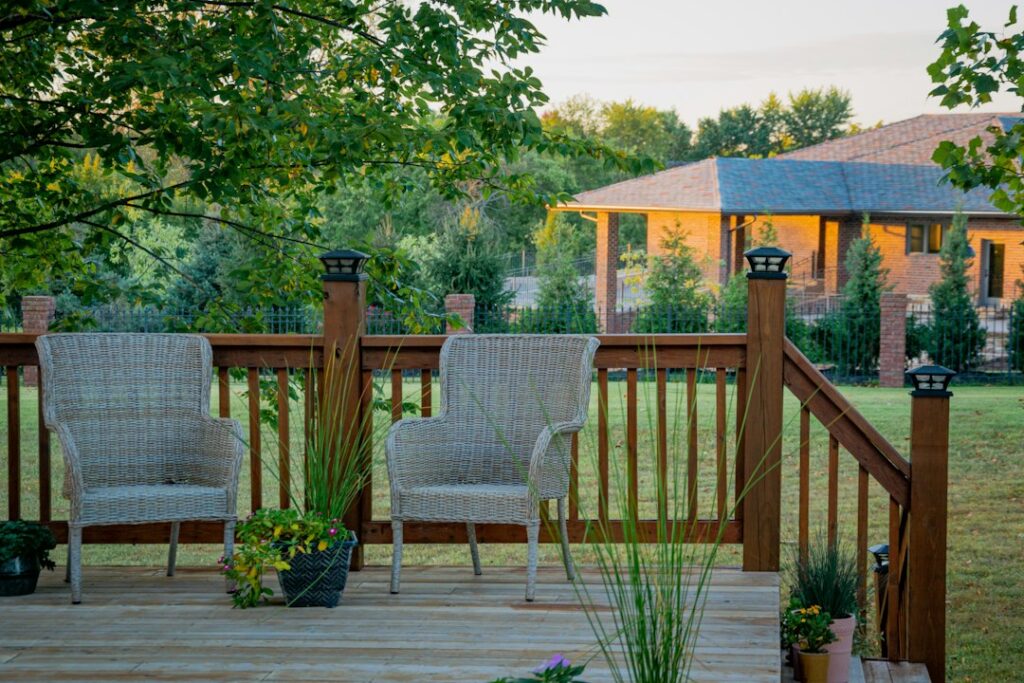
Deck post lights turn the top of each railing post into a small light source, usually a cap fixture that sits on a 4×4 or 6×6 post and glows downward or outward. They make a deck usable after dark, mark the edges and stairs, and give the yard a finished look from inside the house. The two main types, solar caps and low-voltage wired caps, solve the same problem in very different ways. Solar is easy to install and easy to replace; low-voltage is brighter, more consistent and more involved. On the Colorado Front Range, short winter days, snow cover, hail and intense summer sun all affect how each type performs. This guide compares the options, explains the wiring and transformer basics, covers stair and edge lighting for fall prevention, and outlines what deck post lighting typically costs.
Part of our Home Electrical guide — start there for the full picture →
What Deck Post Lights Are and How They Work
A post cap light replaces the decorative cap on a deck railing post, or mounts on top of it, and houses a small LED light source. Variations include:
- Post cap lights, which sit on top of the post and shine down onto the deck surface or glow through a lens.
- Post side lights, small fixtures mounted on the face of a post, usually aimed at the deck floor or the stairs.
- Stair riser and tread lights, recessed into the stair risers or the sides of stringers, often paired with post lights.
- Under-rail lights, strips or pucks mounted beneath the top rail that wash light over the deck edge.
Most products use LEDs because they run cool, last a long time and work at low power. ENERGY STAR notes that LED lighting products produce light up to 90 percent more efficiently than incandescent bulbs, and that LEDs typically dim gradually over time rather than burning out, with rated lifetime based on when light output drops by 30 percent. That gradual fade is worth remembering when one cap on a deck looks noticeably dimmer than the rest.
For related products and placement ideas, our guides to LED step lights and landscape lighting cover fixtures beyond the deck itself.
Solar vs Low-Voltage Post Cap Lights
The choice between solar and low-voltage usually comes down to how much light the deck needs, how reliable it must be and how much installation work the owner is willing to take on.
Solar post cap lights
A solar cap contains a small photovoltaic panel on top, a rechargeable battery, a light sensor and an LED. It charges during the day and turns on at dusk. Installation usually means removing the existing cap and screwing or adhesive-mounting the solar cap in its place, often with an adapter sleeve sized to the post.
- Advantages: no wiring, no transformer, no outlet needed, simple replacement, and no electrical permit for most installations.
- Drawbacks: lower and less consistent light output, dimmer or shorter run times after cloudy days and in winter, battery replacement every few years, and panels that degrade with sun and hail exposure.
- Placement matters: a cap shaded by a roof overhang, a tree or a pergola may never fully charge.
Front Range sun helps solar lights for much of the year, but December days are short and snow can cover the panels. Many owners find solar caps work well as decorative accent lights and marker lights, and less well as the primary lighting for stairs used every evening. Our solar lights guide explains batteries, panel types and what to expect from outdoor solar fixtures.
Low-voltage post cap lights
Low-voltage systems run at roughly 12 volts from a transformer that plugs into an outdoor receptacle or is hardwired by an electrician. Low-voltage cable runs from the transformer along the deck framing and up through or beside each post to the fixture.
- Advantages: brighter and consistent light every night, central control by timer, photocell or smart switch, and longer-lasting fixtures with no batteries.
- Drawbacks: more installation work, the need to route cable through framing or hide it under rails, a transformer that must be sized correctly and an outdoor power source.
- Best for: stairs, decks used often after dark and installations where every cap should match in brightness.
Line-voltage options
Some post-mounted fixtures run at standard 120-volt line voltage. Those installations involve wiring rated for outdoor and wet locations, appropriate boxes and GFCI protection, and generally require a licensed electrician and a permit in Front Range jurisdictions. For most decks, low-voltage or solar is simpler and safer for owners to manage.
Transformers, Outdoor Outlets and GFCI Protection
A low-voltage system is only as good as its transformer and power source. The transformer converts household current to low voltage and must be rated for the total wattage of the connected fixtures, with some headroom recommended by most manufacturers. Undersized transformers can overheat or trip, and very long cable runs can cause voltage drop that makes the far fixtures dimmer than those near the transformer.
Practical points for installation:
- Mount the transformer as directed. Most are designed to mount at a specified height above grade on a wall or post, not lie on the ground or sit under the deck where snowmelt collects.
- Use an outdoor-rated, GFCI-protected receptacle with an in-use cover. NFPA states that all outdoor receptacles should be GFCI protected and recommends testing GFCIs monthly according to the manufacturer’s recommendations.
- Use low-voltage cable rated for direct burial or outdoor use, and protect it from mower blades, string trimmers and deck board fasteners.
- Use the connectors specified by the fixture manufacturer. Pinch or piercing connectors can corrode over time, especially where they collect water.
- Plan for the timer or photocell. Many transformers include one; set it so stairs are lit whenever the deck is likely to be used.
If there is no outdoor receptacle near the deck, adding one is electrical work that usually needs a permit and a licensed electrician. Our guide to the outdoor outlet covers placement, GFCI requirements and covers, and the outdoor outlet cover guide explains why an in-use bubble cover is the right choice for a transformer that stays plugged in year-round.
Lighting Stairs and Edges to Prevent Falls
Decorative glow is a bonus. The real safety value of deck post lights is making stair edges, level changes and the deck perimeter visible at night. A deck that is fine in daylight can be disorienting after dark, especially for guests who do not know where the stairs start.
Falls are a serious public health issue for older adults. The CDC reports that falls among adults 65 and older caused over 43,000 deaths in 2024, making falls the leading cause of injury death for that age group, and that emergency departments recorded about 4.5 million visits for older adult falls that year. The agency emphasizes that falls can be prevented. Good lighting on outdoor steps is one of the straightforward ways homeowners can reduce risk, alongside sturdy handrails and even, well-maintained stair treads.
Lighting guidelines that help:
- Light every stair, not just the top and bottom. Post caps at the top and bottom of a run mark the stairs, but riser or stringer lights illuminate each tread.
- Avoid glare. Fixtures that shine into the eyes of someone climbing the stairs can make treads harder to see. Downward-facing caps and shielded fixtures help.
- Light the landing and the path. The transition from deck stairs to a patio or lawn is a common trip point.
- Keep lighting reliable. A stair light that fades out by 9 p.m. after a cloudy day is less useful than a wired light on a timer.
- Mark edges on raised decks. Under-rail or post lighting that outlines the perimeter helps on decks without full railing coverage or with wide openings at stairs.
Lighting does not replace safe construction. Loose railing posts, missing handrails and uneven stair rises are structural and safety issues on their own. Our deck railing guide covers height, baluster spacing and post attachment, which is also relevant because post cap lights add a little weight and a tempting handhold to the top of each post.
Planning a Low-Voltage Layout
A little planning before buying fixtures avoids the most common problems: dim lights at the end of a run, cable stapled where it will be damaged and a transformer that cannot handle a later expansion.
- Count and map the fixtures. Sketch the deck, mark each post, stair and landing that needs light, and add up the wattage of the fixtures you plan to use.
- Size the transformer with room to grow. Many manufacturers suggest not loading a transformer to its full rating, which also leaves capacity for path or landscape lights later.
- Choose a cable layout. A single long daisy chain is simple but can cause voltage drop at the far end. Splitting the deck into two or more runs, or feeding the middle of a run, keeps brightness more even. Fixture and transformer instructions usually include cable gauge and length guidance.
- Route cable through protected paths. Running cable along the inside of joists, through drilled post cores or under the top rail keeps it away from feet, snow shovels and mower decks.
- Plan access for repairs. Leave a little slack at each fixture and avoid burying connections inside sealed posts where they cannot be reached.
- Coordinate with deck work. The easiest time to run cable through posts and framing is during construction or a railing replacement, before boards and caps go on.
For an existing deck, many post cap fixtures are designed for surface-mounted cable that runs down the back side of the post and along the underside of the rail, where it is reasonably hidden. Composite and vinyl post sleeves often leave room inside the sleeve for cable, which simplifies a clean installation.
Maintaining Post Lights Through the Seasons
Deck lighting needs a little attention each year. Wipe dust and pollen off solar panels in spring, check that caps are still firmly attached after windstorms, replace solar batteries when run times shorten noticeably, and look for cracked lenses after hail. For wired systems, check the transformer’s timer after power outages and daylight saving changes, look for cable that has worked loose from its clips, and test the GFCI on the receptacle that feeds the transformer. If one fixture is out while the rest work, the problem is often a corroded connector at that fixture rather than the transformer.
Heat, Hail and Wildfire Considerations
Outdoor lighting on the Front Range has to handle more than rain. A few regional factors are worth considering:
- Heat and sun. Dark caps on south- and west-facing posts can get very hot in summer. ENERGY STAR notes that heat management is generally the single most important factor in LED performance, since higher operating temperatures make light output degrade faster and shorten useful life. Lighter-colored or metal caps with adequate heat sinking may hold up better than inexpensive plastic units.
- Hail. Solar panels and plastic lenses are vulnerable. Some owners keep spare caps on hand after a hail season, and metal or tempered-glass caps tend to survive better.
- UV. High-altitude sun yellows and embrittles cheap plastic lenses. Look for UV-stabilized materials.
- Snow and ice. Caps on posts collect snow; solar panels covered by snow will not charge, and ice can stress plastic housings.
Homes in the foothills and wildland-urban interface from Boulder County to Douglas and El Paso counties face wildfire risk. NFPA’s Firewise USA program notes that research points to embers and small flames as the main way the majority of homes ignite in wildfires, and that embers can be carried more than a mile by wind. Lighting is a minor factor compared with deck materials, debris and vegetation, but sensible choices still help: keep leaves and pine needles from collecting around post bases and under the deck, prefer metal or glass fixtures over flimsy plastic where practical, and keep transformers and wiring tidy and away from stored firewood or combustible debris.
Choosing Fixtures and What ENERGY STAR Covers
Owners shopping for deck post lights sometimes look for an ENERGY STAR label and cannot find one. That is expected. ENERGY STAR explains that because inefficient bulbs are no longer available for most household uses and LEDs have become the standard, EPA ended the ENERGY STAR program for the most common light fixtures, leaving only high-performing recessed downlights eligible to earn the label. Outdoor post cap lights therefore generally will not carry the label, and buyers should look instead at the manufacturer’s specifications.
Useful specifications include:
- Lumens, which indicate brightness. Accent caps may be quite dim, while stair lighting typically needs more light.
- Color temperature, with warm white often preferred for residential decks.
- Wet-location listing from a recognized testing laboratory for any wired fixture.
- Post size compatibility, since nominal 4×4 and 6×6 posts vary in actual dimensions and composite post sleeves differ again.
- Warranty on the fixture and, for solar models, the battery.
Mixing solar and low-voltage caps on the same deck is common and reasonable: wired lights for stairs and entries, solar caps for decorative accent posts far from power.
What Deck Post Lights Typically Cost
Prices vary by brand, materials, number of posts, deck layout and whether an electrician is needed. These are rough 2026 planning ranges for the Front Range, not quotes.
- Solar post caps: generally inexpensive per cap for basic plastic units, with metal and glass models costing more.
- Low-voltage post cap fixtures: typically more per fixture than solar, with premium brands at the higher end.
- Transformer and cable: a moderate one-time cost depending on wattage and features such as timers or smart controls.
- Professional low-voltage installation: often several hundred dollars to a few thousand dollars for a full deck, depending on the number of fixtures and how much cable must be concealed.
- New outdoor GFCI receptacle: commonly a few hundred dollars or more with a permit, depending on distance from the panel and wall construction.
During a home inspection, deck lighting is typically treated as an exterior or electrical observation: inspectors may note missing GFCI protection at the transformer’s receptacle, damaged fixtures, loose posts or stairs without adequate lighting. The electrical inspection hub gathers related guides, and the main hiring process page explains how to choose an inspector.
References
- About Older Adult Fall Prevention — Centers for Disease Control and Prevention
- Learn About LED Lighting — ENERGY STAR
- Light Fixtures (Downlights) — ENERGY STAR
- Electrical Safety in the Home — National Fire Protection Association
- Firewise USA — National Fire Protection Association
Frequently asked questions
Are solar or low-voltage deck post lights better?
Solar caps are easier to install and need no wiring, but light output varies with sun and season. Low-voltage lights are brighter and consistent every night, which makes them the better choice for stairs and frequently used decks. Many owners combine both.
Do deck post lights need a GFCI outlet?
Low-voltage systems plug their transformer into an outdoor receptacle, and NFPA states that all outdoor receptacles should be GFCI protected. Use an in-use cover so the plug stays protected. Solar caps need no outlet.
How long do deck post cap lights last?
LED light sources typically fade gradually rather than burning out, and solar models need new batteries every few years. Plastic housings and solar panels may degrade sooner in strong sun and hail. Check the manufacturer's warranty for expected life.
Why don't deck post lights have an ENERGY STAR label?
ENERGY STAR ended its program for most common light fixtures because LEDs have become standard, and only high-performing recessed downlights can still earn the label. Compare lumens, color temperature and wet-location listings instead.
Do deck stairs need lighting?
Requirements for exterior stair lighting vary by code edition and jurisdiction, so check with your building department. Regardless of code, lighting each tread and the landing helps reduce trips and falls after dark.
Want the deck, stairs, railings and exterior wiring looked over before you buy? Contact us to connect with a qualified inspector serving the Front Range.