Outdoor Outlet Covers: In-Use Bubble Covers vs Flip Lids
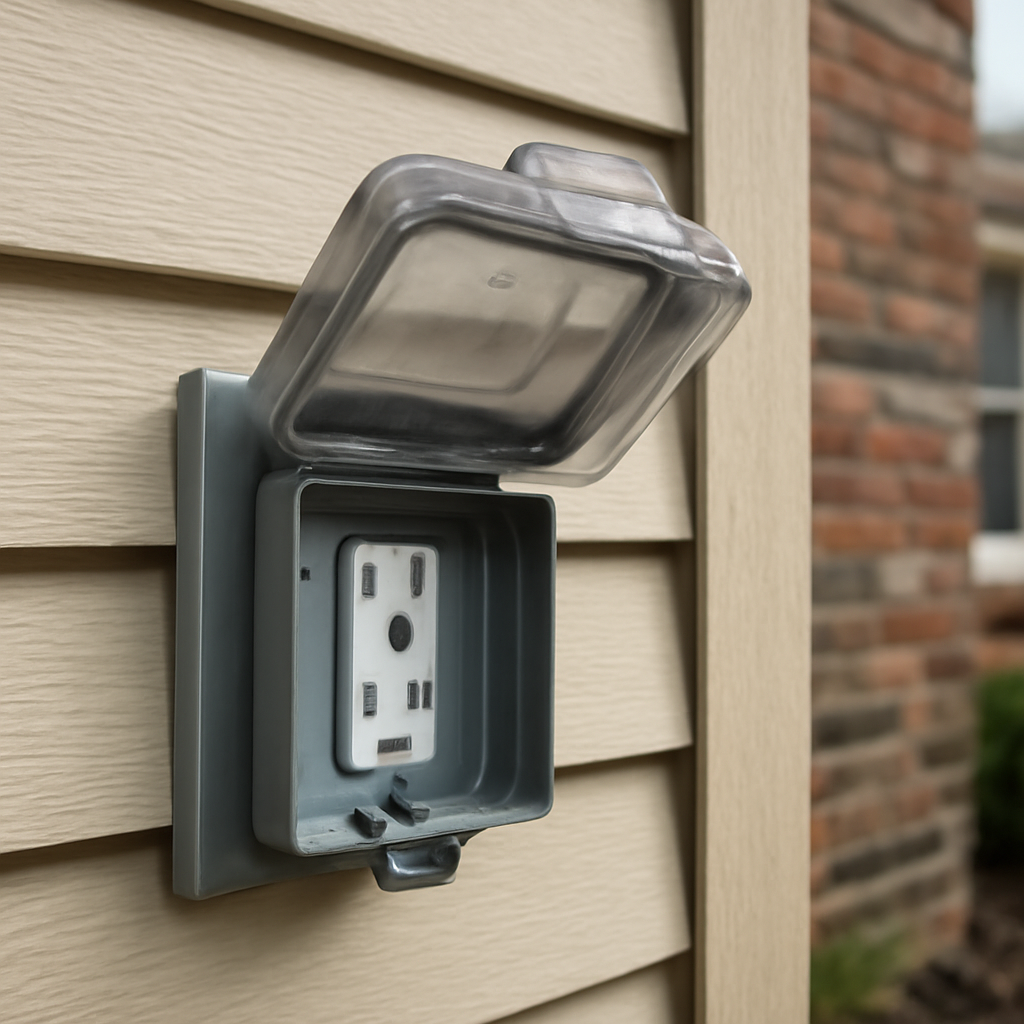
An outdoor outlet cover is a small part with a big job. It keeps rain, snowmelt, sprinkler spray and dust away from live contacts on the outside of a house. On the Colorado Front Range those covers also deal with hail, intense high-altitude UV, wind-driven spring snow and freeze-thaw cycles that turn a hairline crack into a broken lid within a season or two. Home inspectors check exterior receptacles on nearly every job, and damaged or wrong-type covers are among the most common electrical write-ups. This guide explains the two main cover styles, why the code language around “weatherproof while in use” matters, how GFCI protection and weather-resistant receptacles fit in, and what to do about cracked covers, hot tubs and seasonal lighting.
Part of our Home Electrical guide — start there for the full picture →
Electrical problem? Talk to a licensed electrician.
📞 Call (877) 560-2714What an Outdoor Outlet Cover Does
A receptacle mounted on an exterior wall sits in what electricians classify as either a damp location or a wet location. A receptacle under a deep covered porch may be considered damp; one on an open wall exposed to rain and sprinklers is generally treated as wet. The cover, together with the box and gasket behind it, forms the enclosure that keeps water out of the device.
Outdoor receptacles usually combine three layers of protection:
- The cover, which keeps water from reaching the face of the receptacle.
- The receptacle itself, which should be a weather-resistant (WR) type rated for outdoor exposure.
- Ground-fault protection, from a GFCI receptacle at that location, a GFCI receptacle upstream on the same circuit or a GFCI breaker in the panel.
The cover is the only part that is visible, so it gets the most attention, but an inspector will also test whether the outlet trips when a GFCI tester is applied and whether the receptacle is in good condition. Our guide to the outdoor outlet covers location, height and circuit requirements in more detail.
In-Use Bubble Covers vs Flip Lids
There are two broad families of exterior receptacle covers, and the difference is whether the cover protects the outlet only when nothing is plugged in, or also while a cord is in use.
Flip-lid (while-not-in-use) covers
The older and still common style is a flat plate with one or two spring-loaded lids that snap shut over the receptacle. When nothing is plugged in, the lid closes against a gasket and sheds water reasonably well. Once a cord is plugged in, though, the lid cannot close, and the receptacle face is exposed to rain and sprinkler spray. These covers are sometimes called “weatherproof when closed” or “while-not-in-use” covers.
In-use (bubble) covers
An in-use cover, often called a bubble cover or extra-duty cover, is a deeper housing with a hinged hood. Cords exit through notches or knockouts at the bottom, so the hood can close fully even with plugs inserted. The enclosure stays protected while the outlet is in service, whether that means a fountain pump running all summer, a block heater on a truck in January or lights that stay plugged in from Thanksgiving to New Year’s.
What the code language generally says
Current editions of the National Electrical Code generally require 15- and 20-amp, 125- and 250-volt receptacles installed in wet locations to have an enclosure that is weatherproof whether or not an attachment plug is inserted, and many editions add that the outlet box hood be listed and identified as extra-duty. In practice, that language is why in-use covers have become standard for new installations and replacements in wet locations. Damp locations have somewhat different rules, and older homes may still have flip-lid covers that were acceptable when installed.
Exact requirements depend on the code edition your city or county has adopted, any local amendments and whether the location is classified as wet or damp. Treat this as general orientation and confirm with a licensed electrician or your building department before replacing covers as part of a permitted project.
Choosing between them
- Choose an in-use cover for any outlet exposed to rain, snow or sprinklers, any outlet used for long periods with something plugged in, and any replacement where you want to meet the current approach without guessing.
- A flip lid may be acceptable on a protected porch or covered patio where the receptacle stays dry and is only used briefly, if local rules allow it.
- Look for depth. Bubble covers come in shallow and deep versions. Deep covers accommodate bulky plugs, timers and transformer bodies.
- Check materials. Polycarbonate covers resist impact better than some cheaper plastics, and metal die-cast covers are durable but can be heavy and may need a gasket in good condition to seal well.
If an outlet has a standard interior cover plate on the outside of the house, that is a clear defect regardless of code edition. The same is true of a receptacle missing its cover entirely. Our guide to outlet covers explains the differences among interior plates, safety caps and exterior enclosures.
GFCI Protection and Weather-Resistant Receptacles
A cover keeps water out. GFCI protection addresses the shock risk if water or a damaged cord creates a path to ground anyway. NFPA explains that ground-fault circuit interrupters are designed to protect people from hazardous ground faults that can arise from plugging in defective appliances or corded equipment, and states plainly that all outdoor receptacles should be GFCI protected. NFPA also advises testing AFCIs and GFCIs after installation and once a month thereafter, following the manufacturer’s recommendations, and replacing defective devices immediately because a nonfunctioning device can create a false sense of security.
Inspectors commonly find exterior outlets that are not GFCI protected in older homes, protected from an unexpected upstream location, such as a GFCI in the garage or a bathroom feeding the exterior outlet, or protected by a GFCI that has failed and no longer trips. If an outdoor outlet seems dead, it may simply be downstream of a tripped GFCI somewhere else. The guide on a GFCI outlet not working walks through how to trace and reset the device.
Weather-resistant receptacles carry a “WR” marking on the face. They use materials and plating intended to hold up better to moisture, UV and temperature swings than standard indoor receptacles. Current code editions generally call for WR receptacles in damp and wet locations for common 15- and 20-amp outlets. Tamper-resistant (TR) receptacles, which NFPA describes as having a built-in mechanism that helps prevent electricity from energizing objects inserted into the slots, are also widely required in new residential work, and many outdoor receptacles are sold marked both WR and TR.
A practical point for owners: a WR-rated receptacle behind a broken cover is still not a safe installation. The rating helps the device survive exposure; it does not make an open receptacle face rainproof.
Cracked Covers, Missing Gaskets and Other Common Defects
Front Range sun is hard on plastic. At elevations above 5,000 feet, UV exposure is higher than at sea level, and a cover on a south- or west-facing wall can become brittle within a few years. Hail finishes what the sun started. Typical findings include:
- Cracked or shattered hoods that no longer close or that let water pour directly onto the receptacle.
- Broken hinges so the lid hangs open permanently.
- Missing or flattened gaskets between the cover and the box or wall.
- Gaps behind the box where siding was replaced and the box no longer sits flush, letting water run behind the cover into the wall.
- Covers painted shut or caulked closed, which hides problems and makes the outlet unusable.
- Interior-style plates used outdoors, or outlets with no cover at all.
- Loose receptacles where plugs fall out, which the U.S. Fire Administration flags as a reason to replace the outlet; its guidance is to replace wall outlets if plugs do not fit snugly and to insert plugs fully into sockets.
- Burn marks or melted plastic on the receptacle face, which suggest overheating and call for an electrician rather than a new cover.
Replacing a cover on an otherwise sound box is usually a straightforward job, but some caution applies. Turn the circuit off at the breaker before removing a cover that has been letting water in, because the receptacle may be wet or corroded behind it. If you find rust, discoloration, water in the box or a crumbling receptacle, stop and call an electrician. A new cover over a corroded device simply hides the problem.
When the box itself is the issue, such as a box set too deep in new siding or a box that is not designed for outdoor use, the fix may involve a new weatherproof box, a mounting block or an extension ring, and possibly a new receptacle. That is electrician territory in most cases and may require a permit.
Hot Tubs, Holiday Lights and Other Heavy Users
Outdoor receptacles take on loads that indoor outlets rarely see: pond pumps, pressure washers, electric mowers, string lights, inflatables, heated pet bowls and block heaters. Some of those loads run for weeks at a time in freezing weather and wet snow, which is exactly when an in-use cover earns its cost.
Hot tubs and spas
Most full-size hot tubs are hardwired on a dedicated 240-volt circuit with a GFCI-protected disconnect located within sight of the tub but at a required minimum distance from the water. Smaller 120-volt “plug-and-play” spas plug into a GFCI-protected receptacle, and the manufacturer usually specifies the circuit size and whether an extension cord is permitted (often it is not). Receptacles near a spa have their own distance rules under the electrical code. Our hot tub guide explains what inspectors look for at the disconnect, the bonding and the clearances. A bubble cover on a nearby receptacle helps, but it does not solve a spa installed without the right circuit.
Holiday and seasonal lighting
The Consumer Product Safety Commission’s holiday guidance includes two points that apply directly to exterior outlets: never string together more than three sets of incandescent lights, and never overload electrical outlets. The U.S. Fire Administration similarly advises against overloading outlets and power strips and recommends replacing worn or damaged extension cords right away. For a decorated house, a few practical steps help:
- Use cords and timers rated for outdoor use, and keep connections off the ground where snow and meltwater collect.
- Close the in-use cover over the plugs so the receptacle face stays dry.
- Spread large displays across more than one circuit rather than daisy-chaining everything from a single outlet.
- If the GFCI trips repeatedly in wet weather, treat it as a warning, not a nuisance. Look for a damaged cord, a wet connection or a failing light set.
Many owners add exterior outlets specifically for seasonal lighting. A new receptacle generally means new wiring, a weatherproof box, GFCI protection and an in-use cover, and in most Front Range jurisdictions a permit for the electrical work.
Fitting a Replacement Cover Correctly
Most in-use covers are sold as a kit with a base plate, a hinged hood, gaskets and several inserts for different receptacle styles. The kit only works as designed if a few details are right.
- Match the receptacle type. Kits include inserts for duplex receptacles and for GFCI or decorator-style devices. Using the wrong insert leaves gaps around the receptacle face.
- Match the box orientation. Many covers can mount vertically or horizontally. The hood should open so that cord openings face down, letting water drain away rather than collect.
- Seat the gasket fully. The foam or rubber gasket between the base and the box is what keeps water out of the wall. A twisted or reused flattened gasket defeats the cover.
- Seal the top and sides, not the bottom. Where the box meets lap siding or stucco, a bead of exterior sealant along the top and sides helps shed water, while leaving the bottom open lets any moisture that does get in drain out.
- Remove only the knockouts you need. Breaking out every cord opening invites wind-driven snow.
Read the manufacturer’s instructions that come with the cover; listing and performance depend on following them. If the existing box is recessed behind new siding, a surface-mounted extension or mounting block may be needed before any cover will seal properly.
What an Inspector Checks at Exterior Outlets
The ASHI Standard of Practice directs home inspectors to inspect a representative number of installed receptacles and to inspect ground-fault and arc-fault circuit interrupters. For exterior components, the standard defines a representative number as one component on each side of the building. In practice, many inspectors try to test every accessible exterior receptacle because they are few in number and commonly defective.
A typical exterior outlet check includes:
- Whether the cover is present, intact and appropriate for the location.
- Whether the receptacle is energized and correctly wired, using a plug-in tester.
- Whether GFCI protection trips and resets.
- Whether the box is secure and sealed to the wall.
- Whether the receptacle is loose, damaged or showing signs of heat.
Inspectors do not usually open boxes or trace circuits, so findings like “no GFCI protection detected” or “cover damaged, recommend repair by a qualified electrician” are common report language. The electrical inspection hub collects related guides on panels, wiring and protection devices, and the overall hiring process guide explains how to choose an inspector and read the report.
Outdoor Outlet Cover Costs
Prices vary by brand, material, depth and whether an electrician is needed. These are rough 2026 ranges for the Front Range and should be confirmed locally.
- Flip-lid cover: generally among the least expensive parts in the electrical aisle.
- In-use bubble cover: typically somewhat more than a flip lid, with deep, metal or extra-duty models at the higher end.
- WR/TR GFCI receptacle: commonly a moderate parts cost per device.
- Electrician to replace a cover and receptacle: often a single service-call charge, with additional outlets on the same visit adding modestly.
- New exterior outlet with wiring and permit: commonly several hundred dollars or more depending on wall construction and the distance from the panel.
Because a cover replacement is inexpensive, buyers can often ask sellers to correct damaged exterior covers as part of a repair request, or simply plan to do it after closing with the circuit turned off.
More Questions About Outdoor Outlet Covers
Can an outdoor outlet cover be painted?
An outdoor outlet cover can be painted on the outside face, but paint should never seal the hinge, lid or gasket. Paint can make the lid stick open or closed and keep the cover from sealing, which defeats its purpose.
If color matching matters, many manufacturers sell covers in several colors, which is easier than painting. When painting siding around a cover, masking it or removing it first keeps the gasket clean. Paint that builds up under the cover’s edge can also break the seal against the wall.
How long do outdoor outlet covers last?
Outdoor outlet covers commonly last several years, but plastic covers in direct sun often become brittle and crack sooner. UV exposure, cold weather and repeated use of the lid all shorten service life.
Signs a cover needs replacing include cracks, a lid that will not stay closed, a missing or flattened gasket and a loose fit against siding. Replacement covers are inexpensive and usually install with screws through the existing box. Metal die-cast covers often outlast plastic ones in harsh exposure.
Can a cord stay plugged in under an outdoor outlet cover?
A cord can stay plugged in outdoors only under an in-use (bubble) cover designed to close over the plug. A flip-lid cover is weatherproof only when nothing is plugged in, so a cord left in it lets rain reach the receptacle.
In-use covers have knockouts at the bottom so cords exit without holding the lid open. Choosing an extra-duty in-use cover with enough depth for timers or smart plugs avoids forcing the lid. Check that the cover closes fully with the cord in place.
What size outdoor outlet cover do I need?
An outdoor outlet cover must match the box and receptacle style: single-gang or two-gang, and duplex or GFCI (decorator) opening. Measuring the existing cover or box before buying avoids most fit problems.
In-use covers also come in different depths. Deeper covers are needed for bulky plugs, timers and transformers for landscape lighting. Some universal covers include adapter plates for both duplex and GFCI devices. A cover that does not seat flat against the siding may need a mounting block or siding adapter.
References
- Electrical Safety in the Home — National Fire Protection Association
- Appliance and Electrical Fire Safety — U.S. Fire Administration
- Holiday Safety — U.S. Consumer Product Safety Commission
- ASHI Standard of Practice for Home Inspections — American Society of Home Inspectors
Frequently asked questions
What is an in-use outdoor outlet cover?
An in-use cover, often called a bubble cover, has a deep hinged hood that can close fully while cords are plugged in, with cords exiting through the bottom. It keeps the receptacle protected during use, which is why it is generally used for wet locations.
Are flip-lid outdoor outlet covers still allowed?
Current code editions generally call for covers that stay weatherproof with a plug inserted in wet locations, which flip lids do not. Flip lids may still be found on older homes or in some damp locations. Confirm local requirements with an electrician or building department.
Do outdoor outlets need to be GFCI protected?
NFPA states that all outdoor receptacles should be GFCI protected. Protection can come from a GFCI receptacle at the outlet, one upstream on the same circuit or a GFCI breaker, and it should be tested monthly.
Can I replace an outdoor outlet cover myself?
Swapping a cover on a sound, dry box is usually simple with the circuit turned off at the breaker. If the box is loose, the receptacle is corroded or water has entered the box, call a licensed electrician.
Why does my outdoor GFCI trip when it rains?
Moisture is reaching the receptacle, a cord, a connection or the plugged-in device. Check for a cracked cover, a missing gasket or a damaged cord. Repeated tripping is a warning sign, so have an electrician investigate if the cause is not obvious.
Are metal or plastic outdoor outlet covers better?
Metal die-cast outdoor outlet covers are generally more durable against impact and UV, while plastic covers resist corrosion and cost less. Both work when listed for wet locations. In hail-prone or high-traffic areas, metal often lasts longer; in coastal salt air, plastic avoids rust.
Do outdoor outlet covers need a gasket?
Yes, outdoor outlet covers rely on a foam or rubber gasket between the cover and the box or siding to keep water out. A missing, compressed or torn gasket lets water in even if the lid is closed. Replacement covers usually include a new gasket.
Can an outdoor outlet cover be installed on vinyl siding?
Yes, an outdoor outlet cover can be installed on vinyl siding, but it should sit on a flat mounting block rather than directly on the uneven siding profile. A mounting block gives the gasket a flat surface to seal against and keeps water from running behind the box.
Want exterior outlets, covers and GFCI protection checked before closing on a Front Range home? Get in touch here and we can connect you with a qualified local inspector.