Landscape Lighting: Low-Voltage Systems, GFCI and Safe Wiring

Well-planned outdoor lights make a house safer to walk around after dark, help guests find the front door and show off trees, stonework and garden beds that disappear at sunset. Most residential landscape lighting today runs on low voltage, uses LED fixtures and plugs into a transformer mounted beside an outdoor outlet, which makes it one of the more approachable electrical projects around a home. It still involves electricity, water, digging and buried utilities in the same patch of ground. This guide explains how low-voltage and line-voltage systems differ, why GFCI protection and in-use covers matter, burial depth basics, calling 811 before digging, avoiding sprinkler lines, solar fixture tradeoffs, deck and step lighting, junction boxes, dark-sky considerations, LED efficiency and hedged costs.
Part of our Home Electrical guide — start there for the full picture →
How Landscape Lighting Systems Work
A typical residential system has four parts: a power source, a control, cable and fixtures. In a low-voltage setup, a transformer plugs into or is hardwired to a 120-volt outdoor circuit and steps the voltage down, usually to about 12 volts. Low-voltage cable runs from the transformer through planting beds to path lights, spotlights, well lights and wall washers. A timer, photocell or smart controller built into the transformer turns the system on at dusk and off later in the evening.
Line-voltage systems run standard 120-volt wiring directly to the fixtures. They are more common on commercial properties, for large trees that need powerful floodlights, for post lights at the end of long driveways, and for fixtures mounted on the house itself. Solar fixtures are a third category: self-contained lights with a small panel, a rechargeable battery and an LED, with no wiring at all.
Which approach fits depends on the property, the lighting goals, the budget and how much electrical work the homeowner is comfortable having done.
Low-Voltage vs Line-Voltage Landscape Lighting
The differences go beyond wattage. They affect who can install the system, how cables are buried and what happens if a shovel hits a wire.
Low-Voltage (12V) Systems
Low-voltage systems dominate residential yards because they are flexible and lower risk. A cut cable or exposed connection at 12 volts presents much less shock hazard than one at 120 volts, though it can still cause shorts and, if a transformer or connection is badly overloaded, heat. Many jurisdictions treat the low-voltage side differently from line-voltage work, and some homeowners install these kits themselves, though rules vary by city and county. The transformer and the receptacle it plugs into are still line voltage and must meet outdoor wiring requirements.
Planning matters with low voltage. Long cable runs lose voltage, so fixtures at the end of a run can look dimmer than those near the transformer. Installers manage this with heavier-gauge cable, shorter runs, multiple home runs, hub layouts or multi-tap transformers. Transformers should be sized with headroom above the total fixture load, following the manufacturer’s guidance, rather than loaded to their limit.
Line-Voltage (120V) Systems
Line-voltage lighting can deliver more light over longer distances and connects directly to household circuits. The tradeoff is that it is regular building wiring. It generally requires a licensed electrician, permits in many jurisdictions, conductors rated for burial or protected in conduit, weatherproof junction boxes and GFCI protection where required. Line-voltage fixtures are harder to move once installed, so the layout should be settled before trenching.
Which One Fits
For path lights, garden accents, uplighting small and medium trees and highlighting walls or stone, low voltage is usually enough. For tall trees, large lawns, long driveways or security floodlights, line voltage or a hybrid design may be worth the cost. Many homes end up with both: line-voltage fixtures on the house and a low-voltage system in the yard.
Best Landscape Lighting: our top 3 picks
| Product | Best for | Key features | Price | Buy |
|---|---|---|---|---|
| Gardencoin Solid Brass Spotlight (6 pack) | Best overall uplight |
| $134.22as of Nov 19, 2026 12:52 pm GMT+0000 | Buy now →Check current price |
| SUNVIE RGBW Kit with 300W Transformer | Best complete starter kit |
| $195.49as of Nov 19, 2026 12:52 pm GMT+0000 | Buy now →Check current price |
| PARTPHONER 12V Path Lights (12 pack) | Best low-voltage path lights |
| $127.77as of Nov 19, 2026 12:52 pm GMT+0000 | Buy now →Check current price |


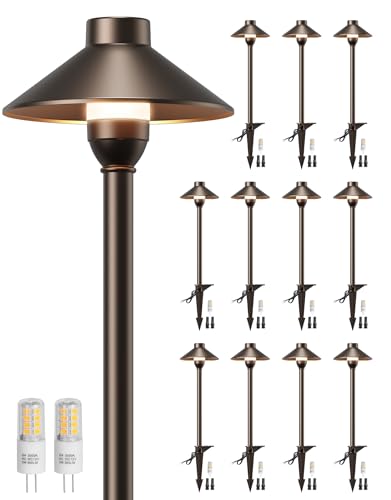
Prices are Amazon’s listed prices as of the time shown and change often; check Amazon for today’s price. As an Amazon Associate we earn from qualifying purchases.
GFCI Protection, Outdoor Receptacles and In-Use Covers
Every landscape lighting system that uses household power starts at an outlet or a hardwired connection, and that is where the shock risk is highest. Water, soil and electricity are a dangerous combination, and outdoor receptacles take a beating from sprinklers, snow and freeze-thaw cycles.
The CPSC Home Electrical Safety Checklist asks whether each outdoor outlet has its own weatherproof cover and whether all outlets are protected by a GFCI. It recommends a “weatherproof while in use” cover for outlets used in wet weather, explaining that most standard covers do not keep water out when a cord is plugged in because water can drip between the plug and the outlet. The checklist also notes that GFCIs protect against electrocution and that many local building codes require GFCIs for outside circuits in new homes and renovations.
A landscape transformer plugged into an outdoor receptacle stays plugged in year-round, which makes a sturdy in-use cover essentially mandatory. Test the GFCI periodically using its test and reset buttons. A GFCI that trips repeatedly after rain often signals moisture in the receptacle, a damaged cord or a fault in the transformer. Our guide to a GFCI outlet that is not working covers resetting, finding the upstream GFCI that protects an outlet, and when nuisance tripping means something needs repair.
Avoid running a landscape system from an extension cord as a permanent setup. The U.S. Fire Administration’s appliance and electrical fire safety guidance advises replacing worn or damaged extension cords and avoiding placing cords where they can be damaged or pinched. Outdoors, cords face UV, foot traffic and mower blades, which makes them a poor permanent power source.
Burial Depth, 811 and Buried Utilities
Landscape lighting involves trenching, and trenching is where projects collide with what is already underground.
Burial Depth Concepts
Low-voltage landscape cable is typically buried shallowly, often a few inches deep, following the manufacturer’s instructions and local rules. Line-voltage conductors have deeper burial requirements that depend on the wiring method, whether conduit is used, and whether the run passes under a driveway or lawn. Requirements come from the electrical code adopted by the local jurisdiction, so the exact depths for a given run are best confirmed with an electrician or the building department rather than taken from a general guide. In Front Range yards, rocky soil and clay can make reaching the required depth harder than expected.
Call 811 Before Digging
Gas lines, electric service, communications cables and water lines can sit only inches below the surface. Before driving a stake, trenching or setting a well light, call 811 or submit a locate request so utility owners can mark their lines. Colorado’s notification center handles requests for the state. Our guide to calling before you dig explains the process, the waiting period and what the colored paint and flags mean. Keep in mind that utility locates generally mark public lines up to the meter; privately installed lines such as a detached garage feed, a gas line to a grill or an existing lighting circuit may not be marked.
Sprinkler Lines and Valves
Irrigation pipe is the buried utility most landscape lighting installers hit. Sprinkler laterals are often shallow, and valve boxes and wiring for zone valves sit in the same planting beds where lights go. Hand-digging near known sprinkler heads, tracing lines before trenching and flagging valve boxes all help. If a line is nicked, it is easier to repair while the trench is still open; our guide to sprinkler system repair covers common fixes. Also aim spray heads away from transformers and outdoor outlets where possible.
Junction Boxes, Connections and Weatherproofing
Most landscape lighting failures are connection failures. Moisture works into splices, corrosion builds up, and fixtures flicker or go dark.
For low-voltage systems, use connectors rated for direct burial and outdoor use, and keep splices accessible where possible. Cheap pierce-type connectors can loosen or corrode over time; many installers prefer sealed, gel-filled connectors or hub junctions. Leave a small service loop of cable at each fixture so it can be moved or serviced.
For line-voltage work, splices belong in listed weatherproof boxes, not buried in the dirt, and the boxes must remain accessible. Our junction box guide explains why boxes cannot be buried behind finishes and how covers and fill limits work. Fixtures mounted on the house should be rated for wet or damp locations as appropriate, and penetrations through siding should be sealed.
Deck, Step and Path Lighting
Lighting where people walk has the most safety value. Stair risers, deck edges, path changes and entry steps become hazards after dark, particularly in winter when ice and snow hide edges. Low-voltage step lights, post-cap lights and under-rail strips are common choices. They should light the walking surface without shining into people’s eyes.
Lights mounted on a deck rail or post should not compromise the railing. Drilling large holes through structural posts or attaching fixtures in a way that weakens a guard is a poor trade for ambiance. Our guide to deck railing covers guard height, baluster spacing and post attachment, which are worth checking before adding lights. Cable routed along deck framing should be secured and protected from foot traffic and weather.
Indoors, similar thinking about low-voltage LED strips applies to under-cabinet lighting, where transformers, connections and heat management also come up.
Solar Fixtures: Pros and Cons
Solar lights are inexpensive, easy to move and require no wiring, trenching or transformer. They work well for marking paths in sunny spots and for temporary or rental situations.
The limitations are real. Light output is usually lower than wired fixtures. Panels need direct sun, so lights under trees, along north-facing walls or under deep eaves may not charge fully. Batteries lose capacity over time and in cold weather, and short winter days on the Front Range mean less charging time when nights are longest. Snow covering the panels stops charging entirely. Many homeowners use solar fixtures for accents and rely on wired lights for steps, entries and security.
LED Efficiency, Light Pollution and Dark-Sky Considerations
LED fixtures are now standard for landscape lighting. ENERGY STAR explains that LED lighting products produce light up to 90 percent more efficiently than incandescent bulbs. Its guidance also notes that LEDs do not typically burn out but dim slowly over time, with lifetime defined by when light output drops by 30 percent, and that heat sinks are used to keep LEDs from overheating. Fixtures with good thermal design are more likely to deliver their rated life outdoors.
More light is not always better. Glare, light trespass onto neighboring properties and skyglow have become planning concerns in many communities. Dark-sky practices generally favor shielded fixtures aimed downward, warmer color temperatures, lower brightness and timers or motion sensors so lights are not on all night. Some Colorado municipalities and counties have outdoor lighting ordinances, particularly in mountain and rural areas, so checking local rules before installing bright uplights or floodlights is wise. Even where no ordinance applies, aiming fixtures carefully is a courtesy to neighbors.
Planning a Layout and Maintaining It Through Colorado Seasons
A good layout starts with priorities, not fixtures. Walk the property at night and note where people actually walk, where steps or grade changes are hard to see, and which features deserve attention. Entries, steps and the path from the driveway usually come first; accent lighting on trees and walls comes second. Sketching fixture locations on a simple site plan, along with known utilities, sprinkler heads and valve boxes, prevents many digging surprises.
Fewer, well-placed fixtures often look better than many bright ones. Path lights spaced to create pools of light, rather than a runway, read as more natural. Uplights placed at the base of a tree and aimed to graze the trunk or canopy avoid shining into windows. Placing the transformer near the center of the layout, rather than at one far corner, can shorten runs and reduce voltage drop.
Front Range weather is hard on outdoor electrical gear. Freeze-thaw cycles can heave fixtures out of plumb, hail can crack lenses, and snowplows and shovels can snap path lights along driveways. A quick spring walk-through to straighten fixtures, clear mulch away from lenses, check connections and confirm the timer still matches the season pays off. In fall, trim plants that have grown over fixtures and verify the GFCI still trips and resets. Wildfire-prone properties in the foothills should also keep fixtures and cable clear of dry debris and follow local defensible-space guidance.
Landscape Lighting Costs (Hedged)
Costs vary with system size, fixture quality, design complexity and local labor. The ranges below are broad estimates from contractor quotes and national cost guides, not government data.
- DIY low-voltage kits: often a few hundred dollars for a small starter set.
- Professionally installed low-voltage systems: commonly in the low-to-mid thousands of dollars, with higher-end brass fixtures and larger designs going well beyond that.
- Line-voltage work: frequently higher per fixture because of trenching depth, conduit, junction boxes, permits and electrician labor.
- Solar fixtures: inexpensive per unit, though replacement batteries and fixtures add up over time.
When comparing bids, ask for the transformer size and its load headroom, the fixture brand and material, the cable gauge, the connector type, whether a new GFCI-protected outdoor receptacle or circuit is included, and what the warranty covers for fixtures, transformers and labor. Itemized quotes make it easier to compare designs fairly.
What a Home Inspector Checks Outdoors
The ASHI Standard of Practice directs inspectors to inspect a representative number of installed lighting fixtures, switches and receptacles, as well as ground fault circuit interrupters. It also states that inspectors are not required to inspect low-voltage wiring systems and components. In practice, that means an inspector may check outdoor receptacles, GFCI protection and covers, and note exposed line-voltage wiring, but the low-voltage landscape system itself is usually outside the standard scope. Buyers who care about an extensive system should ask the seller for installer information and test it at dusk. For more, see our guide to hiring a home inspector and the electrical hub.
More Questions About Landscape Lighting
What size transformer is needed for landscape lighting?
A landscape lighting transformer should be sized so the total fixture wattage is no more than about 80 percent of its rated capacity. Add up the wattage of every fixture planned for that transformer, then divide by 0.8 to find a minimum size. For example, 160 watts of LED fixtures calls for at least a 200-watt transformer. Leaving headroom allows for adding lights later and reduces heat. LED fixtures use far less power than old halogen ones, so smaller transformers often suffice.
Why are some landscape lights dimmer than others?
Landscape lights at the end of a long wire run are often dimmer because of voltage drop, which happens when too much wattage runs through wire that is too thin or too long. Corroded connectors and loose splices cause the same symptom. Solutions include using heavier gauge cable, splitting fixtures into several shorter runs, using a hub or loop layout, or choosing a transformer with higher voltage taps. LED fixtures are more tolerant, but some will flicker if voltage falls too low.
How long do LED landscape lights last?
LED landscape lights commonly last about 30,000 to 50,000 hours, which works out to 15 years or more at typical nightly use, though rated life varies by product. The fixtures themselves often fail sooner from corrosion, cracked lenses or water getting into connections. Integrated LED fixtures must be replaced as a unit when the LEDs fail, while fixtures with replaceable LED lamps can be repaired cheaply. Brass and copper fixtures tend to outlast plastic and painted aluminum outdoors.
Can landscape lighting be controlled with a timer or smart app?
Yes, landscape lighting can be controlled with a timer, a photocell, or a smart transformer or plug-in module that connects to an app. A photocell turns lights on at dusk, and pairing it with a timer turns them off at a set hour to save energy and reduce light pollution. Smart controls add scheduling by zone, dimming and voice control. For outdoor plug-in smart modules, make sure they are rated for outdoor use and plugged into a GFCI-protected outlet with an in-use cover.
How bright should landscape path lights be?
Landscape path lights are typically about 100 to 200 lumens each, which is enough to show the walking surface without glare. Spacing them roughly 6 to 10 feet apart, staggered on alternating sides, usually lights a path evenly. Uplights for trees and walls often need more output. Warm color temperatures around 2700K to 3000K suit most homes and are friendlier to night skies. Shielded fixtures that point light down improve visibility on steps and paths.
References
- Home Electrical Safety Checklist — U.S. Consumer Product Safety Commission
- Appliance and Electrical Fire Safety — U.S. Fire Administration
- Learn About LED Lighting — ENERGY STAR
- ASHI Standard of Practice for Home Inspections — American Society of Home Inspectors
Frequently asked questions
Is low-voltage landscape lighting safe to install yourself?
Many homeowners install plug-in low-voltage kits, and the 12-volt side presents much less shock hazard than household wiring. The transformer still connects to a 120-volt outdoor receptacle that should be GFCI-protected with an in-use cover. Local rules vary, so check permit requirements, and hire an electrician for any new outdoor circuit.
How deep should landscape lighting wire be buried?
Low-voltage cable is typically buried a few inches deep per manufacturer instructions. Line-voltage wiring has deeper requirements that depend on conduit type and location, set by the locally adopted electrical code. Confirm depths with an electrician or building department, and call 811 before digging.
Do I need a GFCI for landscape lighting?
The CPSC home electrical safety checklist recommends GFCI protection for outdoor outlets and notes many local codes require it on outside circuits. A transformer that stays plugged in outdoors also needs a weatherproof-while-in-use cover.
Are solar landscape lights worth it?
Solar lights are cheap and easy, but output is lower, panels need direct sun, and batteries weaken in cold weather. They work for accents in sunny spots, while wired lights are usually better for steps, entries and security.
Will a home inspector check landscape lighting?
Inspectors typically check outdoor receptacles, GFCI protection and a representative number of fixtures. The ASHI Standard of Practice does not require inspecting low-voltage wiring systems, so the landscape system itself is often outside scope.
Does landscape lighting use a lot of electricity?
LED landscape lighting uses relatively little electricity. A system of a dozen LED fixtures at a few watts each running six hours a night typically adds only a few dollars a month to an electric bill, depending on local rates. Older halogen systems use several times more.
Why does my landscape lighting transformer keep shutting off?
A landscape lighting transformer that keeps shutting off is often tripping its overload protection from too much wattage, a short in a damaged cable or a corroded connection. A tripped GFCI on the outlet can also cut power. Disconnect runs one at a time to find the faulty one.
Can landscape lights plug into an existing outdoor outlet?
Yes, most low-voltage landscape lighting transformers plug into an existing outdoor outlet, as long as it is GFCI protected and has a weatherproof in-use cover. Mount the transformer at least the distance above grade the manufacturer specifies. Hardwired transformers need an electrician.
Buying a Front Range home with an elaborate lighting setup or a yard full of outdoor outlets? Contact us through our site and we can connect you with an inspector who checks GFCI protection, in-use covers and exposed outdoor wiring before you close.