Best Thermal Cameras: A 2026 Comparison Guide for Homeowners

Comparing the best thermal cameras gets easier once the marketing numbers are set aside and the one figure that limits detail, the native sensor resolution, is put first. Listings for thermal cameras now lead with processed output such as 384×384 or 512×384, but the detector underneath ranges from 80×60 to 256×192 on the current shelf, a tenfold difference in real pixels. This guide orders its picks by native resolution, from the sharpest sensors down, so homeowners can see what each step costs in detail and what the enhancement claims actually mean. Below are seven picks across the resolution ladder, then a buying guide on reading sensor specs.
Part of our Thermal Imaging for Homes guide — start there for the full picture →
As an Amazon Associate we earn from qualifying purchases.
How we compared: we compared 22 current Amazon listings for thermal cameras, both phone attachments and standalone handhelds, on what each listing states: native infrared resolution, enhanced output, thermal sensitivity (NETD), field of view, visible-light camera and measurement range. We did not lab-test any of these units or handle them. Two models appear in two listings each, so the 22 listings cover 20 distinct models. Prices and availability change, so check the current listing before buying.
Quick picks: the best thermal cameras, ordered by native resolution
| Product | Best for | Key features | Price | Buy |
|---|---|---|---|---|
| TOPDON TC004 | Top resolution in a handheld |
| $280.99as of Nov 23, 2026 9:16 am GMT+0000 | Buy now →Check current price |
| TOPDON TC001 Max | Top resolution in a phone attachment |
| $249.00as of Nov 23, 2026 2:52 am GMT+0000 | Buy now →Check current price |
| AMPBANK M192 | Step-down sensor with square framing |
| $107.94as of Nov 23, 2026 11:56 am GMT+0000 | Buy now →Check current price |
| FLIR One Pro (USB-C) | 160×120 with the most processing |
| $296.65as of Nov 23, 2026 3:50 am GMT+0000 | Buy now →Check current price |
| RISION Magic | 160×120 with deep analysis tools |
| $109.00as of Nov 23, 2026 3:36 am GMT+0000 | Buy now →Check current price |
| TOPDON TC004 Mini | Small handheld for quick checks |
| $149.99as of Nov 23, 2026 1:40 pm GMT+0000 | Buy now →Check current price |
| FLIR TG165-X | Spot temperature with a picture |
| $318.99as of Nov 23, 2026 3:03 pm GMT+0000 | Buy now →Check current price |
Prices are Amazon’s listed prices as of the time shown and change often; check Amazon for today’s price. As an Amazon Associate we earn from qualifying purchases.
The seven picks, from highest native resolution down
1. TOPDON TC004 — Best Top-Resolution Handheld

Handheld with native 256×192, 3.5-inch display, laser pointer, LED light, 64 GB and Wi-Fi transfer.
Check price on Amazon$280.99 as of Nov 23, 2026 9:16 am GMT+0000 — prices change; see Amazon for current price.| Specification | Details |
|---|---|
| Infrared sensor | 256×192 native; TISR to 512×384 |
| Display | 3.5-inch screen |
| Measurement range | -4 °F to 1022 °F |
| Aiming and light | Red laser pointer; integrated LED |
| Storage / transfer | 64 GB internal; Wi-Fi to the TopInfrared app |
| Durability | IP54; 2 m drop |
TOPDON TC004 — 256×192 native (512×384 TISR), 3.5″ display, laser, LED, 64 GB, Wi-Fi, IP54, 2 m drop
One of Only Two Handhelds on the Shelf With a 256×192 Sensor
Twelve of the 22 listings are standalone handhelds. Only two state a native 256×192 sensor: the TC004 and the Thermal Master Thor002. Five others state lower native figures, and five more, including the TOPDON TC005, do not state a native resolution at all. For buyers who want the top resolution class without depending on a phone, the TC004 is one of two candidates.
The handheld form adds things a phone attachment cannot. A laser pointer marks what the sensor is aimed at, so the 256×192 detail lands on the right target from across a room, and the LED lights a dark crawlspace. The 64 GB storage ties the TC005 for the most stated on the shelf.
The listing does not state thermal sensitivity, field of view or battery life. Those gaps make direct comparison with the Thor002, which states 40 mK and 10.5 hours, harder.
Pros
- Native 256×192 in a handheld
- 3.5-inch display
- Laser, LED and 64 GB storage
- IP54 and 2 m drop
Cons
- NETD not stated
- Field of view not stated
- Battery runtime not stated
Check TOPDON TC004 price on Amazon
2. TOPDON TC001 Max — Best Top-Resolution Phone Thermal Camera

Dual-lens phone attachment, native 256×192 with ≤40 mK, USB-C and Lightning adapters, 33 g.
Check price on Amazon$249.00 as of Nov 23, 2026 2:52 am GMT+0000 — prices change; see Amazon for current price.| Specification | Details |
|---|---|
| Infrared sensor | 256×192 native; TISR to 512×384 |
| Visible lens | Built-in visible-light camera combined with the thermal image |
| Sensitivity / frame rate | ≤40 mK; 25 Hz |
| Measurement | -4 °F to 1022 °F; ±2 °C or ±2% |
| Compatibility | Android, iPhone and Windows; USB-C and Lightning adapters; works through most cases |
| Size / weight | 7.1 × 4.2 cm; 33 g |
TOPDON TC001 Max — 256×192 native (512×384 TISR), dual lens, ≤40 mK, -4–1022 °F, ±2 °C/2%, USB-C + Lightning, 33 g
The Only Phone Attachment Pairing a 256×192 Sensor With Its Own Visible Lens
Four of the 22 listings state a native 256×192 sensor, the highest native resolution on the shelf. Two of those are phone attachments. Three phone attachments on the shelf describe their own visible-light camera: this one and two FLIR models, whose sensors are 160×120 and 80×60. The TC001 Max is the only listing that combines the top sensor with a built-in visible lens in a phone-sized body.
The pixel math explains why that matters. A 256×192 sensor has 49,152 detector pixels, about 2.6 times as many as a 160×120 sensor and about ten times as many as an 80×60 sensor. At the same distance, each pixel covers a smaller patch of wall, so small features such as a single fastener line or a narrow gap at a top plate stay visible instead of averaging into their surroundings.
The listing also names both USB-C and Lightning adapters, the only listing on this shelf to say a Lightning adapter is part of the setup. It does not state an IP or drop rating.
Pros
- Top native resolution on the shelf
- Built-in visible lens for sharper outlines
- USB-C and Lightning adapters named
- ±2 °C or 2% stated accuracy
Cons
- No IP or drop rating stated
- Depends on phone battery and app
- No battery runtime figure stated
Check TOPDON TC001 Max price on Amazon
3. AMPBANK M192 — Best Step-Down Sensor With Square Framing

30 g USB-C attachment with a native 192×192 sensor, 40 mK, selectable 240 or 384 output, PC software.
Check price on Amazon$107.94 as of Nov 23, 2026 11:56 am GMT+0000 — prices change; see Amazon for current price.| Specification | Details |
|---|---|
| Infrared sensor | 192×192 native; selectable enhancement to 240×240 or 384×384 |
| Sensitivity / frame rate | 40 mK; 25 Hz |
| Measurement | -4 °F to 842 °F; ±2 °C or 2%; adjustable emissivity, ambient and distance |
| Compatibility | USB-C phones, tablets and devices on iOS, Android and Windows |
| Software | ThermCam app, 10 color palettes, PC analysis software |
| Size / warranty | 70 × 44 × 14 mm, 30 g; 50 cm extension cable; 1-year warranty |
AMPBANK M192 — 192×192 native (240/384 TISR modes), 40 mK, -4–842 °F, ±2 °C/2%, USB-C iOS/Android/Windows, 30 g
The Only 192×192 Native Sensor on the Shelf
Between the top 256×192 class and the common 160×120 class sits one listing: the M192, with 36,864 detector pixels. That is about 1.9 times a 160×120 sensor and three-quarters of a 256×192 sensor. The square format captures equal width and height, which suits scanning a ceiling corner or a tall wall section without rotating the phone.
The listing is also candid about processing. It offers two enhancement modes, a medium 240×240 setting for standard phones and a high 384×384 setting for flagship models, rather than a single headline figure. It is one of 9 listings on the shelf that state 40 mK.
One inconsistency is worth noting: the product data lists a model field of “M256” while the title and bullets describe the M192. The listing does not state an IP or drop rating.
Pros
- 192×192 native, more pixels than 160×120 rivals
- 40 mK stated
- Two enhancement modes matched to phone power
- PC software and extension cable included
Cons
- Lower 842 °F ceiling
- No IP or drop rating stated
- Model field in the listing data is inconsistent
Check AMPBANK M192 price on Amazon
4. FLIR One Pro (USB-C) — Best 160×120 Camera With the Most Processing
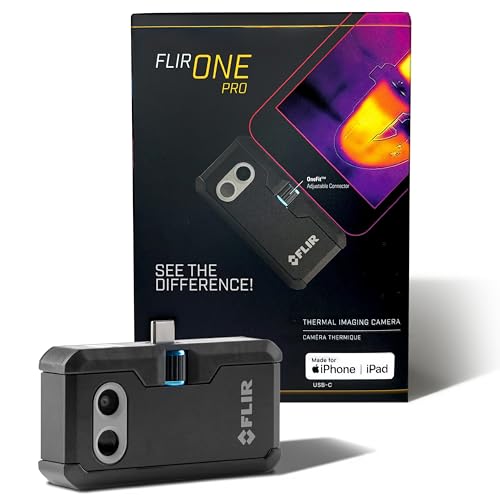
160×120 FLIR sensor upscaled to 480×360, MSX visual overlay, for USB-C iPhones; 2-10 warranty.
Check price on Amazon$296.65 as of Nov 23, 2026 3:50 am GMT+0000 — prices change; see Amazon for current price.| Specification | Details |
|---|---|
| Infrared sensor | 160×120 native; VividIR to 480×360 |
| Overlay | MSX embeds visible-camera edge detail into the thermal image |
| Accuracy | ±3 °C or ±5% within stated device and scene conditions |
| Compatibility | USB-C iPhones (iPhone 15 and newer) |
| App | Step-by-step home inspection guides for air leaks and moisture |
| Durability / warranty | 1.5 m drop; 2 years on camera, 10 years on detector |
FLIR One Pro 435-0008-03 — 160×120 native (480×360 VividIR), MSX, USB-C iPhone 15+, 1.5 m drop, 2-10 warranty
The Highest Enhanced Output From Any 160×120 Sensor Here
Four listings on the shelf state a native 160×120 sensor: two Thermal Master P1 listings, the RISION Magic and this FLIR One Pro. The others process their output to 320×240. FLIR states 480×360, three times the native figure on each axis. That processing smooths edges and makes the image easier to read, but it cannot add temperature data the 19,200 detector pixels did not capture.
MSX helps in a different way. By embossing visible edges onto the thermal image, it makes outlines of windows, outlets and framing readable even where the thermal pattern is faint. FLIR’s three listings here also share the only 10-year detector coverage on the shelf.
The listing does not state NETD; 14 of the 22 listings do. Its accuracy tolerance is wider than the ±2 °C figures several rivals give, and it only works with USB-C iPhones.
Pros
- Highest output of the 160×120 cameras
- MSX overlay makes images easy to place
- 10-year detector coverage
- In-app inspection guides
Cons
- NETD not stated
- USB-C iPhones only
- Wider accuracy tolerance
Check FLIR One Pro price on Amazon
5. RISION Magic — Best 160×120 Camera for Analysis Tools

160×120 USB-C attachment with 40 mK, 52°×39° view, 12 palettes, spot/line/area analysis and 2-year warranty.
Check price on Amazon$109.00 as of Nov 23, 2026 3:36 am GMT+0000 — prices change; see Amazon for current price.| Specification | Details |
|---|---|
| Infrared sensor | 160×120 native; QuadIR processing to 320×240 |
| Sensitivity / optics | 40 mK; 25 Hz; 52° × 39° field of view |
| Measurement | -4 °F to 1112 °F; ±3.6 °F; adjustable emissivity |
| App | No registration; thresholds, picture-in-picture, spot, line and area reports, real-time graphs, isotherms |
| Compatibility | USB-C on iOS, Android and Windows; Mac not supported |
| Warranty | 2 years |
RISION Magic AF01 — 160×120 native (320×240 QuadIR), 40 mK, 52°×39°, -4–1112 °F, 12 palettes, 2-yr warranty
The Most Color Palettes Stated, on a Mid-Resolution Sensor
RISION lists 12 color palettes, more than any other listing on the shelf; the next highest are 10 from AMPBANK and 9 each from the two FOXWELL handhelds and REVASRI. Palettes do not add resolution, but switching between a high-contrast palette and a grayscale one helps separate a subtle insulation pattern from background variation.
Its 52° × 39° view is the widest horizontal figure stated on the shelf, matched by one of the P1 listings, and it shares the highest stated measurement ceiling, 1112 °F, with the two P1 listings. The RISION app adds spot, line and area reporting with live graphs and describes AI fusion with the phone’s own camera.
The trade-off is the sensor class: at 19,200 pixels it shows less than half the detail of the 256×192 picks above. The listing does not state an IP or drop rating.
Pros
- 12 palettes, the most on the shelf
- 40 mK and a wide 52° × 39° view
- Reporting app with no registration
- 2-year warranty
Cons
- 160×120 native sensor
- Mac not supported
- No IP or drop rating stated
Check RISION Magic price on Amazon
6. TOPDON TC004 Mini — Best Small Handheld for Quick Checks

Pocket handheld, 128×128 native shown at 240×240, 15-hour battery, auto-capture on alarm, IP54.
Check price on Amazon$149.99 as of Nov 23, 2026 1:40 pm GMT+0000 — prices change; see Amazon for current price.| Specification | Details |
|---|---|
| Infrared sensor | 128×128 native; TISR to 240×240 |
| Optics | 40° × 30° field of view; 25 Hz |
| Measurement | -4 °F to 842 °F; ±3.6 °F or 2%; hot, cold and center tracking |
| Alarms and capture | On-screen warning with automatic photo when a preset limit is passed |
| Battery / storage | Up to 15 hours; 512 MB for about 8,000 photos |
| Durability | IP54; 2 m drop |
TOPDON TC004 Mini — 128×128 native (240×240 TISR), 40°×30°, -4–842 °F, auto-capture alarm, 15 h, IP54
The Longest Stated Battery Among the Handhelds Here, and the Only Auto-Capture Alarm
Eight of the 12 handheld listings state a run time. The TC004 Mini’s 15 hours is the longest, ahead of 14 hours for the two AccuMEMS GT14S listings. It is also the only listing that describes automatically taking a photo when a temperature alarm trips, a small convenience when sweeping a panel cover or a row of radiators.
On the resolution ladder, its 16,384-pixel sensor sits just below the 160×120 class and is the only 128×128 sensor on the shelf. The narrower 40° × 30° field of view partly compensates, because each pixel covers a smaller area at a given distance than on a 50° camera, though the whole frame covers less wall.
The listing does not state a thermal sensitivity figure, and the box includes a cable but no charging head.
Pros
- 15-hour stated battery
- Auto-photo when alarms trigger
- IP54 and 2 m drop
- Pocket-sized standalone unit
Cons
- 128×128 native sensor
- NETD not stated
- No charging head included
Check TOPDON TC004 Mini price on Amazon
7. FLIR TG165-X — Best for Spot Temperature With a Picture

Spot-IR thermal camera with 4,800-pixel sensor, MSX detail, bullseye laser and FLIR 2-10 warranty.
Check price on Amazon$318.99 as of Nov 23, 2026 3:03 pm GMT+0000 — prices change; see Amazon for current price.| Specification | Details |
|---|---|
| Infrared sensor | 4,800 pixels (80×60 class) |
| Measurement range | -13 °F to 572 °F |
| Image detail | MSX embosses visible detail onto the thermal image |
| Aiming | Laser that shows the size of the measurement area |
| Durability | Drop-tested; IP54 enclosure |
| Warranty | 2 years on camera, 10 years on detector |
FLIR TG165-X 87501-0101 — 4,800-pixel IR, -13–572 °F, MSX, bullseye laser, IP54, 2-10 warranty
The Lowest Pixel Count on the Shelf, Built Around a Spot Measurement
The TG165-X and the FLIR One share the lowest native resolution on the shelf, 4,800 pixels. The TG165-X is designed differently from every other pick: it is a spot infrared thermometer with a thermal picture, and its laser outlines the size of the measured area. That suits checking a single register, a pipe or a breaker cover, not mapping a wall.
It is the only listing that states a low end below -4 °F, reaching -13 °F, and the only one whose upper limit stops at 572 °F. For a buyer used to an infrared thermometer gun, it adds an image without changing the workflow.
For whole-room scanning, the pixel count is the limit: a 256×192 camera has more than ten times as many detector pixels. The listing does not state thermal sensitivity or battery life.
Pros
- Familiar spot-thermometer workflow
- MSX makes small images readable
- 10-year detector coverage
- Lowest stated minimum temperature
Cons
- Lowest pixel count on the shelf
- NETD and battery life not stated
- Lower 572 °F ceiling
Check FLIR TG165-X price on Amazon
The resolution ladder on today’s shelf
Sixteen of the 22 listings state a native sensor resolution. Here is how they fall, with pixel counts:
| Native resolution | Detector pixels | Listings stating it |
|---|---|---|
| 256×192 | 49,152 | 4 (2 handheld, 2 phone) |
| 192×192 | 36,864 | 1 |
| 160×120 | 19,200 | 4 |
| 128×128 | 16,384 | 1 |
| 120×90 | 10,800 | 1 |
| 96×96 | 9,216 | 3 |
| 80×60 | 4,800 | 2 |
Six listings do not state a native figure at all, only an enhanced or “super resolution” number. Treat a missing native figure as a reason to ask the seller before buying.
How to read thermal camera specs
Native vs enhanced resolution
Enhancement names such as TISR, X³, VividIR and QuadIR describe processing that interpolates or sharpens the image, sometimes with help from a visible camera. The output looks smoother and is easier to interpret, but each displayed pixel is an estimate built from the native readings. When two cameras both claim 512×384, compare their native figures; when one states only an enhanced number, assume the native figure is lower.
Resolution and distance
Each detector pixel views a small cone that widens with distance. Close up, even a 96×96 sensor can resolve a leaking pipe joint; from across a living room, the same pixel may average a cold gap together with the warm wall around it. Higher native resolution, or a narrower field of view, lets the camera resolve smaller targets from farther away. This is why a 256×192 sensor makes whole-wall insulation surveys easier, while a lower-resolution camera works if the user is willing to step closer.
Thermal sensitivity (NETD)
NETD measures how small a temperature difference the sensor can separate from noise. Fourteen of the 22 listings state it, and 9 of those claim 40 mK. Resolution decides how small a feature can be; sensitivity decides how faint it can be. Insulation voids on a mild day need both.
Field of view
Stated views on this shelf run from 40° × 30° to about 52°. Wider views fit more of a small room into one frame; narrower views concentrate pixels on a smaller area.
Visible-light reference
Seven listings here describe a visible camera or visual overlay, counting FLIR’s MSX models and TOPDON’s dual-lens units. A reference image makes each thermal photo easy to place afterward, which matters more as the number of images grows.
What a homeowner actually needs
For finding drafts, wet ceilings and radiant floor loops, a 160×120 native sensor is usually enough. For whole-house insulation surveys, documentation for a contractor or frequent use, 256×192 is worth the step up. Below 160×120, cameras work best close to the target or as spot tools.
ENERGY STAR’s list of common home problems, including drafty rooms, uneven temperatures, high bills, ice dams and cold floors, maps neatly to thermal scanning, and its DIY checks for air leaks use fans and smoke to make leaks visible. Running bath and kitchen exhaust fans during a thermal scan uses the same idea. ENERGY STAR also says that in a typical house, about 20 to 30 percent of the air moving through ducts is lost to leaks, holes and poor connections, so ducts in attics, crawlspaces and garages are worth scanning.
For moisture, EPA’s guidance is that moisture control is the key to mold control and that wet materials should be dried within 24 to 48 hours. A thermal camera can find where a wet area ends, but it cannot measure moisture or identify mold; confirm with a moisture meter. Our guide to an infrared scan during a home inspection shows how inspectors combine the two, and buyers who only need a camera for a weekend can compare thermal imaging camera rental options.
Colorado notes for Front Range homes
Cold, clear Front Range winter mornings create the strong indoor-outdoor temperature differences that let even modest sensors show insulation gaps. Plains communities like Platteville and Ault also see wind that can smooth out exterior patterns, so interior scans are often more reliable.
Dry air makes wet materials cool by evaporation, which helps a thermal camera find leaks, but it also dries them quickly, so scan soon after a storm or plumbing problem. ENERGY STAR cautions that air sealing can trap radon and carbon monoxide and cause combustion appliances to backdraft; with radon common in Colorado, test before and after tightening a home.
Limits of DIY thermal cameras vs a professional inspection
No resolution class lets a camera see through walls; it shows surface temperatures only. Reflective surfaces fool it, dried leaks are invisible to it, and it cannot measure air leakage the way a blower-door test does. ENERGY STAR recommends a home energy professional for a comprehensive audit that finds hidden air leaks and identifies safety issues. A trained inspector pairs thermal imaging with moisture meters, attic and crawlspace access and written documentation.
For a single best pick for most homeowners, see our companion guide to the best thermal camera. For a professional scan during a purchase, contact us, and see our home inspection tools hub for the meters that confirm what a camera finds.
More Questions About Thermal Cameras
Can a thermal camera see through glass?
No, a thermal camera cannot see through ordinary window glass, because glass blocks long-wave infrared and acts like a mirror for heat. Pointing a thermal camera at a window usually shows the glass’s own temperature plus reflections of you and nearby warm objects. That is why heat-loss checks should focus on window frames and surrounding walls rather than the pane. Thermal camera lenses are made from special materials such as germanium for this reason. Doors with glass panels have the same limitation.
Why are shiny surfaces hard for a thermal camera to read?
Shiny surfaces are hard for a thermal camera to read because they have low emissivity, meaning they emit little infrared energy and reflect heat from their surroundings instead. Polished metal, foil-faced insulation, stainless appliances and chrome fixtures can show false hot or cold spots or reflect the person holding the camera. Setting emissivity correctly helps a little, but placing a piece of electrical tape or matte paint on the surface and measuring that spot gives a more reliable reading. Comparing angles also reveals reflections.
Does frame rate matter on a thermal camera?
Frame rate matters on a thermal camera mainly for moving scenes, while home inspection subjects such as walls and ceilings stay still, so lower frame rates work fine. Many consumer thermal cameras run at 9 Hz or less, partly because of export regulations, while some higher-end models offer faster rates. A slower frame rate can cause slight lag or blur when panning quickly. Moving the camera slowly solves most of this. Faster frame rates help more with outdoor wildlife, vehicles or moving machinery.
Do thermal cameras need calibration?
Thermal cameras are calibrated at the factory, and most consumer cameras perform an automatic shutter correction during use to keep readings stable. Professional thermographers sometimes send cameras for periodic recalibration, typically every year or two, when accurate temperature measurements are needed for reports. Homeowners using a camera to spot relative temperature differences, such as drafts or wet spots, rarely need recalibration. If readings drift noticeably compared with a known reference, contact the manufacturer for service options.
How long does a thermal camera sensor last?
A thermal camera sensor typically lasts many years, because uncooled microbolometer sensors used in consumer cameras have no moving parts beyond the shutter. The parts more likely to fail are batteries, connectors, screens and the shutter mechanism. Pointing the camera at the sun or very hot sources such as welding arcs can damage the sensor permanently. Storing the camera in its case, protecting the lens and keeping firmware updated helps it last. Phone attachments may become obsolete sooner if phone ports or apps change.
References
- What to Look For: DIY Checks and Inspections — ENERGY STAR
- Identify the Problems You Want to Fix — ENERGY STAR
- Duct Sealing — ENERGY STAR
- A Brief Guide to Mold, Moisture and Your Home — U.S. Environmental Protection Agency
Frequently asked questions
What resolution should a thermal camera have for home use?
A native 160×120 sensor is a practical floor for drafts, wet ceilings and radiant floors. A native 256×192 sensor, the highest on the current shelf, has about 2.6 times as many detector pixels and makes whole-house insulation surveys and documentation easier.
What is the difference between native and super resolution on thermal cameras?
Native resolution is the number of real infrared detector pixels. Super resolution, sold under names like TISR, X³ or VividIR, is processed output that smooths and enlarges the image. It improves readability but cannot add temperature data the detector did not measure, so compare cameras on native resolution.
Are phone thermal cameras as good as handheld thermal cameras?
At the same native resolution, phone attachments can show the same detail as handhelds, and two phone attachments on the current shelf match the top 256×192 class. Handhelds add a dedicated screen, buttons, battery and often a laser or light, which helps in attics and crawlspaces.
Does NETD matter as much as resolution?
They measure different things. Resolution determines how small a feature the camera can see, while NETD determines how faint a temperature difference it can detect. Insulation voids on a mild day need both, so prefer cameras that state a native resolution and an NETD figure.
Can a thermal camera find mold?
No. It can show cool areas that often indicate moisture, which mold needs, but it cannot identify mold. Confirm with a moisture meter, dry wet materials quickly as EPA advises, and have a professional assess any visible growth or persistent odor.
What temperature range does a home thermal camera need?
A home thermal camera typically needs a range from below freezing to a few hundred degrees Fahrenheit to cover drafts, insulation checks, plumbing and most electrical hot spots. Fireplaces, ovens and industrial uses need higher ranges. Checking the stated range on the listing avoids saturated readings.
Can a thermal camera see through smoke?
Yes, thermal cameras can see through many types of smoke better than ordinary cameras, which is why firefighters use specialized thermal imagers. Consumer home-inspection cameras are not designed or rated for firefighting. If there is smoke in a home, leave and call emergency services.
Are cheap thermal cameras accurate?
Cheap thermal cameras are often accurate enough to show relative temperature differences, such as drafts or wet spots, but their absolute readings may vary by several degrees. Low native resolution and enhanced images can hide small details. Check stated accuracy, native resolution and sensitivity before buying.
Want a thermal scan as part of a Front Range home inspection? Reach out through our contact page to connect with a vetted local inspector.