Best Refrigerant Leak Detectors (2026): 7 Sniffers Compared
Choosing the best refrigerant leak detector comes down to three questions: what sensor it uses, how small a leak it claims to find, and whether it recognizes the refrigerant in the system you are checking. Infrared and heated diode sniffers dominate the professional end, while cheaper corona and semiconductor units cover quick checks. The newer A2L refrigerants going into heat pumps and air conditioners add a fourth question. This guide compares current listings on what each one states, then explains where a homeowner’s role ends: under federal rules, repairing and recharging a refrigerant circuit is work for an EPA-certified technician. Seven picks follow, each matched to a job.
Part of our Home Inspection Tools guide — start there for the full picture →
As an Amazon Associate we earn from qualifying purchases.
How we compared: we compared 13 current Amazon listings for handheld refrigerant leak detectors on what each listing states: sensor type, rated sensitivity in ounces per year, refrigerant families covered, sensor life, power source, display and alarm features. All 13 were genuine refrigerant sniffers. We did not lab-test any of these instruments or use them hands-on, and stated sensitivity figures come from the sellers. Prices and availability change often, so check the current listing before buying.
Quick picks: the best refrigerant leak detectors by use case
| Product | Best for | Key features | Price | Buy |
|---|---|---|---|---|
| Fieldpiece DR82 | Best overall infrared sniffer |
| $565.25as of Oct 24, 2026 11:30 am GMT+0000 | Buy now →Check current price |
| Fieldpiece DR58 | Heated diode with tracer gas |
| $370.20as of Oct 24, 2026 11:30 am GMT+0000 | Buy now →Check current price |
| Inficon 705-202-G1 | A2L-certified heated diode |
| $232.99as of Oct 24, 2026 11:30 am GMT+0000 | Buy now →Check current price |
| Elitech ILD-200 | Compact infrared value pick |
| $190.99as of Oct 24, 2026 11:29 am GMT+0000 | Buy now →Check current price |
| Aprvtio ALD-200 | A1, A2L and A3 refrigerants |
| $109.99as of Oct 24, 2026 12:04 pm GMT+0000 | Buy now →Check current price |
| SENSYX SFD201 | Refrigerant plus combustible gas |
| $56.90as of Oct 24, 2026 12:04 pm GMT+0000 | Buy now →Check current price |
| ZLLJYBLG GL77A | Pairing with UV dye checks |
| $22.09as of Oct 24, 2026 12:04 pm GMT+0000 | Buy now →Check current price |
Prices are Amazon’s listed prices as of the time shown and change often; check Amazon for today’s price. As an Amazon Associate we earn from qualifying purchases.
The 7 picks, compared listing by listing
1. Fieldpiece DR82 — Best Overall Infrared Refrigerant Leak Detector

Infrared sniffer rated under 0.03 oz/yr with a 10-year sensor life, IP54 housing, 17-inch probe and USB-C battery.
Check price on Amazon$565.25 as of Oct 24, 2026 11:30 am GMT+0000 — prices change; see Amazon for current price.Why we like it
- Tied for the most sensitive stated rating
- Infrared sensor rated for 10 years
- IP54 housing resists moisture and oil
- Backlit screen shows leak size and intensity
| Specification | Details |
|---|---|
| Sensor | Infrared |
| Stated sensitivity | Under 0.03 oz/yr; described as 20 times more sensitive than bubbles |
| Refrigerants | CFC, HCFC, HFC, HFO and blends |
| Durability | IP54; 10-year sensor life; replaceable filter tips |
| Probe / power | 17-inch flexible probe; USB-C rechargeable, 10+ hours |
| Weight | About 1 lb |
Fieldpiece DR82 — infrared, <0.03 oz/yr, CFC/HCFC/HFC/HFO, IP54, 10-yr sensor, 17 in probe, USB-C 10+ h
The Only Listing Pairing the Top Sensitivity Rating With a 10-Year Sensor
Nine of the 13 listings state a sensitivity in ounces per year, and the two Fieldpiece models share the best figure at under 0.03 oz/yr. Four listings state a sensor life. Two of those are infrared units rated for 10 years: this DR82 and the Elitech ILD-200. The DR82 is the only one that combines the top sensitivity claim with the decade-long sensor, which is why it leads this list.
Infrared sensors measure how refrigerant absorbs infrared light, so they do not burn out the way heated diode tips do over hundreds of hours. That matters for a tool that sits in a truck or a utility closet between uses. The DR82 also shares the DR58’s IP54 rating, which only the two Fieldpiece listings mention, along with a 17-inch probe that is the longest stated on the shelf.
Unlike its DR58 sibling, the DR82 listing does not mention hydrogen-nitrogen tracer gas, and it does not specifically name A2L refrigerants such as R32 or R454B. It lists HFOs and blends broadly. Confirm compatibility with the refrigerant on the equipment nameplate before relying on it.
Pros
- Under 0.03 oz/yr stated sensitivity
- 10-year infrared sensor life
- IP54 and the longest probe on the shelf
Cons
- A2L refrigerants not named specifically
- No tracer gas detection listed
- Professional-grade tool for occasional home use
Check Fieldpiece DR82 price on Amazon
2. Fieldpiece DR58 — Best Heated Diode Detector With Tracer Gas Support

Heated diode sniffer rated under 0.03 oz/yr that also detects H2/N2 tracer gas, with an 18-hour USB battery.
Check price on Amazon$370.20 as of Oct 24, 2026 11:30 am GMT+0000 — prices change; see Amazon for current price.Why we like it
- Matches the DR82’s under-0.03 oz/yr rating
- Also detects hydrogen-nitrogen tracer gas
- 18-hour USB rechargeable battery
- IP54 and a 17-inch probe
| Specification | Details |
|---|---|
| Sensor | Heated diode; 300-hour sensor life |
| Stated sensitivity | Under 0.03 oz/yr |
| Gases | HFC, CFC, HCFC, HFO, blends and H2/N2 tracer gas |
| Display / alarms | Backlit LCD with leak size; LED tip and beep |
| Power | USB rechargeable, 18 hours |
| Weight | Listed at 3 lb shipping weight |
Fieldpiece DR58 — heated diode, <0.03 oz/yr, HFC/CFC/HCFC/HFO + H2/N2 tracer, IP54, 300 h sensor, 18 h USB battery
One of Two Listings That Detect Tracer Gas
When a system has been emptied for repair, technicians sometimes pressurize it with a hydrogen and nitrogen mix rather than refrigerant to find the leak. Only two listings mention that tracer gas: this DR58 and the Aprvtio ALD-200. The DR58 pairs it with the top stated sensitivity on the shelf, which gives a technician one tool for both stages of a repair.
Heated diode sensors are the long-standing professional choice, and four listings on the shelf use one (this, the Elitech ILD-100H, the Inficon and the Aprvtio). The trade-off is sensor life: the DR58 states 300 hours, against 10 years for the infrared units. Replacement sensors are a normal running cost for heavy users. For a homeowner who checks a system a few times a year, 300 hours lasts a long time.
The listing does not specifically name A2L refrigerants, and its stated weight appears to be a shipping weight.
Pros
- Top stated sensitivity, under 0.03 oz/yr
- Detects H2/N2 tracer gas
- Long 18-hour battery and IP54 housing
Cons
- 300-hour heated diode sensor needs replacing
- A2L refrigerants not named specifically
- Weight listed only as shipping weight
Check Fieldpiece DR58 price on Amazon
3. Inficon 705-202-G1 — Best for A2L Refrigerant Systems
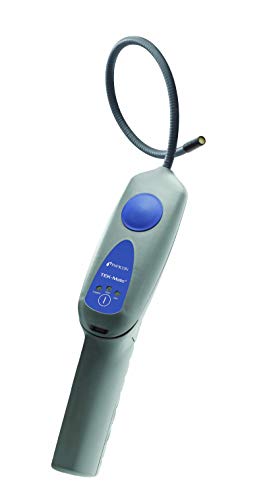
Heated diode detector rated 0.25 oz/yr, described as A2L Certified, with automatic zeroing and a rugged case.
Check price on Amazon$232.99 as of Oct 24, 2026 11:30 am GMT+0000 — prices change; see Amazon for current price.Why we like it
- Only listing that says “A2L Certified”
- Automatic background zeroing
- No false alarms from soap solutions, per listing
- Made in the United States; carrying case included
| Specification | Details |
|---|---|
| Sensor | Heated diode; 100-hour sensor life |
| Stated sensitivity | 0.25 oz/yr (7 g/yr) |
| Refrigerants | All CFCs, HCFCs, HFCs and HFOs; A2L Certified |
| Calibration | Automatic background adjustment |
| Power | Two D-cell alkaline batteries |
| Size / weight | About 4 x 4 x 12 in; 3.1 lb |
Inficon 705-202-G1 — heated diode, 0.25 oz/yr, CFC/HCFC/HFC/HFO, A2L Certified, auto-zero, 2 D-cells, 100 h sensor
The Only Listing That Claims A2L Certification
Newer residential heat pumps and air conditioners are moving to A2L refrigerants such as R32 and R454B, which are mildly flammable. Five listings name one of those refrigerants in their compatibility lists, but naming a gas is not the same thing as stating certification for use around it. The Inficon is the only listing that says “A2L Certified,” and the Aprvtio is the only other one that uses the A2L class name at all.
The Inficon also states it will not false-alarm on soap solutions, which helps when a technician has already bubble-tested a joint, and it zeroes itself against background refrigerant in the air. Both features help in a cramped mechanical room where traces of refrigerant linger.
Its stated 0.25 oz/yr sensitivity is well below the Fieldpiece pair, and its 100-hour sensor life is the shortest stated on the shelf. D-cell power makes it bulky at 3.1 lb, though D-cells are easy to find. The listing does not describe a display.
Pros
- Only listing stating A2L certification
- Ignores soap solutions; auto-zeroing
- Uses easy-to-find D-cell batteries
Cons
- Lower stated sensitivity at 0.25 oz/yr
- Shortest stated sensor life, 100 hours
- Heavy at 3.1 lb; no display described
Check Inficon 705-202-G1 price on Amazon
4. Elitech ILD-200 — Best Compact Infrared Value Pick
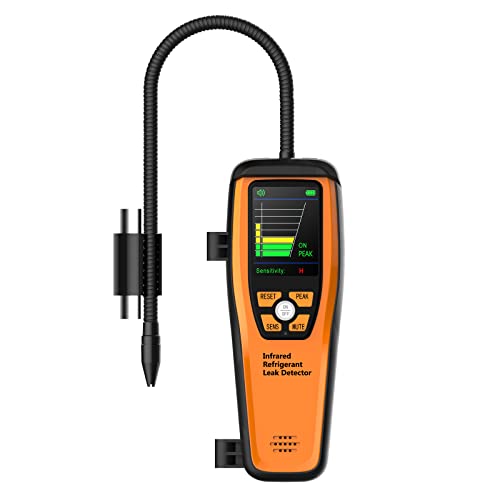
Under-1-lb infrared sniffer with a 10-year sensor life, three sensitivity levels to 0.14 oz/yr and a peak display.
Check price on Amazon$190.99 as of Oct 24, 2026 11:29 am GMT+0000 — prices change; see Amazon for current price.Why we like it
- Infrared sensor rated for 10 years
- Three sensitivity levels, up to 0.14 oz/yr
- Peak display helps pinpoint the leak spot
- Light at 0.93 lb
| Specification | Details |
|---|---|
| Sensor | Infrared; 10-year sensor life |
| Stated sensitivity | High, medium and low; maximum 0.14 oz/yr |
| Refrigerants | CFCs, HFCs, HCFCs, HCs, HFOs and blends |
| Display | 2.8-inch screen with peak display |
| Power | Not stated in listing |
| Weight / warranty | 0.93 lb; 1-year warranty |
Elitech ILD-200 — infrared, 0.14 oz/yr max, 3 levels, CFC/HFC/HCFC/HC/HFO, 2.8 in screen with peak, 0.93 lb, 1-yr warranty
The Lighter of the Two Infrared Units With a 10-Year Sensor
Only two listings on the shelf use an infrared sensor with a stated 10-year life, the Fieldpiece DR82 and this Elitech. The ILD-200 gives up sensitivity, with a stated maximum of 0.14 oz/yr rather than under 0.03, but it keeps the long-life sensor in a smaller body that weighs under a pound.
It is also one of two listings with a peak function, the other being the Aprvtio. A peak display holds the highest reading so you can sweep a coil and then return to where the signal spiked. Three sensitivity levels let you start broad and narrow down.
The listing does not state the battery type or runtime and does not specifically name A2L refrigerants, though it lists HCs and HFOs. Its warranty is one year.
Pros
- 10-year infrared sensor in a sub-1-lb body
- Peak display and three sensitivity levels
- Broad refrigerant family coverage
Cons
- 0.14 oz/yr, well short of the Fieldpiece pair
- Battery type and runtime not stated
- A2L refrigerants not named
Check Elitech ILD-200 price on Amazon
5. Aprvtio ALD-200 — Best for Mixed A1, A2L and A3 Refrigerants

Heated diode sniffer naming R410A, R32, R454B and R290 coverage, plus tracer gas, peak mode and a 2.8-inch color screen.
Check price on Amazon$109.99 as of Oct 24, 2026 12:04 pm GMT+0000 — prices change; see Amazon for current price.Why we like it
- Names A1, A2L and A3 refrigerant classes
- Also detects H2/N2 tracer gas
- Peak mode and reset recalibration
- Rechargeable, oil-resistant housing
| Specification | Details |
|---|---|
| Sensor | Heated diode |
| Stated sensitivity | Adjustable to 0.14 oz/yr |
| Refrigerants | A1 (R410A), A2L (R32, R454B), A3 (R290, R600), plus H2/N2 tracer |
| Display / alarms | 2.8-inch TFT color screen; beep rate rises with concentration; mute |
| Features | Peak mode; reset recalibration; auto-zero in clean air |
| Power | Rechargeable, described as lasting a full day |
Aprvtio ALD-200 — heated diode, 0.14 oz/yr, A1/A2L/A3 + tracer gas, 2.8 in TFT, peak mode, rechargeable
The Only Listing That Names All Three Safety Classes
Two listings name R290 (propane refrigerant), and two use the A2L class name. The Aprvtio is the only listing in both groups, and it states coverage of A1, A2L and A3 refrigerants by class. That breadth fits a household with an older R410A air conditioner, a new heat pump on R454B and a propane-refrigerant appliance in the garage.
It is also one of two listings that detect tracer gas, alongside the Fieldpiece DR58, and one of two with a peak mode, alongside the Elitech ILD-200. Few units combine those features at the same time.
Note what it does not claim: certification. Unlike the Inficon, the listing says it detects A2L gases but not that it is certified for use with them. It does not state sensor life, battery runtime in hours or warranty.
Pros
- Names A1, A2L and A3 refrigerant classes
- Tracer gas detection plus peak mode
- Color screen with rising beep rate
Cons
- No A2L certification claimed
- Sensor life and warranty not stated
- Battery runtime given only as a full day
Check Aprvtio ALD-200 price on Amazon
6. SENSYX SFD201 — Best for Refrigerant and Combustible Gas in One Tool

Semiconductor sniffer with a live ppm readout that detects refrigerants plus methane, propane and natural gas.
Check price on Amazon$56.90 as of Oct 24, 2026 12:04 pm GMT+0000 — prices change; see Amazon for current price.Why we like it
- Detects refrigerants and combustible gases
- Shows live concentration in ppm
- Up to 24 hours on a USB-C charge
- Clear instructions on probe speed and warm-up
| Specification | Details |
|---|---|
| Sensor | Metal-oxide semiconductor |
| Gases | CFCs, HCFCs, HFCs, HFOs; plus methane, propane, isobutane, natural gas, LPG |
| Display | Color LCD with ppm reading and bar graph; mutable buzzer |
| Sensitivity | High and low settings; oz/yr rating not stated in listing |
| Power | 2,500 mAh lithium, up to 24 hours; USB-C |
| Weight | 0.5 lb |
SENSYX SFD201 — metal-oxide, refrigerants + combustible gases, live ppm display, 24 h USB-C battery, 0.5 lb
The Only Two-in-One Refrigerant and Combustible Gas Detector Here
Of the 13 listings, only the SFD201 also detects combustible gases such as natural gas and propane. Its sibling, the SFD200, is refrigerant-only. For a homeowner who wants one instrument for checking a furnace’s gas line and an air conditioner’s line set, that combination is the reason to buy it.
It is also one of three listings that show a ppm number, with the SFD200 and POROMETISTO. A climbing ppm reading is easier to follow than a beep rate. The listing is unusually honest about technique: metal-oxide sensors need several hours of initial run-in, and the probe should move no faster than an inch per second about a quarter inch from the joint.
It does not give a sensitivity in oz/yr, so it cannot be compared directly with the diode and infrared units. The listing itself says it is a handheld inspection tool and not a substitute for a listed gas alarm, which is correct: for gas safety, a fixed alarm is still needed.
Pros
- Only listing that adds combustible gas detection
- Live ppm reading and bar graph
- Long battery life and clear usage guidance
Cons
- No oz/yr sensitivity rating stated
- Needs hours of initial warm-up when new
- Not a replacement for a fixed gas alarm
Check SENSYX SFD201 price on Amazon
7. ZLLJYBLG GL77A — Best Budget Sniffer to Pair With UV Dye

AAA-powered halogen sniffer with UV probe light, 30-second warm-up, auto power-off and a 2-year warranty.
Check price on Amazon$22.09 as of Oct 24, 2026 12:04 pm GMT+0000 — prices change; see Amazon for current price.Why we like it
- UV light on the probe for dye-marked leaks
- 30-second automatic warm-up
- States probe distance and sweep speed
- Two-year manufacturer warranty
| Specification | Details |
|---|---|
| Sensor | Semiconductor type; listed as “heat dioxide semiconductor” |
| Stated sensitivity | 0.49 oz/yr (14 g/yr) |
| Refrigerants | Halogenated, including R134a, R1234yf, R410a, R22, R454b, R32 |
| Extras | UV probe light; backlit LCD; auto power-off; reset calibration |
| Technique | Probe within 0.25 in, moving no faster than 3 in per second |
| Power / warranty | 2 AAA batteries, included; 2-year manufacturer warranty |
ZLLJYBLG GL77A — semiconductor sniffer, 0.49 oz/yr, UV probe light, backlit LCD, 2 AAA, 2-yr warranty
The Clearest UV Light Feature on the Shelf
UV dye is a separate leak-finding method: a technician injects fluorescent dye into the system, then looks for glowing residue at joints under ultraviolet light. Three listings mention some form of UV or purple light, but the GL77A is the one whose features describe using that light to visualize leaks in real time. Combining a sniffer with UV lets you narrow the area electronically, then confirm the exact joint visually.
It is also one of two listings that state a two-year manufacturer warranty, along with the POROMETISTO. The listing gives specific technique numbers, a probe distance of a quarter inch and a sweep of no more than three inches per second.
The weakness is sensitivity. At 0.49 oz/yr it has the lowest stated figure of the nine listings that give one, so it will miss leaks the infrared and diode units find. Its sensor description is vague. Treat it as a budget helper, not a primary diagnostic tool.
Pros
- UV light for dye-based confirmation
- Fast 30-second warm-up
- Two-year warranty; batteries included
Cons
- Lowest stated sensitivity at 0.49 oz/yr
- Vague sensor description
- Not a primary diagnostic tool
Check ZLLJYBLG GL77A price on Amazon
Heated diode vs infrared vs other sensor types
Every electronic refrigerant leak detector on this shelf is a “sniffer”: it draws air through a probe tip and reacts to halogenated gas. How it reacts is what separates them. Our refrigerant leak detector guide covers each method in more depth.
- Heated diode sensors react chemically to refrigerant molecules on a heated element. They are sensitive and well proven but the sensor wears with use; listings here state 100 to 300 hours. Four listings use one.
- Infrared sensors measure how refrigerant absorbs infrared light. Elitech’s listing credits infrared with stronger resistance to interference, and both infrared listings state a 10-year sensor life. They generally cost more up front.
- Metal-oxide semiconductor sensors, like the SENSYX pair, respond to a broad range of gases and are inexpensive, but they need warm-up time and can react to other vapors.
- Corona discharge sensors, used in older and entry-level designs such as the Elitech CLD-100, are the most basic design; the CLD-100 lists a stated 0.21 oz/yr and six-second preheat.
- UV dye is not a sensor at all. A technician adds dye to the system and finds the leak by its glow. It is slow to show results but excellent for confirming the exact spot.
- Bubble solution is the oldest method and still useful on accessible joints. Fieldpiece describes its detectors as 20 times more sensitive than bubbles.
For broad comparisons with other leak-finding tools, see our guides to the electronic leak detector and the Fieldpiece DR82 infrared detector.
Reading sensitivity ratings and refrigerant compatibility
Ounces per year. A rating like 0.1 oz/yr describes the smallest steady leak the sensor can theoretically detect under ideal conditions. Lower is more sensitive. On this shelf the stated figures run from under 0.03 to 0.49 oz/yr, a sixteen-fold spread. Real-world performance depends heavily on technique: probe distance, sweep speed, drafts and whether the sensor has warmed up.
Refrigerant families. Older systems use R22 (an HCFC); most systems installed in the last two decades use R410A (an HFC blend). Many new heat pumps and air conditioners use A2L refrigerants such as R32 or R454B, and car air conditioners use R134a or R1234yf. Check the nameplate on the outdoor unit and confirm the detector names that refrigerant or its class.
A2L and A3 refrigerants. The EPA notes that refrigerant hazards can include toxicity, flammability, asphyxiation and physical hazards, which equipment design and handling procedures are meant to control. A2L refrigerants are mildly flammable and A3 refrigerants, such as propane, are flammable. A detector certified for A2L use, like the Inficon, is designed with that risk in mind.
Technique specs. The best listings give working guidance: SENSYX says move about one inch per second a quarter inch from the joint, and ZLLJYBLG says no faster than three inches per second. Slow, close and draft-free is the rule for every sensor type.
EPA Section 608: what homeowners can and cannot do
A leak detector lets a homeowner confirm a suspicion, but the repair is regulated. Under Section 608 of the Clean Air Act, technicians who maintain, service, repair or dispose of equipment that could release refrigerants must be EPA-certified. The same rules prohibit anyone from intentionally venting refrigerants, including common HFCs, while working on air conditioning or refrigeration equipment.
The rules also restrict who can buy refrigerant. The EPA’s sales restriction says that, with limited exceptions, only certified technicians may purchase refrigerant in cylinders, cans or drums. One exception covers small cans of certain refrigerants for car air conditioners. For a home central air or heat pump system, that means a homeowner cannot legally top off refrigerant, and “recharge kits” sold for home systems are not a workaround.
Federal leak-repair requirements with specific trigger rates apply to appliances holding 50 or more pounds of refrigerant, well above a typical residential split system, so the formal leak-rate rules usually do not apply to houses. A leaking home system still loses efficiency, can damage the compressor and releases refrigerant into the air, so a found leak should be repaired, not repeatedly recharged.
What a homeowner can reasonably do with a detector:
- Sniff around accessible fittings, the outdoor unit’s service valves and an exposed line set to confirm a suspected leak before calling a technician.
- Check a refrigerator or freezer compartment for a slow leak, then call a certified appliance technician.
- Verify after a repair that a reported fix is holding, while the technician’s work is still under warranty.
Leave gauges, valve cores and recharging to a certified technician.
Front Range considerations
Front Range air conditioners and heat pumps work in a climate of hot, dry summers, hail, wide day-night temperature swings and long periods of idleness in winter. Those swings stress brazed joints and flare fittings, and hail can damage coil fins and exposed line sets. Heat pumps, increasingly common as primary heat in Colorado homes, run refrigerant through the circuit year round, so a slow leak shows up as weaker heating as well as weaker cooling.
ENERGY STAR recommends annual pre-season check-ups by a contractor, with cooling systems checked in spring before contractors get busy. A detector is a useful companion to that visit, not a replacement for it. For other gas and leak tools around the house, see our combustible gas leak detector guide and the inspection tools hub.
When to call a professional
Call a certified HVAC technician when the system blows warm air, ices up on the indoor coil or the outdoor refrigerant lines, short-cycles, or when a detector confirms a leak. Ask the technician which refrigerant the system uses and whether the repair plan includes a leak search and verification, not only a recharge.
If you are buying a Front Range home, a home inspection notes the age and condition of the air conditioner or heat pump and flags visible damage, though inspectors do not perform refrigerant leak searches. Our home inspection tools overview explains what inspectors carry. To connect with a vetted local inspector, reach out through our contact page.
References
- Section 608 of the Clean Air Act — U.S. Environmental Protection Agency
- Section 608 Technician Certification — U.S. Environmental Protection Agency
- Refrigerant Sales Restriction — U.S. Environmental Protection Agency
- Stationary Refrigeration Leak Repair Requirements — U.S. Environmental Protection Agency
- Refrigerant Safety — U.S. Environmental Protection Agency
- Maintenance Checklist — ENERGY STAR
Frequently asked questions
What is the best type of refrigerant leak detector?
Infrared and heated diode detectors are the most sensitive types on the current market. Infrared sensors last much longer, with some listings stating 10 years, while heated diode sensors are proven but wear out after a few hundred hours. Semiconductor and corona units cost less but are less sensitive and more prone to false alarms.
Can a homeowner fix a refrigerant leak?
A homeowner can use a detector to confirm a suspected leak, but repair belongs to a certified technician. EPA Section 608 rules require technicians who service equipment that could release refrigerant to be certified, prohibit intentional venting, and restrict refrigerant sales mostly to certified technicians, with limited exceptions such as small cans for car air conditioners.
Do refrigerant leak detectors work on R32 and R454B?
Many do, but check the listing. Several current detectors name R32 and R454B in their compatibility lists, and one listing on our shelf states A2L certification. Because A2L refrigerants are mildly flammable, a detector designed and certified for A2L use is the better choice for new heat pumps and air conditioners.
How sensitive does a refrigerant leak detector need to be?
For HVAC work, stated sensitivities around 0.1 oz per year or lower are common on professional tools, and the best listings claim under 0.03. Technique matters as much as the rating: move the probe slowly, about a quarter inch from the joint, with fans off. A cheap, less sensitive sniffer can still confirm an obvious leak.
Is a refrigerant leak detector the same as a gas leak detector?
No. Refrigerant detectors respond to halogenated refrigerants, while gas leak detectors respond to natural gas or propane. One listing we compared detects both. For gas safety in the home, a handheld detector is an inspection tool only; fixed, listed gas and carbon monoxide alarms are still needed.