Best Water Leak Detectors (2026): 7 Picks, Alarms to Smart
The best water leak detector depends on one question: who will hear it? A standalone alarm under the sink is loud and simple, but it only helps if someone is home. A smart sensor sends a phone alert wherever you are, and a few systems can go further and trigger a shutoff valve. A third category, acoustic pipe detectors, does a different job entirely: finding a hidden leak you already suspect. Below are seven picks across all three types, then a guide on where to place sensors, what the specs mean and when a leak needs a plumber or an inspection.
Part of our Moisture Meters & Water Damage Detection guide — start there for the full picture →
As an Amazon Associate we earn from qualifying purchases.
How we compared: we compared 12 current Amazon water leak detector listings on what each states: alert method (local siren, app, SMS or email), hub or gateway requirement, wireless range, battery type and life, probe layout, waterproof rating and any shutoff integration. Six are app-connected sensor kits, four are standalone audible alarms, and two are acoustic instruments for locating leaks in pipes. We did not test any of these devices hands-on. Prices and availability change often, so check the current listing before buying.
Quick picks: the best water leak detectors by job
| Product | Best for | Key features | Price | Buy |
|---|---|---|---|---|
| YoLink Leak Sensor 1 Kit | Alerts plus automatic shutoff |
| $49.49as of Oct 19, 2026 9:08 pm GMT+0000 | Buy now →Check current price |
| GoveeLife 1s 3-Pack | Phone alerts with a loud siren |
| $39.99as of Oct 19, 2026 8:59 pm GMT+0000 | Buy now →Check current price |
| X-Sense SWS0A41 | Tight spots behind appliances |
| — | Buy now →Check current price |
| METAK 5-Pack | Simple standalone alarms |
| $35.99as of Oct 19, 2026 8:59 pm GMT+0000 | Buy now →Check current price |
| RUIKORING 5-Pack | Adjustable volume alarms |
| $32.39as of Oct 19, 2026 8:59 pm GMT+0000 | Buy now →Check current price |
| Stechro WD76 5-Pack | Budget standalone set |
| $36.99as of Oct 19, 2026 8:59 pm GMT+0000 | Buy now →Check current price |
| PQWT PQ125A | Finding hidden pipe leaks |
| $705.00as of Oct 19, 2026 8:59 pm GMT+0000 | Buy now →Check current price |
Prices are Amazon’s listed prices as of the time shown and change often; check Amazon for today’s price. As an Amazon Associate we earn from qualifying purchases.
The seven picks, compared listing by listing
1. YoLink Water Leak Sensor 1 Kit (4-Pack + Hub) — Best for Alerts Plus Shutoff

Hub and four LoRa leak sensors with app, email and SMS alerts that can trigger YoLink shutoff valves without internet.
Check price on Amazon$49.49 as of Oct 19, 2026 9:08 pm GMT+0000 — prices change; see Amazon for current price.Why we like it
- Only kit that can trigger shutoff valves directly
- Works locally during internet outages
- Longest stated range, up to 2,034 ft
- One hub supports 300+ devices
| Specification | Details |
|---|---|
| Contents | 1 hub and 4 Leak Sensor 1 units |
| Alerts | App, email and SMS; sensors have no built-in siren |
| Shutoff | Control-D2D lets sensors trigger YoLink sirens or shutoff valves directly (sold separately) |
| Range | LoRa, up to 2,034 ft open air |
| Battery | Up to 5 years |
| Integrations | Works with Alexa |
YoLink YS1603 + 4 x YS7903 — LoRa hub kit, app/email/SMS alerts, local shutoff triggering, up to 5-yr battery, no siren
The Only Listing That Links Sensors to a Shutoff Without the Cloud
None of the 12 listings on the shelf is a shutoff valve itself. YoLink is the only sensor kit that says its sensors can directly command a shutoff valve, and it can do so without internet through device-to-device control. That is the difference between learning about a leak and stopping it. A burst washer hose can release a great deal of water in the hours before anyone gets home.
Six listings send phone alerts. YoLink adds SMS and email alongside the app, and its LoRa radio claims the longest range on the shelf, up to 2,034 feet in open air. That suits detached garages and large basements where Wi-Fi is weak.
The trade-off is the silent sensor. YoLink states Leak Sensor 1 has no built-in siren, so a guest or babysitter will not hear it unless you add a YoLink siren or speaker hub. The shutoff valve is a separate purchase that a plumber may need to fit to the main.
Pros
- Direct shutoff valve triggering
- Works during internet outages
- Longest stated range
- App, SMS and email alerts
Cons
- No siren on the sensors
- Shutoff valve sold separately
- Ties you to the YoLink ecosystem
Check YoLink Leak Sensor 1 Kit price on Amazon
2. GoveeLife Smart Water Leak Detector 1s (3-Pack) — Best Phone Alerts With a Loud Siren
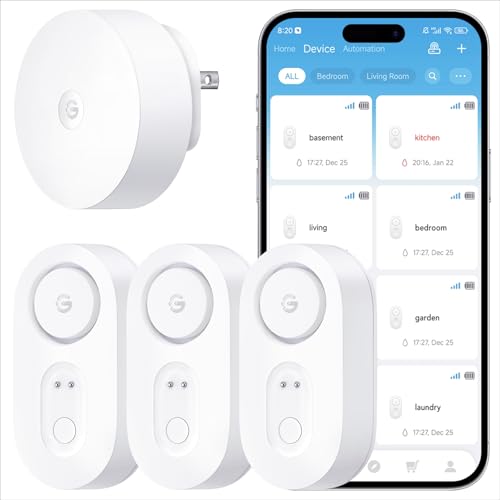
Gateway and three sensors with app, SMS and email alerts plus a 105 dB local alarm, IP67 rating and 5-year battery.
Check price on Amazon$39.99 as of Oct 19, 2026 8:59 pm GMT+0000 — prices change; see Amazon for current price.Why we like it
- Phone alerts and a 105 dB siren together
- Free SMS alerts per listing
- Adjustable volume in four levels
- IP67 sensors survive submersion
| Specification | Details |
|---|---|
| Contents | Gateway plus 3 sensors (H5059 + H5044) |
| Alerts | App push, SMS and email; 105 dB siren with red flash |
| Range | Sub-1G radio, up to 1,804 ft, through walls per listing |
| Battery | Up to 5 years |
| Waterproof rating | IP67 |
| Network | Gateway needs 2.4 GHz Wi-Fi |
GoveeLife 1s 3-pack — gateway + 3 sensors, app/SMS/email, 105 dB siren, IP67, 1,804 ft range, 5-yr battery, 2.4 GHz
Both Alert Types in Every Sensor
Four of the 12 listings are GoveeLife, in 3-, 4-, 5- and 6-packs of the same sensor. What sets them apart from YoLink is that each sensor also sounds a 105 dB siren, the loudest stated among the app-connected kits. X-Sense puts its 100 dB alarm in the base station instead. So with Govee you get a phone alert when away and a loud local alarm when home.
The app’s “Find Device” feature makes a sensor beep so you can locate it, and you can add several email recipients, which helps a family or a landlord. Alarms can be silenced from the app.
The gateway requires 2.4 GHz Wi-Fi and only pairs with GoveeLife sensors. There is no shutoff integration in the listing. Choose a larger pack if you have more than three risk spots.
Pros
- Siren plus remote alerts
- Free SMS per listing
- IP67 and 5-year battery
Cons
- No shutoff valve integration stated
- 2.4 GHz Wi-Fi gateway required
- Govee-only ecosystem
Check GoveeLife 1s 3-Pack price on Amazon
3. X-Sense SWS0A41 Ultra-Slim — Best for Tight Spots Behind Appliances

Four 0.7-inch-thin Wi-Fi leak sensors with base station, sensing water 0.4 mm deep and drips from above.
Check price on AmazonWhy we like it
- Thinnest sensors on the shelf, 0.7 in
- States a 0.4 mm detection depth
- Top and bottom probes catch drips
- Alarm history and timed snooze in app
| Specification | Details |
|---|---|
| Contents | Base station plus 4 sensors |
| Size | 0.7 in (17 mm) thick, 3 in diameter |
| Detection | Water as shallow as 0.4 mm; 2 top and 4 bottom probes |
| Alerts | App alerts; base station alarm up to 100 dB; red light on sensor |
| Range | Up to 1,700 ft open area |
| Battery life | Not stated in listing |
X-Sense SWS0A41 — base + 4 sensors, 0.7 in thin, detects 0.4 mm, top/bottom probes, app + 100 dB base alarm
The Only Listing That States How Shallow a Leak It Detects
Most listings say a sensor alarms when it “touches water.” X-Sense gives a number, 0.4 mm, and pairs it with a 0.7-inch profile that slides under a dishwasher toe kick or behind a toilet. Several listings use top and bottom probes, but this is the slimmest housing among them.
The app keeps an alarm history and offers a timed “remind me later” mute from 10 minutes to 12 hours, useful while you mop up. The base station sounds the local alarm, so put it where people will hear it.
The listing does not state battery life or a waterproof rating, and there is no shutoff integration.
Pros
- Very thin sensors
- Stated 0.4 mm detection depth
- Alarm history in app
Cons
- Alarm sounds at base, not sensor
- Battery life not stated
- No shutoff integration
Check X-Sense SWS0A41 price on Amazon
4. METAK 5-Pack Water Leak Detectors — Best Simple Standalone Alarms

Five battery alarms with 100 dB sirens, front drip probes and rear floor probes, IP66, no Wi-Fi or setup.
Check price on Amazon$35.99 as of Oct 19, 2026 8:59 pm GMT+0000 — prices change; see Amazon for current price.Why we like it
- No app, hub or Wi-Fi to manage
- Front drip and rear floor probes
- 100 dB siren with mute button
- Low-battery warning light
| Specification | Details |
|---|---|
| Contents | 5 standalone alarms |
| Probes | 2 front drip probes, 4 rear floor probes |
| Alarm | 100 dB, mute mode |
| Power | 2 x AAA, over 2 years standby claimed, low-battery light |
| Waterproof rating | IP66 |
| Connectivity | None |
METAK 5-pack — standalone, 100 dB, drip + floor probes, 2 x AAA (2+ yr), IP66, no Wi-Fi
The Plain Alarm, With a Drip-Probe Twist
Four of the 12 listings are standalone audible alarms with no connectivity. They cost less per sensor and need nothing but batteries. METAK’s design puts drip probes on the front so the unit can be placed directly under a pipe joint or valve where drops fall, as well as floor probes for spreading water.
The obvious limit applies to every standalone alarm: it only helps if someone hears it. Good for a kitchen sink or laundry room on the main floor, much weaker in a basement mechanical room when the house is empty for a weekend.
Pros
- No setup or subscription
- Drip and floor probes
- Five sensors per pack
Cons
- No remote alerts
- Fixed 100 dB volume
- IP66, not IP67
Check METAK 5-Pack price on Amazon
5. RUIKORING 5-Pack (CARK-WD70) — Best Adjustable-Volume Alarms

Five standalone alarms with four volume levels from mute to 120 dB, IP67 rating and 10 AAA batteries included.
Check price on Amazon$32.39 as of Oct 19, 2026 8:59 pm GMT+0000 — prices change; see Amazon for current price.Why we like it
- Loudest stated maximum, 120 dB
- Four volume levels including mute
- IP67 rating, short submersion
- Honest note about humidity false alarms
| Specification | Details |
|---|---|
| Contents | 5 standalone alarms; 10 AAA batteries |
| Probes | 4 bottom, 2 top |
| Alarm | 0 to 120 dB in 4 levels; red LED |
| Battery life | 5 years per title |
| Waterproof rating | IP67 |
| Caution stated | Top probes may false-trigger in heavy humidity |
RUIKORING 5-pack — standalone, 0–120 dB adjustable, 4 bottom + 2 top probes, IP67, 10 AAA included
The Only Listing That Warns About False Alarms
RUIKORING and Stechro both offer volume up to 120 dB, the loudest on the shelf, with lower settings for bedrooms. What stands out is that RUIKORING admits a limitation: its top probes can be triggered by heavy mist, and it advises wiping probes dry. No other listing mentions false alarms. For a sensor near a shower or a humidifier, that is useful to know.
It is also the only standalone alarm on the shelf with an IP67 rating; the METAK and Stechro units are IP66. It includes spare batteries too.
Pros
- Up to 120 dB, adjustable
- IP67 rating
- Spare batteries included
Cons
- No remote alerts
- Humidity can cause false alarms
- 5-year battery claim is optimistic for AAA
Check RUIKORING 5-Pack price on Amazon
6. Stechro WD76 5-Pack — Best Budget Standalone Set

Five standalone alarms with four volume levels up to 120 dB, drip sensor, IP66 rating and up to 3-year battery life.
Check price on Amazon$36.99 as of Oct 19, 2026 8:59 pm GMT+0000 — prices change; see Amazon for current price.Why we like it
- Five alarms with adjustable volume
- Top drip sensor plus floor probes
- Up to 3-year battery stated
- Clear note that it has no Wi-Fi
| Specification | Details |
|---|---|
| Contents | 5 alarms, 10 batteries, 2 opening tools |
| Probes | 4 bottom flood probes, 1 top drip sensor |
| Alarm | 4 levels, 0 to 120 dB |
| Battery life | Up to 3 years |
| Waterproof rating | IP66 |
| Connectivity | None; listing states it cannot connect to Wi-Fi |
Stechro WD76 5-pack — standalone, 0–120 dB, 4 floor probes + drip sensor, IP66, up to 3-yr battery
Clear About What It Is Not
Stechro’s listing opens with a reminder that this model cannot connect to Wi-Fi and will not pair with the brand’s gateway, a separate product. That clarity heads off a common mistake, since the brand sells a similar-looking connected version. Its 3-year battery claim is more modest than RUIKORING’s.
Use it where a household member will hear it: kitchen, laundry, hall bath.
Pros
- Adjustable up to 120 dB
- Drip and floor detection
- Batteries and tools included
Cons
- No remote alerts
- IP66 only
- Easily confused with the Wi-Fi version
Check Stechro WD76 5-Pack price on Amazon
7. PQWT PQ125A — Best for Finding Hidden Pipe Leaks
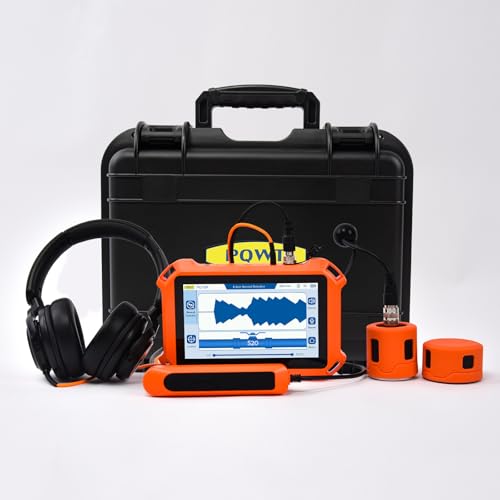
Acoustic leak locator with two resonance sensors, earphones and a touchscreen that compares signals across 16 points.
Check price on Amazon$705.00 as of Oct 19, 2026 8:59 pm GMT+0000 — prices change; see Amazon for current price.Why we like it
- Locates leaks in walls, floors and buried lines
- Location mode compares 16 points
- Two sensors for different surfaces
- 2-year warranty, lifetime maintenance
| Specification | Details |
|---|---|
| Type | Acoustic pipe leak detector with earphones |
| Sensors | Two dual-membrane resonance sensors (DMR-H40, DMR-V59) |
| Modes | General detection scan; location mode capturing 16 points |
| Display | Touchscreen with guidance and error pop-ups |
| Weight | About 11.8 lb with case |
| Warranty | 2 years, lifetime maintenance |
PQWT PQ125A — acoustic leak locator, 2 resonance sensors, 16-point location mode, touchscreen, 2-yr warranty
A Different Tool for a Different Job
Two listings on the shelf are acoustic instruments: this PQWT and a Redants detector. They do not sit on the floor waiting for water. They listen to pressurized pipes for the hiss of escaping water, so you can pinpoint a leak inside a wall, under a slab or along a buried service line before opening anything up. PQWT’s location mode records signals from 16 points and compares them, which makes the loudest spot easier to find.
This is a tool for a suspected leak: a water meter that keeps moving with every tap off, a warm spot on a slab, or a damp patch of drywall. It takes practice, and pros pair it with thermal cameras and moisture meters. For most homeowners, a plumber or leak-detection service with this kind of equipment is a better first call.
Pros
- Finds hidden leaks before demolition
- Guided touchscreen
- 2-year warranty
Cons
- Not a monitoring alarm
- Learning curve for accurate results
- Heavy kit
Check PQWT PQ125A price on Amazon
Sensor alarms vs smart sensors vs shutoff systems
Standalone alarms
Battery sensors with a siren. Cheap, no setup, nothing to fail but the battery. They protect you only when someone is within earshot. Best for main-floor sinks, laundry rooms and bathrooms in an occupied house.
Smart sensors
Sensors that talk to a hub or gateway and send phone alerts. They cover the empty-house problem and let you add sensors in basements and garages. Most need home Wi-Fi to reach your phone; YoLink’s local device-to-device mode is an exception for triggering connected devices.
Automatic shutoff
A motorized valve on the main water line that closes when a sensor trips, or a flow-monitoring device that closes it when water runs too long. None of the listings on this shelf is a shutoff valve, but YoLink sensors can trigger one. The EPA’s WaterSense program publishes a guide to leak detection and flow monitoring devices that explains the options. Installing a valve on the main is usually a job for a plumber.
Where to put water leak sensors
- Under the kitchen sink and next to the dishwasher
- Behind or beside each toilet
- Under the washing machine or beside its supply valves
- Beside the water heater, at the drain pan
- Next to the sump pit and in the lowest corner of the basement
- Near a water softener, well pressure tank or refrigerator ice maker line
- Under a wet bar or second-floor laundry, where a leak damages ceilings below
Place sensors flat on the floor at the low point where water will collect first. Test each one with a damp cloth after setup and when you change batteries.
Reading the specs
- Alarm volume. Stated levels on the shelf run from 100 to 120 dB. Adjustable volume helps near bedrooms.
- Range. Long-range radios (LoRa, Sub-1G) reach detached garages and deep basements better than ordinary Wi-Fi sensors. Stated figures are open-air maximums.
- Waterproof rating. IP67 means the sensor survives brief submersion; IP66 means heavy splashing. In a flooding basement, IP67 keeps working.
- Probes. Top probes catch drips from above; bottom probes catch pooling water. Several models have both.
- Battery. Low-battery alerts matter more than headline life claims. Replace batteries on a schedule.
Why leaks matter: water waste and mold
Most leaks are small and slow. The EPA estimates the average household’s leaks can waste more than 9,300 gallons a year, and that nine percent of homes have leaks wasting 50 gallons or more per day. Common culprits are worn toilet flappers, dripping faucets and leaking valves.
The bigger cost is often damage. The EPA’s mold guidance says water-damaged areas and items should be dried within 24 to 48 hours to prevent mold growth. A sensor that alerts within minutes is what makes that window achievable. If a leak has run unnoticed, a moisture meter helps map how far water spread; our moisture meters hub covers the tools.
Finding a leak you cannot see
Before buying a pipe detector, use the water meter. The EPA suggests reading it before and after a two-hour period when no water is used; if it moves, you probably have a leak. A few drops of food coloring in a toilet tank that show up in the bowl within 10 minutes reveal a flapper leak.
For leaks inside walls or slabs, our guides to acoustic leak detectors and infrared water leak detectors explain how professionals locate them. For connected sensors specifically, see our smart water leak detector guide.
Keeping a leak detection system working
A sensor that has quietly died is worse than none, because it gives false confidence. A simple routine keeps a system honest:
- Test quarterly. Touch each sensor’s probes with a damp paper towel and confirm the siren sounds and, for smart kits, that the phone alert arrives. Note how long the alert takes.
- Replace batteries on a calendar. Battery-life claims on this shelf run from about 2 to 5 years, but cold garages and frequent test alarms shorten them. Swap them on a fixed date rather than waiting for a low-battery chirp.
- Keep probes clean and dry. Dust, soap residue and mineral film can dull contacts. RUIKORING’s own listing recommends wiping probes regularly.
- Check after moving appliances. Sensors get kicked out of place when a washer or fridge is pulled out for service. Put them back at the low point.
- Review notification settings. After a phone change or router swap, confirm the app still reaches you and that other household members are on the alert list.
Pair sensors with an annual walk-through: look at supply hoses on the washer, toilet and sink for bulges or rust, check the water heater drain pan, and run the sump pump.
Front Range considerations
Cold snaps along the Front Range bring frozen and burst pipes in exterior walls, crawlspaces and garages. Sensors in those spaces, and a phone-connected system when you travel in winter, are cheap insurance. Many homes here have finished basements where a water heater or sump failure soaks carpet and drywall before anyone notices. Low humidity helps things dry, but not fast enough to beat the 24 to 48 hour mold window in a closed-up basement.
When to call a plumber or inspector
A sensor tells you water is present. It does not fix the cause. Call a plumber for leaking supply lines, failed valves, slab leaks or a water heater that is weeping. If water has soaked drywall, flooring or insulation, have the area dried and checked for moisture before closing it back up. Our home inspection tools guide covers the instruments inspectors use to trace moisture.
Buying a Front Range home and want past leaks, plumbing and moisture checked before closing? Contact us to connect with a vetted local inspector.
Frequently asked questions
What is the best water leak detector for a home?
For most homes, a smart sensor kit that sends phone alerts and sounds a local alarm covers the most situations. If you want leaks stopped automatically, choose a system whose sensors can trigger a shutoff valve, such as YoLink. Standalone alarms work well in rooms where someone will hear them.
Do water leak detectors need Wi-Fi?
Standalone alarms do not; they simply sound a siren. Smart sensors usually connect to a hub or gateway that uses home Wi-Fi to reach your phone. Some, like YoLink, can still trigger connected sirens or valves locally during an internet outage.
Where should I place water leak sensors?
Put them at the low point where water collects first: under sinks, behind toilets, under the washer, beside the water heater, near the sump pit and next to softeners or pressure tanks. Test each one with a damp cloth after installing it.
Can a water leak detector shut off the water?
Only when paired with a motorized shutoff valve on the main line. None of the listings we compared is a valve, but YoLink sensors can trigger YoLink shutoff valves sold separately. A plumber usually installs the valve.
How quickly should I dry a water leak to prevent mold?
The EPA says water-damaged areas and items should be dried within 24 to 48 hours to prevent mold growth. Fix the source first, then dry materials thoroughly. Porous materials that stay wet or grow mold may need to be removed.
References
- Fix a Leak Week — U.S. Environmental Protection Agency
- WaterSense Statistics and Facts — U.S. Environmental Protection Agency
- A Brief Guide to Mold, Moisture and Your Home — U.S. Environmental Protection Agency
- WaterSense Residential Toilets — U.S. Environmental Protection Agency