Best Natural Gas Detector: A 2026 Buyer’s Guide
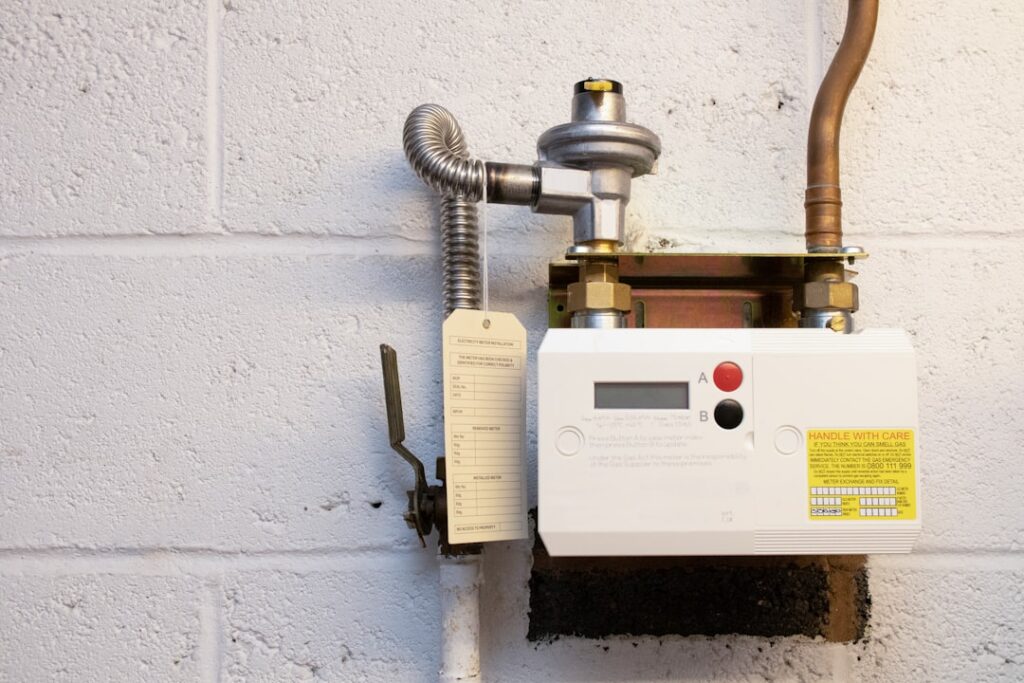
The best natural gas detector for most homes is a fixed plug-in alarm that watches the air around gas appliances around the clock, backed by a small handheld sniffer for checking a suspected leak at a fitting. These are two different jobs. A plug-in alarm wakes the household when methane builds up in a room; a sniffer helps narrow down where a slow leak is coming from once you already suspect one. This guide covers fixed methane and propane alarms first, then the two handheld units that pair best with them, and spends extra time on the step most buyers get wrong: placement. Natural gas rises and propane sinks, so the right height depends on which fuel your home burns.
Part of our Home Inspection Tools guide — start there for the full picture →
As an Amazon Associate we earn from qualifying purchases.
How we compared: we compared 10 current Amazon listings that state they detect natural gas or methane: 4 fixed plug-in alarm listings (covering 3 distinct model numbers, because one Kidde model appears twice) and 6 handheld combustible-gas sniffers. We judged each on what its listing actually states: gases named, power and backup, display, alarm loudness, detection range, certifications named and warranty. We did not lab-test any of these units or handle them. The same search also returned CO-only and smoke-and-CO alarms that do not sense natural gas; we left those out of the count. Prices and availability change often, so check the current listing before buying.
Quick picks: the best natural gas detectors by job
| Pick | Best for | Key spec | Key detail |
|---|---|---|---|
| Kidde COPDLG | Plug-in gas + CO alarm for most homes | 120V plug-in + 2 AA backup | Display shows CO level or “GAS”; early low-level CO alert |
| Kidde KN-COEG-3 | Gas + CO alarm with 9-volt backup | 120V plug-in + 9V backup | Digital display; event memory for last CO detection |
| Wurapl WA886 | Gas-only alarm for a kitchen or garage outlet | Plug-in, no backup stated | Natural gas, LPG and LNG named; display in title |
| TOPTES PT199 | Pocket sniffer to confirm an alarm | 2 AAA; 50–1,000 ppm (methane) | LCD turns red at high readings |
| Klein Tools ET190 | Compact sniffer with two sensitivity modes | High/low sensitivity toggle | 30-second automatic zeroing; pen clip |
The five picks, compared listing by listing
1. Kidde COPDLG — Best Plug-In Natural Gas and CO Alarm

Plug-in alarm for natural gas, propane and CO with AA backup, backlit display and a 30–70 ppm early CO alert.
Check price on Amazon$61.97 as of Oct 12, 2026 1:05 am GMT+0000 — prices change; see Amazon for current price.| Specification | Details |
|---|---|
| Gases detected | Carbon monoxide, natural gas and propane |
| Power | 120V outlet; two AA backup batteries included; plug rotates for vertical or horizontal outlets |
| Display | Backlit digital display shows the CO level, or the word “GAS” when explosive gas is sensed |
| Alarm | 85 dB; separate light and sound pattern for low CO (30–70 ppm) and for 70 ppm and above |
| Certification named | UL 2034 5th Edition (the CO standard); ETL Listed; no gas-alarm standard named |
| Model / warranty | COPDLG (replaces 900-0113 and KN-COEG-3); listing states both a 7-year and a 10-year limited warranty |
Kidde COPDLG — CO + natural gas + propane, 120V plug-in with 2xAA backup, backlit display, 85 dB, low-level CO alert, UL 2034 5th Ed. / ETL
The Only Gas Alarm Here That Names a Current Standard and an Early CO Alert
Of the 4 fixed alarm listings on this shelf, the COPDLG is the only one that names any certification at all. It cites UL 2034 5th Edition and ETL listing. That standard covers the carbon monoxide side of the alarm, and the listing does not name a separate standard for the explosive-gas sensor, so treat the gas function as described by the manufacturer rather than certified on the page. Still, the other three fixed listings name nothing.
The COPDLG is also the only fixed alarm on the shelf that describes two CO alert tiers: a distinct pattern between 30 and 70 ppm, then a separate alarm at 70 ppm. That matters because a natural gas appliance with a combustion problem usually announces itself through carbon monoxide long before raw gas reaches a dangerous concentration. The CPSC notes that most healthy adults feel nothing at roughly 1 to 70 ppm over long periods, while symptoms become more noticeable as levels stay above 70 ppm. A warning below that line gives time to ventilate and call for service.
Backup power comes from two AA cells rather than the 9-volt cell in the older Kidde gas alarm, and the listing says the plug rotates to fit either outlet orientation. One inconsistency to flag: the feature bullets mention a 7-year limited warranty on the alarm while the manufacturer field says 10 years. Confirm on the packaging.
Pros
- Covers natural gas, propane and CO in one outlet
- Only fixed gas alarm here naming UL 2034 5th Edition and ETL
- Early 30–70 ppm CO alert pattern
- Rotating plug and AA battery backup
Cons
- No gas-alarm standard named for the methane/propane sensor
- Outlet height fixes the mounting position
- Warranty length stated two different ways
2. Kidde KN-COEG-3 — Best Gas and CO Alarm With 9-Volt Backup
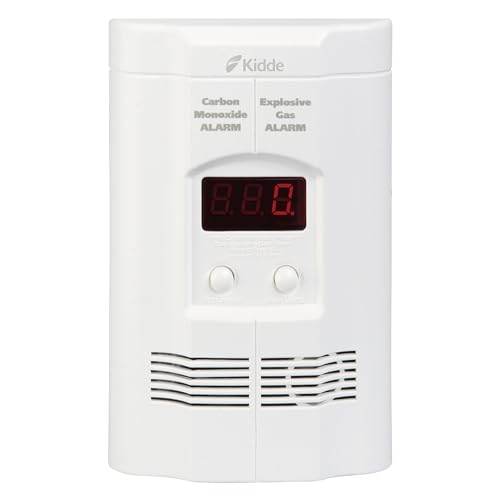
Plug-in CO and explosive-gas alarm with digital display, 9V backup and memory of the last CO event.
Check price on Amazon$57.47 as of Oct 12, 2026 1:05 am GMT+0000 — prices change; see Amazon for current price.| Specification | Details |
|---|---|
| Gases detected | Carbon monoxide plus explosive gas, with natural gas and propane named in the title |
| Power | Standard 120V outlet; 9-volt battery backup for outages |
| Display | Digital LED readout shows the CO level being sensed, or “GAS” when explosive gas is present |
| Alarm / memory | 85 dB; peak-level memory records the last CO detection or last test |
| Size | About 6.1 x 3.8 x 2.5 in |
| Model / warranty | KN-COEG-3 (“3rd Edition” in title); warranty not stated in this listing |
Kidde KN-COEG-3 — CO + explosive gas, 120V plug-in, 9V backup, digital LED display, 85 dB, event memory
The Only Fixed Gas Alarm Here With a 9-Volt Backup and Event Memory
The KN-COEG-3 is the predecessor the COPDLG listing says it replaces, and it is still sold under two separate listings on this shelf. Both describe the same 9-volt backup, the same digital display that switches between a CO number and the word “GAS”, and the same peak-level memory. The older of the two listings adds a 5-year limited warranty; this newer one does not state a warranty at all.
The memory feature deserves a careful read. The listing says it records the last time carbon monoxide was detected or the unit was last tested, which is a timestamp rather than the highest concentration measured. That is useful when you come home to a silent alarm and want to know whether something happened while you were out, but it will not tell a technician how high the reading went.
What this listing leaves out is notable next to pick 1. It names no certification, no low-level CO tier and no sensor type, and it does not say what concentration of methane or propane trips the “GAS” alarm. None of the 4 fixed alarm listings on this shelf state a gas trip point, so this is a shelf-wide gap rather than a Kidde-only one. The reason to choose this model over the COPDLG is narrow: a household that prefers 9-volt backup cells or already has a drawer full of them.
Pros
- Gas and CO in one plug-in housing
- Display distinguishes a CO reading from a gas alarm
- Event memory shows the last detection or test
- 9-volt backup keeps it running during outages
Cons
- No certification named in this listing
- Memory records time of last event, not the peak level
- Superseded by the COPDLG per Kidde’s own listing
- Warranty not stated on this listing
3. Wurapl WA886 — Best Gas-Only Plug-In for a Kitchen or Garage Outlet

Gas-only plug-in alarm naming natural gas, LPG and LNG, with sound, flashing light and a digital display.
Check price on Amazon$29.99 as of Oct 12, 2026 1:05 am GMT+0000 — prices change; see Amazon for current price.| Specification | Details |
|---|---|
| Gases detected | Natural gas, LPG and LNG named; no CO detection stated |
| Power | Plug-in; battery backup not stated in listing |
| Display / alerts | Digital display named in the title; audible alarm and flashing light |
| Suggested rooms | Kitchens, garages and utility rooms with gas appliances or lines |
| Certification | Not stated in listing |
| Model / warranty | WA886; warranty not stated in listing |
Wurapl WA886 — gas-only plug-in, natural gas/LPG/LNG, audible + flashing alert, display, no certification or backup stated
The Only Fixed Alarm on the Shelf That Senses Gas Without CO
Three of the 4 fixed alarm listings combine gas and CO detection, all from Kidde. The WA886 is the exception: a dedicated combustible-gas alarm. That can actually be an advantage in one specific spot. The CPSC does not recommend installing CO alarms in kitchens or directly above fuel-burning appliances, but a gas range or a gas dryer is exactly where a fitting is most likely to seep. A gas-only unit near the range, paired with a proper CO alarm in the hallway, keeps each sensor where it belongs.
The listing is thin, though. It says the sensor is “high-sensitivity” without giving a ppm or percent-LEL trip point, names no certification and does not mention battery backup, which means it goes silent in an outage. Its stated product dimensions (fractions of an inch) are obviously not the real size, so expect the data on the page to be loosely maintained. Treat this as a supplementary alarm, not your primary safety device.
The wording also calls it “portable” and suitable for outdoor and RV use. Because it plugs into an outlet, portability simply means it can move between outlets; it is not a handheld locator like picks 4 and 5.
Pros
- Gas-only, so it can sit near a range where CO alarms are discouraged
- Names natural gas, LPG and LNG
- Both audible and flashing visual alerts
Cons
- No CO detection
- No certification, trip point or backup power stated
- Listing dimensions are clearly inaccurate
- Warranty not stated
4. TOPTES PT199 — Best Pocket Sniffer to Confirm an Alarm
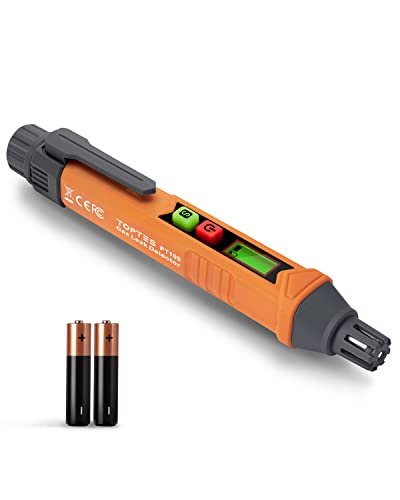
Pocket combustible-gas sniffer, 50–1,000 ppm methane range, red-shifting LCD and rising audible alarm.
Check price on Amazon$22.99 as of Oct 12, 2026 1:05 am GMT+0000 — prices change; see Amazon for current price.| Specification | Details |
|---|---|
| Gases named | Natural gas, methane, propane, butane, LPG and other combustibles |
| Detection range | 50–1,000 ppm (methane basis); sensing distance 1–5 cm |
| Response / warm-up | Alarms within about 0.5 seconds; 30-second warm-up |
| Alerts | Sound and visual alarm that intensify with concentration; LCD turns red at high levels |
| Power | 2 AAA (included); low-battery indicator below 2.4V; auto-off after 5 minutes idle |
| Size / weight | About 6.5 in long; 0.13 lb; storage bag included |
TOPTES PT199 — handheld, 50–1,000 ppm methane, 0.5 s response, LCD + audible, 2xAAA, 0.13 lb
The Lightest Handheld Here That Also States a Methane Range
Six of the 10 listings are handheld sniffers. Four of those six state a detection range, and the PT199’s 50 to 1,000 ppm is the narrowest of the four; the PT520A and Klein ET120 both claim up to 10,000 ppm, and the PT210S tops out at 5,000 ppm. For a homeowner, the narrow range is not a real drawback. A fixed alarm going off is the reason to pick this tool up, and 1,000 ppm of methane is still only about a fiftieth of the concentration at which natural gas can burn.
At a stated 0.13 lb, it is the lightest of the four handhelds that state a detection range (only the Klein ET190, at 0.12 lb with no range given, weighs less), which makes it the one most likely to live in a kitchen drawer and actually get used. Within those handhelds, it is also one of only two whose screen changes color with concentration rather than relying on a row of LED bars.
The listing does not name a sensor type, a certification or a warranty, and it gives no alarm loudness in decibels. It also has no gooseneck, so reaching the back of a range or a furnace gas valve means getting your hand close to the fitting.
Pros
- Very light and pocket-sized
- Stated methane range and response time
- Color-changing LCD plus audible alarm
- Batteries and storage bag included
Cons
- No gooseneck or probe for tight spots
- Narrowest stated range of the handhelds
- No warranty, certification or dB rating stated
5. Klein Tools ET190 — Best Compact Sniffer With Dual Sensitivity
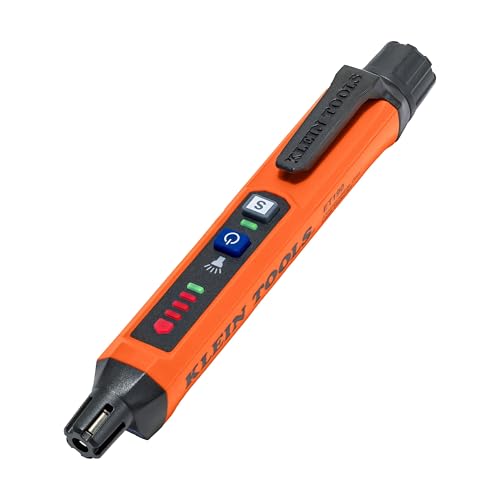
Pen-style combustible gas leak detector with high/low sensitivity modes and 30-second auto-zero.
Check price on Amazon$26.00 as of Oct 12, 2026 1:05 am GMT+0000 — prices change; see Amazon for current price.| Specification | Details |
|---|---|
| Detector type | Combustible gas leak detector, pen-style with clip |
| Sensitivity | High and low modes, selectable |
| Start-up | 30-second automatic zeroing at power-up |
| Alerts | LED indicators and escalating audible tones |
| Detection range | Not stated in listing |
| Size / weight | About 6.3 x 1.1 x 0.9 in; 0.12 lb |
Klein Tools ET190 — pen-style combustible gas sniffer, high/low sensitivity, 30 s auto-zero, LED + tones, 0.12 lb
The Only Pocket-Clip Sniffer Here With Two Sensitivity Modes
Two-mode sensitivity is the feature that makes pinpointing practical. On high, a detector picks up faint traces from a distance; switch to low and it only reacts close to the source, so you can tell which of three fittings is the leaker. Three of the 6 handhelds on this shelf describe a high/low toggle: both Klein units and the TOPTES PT210S. The ET190 is the only one of those three built in a slim pen-clip format; the ET120 uses an 18-inch gooseneck and the PT210S a 4-inch probe.
Klein also describes 30 seconds of automatic zeroing at start-up. Zeroing is why every sniffer should be switched on in clean outdoor air, not in a room where you already smell gas, or the detector treats the leak as its baseline.
The gaps are real. The listing gives no ppm range, no alarm loudness and no battery type, and the warranty field just says to see the manufacturer’s website. It is the tool to pick if you want a sniffer you will clip in a shirt pocket while checking appliance connections, not if you want numbers.
Pros
- High/low sensitivity for narrowing down a leak
- Pen clip and 0.12 lb weight
- Automatic zeroing at start-up
Cons
- No detection range stated
- No gooseneck for reaching behind appliances
- Battery type and dB level not stated
- Warranty only referenced to manufacturer site
Fixed alarm or handheld sniffer: which do you need?
They answer different questions. A fixed alarm answers “is gas building up in this room right now?” and it answers it at 3 a.m. while everyone sleeps. A sniffer answers “where exactly is the gas coming from?” and only when someone is holding it. Every home with gas appliances benefits from the first; the second is a convenience for owners who want to check a new appliance connection or follow up on a faint odor before calling the utility. For a deeper look at handheld models, our combustible gas leak detector guide compares the sniffer category on its own.
Neither replaces your nose or your gas utility. Natural gas and propane are odorized for exactly this reason; NIOSH notes that propane is colorless and odorless on its own and that a foul-smelling odorant is often added for fuel use. If you smell that rotten-egg odor, the response is the same no matter what any detector says. Our guide to the gas leak smell covers what that odor means and what can mimic it.
Placement: natural gas rises, propane sinks
This is the single most important buying and installation detail, and plug-in units make it tricky. PubChem lists methane, the main component of natural gas, with a vapor density of about 0.55 relative to air: lighter than air, so it tends to rise. NIOSH lists propane’s relative gas density as 1.55: heavier than air, so it tends to sink and pool.
- Natural gas homes: a fixed methane alarm works best high in the room, near the ceiling and within the distance of the appliance the manual specifies. A plug-in alarm at outlet height is a compromise. Check the manual for an approved high-mounting option or an outlet near the top of a wall, such as one installed for a range hood or garage opener.
- Propane homes: the alarm belongs low, near the floor, where an outlet-mounted unit naturally sits. Propane can also flow down stairs into a basement, so a second alarm at the basement appliance is worth considering.
- Combo gas-and-CO units: carbon monoxide mixes with room air, which is why combo units can work at outlet height for the CO side. The trade-off is the gas side, so follow the Kidde manual’s placement guidance for your fuel type.
- Avoid: spots directly above a range or a heating appliance, inside cabinets, near vents or open windows that dilute readings, and humid laundry and bath areas unless the manual allows them.
Our separate guides on propane gas leak detectors and gas leak detectors for home use go further into room-by-room setups.
Specs that matter on a natural gas detector listing
Which gases it names
Nine of the 10 listings here name natural gas or methane; the Klein ET190 says only “combustible gas.” Seven name propane specifically, while the Wurapl lists LPG and the two Klein listings name no fuel other than methane as a reference. If your home burns propane, confirm propane is listed by name rather than assuming a “natural gas detector” covers it. If you want CO protection in the same housing, only the three Kidde listings provide it among the fixed alarms.
Trip point and detection range
For fixed alarms, the useful number is the concentration that triggers the alarm, usually expressed as a percentage of the lower explosive limit (LEL). None of the 4 fixed listings here state it. For handhelds, look for a ppm range; 4 of 6 state one. As a reference point, PubChem gives methane’s lower flammable limit at roughly 5 percent by volume, and NIOSH gives propane’s lower explosive limit as 2.1 percent. A detector that alarms at a small fraction of those figures gives time to act.
Backup power
A plug-in alarm without backup stops working in an outage, which is also when people run generators and space heaters. Both Kidde models state battery backup; the Wurapl listing does not.
Sensor type and lifespan
Combustible-gas sensors in consumer alarms are commonly semiconductor or catalytic types, and they age. None of the five picks here name a sensor type or a rated sensor life, which makes the manufacturer’s replacement date on the housing the controlling number. Our gas detector sensor guide explains how the main sensor types behave.
Certification wording
The COPDLG names UL 2034 for its CO function. No fixed alarm on this shelf names a gas-alarm standard, so ask the manufacturer or check the packaging if formal listing for the methane sensor matters to you or your insurer.
Does a CO alarm detect a gas leak?
No. A CO-only alarm detects carbon monoxide, a byproduct of incomplete combustion; it does not respond to unburned methane or propane leaking from a fitting. The CPSC lists natural gas and propane among the fuels whose incomplete burning produces CO, which is why gas homes need both kinds of protection. A combo gas-and-CO alarm covers both, but many homes are better served by CO alarms where the CPSC and NFPA place them (outside sleeping areas and on every level) and a separate gas alarm near the appliances. Our explainer on whether a carbon monoxide detector detects a gas leak goes deeper.
What to do when a natural gas detector alarms
Treat a gas alarm as real until a professional says otherwise. The CPSC advises that if you smell or hear gas leaking, leave the home immediately and contact the gas utility from outside, without operating electronics such as lights or phones before leaving. That means no light switches, no garage door opener and no handheld sniffer hunt indoors while gas is present. Once outside, call the utility’s emergency line or 911.
A handheld sniffer is for the calmer situation: a faint, intermittent odor near one appliance, a newly installed range connection or a fitting that was just reworked. Even then, a positive reading means turning off the appliance valve if it is safe to do so and calling a licensed gas fitter. Soap-solution checks are another low-tech confirmation; see our gas leak detector spray guide.
Colorado notes for Front Range homes
Most homes in metro Denver, Boulder and Colorado Springs burn utility natural gas for furnaces, water heaters, ranges, fireplaces and dryers, so the ceiling-high placement rule applies to most Front Range buyers. Foothills and mountain properties beyond the gas mains often run on propane from a tank, and those homes need low-mounted alarms, with extra attention to basements and crawl spaces where heavier-than-air propane collects. Homes that switched fuels during a remodel sometimes keep alarms mounted for the old fuel, which is worth checking.
Garden-level and finished basements are common here, and they often hold the furnace and water heater. A gas alarm in the mechanical room and a CO alarm outside the basement bedroom cover the two different hazards that room creates.
Limits of DIY detectors vs a professional inspection
Consumer detectors are a safety net, not a diagnosis. They do not tell you whether a flue drafts properly, whether a heat exchanger is cracked or whether a gas line was sized and supported correctly. A home inspector checks visible gas piping, appliance connectors, venting and clearances, and will flag conditions that need a licensed plumber or HVAC technician. Inspectors often carry a combustible-gas sniffer to check accessible fittings, but the utility or a licensed fitter performs pressure tests and repairs. For more on the instruments inspectors carry, see our home inspection tools guide.
If you are buying a Front Range home with gas appliances, a propane tank or an older fireplace insert, a professional inspection is the best time to find these issues. Contact us to connect with a local inspector.
References
- Methane (compound summary) — PubChem, National Institutes of Health
- NIOSH Pocket Guide to Chemical Hazards: Propane — Centers for Disease Control and Prevention
- Winter Storm Safety Tips: Carbon Monoxide, Fires and Gas Leaks — U.S. Consumer Product Safety Commission
- Carbon Monoxide Questions and Answers — U.S. Consumer Product Safety Commission
- Carbon Monoxide Safety — National Fire Protection Association
Frequently asked questions
Where should a natural gas detector be placed?
Natural gas is mostly methane, which is lighter than air, so a fixed natural gas alarm generally belongs high in the room near the appliance, following the manufacturer's distance rules. Propane is heavier than air and sinks, so propane alarms belong low, near the floor. Plug-in units sit at outlet height, so check the manual for approved mounting options.
Will a carbon monoxide detector detect a natural gas leak?
No. A CO-only alarm senses carbon monoxide from incomplete combustion, not unburned methane or propane. Homes with gas appliances need CO alarms outside sleeping areas and on every level, plus a gas alarm near the appliances or a combination unit that senses both.
Is a plug-in or handheld natural gas detector better?
They do different jobs. A plug-in alarm monitors a room continuously and wakes the household, while a handheld sniffer helps locate the source of a suspected leak at a fitting. Most homes should start with a fixed alarm and add a sniffer only if they want to check connections themselves.
What should you do if a natural gas detector goes off?
Leave the home right away, without flipping switches or using phones inside, and call the gas utility or 911 from outside. The CPSC advises contacting local gas authorities from outside the home. Do not go back in until the utility or fire department clears it.
How long do natural gas detectors last?
Gas sensors age, and none of the fixed alarm listings reviewed here state a rated sensor life, so follow the replacement date printed on the unit or in the manual. Write the install date on the housing, test it as directed and replace the alarm when it signals end of life or reaches its stated date.
Buying a Front Range home with gas or propane appliances? Reach out through our contact page to have gas piping, venting and safety alarms reviewed by a vetted local inspector.
CO & gas detectors
A carbon monoxide alarm is the cheapest life-safety device in the house. Combination CO + explosive-gas units add a layer near furnaces and gas lines.
| Product | Why | Buy |
|---|---|---|
 First Alert CO Alarm First Alert CO Alarm | Plug-in with battery backup. | Amazon — $21.99 |
 Kidde Nighthawk CO + Gas Kidde Nighthawk CO + Gas | Detects CO + natural/propane gas. | Amazon — $57.47 |