Best Long Term Radon Test Kit: 2026 Guide
A long-term radon test kit stays in your home for more than 90 days, long enough to average out the day-to-day and season-to-season swings that can push a 48-hour test high or low. The EPA says that makes a long-term result more likely to reflect your home’s year-round average, which is the number that matters for a family planning to stay. The traditional long-term kit is an alpha-track detector that goes back to a lab at the end of the test. A continuous digital monitor left running for 90 days or more can also produce a long-term average, with no lab step. This roundup covers the three alpha-track kits on the current Amazon shelf and three digital monitors best suited to long-term averaging.
Part of our Radon Levels guide — start there for the full picture →
As an Amazon Associate we earn from qualifying purchases.
How we compared: we compared 17 current Amazon listings for radon testing, 7 mail-in lab kits (3 of them long-term alpha-track kits) and 10 digital monitor listings covering 9 models, on what each listing actually states: detector technology, stated test window, lab-fee terms, return shipping, credentials, battery life, averaging periods and data history. We did not lab-test any of these products or use them hands-on. Prices, lab fees and availability change, so check the current listing before buying.
Quick picks: the best long-term radon test kits
| Pick | Best for | Key spec | Key detail |
|---|---|---|---|
| RSSI AT-101 | Best long-term kit overall | Alpha track, 1 month to 1 year | NRPP and C-NRPP certified; analysis and prepaid return included |
| PRO-LAB RL116 | Defined 3–12 month window | Alpha track | Separate per-detector lab fee; email/text updates |
| PRO-LAB RL416 | Everything included | Alpha track | Lab fee, prepaid envelope and expert consultation included |
| X-Sense XR0A-SR | Digital 90-day averages, no app | Battery up to 24 months | 1/7/30/90-day and long-term averages on screen |
| Airthings Corentium Home 2 (325) | Long-term average plus app graphs | Battery, Bluetooth | Short- and long-term averages on display |
| X-Sense XR0A-iR | Year-plus logging with exports | Wi-Fi, 2-year battery | Up to 999 days; PDF, XLSX and CSV export |
The six picks, compared listing by listing
1. RSSI AT-101 Long-Term Alpha Track — Best Long-Term Radon Test Kit Overall
Alpha-track radon kit for 1-month to 1-year tests, with analysis and prepaid return postage; NRPP certified.
Check price on Amazon| Specification | Details |
|---|---|
| Detector technology | Alpha track |
| Test window | One month to one year; listing notes EPA defines long term as 91 days or longer |
| Included | Test, full instructions, analysis, prepaid shipping and return postage within the U.S. |
| Credentials named | NRPP and C-NRPP certified; state licensed |
| Report | Sent by email or mail and available online; includes EPA radon link and state radon program phone |
| Model / restriction | AT-101; cannot ship to New Jersey addresses |
RSSI AT-101 — alpha track, 1 month–1 year, analysis + prepaid return included, NRPP/C-NRPP certified, state licensed
The Only Long-Term Kit That Names Its Proficiency Credentials
Three of the 17 listings are long-term alpha-track kits: the RSSI AT-101 and two PRO-LAB models. The AT-101 is the only one of the three that names a proficiency credential: NRPP, its Canadian counterpart C-NRPP, and state licensing. The EPA’s guidance on finding testers points to state credentialing and to two national programs, NRPP and NRSB. The two PRO-LAB long-term kits use “EPA approved” wording instead.
It also covers the costs that tend to surprise long-term buyers. Analysis, prepaid shipping and return postage are all included, and the listing is the only one of the three to cite the EPA’s long-term definition directly. Its report links to the EPA radon page and your state radon program, which is a practical touch if the result is high.
Two cautions. The stated window starts at one month, which is below the EPA’s more-than-90-day long-term threshold, so leave the detector out at least three months (six to twelve captures more seasonal change). And the listing gives no turnaround time for results.
Pros
- Names NRPP, C-NRPP and state licensing
- Analysis and prepaid return postage included
- Flexible window up to one year
- Report points to your state radon program
Cons
- One-month lower limit is not a true long-term test
- No turnaround time stated
- Cannot ship to New Jersey
2. PRO-LAB RL116 — Best for a Defined 3–12 Month Test Window

Alpha-track long-term radon detector for 3 to 12 month tests; separate per-detector lab fee applies.
Check price on Amazon$12.99 as of Oct 12, 2026 11:38 am GMT+0000 — prices change; see Amazon for current price.| Specification | Details |
|---|---|
| Detector technology | Alpha track |
| Test window | 3 to 12 months |
| Lab analysis | Separate lab analysis fee per detector (amount in listing) |
| Status updates | Email and text notifications from lab receipt through results |
| Return postage / turnaround | Not stated in listing |
| Model / size | RL116; about 7.2 x 5.8 x 1.5 in, 0.1 lb |
PRO-LAB RL116 — alpha track, 3–12 months, per-detector lab fee, email/text updates
The Only Long-Term Kit Whose Stated Window Starts at Three Months
Of the three alpha-track kits, the RL116 is the only one whose stated window begins at three months. The RSSI kit allows tests as short as one month, and the PRO-LAB RL416 listing gives no window at all. A kit built around a 3–12 month exposure keeps the test inside long-term territory by design, which is useful if you want the instructions, not your own judgment, to enforce a full-length test.
The trade-off is cost structure. The RL116 is the one long-term kit that states a separate per-detector lab fee, so the box price is not the full price. It also does not mention prepaid return postage, while the other two long-term kits do.
The listing names no NRPP or NRSB credential and gives no turnaround time. The email and text updates help on a test where months can pass between placing the detector and mailing it.
Pros
- Stated window keeps the test long-term
- Alpha-track detector
- Email and text status notifications
Cons
- Separate lab fee per detector
- Prepaid return postage not mentioned
- No named proficiency credential
3. PRO-LAB RL416 — Best All-Included Long-Term Kit
Alpha-track long-term kit with lab analysis fee, prepaid first-class return envelope and expert consultation included.
Check price on Amazon| Specification | Details |
|---|---|
| Detector technology | Alpha track |
| Test window | Not stated in listing |
| Lab analysis | Lab analysis fee included |
| Return shipping | Prepaid first-class return envelope included |
| Support | Expert consultation included |
| Model | RL416; one detector |
PRO-LAB RL416 — alpha track, lab fee + prepaid return envelope + expert consultation included
The Only Long-Term Kit That Includes an Expert Consultation
The RL416 and RL116 come from the same lab brand, but their listings describe different packages. The RL416 includes the lab fee, a prepaid return envelope and an expert consultation; the RL116 charges the lab fee separately and mentions neither. Among the seven lab-kit listings on the shelf, the RL416 is the only one that promises a consultation about the result.
That is worth more on a long-term test than on a short one. A long-term result is the number the EPA says to base the fix decision on, and a homeowner reading 3.5 or 4.5 pCi/L after a six-month wait will usually have questions about what comes next.
The listing is the thinnest of the three on specifications. It does not state the exposure window, turnaround or any named credential, so read the printed instructions for the required minimum time and plan for at least the EPA’s more-than-90-day period.
Pros
- Lab fee included
- Prepaid first-class return envelope
- Only kit listing with expert consultation
Cons
- Exposure window not stated in listing
- No turnaround time stated
- No named proficiency credential
4. X-Sense XR0A-SR — Best Digital Monitor for 90-Day Averages
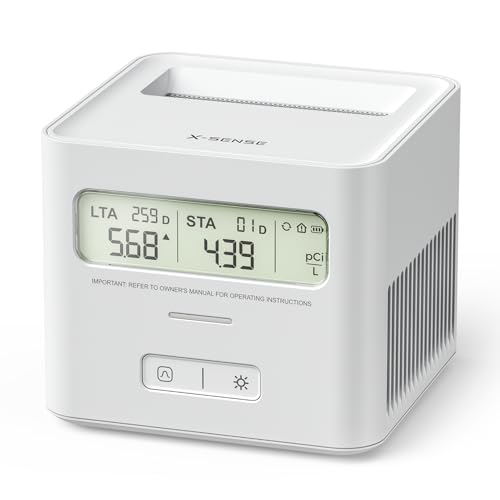
Battery radon monitor showing 1, 7, 30 and 90-day averages plus a long-term cumulative average; no lab fees.
Check price on Amazon$53.99 as of Oct 12, 2026 11:38 am GMT+0000 — prices change; see Amazon for current price.| Specification | Details |
|---|---|
| Averages on screen | Past 1, 7, 30 and 90 days, plus long-term cumulative average |
| Stated accuracy | 90% consistency with reference results after 7 days of continuous use |
| Power | Battery, up to 24 months under typical use |
| Data retention | Keeps prior data through a battery change if power is restored within 4 hours |
| Alerts | None by design; silent operation, backlight on demand |
| Warranty | 60-day money-back guarantee; 5-year quality warranty |
X-Sense XR0A-SR — battery up to 24 months, 1/7/30/90-day + long-term averages, data kept through battery swap, silent
The Only Monitor on the Shelf With a 90-Day Average View
Nine digital models appear on this shelf, and the XR0A-SR is the only one whose listing names a 90-day average on the device screen. That is the exact line the EPA and CDC use between short-term and long-term testing, so this unit reports the same kind of number as an alpha-track kit, alongside a long-term cumulative average for anything beyond that.
Its battery is stated at up to 24 months, which covers a full-year test with room to spare; three X-Sense models on the shelf state roughly two-year battery life, while the three AEGTEST models list either 45 days per charge or 400 days on AAA batteries. It is also one of two monitors here that say stored data survives a battery change, which matters on a test that runs for months.
The limits: no app, no data export and no alarm. The accuracy statement is the manufacturer’s own, not a proficiency-program listing. For a real estate file, a lab kit or credentialed tester is still the norm.
Pros
- 90-day and long-term averages on screen
- Up to 24-month battery
- Data retained through battery change
- No lab fees
Cons
- No app or export
- No alarm
- Accuracy is a manufacturer claim
5. Airthings Corentium Home 2 (325) — Best Long-Term Monitor With App Graphs
Battery radon monitor with short- and long-term averages on its display, Bluetooth app graphs, temp and humidity.
Check price on Amazon| Specification | Details |
|---|---|
| Averages on screen | Short-term and long-term radon averages with GOOD/FAIR/POOR indicators |
| Connectivity | Bluetooth app with radon graphs; remote monitoring when paired with an Airthings Hub or View monitor |
| Other sensors | Temperature and humidity |
| Power | Battery powered; battery type not stated in listing |
| Lab fees | None |
| Model / size | 325; about 4.45 x 2.4 x 1.14 in; listed release June 2025 |
Airthings Corentium Home 2 (325) — battery, short/long-term averages on screen, Bluetooth graphs, temp + humidity
The Only Monitor Here That Shows a Long-Term Average on Screen and Graphs It in an App
Three monitor listings on this shelf say they display a long-term average on the device itself: the Airthings Corentium Home 223, this Corentium Home 2 and the X-Sense XR0A-SR. Of those three, only the Corentium Home 2 adds an app; its listing describes Bluetooth graphs that show how radon rises and falls. The Airthings Wave Radon also has app graphs, but its listing describes a color-coded wave indicator rather than numbers on the device.
That combination suits a long-term test well. You can read the running long-term average at a glance, and the app history shows whether the number is being driven by a few winter weeks or is steady through the year, which helps when deciding between mitigation and more monitoring.
What the listing leaves out: battery type and life, a measurement range, an accuracy figure, and any alarm. Remote monitoring requires a separate Airthings hub or View monitor.
Pros
- Long-term average on the display
- App graphs of radon over time
- Temperature and humidity readings
- No lab fees
Cons
- Battery life not stated
- No alarm mentioned
- Remote access needs a separate hub
6. X-Sense XR0A-iR — Best for Year-Plus Logging and Report Exports

Wi-Fi radon monitor with app alerts, up to 999 days of history and PDF, XLSX or CSV report export.
Check price on Amazon$79.99 as of Oct 12, 2026 11:38 am GMT+0000 — prices change; see Amazon for current price.| Specification | Details |
|---|---|
| Connectivity | 2.4 GHz Wi-Fi; app notifications |
| History | Up to 999 days of continuous monitoring; history kept after battery replacement |
| Exports | PDF reports and XLSX/CSV files |
| Display | LCD with current level and trend arrows |
| Power | Battery, up to 2 years |
| Extras / warranty | Temperature and humidity trends; reset for new rooms; 5-year quality warranty |
X-Sense XR0A-iR — Wi-Fi app alerts, 999-day history, PDF/XLSX/CSV export, 2-yr battery, temp + humidity
The Only Monitor on the Shelf With Wi-Fi and Spreadsheet Export
Of the nine monitor models here, three are app-connected: two Airthings models over Bluetooth and this X-Sense over Wi-Fi. The XR0A-iR is the only one that connects directly to Wi-Fi without an extra hub, and the only listing that says you can export data as PDF reports or XLSX/CSV files.
For a long-term test, exports are the point. A year of readings in a spreadsheet lets you compute your own 90-day or annual average, compare heating season to summer, and hand a clean record to a mitigation contractor. Up to 999 days of history matches the longest window on the shelf (the X-Sense XR0B-SR states the same), and the listing says history is kept after a battery change.
The listing does not state time to first reading, an accuracy figure or a sensor type, and it shows a current level with trend arrows rather than naming a long-term average on the screen. It works on 2.4 GHz Wi-Fi only.
Pros
- Direct Wi-Fi with app alerts
- PDF and spreadsheet exports
- Up to 999 days of history
- Up to 2-year battery
Cons
- 2.4 GHz Wi-Fi only
- No accuracy figure stated
- Long-term average not described on screen
Why long-term radon testing gives the better answer
The EPA and CDC both define long-term tests as lasting more than 90 days. Because radon levels vary from day to day and season to season, the EPA says a long-term test is more likely than a short-term test to tell you your home’s year-round average. The CDC puts it plainly: the longer the test, the better the results reflect your home’s radon levels and your lifestyle.
That matters for the fix decision. The EPA’s testing steps say that if you follow up a high short-term result with a long-term test, fix the home if the long-term result is 4 pCi/L or more. A second short-term test is faster, but results near the action level are uncertain: the EPA notes that two short-term tests averaging 4.1 pCi/L leave about a 50% chance that the true yearly average is somewhat below 4. A long-term number removes much of that doubt. For background on why cumulative exposure is what counts, see how long radon exposure takes to matter and what happens if radon levels are high.
Alpha-track kit or digital monitor for a long-term test
The EPA names alpha track and electret detectors as the devices commonly used for long-term testing. Alpha-track kits have no electronics or batteries; they collect a record over the exposure period and a lab reads it. That makes them simple and cheap to deploy, but you see nothing until the test ends.
A digital monitor left in place for more than 90 days produces a running average you can watch as it builds. That helps you spot seasonal patterns and decide sooner if a number is clearly high. The trade-off is trust: consumer monitor accuracy is the manufacturer’s claim, and none of the nine monitor models here names an NRPP or NRSB device listing. Our guide to digital radon detector accuracy explains how to check one. A sensible approach is to run one alpha-track kit beside a monitor for the same period and compare.
| Factor | Alpha-track kit | Digital monitor |
|---|---|---|
| Result | One lab-reported average at the end | Running averages throughout |
| Ongoing cost | Lab fee may apply per detector | None after purchase |
| Credential | Lab credential (NRPP named on one kit here) | Manufacturer claims only on this shelf |
| Reuse | Single use | Reset and reuse in other rooms |
| Power | None | Batteries or recharging |
How to deploy a long-term kit
The EPA’s placement rules apply to long-term tests too: the lowest lived-in level of the home, in a regularly used room that is not a kitchen or bathroom, at least 20 inches above the floor, and away from drafts, high heat, high humidity and exterior walls. The EPA’s closed-house instructions are written for short-term tests; a long-term test is meant to capture normal living conditions over months.
- Pick a spot nobody will disturb for three months or more. A shelf in a finished basement family room is typical.
- Record start and stop dates on the lab form exactly as the instructions ask.
- Cover a heating season if you can. A test that runs through part of winter and part of summer shows more of the yearly range than a summer-only test.
- Send it promptly. The EPA says to reseal the kit and send it to the lab right away once the test ends.
- Retest after changes. The EPA says to retest on a lower level if your living patterns change, such as finishing a basement, and the CDC says to retest a few months after a home is fixed.
Reading a long-term result
The EPA recommends fixing the home at 4 pCi/L or more and considering a fix between 2 and 4 pCi/L, since there is no known safe level. The national average indoor level is about 1.3 pCi/L. A long-term result at or above 4 is the clearest signal on this list to call a mitigation contractor; our guides to radon mitigation installation cost and basement radon fans cover the next steps. If the result is below 2, the CDC says no action is needed now, though you should test again if you start living on a lower level.
Long-term testing on the Colorado Front Range
The EPA’s Map of Radon Zones lists Denver, Jefferson, Arapahoe, Adams, Douglas, Elbert, Boulder, Broomfield and El Paso counties as Zone 1, the high radon potential category. The EPA cautions that the map should not decide whether an individual home is tested, because neighboring homes can differ. That is a strong argument for a long-term test in a home you plan to keep: Front Range winters keep houses closed for months, and a test spanning that period captures conditions a summer weekend test can miss. See Colorado radon levels by ZIP code for local context and the radon testing pillar for the full picture. The site’s radon test kit category lists other kit options.
When long-term testing is the wrong tool
A long-term test does not fit a real estate deadline. The EPA allows two short-term tests to guide a mitigation decision in a sale and recommends hiring a qualified tester when buying or selling. If you are under contract, a professional short-term test is usually the practical route, with a long-term test after move-in to confirm the year-round picture.
If your long-term result is high, or you want a professional to verify a monitor’s readings, contact us to connect with a local inspector and radon tester.
References
- A Citizen’s Guide to Radon — U.S. Environmental Protection Agency
- Testing Your Home for Radon — Centers for Disease Control and Prevention
- What is EPA’s Action Level for Radon and What Does it Mean? — U.S. Environmental Protection Agency
- Find a Radon Test Kit or Measurement and Mitigation Professional — U.S. Environmental Protection Agency
- The EPA Map of Radon Zones — U.S. Environmental Protection Agency
Frequently asked questions
How long does a long-term radon test take?
The EPA and CDC define a long-term test as more than 90 days. Many alpha-track kits allow up to a year. Running through part of the heating season captures more of the yearly range than a summer-only test. Add mailing time and lab turnaround after the test ends.
Is a long-term radon test better than a short-term test?
For a home you live in, yes. The EPA says a long-term test is more likely to reflect the year-round average because it smooths out daily and seasonal swings. Short-term tests are faster and are the EPA's recommended first step, and two short-term tests are acceptable when time is short, such as during a home sale.
Can a digital radon monitor replace a long-term test kit?
A monitor left in place for more than 90 days produces a long-term average, and some show it on screen. Consumer monitor accuracy is the manufacturer's claim, however, while a lab kit carries the lab's credential. Running one alpha-track kit beside a monitor over the same period is a good check.
Where should a long-term radon detector be placed?
Follow the EPA rules: the lowest lived-in level, in a regularly used room that is not a kitchen or bathroom, at least 20 inches above the floor and away from drafts, heat, humidity and exterior walls. Choose a spot where the detector will not be moved for the full test.
What long-term radon level means I should fix my home?
The EPA says to fix the home if a long-term test shows 4 pCi/L or more and to consider fixing between 2 and 4 pCi/L, since there is no known safe level. Retest a few months after mitigation to confirm the system worked.
Got a long-term radon result you want a professional to look at? Reach out through our contact page to connect with a vetted Front Range inspector.
Radon test kits we recommend
Short-term charcoal kits are the cheapest way to get a first reading; mail the canister to the lab and results come back in days.
| Product | Why | Buy |
|---|---|---|
 AirChek Charcoal Radon Test Kit AirChek Charcoal Radon Test Kit | Lab fee usually included; EPA short-term protocol. | Amazon — $21.95 |
 First Alert RD1 Radon Test Kit First Alert RD1 Radon Test Kit | Widely stocked; 48-hour charcoal test. | Amazon — $16.98 |
| Health Metric Radon Test Kit | Two-pack option for closed-house testing. | Amazon — $16.98 |