Best Log Splitters (2026): 7 Picks Compared by Tonnage

The best log splitter is the smallest machine that reliably splits the wood you actually burn. For many Colorado Front Range households heating with a wood stove or fireplace, that means seasoned softwood rounds under about 10 inches, which a quiet electric splitter handles. Foothills homes cutting their own hardwood, or anyone splitting large, knotty rounds, need a gas machine with far more tonnage. Below are seven picks spanning electric, gas, manual hydraulic and kindling splitters, each matched to a job, then a buying guide on tonnage, cycle time, safety and why properly split, dry firewood matters for your chimney.
Part of our Structure & Exterior guide — start there for the full picture →
As an Amazon Associate we earn from qualifying purchases.
How we compared: we compared 14 current Amazon listings for electric and gas hydraulic splitters, a manual hydraulic unit, a screw-type splitter and kindling splitters, on what each listing states: splitting force, maximum log length and diameter, cycle time, power source, controls, mobility and warranty. A splitting maul in the same search was set aside as a different tool. We did not lab-test these machines or use them hands-on. Prices and availability change often, so check the current listing before buying.
Quick picks: the best log splitters by use case
| Product | Best for | Key features | Price | Buy |
|---|---|---|---|---|
| BILT HARD 6.5-ton with stand | Best overall for home firewood |
| $399.99as of Oct 20, 2026 11:21 pm GMT+0000 | Buy now →Check current price |
| Evernexta 7-ton electric | Electric with auto return |
| $379.99as of Oct 20, 2026 11:21 pm GMT+0000 | Buy now →Check current price |
| BILT HARD 22-ton gas | Hardwood and high volume |
| $1,199.99as of Oct 20, 2026 11:21 pm GMT+0000 | Buy now →Check current price |
| Full Boar 20-ton gas | Compact gas, push-around |
| $799.00as of Oct 20, 2026 11:21 pm GMT+0000 | Buy now →Check current price |
| BILT HARD 30-ton gas | Big rounds, vertical mode |
| $1,699.99as of Oct 20, 2026 11:21 pm GMT+0000 | Buy now →Check current price |
| Takywep 12-ton manual | No power, off-grid cabins |
| $199.99as of Oct 20, 2026 11:21 pm GMT+0000 | Buy now →Check current price |
| Kindling Cracker King XL | Safe kindling splitting |
| $109.99as of Oct 20, 2026 11:21 pm GMT+0000 | Buy now →Check current price |
Prices are Amazon’s listed prices as of the time shown and change often; check Amazon for today’s price. As an Amazon Associate we earn from qualifying purchases.
The seven picks, compared listing by listing
1. BILT HARD 6.5-Ton Electric Log Splitter With Stand — Best Overall for Home Firewood

15-amp, 6.5-ton electric splitter with two-hand controls and a stand that sets a 33-inch working height.
Check price on Amazon$399.99 as of Oct 20, 2026 11:21 pm GMT+0000 — prices change; see Amazon for current price.Why we like it
- Included stand raises work to about 33 inches
- Two-hand controls keep both hands off the wedge
- Plugs into a standard 120V outlet
- No exhaust, quieter than gas
| Specification | Details |
|---|---|
| Splitting force | 6.5 tons |
| Log capacity | Up to 9.8 inches diameter, 20.5 inches long |
| Power | 15-amp electric motor, 120V |
| Controls | Two-hand operation |
| Mobility / height | 5.7-inch wheels; stand gives 33-inch working height |
| Weight | About 114.6 lb with stand |
BILT HARD 6.5 Ton with stand — 15 A, 120V, logs 9.8 x 20.5 in., two-hand controls, 33 in. stand, 114.6 lb
One of Only Two Electric Splitters Here Sold With a Stand
Five of the 14 listings are electric hydraulic splitters: three BILT HARD 6.5-ton variants, the PROYAMA 7-ton and the Evernexta 7-ton. They are close on paper, with capacities of 9.8 to 10 inches in diameter and 20.5 inches long. The difference that changes daily use is working height. A horizontal splitter on the ground forces you to bend for every log; this BILT HARD listing includes a stand that raises the beam to about 33 inches. The PROYAMA mentions a 34-inch stand; the other three electrics do not.
The electric format fits most Front Range households. The listing names fume-free operation and two-hand controls, which keep both hands on the levers and away from the wedge during the stroke.
The listing has gaps. It does not state a cycle time, although its sibling listing without a stand gives 18 seconds; it recommends a 40-amp breaker, which is unusual for a 15-amp tool, so confirm the circuit and extension cord requirements in the manual. The other BILT HARD listing caps extension cords at about 15 meters. And 6.5 tons is a softwood and medium-log machine, not a tool for large knotty hardwood.
Pros
- Stand eliminates bending
- Two-hand controls
- No exhaust or engine maintenance
- Standard household power
Cons
- 6.5 tons limits it to modest logs
- Cycle time not stated on this listing
- Circuit guidance in listing is unclear
Check BILT HARD 6.5-ton with stand price on Amazon
2. Evernexta 7-Ton Electric Log Splitter — Best Electric With Automatic Return

7-ton, 2900 PSI electric hydraulic splitter with a 17-second cycle, automatic ram return and 6-inch wheels.
Check price on Amazon$379.99 as of Oct 20, 2026 11:21 pm GMT+0000 — prices change; see Amazon for current price.Why we like it
- Fastest stated cycle among the electric splitters
- Automatic ram return after each split
- Handles logs from 2 to 10 inches across
- Two-hand safety control
| Specification | Details |
|---|---|
| Splitting force | 7 tons; 2900 PSI |
| Log capacity | 2 to 10 inches diameter, up to 20.5 inches long |
| Cycle time | 17 seconds, with automatic return |
| Power | 15-amp electric motor |
| Size / mobility | About 36.6 x 9.8 x 18.3 inches; 6-inch wheels |
| Warranty | Not stated in listing |
Evernexta V0400501 — 7 tons, 2900 PSI, logs 10 x 20.5 in., 17 s cycle, auto return, 15 A, 6 in. wheels
The Fastest Stated Cycle Among the Electrics
Only two of the five electric listings give a cycle time at all: BILT HARD at 18 seconds and Evernexta at 17. The one-second gap is small, but the Evernexta also names automatic ram return, so the ram resets on its own while you place the next piece. Over a cord of wood, that rhythm matters more than peak force.
Its 7-ton rating and 10-inch maximum diameter put it a notch above the 6.5-ton BILT HARD units, matching the PROYAMA. The listing also gives a minimum diameter of 2 inches, a small but useful note for anyone also splitting smaller pieces.
It does not come with a stand, so plan on a sturdy workbench or bending to ground level. No warranty is stated.
Pros
- 17-second cycle, fastest stated electric
- Automatic return
- 10-inch log capacity
Cons
- No stand included
- No warranty stated
- Still a softwood-focused tonnage
Check Evernexta 7-ton electric price on Amazon
3. BILT HARD 22-Ton Gas Log Splitter — Best for Hardwood and Volume
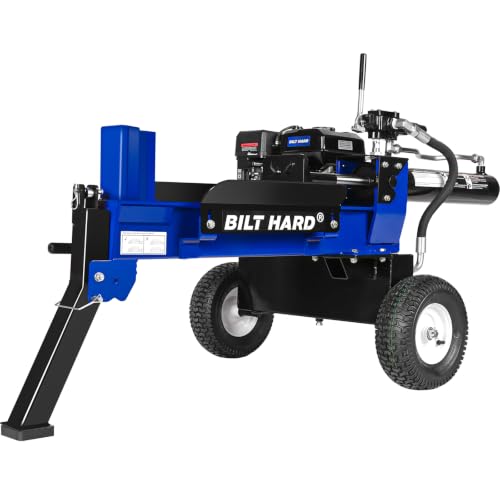
22-ton horizontal splitter with a 209cc engine, 14 GPM two-stage pump, 7-second cycle and 21-inch log capacity.
Check price on Amazon$1,199.99 as of Oct 20, 2026 11:21 pm GMT+0000 — prices change; see Amazon for current price.Why we like it
- Fastest stated cycle on the shelf, 7 seconds
- 14 GPM two-stage pump
- Splits logs up to 21 inches long
- Towable up to 25 mph on 13-inch wheels
| Specification | Details |
|---|---|
| Splitting force | 22 tons |
| Engine / pump | 209cc gas; 14 GPM two-stage gear pump |
| Cycle time | 7 seconds |
| Log length | Up to 21 inches; maximum diameter not stated |
| Cylinder | 3.5 x 19 inches; 25.5 MPa max operating pressure |
| Weight / towing | About 274 lb; towable up to 25 mph |
BILT HARD 22 Ton gas — 209cc, 14 GPM, 7 s cycle, 21 in. logs, 3.5 x 19 in. cylinder, 274 lb, towable 25 mph
The Fastest Stated Cycle Time of Any Splitter Here
Four gas splitters appear on the shelf. Three give cycle times: 7 seconds for this BILT HARD, 8.5 for the Full Boar and 11 for the BILT HARD 30-ton. The 22-ton is the fastest, more than twice as fast as the electrics, and its 14 GPM pump is the main reason. When you are splitting several cords of hardwood, cycle time decides how long the job takes.
Twenty-two tons is enough for most hardwood rounds a homeowner encounters, which is why this is our pick for anyone processing their own oak, ash or fruitwood rather than buying pre-split softwood.
The listing does not give a maximum log diameter, does not say whether hydraulic oil is included, and states no warranty. At about 274 lb it is a machine you tow or roll, not lift. And because it burns gasoline, it must run outdoors, away from garages and open windows.
Pros
- 7-second cycle, fastest stated
- 22 tons for hardwood
- Towable on 13-inch wheels
Cons
- Max diameter not stated
- Oil and warranty details missing
- Gas engine noise, exhaust and maintenance
Check BILT HARD 22-ton gas price on Amazon
4. Full Boar 20-Ton Gas Log Splitter — Best Compact Gas Machine

20-ton push-around splitter with an EPA-certified 209cc engine, auto-return valve, 10.5 GPM pump and flat-free tires.
Check price on Amazon$799.00 as of Oct 20, 2026 11:21 pm GMT+0000 — prices change; see Amazon for current price.Why we like it
- Integrated beam-and-tank design saves space
- Auto-return control valve with adjustable detent
- Wide-angle wedge said to reduce log lift
- Flat-free 10-inch tires
| Specification | Details |
|---|---|
| Splitting force | 20 tons |
| Engine / pump | 209cc EPA-certified; 10.5 GPM two-stage pump |
| Cycle time | 8.5 seconds |
| Wedge / rod | Wide-angle wedge with 5-degree angle; 45 mm piston rod |
| Mobility | Push design, 10-inch flat-free tires; not towable |
| Hydraulic oil | Not included; 1.45-gallon capacity |
Full Boar H5220FB — 20 tons, 209cc, 10.5 GPM, 8.5 s cycle, flat-free 10 in. tires, not towable, 1.45 gal oil
The Only Gas Splitter Here Designed to Push, Not Tow
The two BILT HARD gas machines are built to be towed behind a lawn tractor or UTV. The Full Boar is the only gas listing that says plainly it is not towable; instead it uses an integrated beam-and-tank design and a push handle with flat-free tires. For a suburban lot where the splitter lives in a shed and rolls out to the driveway, that compact layout is easier to store.
It is also the most detailed listing on hydraulics. It names the oil capacity, 1.45 gallons, the acceptable oil types and states plainly that oil is not included.
No log diameter or length is stated, and no warranty term appears. Plan to buy hydraulic oil before the first use.
Pros
- Compact, push-around design
- Auto-return valve
- Clear hydraulic oil specs
- Flat-free tires
Cons
- Not towable
- Oil not included
- Log capacity not stated
Check Full Boar 20-ton gas price on Amazon
5. BILT HARD 30-Ton Horizontal/Vertical Gas Splitter — Best for Big Rounds

30-ton splitter with a 223cc OHV engine, horizontal or vertical modes, 24-inch log length and DOT tires for towing.
Check price on Amazon$1,699.99 as of Oct 20, 2026 11:21 pm GMT+0000 — prices change; see Amazon for current price.Why we like it
- Only splitter here that works vertically
- Highest force on the shelf at 30 tons
- Splits logs up to 24 inches long
- Hydraulic and engine oil included
| Specification | Details |
|---|---|
| Splitting force | 30 tons |
| Engine / pump | 223cc OHV, 7.5 HP; 14 GPM two-stage gear pump |
| Cycle time | 11 seconds, with auto return |
| Log length / wedge | Up to 24 inches; 8-inch hardened steel wedge |
| Modes | Horizontal or vertical |
| Towing | 2-inch ball coupler, safety chains, 16-inch DOT tires; up to 45 mph |
BILT HARD 30 Ton gas — 223cc OHV, 14 GPM, 11 s cycle, 24 in. logs, horizontal/vertical, DOT tires, towable 45 mph
The Only Vertical-Capable Splitter and the Highest Tonnage
Lifting a large, heavy round onto a horizontal beam is the hardest part of splitting big wood. This BILT HARD is the only listing on the shelf that switches to vertical mode, so you can roll a heavy round onto the foot plate instead of lifting it. Its 30-ton rating is the highest among the 14 listings, and the 24-inch log length is the longest stated.
It is also the only gas listing that includes both hydraulic and engine oil, and it is built for real towing with DOT-certified tires, a 2-inch ball coupler and safety chains. The 11-second cycle is slower than the 22-ton BILT HARD, the price of extra force.
This is more machine than most suburban households need. If your wood comes pre-cut and seasoned, a 7-ton electric will do. If you clear your own property in the foothills and deal with large-diameter rounds, the vertical mode alone may justify it.
Pros
- Vertical mode for heavy rounds
- 30 tons, the most on the shelf
- Oils included
- Highway-towable
Cons
- Slower cycle than the 22-ton
- Large to store
- No warranty stated
Check BILT HARD 30-ton gas price on Amazon
6. Takywep 12-Ton Manual Hydraulic Log Splitter — Best With No Power Source

Hand-pumped 12-ton hydraulic splitter with a two-speed pump, 37-inch handles and wheels, for logs to 8 by 18.7 inches.
Check price on Amazon$199.99 as of Oct 20, 2026 11:21 pm GMT+0000 — prices change; see Amazon for current price.Why we like it
- No gas, cord or electricity required
- Two-speed pumping for easy and tough grain
- 12 tons from hand pumping
- Built-in wheels to roll to the woodpile
| Specification | Details |
|---|---|
| Splitting force | 12 tons |
| Log capacity | Up to 8 inches diameter, 18.7 inches long |
| Operation | Manual hydraulic, two-speed pump, 37-inch handles |
| Reset | Spring-loaded return knob |
| Weight | About 97 lb |
Takywep manual splitter — 12 tons hand-pumped, 2-speed, logs 8 x 18.7 in., 37 in. handles, wheels, 97 lb
The Only Hand-Powered Hydraulic Splitter on the Shelf
Everything else that splits full logs here needs a cord or a gas engine. The Takywep is the only manual hydraulic unit: you pump the handles and the ram pushes the log into the wedge. The listing claims 12 tons, more than the electric units, but delivered slowly, one pump at a time.
That makes sense for a mountain cabin with no outlet near the woodpile, for anyone splitting a small amount each week, or as a quiet option where neighbors are close. The listing’s 8-inch diameter and 18.7-inch length capacity are smaller than the electrics, so check your rounds.
Speed is the obvious cost. A hand-pumped splitter is far slower than any powered unit, and the listing gives no cycle time or warranty.
Pros
- Works anywhere without power
- Quiet and emission-free
- 12 tons claimed
Cons
- Slow by design
- Smaller log capacity
- No warranty stated
Check Takywep 12-ton manual price on Amazon
7. Kindling Cracker King XL — Best for Safe Kindling

One-piece cast iron kindling splitter with a 9-inch safety ring, fixed wedge and 17-inch frame; strike with a mallet.
Check price on Amazon$109.99 as of Oct 20, 2026 11:21 pm GMT+0000 — prices change; see Amazon for current price.Why we like it
- Safety ring keeps hands away from the blade
- No axe swing needed
- Single-piece cast iron, nothing to maintain
- XL ring takes larger pieces
| Specification | Details |
|---|---|
| Type | Fixed-wedge kindling splitter |
| Opening | 9-inch inside diameter safety ring |
| Height | 17 inches |
| Material | One-piece cast iron, no welds or moving parts |
| Use | Strike the top of the piece with a mallet or hammer |
Kindling Cracker King XL 118995 — cast iron, 9 in. safety ring, 17 in. tall, fixed wedge, mallet-driven
The Largest Kindling Ring on the Shelf
Three kindling splitters appeared in the search: this Kindling Cracker, the KABIN Kindle Quick and a small WujinJoy wedge. The Kindling Cracker King XL lists the largest stated opening, a 9-inch ring, and the listing says it fits logs nearly 40% larger than the original model. Its 17-inch frame gives room for longer pieces.
The safety idea is simple: the log sits inside a ring above a fixed wedge, and you strike the top of the log with a mallet. Your hands stay outside the ring, and there is no swinging blade.
This is not a log splitter in the hydraulic sense. It makes kindling and splits small pieces, which pairs well with any of the machines above.
Pros
- Hands stay clear of the wedge
- No maintenance or power
- 9-inch ring for bigger pieces
Cons
- Kindling and small splits only
- Best bolted to a stump or base
- Needs a mallet
Check Kindling Cracker King XL price on Amazon
Tonnage, log size and cycle time: reading the specs
How much tonnage you need
As a rule of thumb rather than a precise standard: about 5 to 7 tons handles seasoned softwood and smaller rounds up to roughly 10 inches; 10 to 20 tons covers larger softwood and many hardwoods; and 20 tons or more is for large, knotty or green hardwood. Knots, twisted grain and freshly cut wood all need more force than the diameter suggests. Along the Front Range, a lot of purchased firewood is softwood such as pine, which suits the electric units; hardwood and big rounds call for gas.
Log length and diameter
Measure your firebox, then cut logs a few inches shorter. Most stoves and fireplaces take pieces well under 20 inches, which matches the 20.5-inch capacity of the electric splitters here. Maximum diameter is the more common limit; a 10-inch electric will struggle with a 14-inch round no matter its tonnage.
Cycle time and auto return
Cycle time is how long the ram takes to extend and return. Electrics here list 17 to 18 seconds; gas machines list 7 to 11 seconds. Auto return means you release the lever and the ram resets on its own, letting you place the next log while it retracts.
Electric, gas or manual
- Electric: quiet, no exhaust, low maintenance, suited to a driveway or garage apron. Limited to modest tonnage and log size.
- Gas: high tonnage and fast cycles, portable anywhere, but noisy, heavy and needs fuel and engine care.
- Manual hydraulic: no power needed, slow, good for small volumes or remote sites.
- Kindling splitters: safe small splits and fire starters only.
Log splitter safety
Hydraulic splitters develop tons of force slowly, which makes them feel safe until a hand or glove gets between the log and the wedge. Two-hand controls, named on several of the electric listings here, are designed so the operator cannot hold the log during the stroke. Never defeat them.
- Eye protection: splitting throws chips and bark. OSHA notes that thousands of people are blinded each year from work-related eye injuries that proper eye and face protection could have prevented. Wear safety glasses, gloves and sturdy boots.
- One operator: one person loads and runs the controls; helpers stand clear.
- Stable footing: run the splitter on level ground and chock the wheels on gas units.
- Hydraulic lines: never run a hand along a hose to find a leak; follow the manual for inspecting hoses and fittings with the machine off.
Gas engines and carbon monoxide: the CPSC warns never to operate a portable generator or any other gasoline engine-powered tool in or near an enclosed space such as a garage, house or other building, because even with doors and windows open, carbon monoxide can build to lethal levels. Run gas splitters outdoors, well away from open garage doors and windows.
Why split wood matters for your chimney
Splitting is the first step toward dry firewood. Split pieces expose more surface area and dry far faster than whole rounds. The EPA recommends burning only dry, split, well-seasoned wood, seasoning it for at least six months, and storing it outdoors, off the ground, with only the top covered. It notes that wood burns best at a moisture content below 20 percent and suggests testing with a wood moisture meter.
A firewood moisture meter takes the guesswork out of seasoning; split a piece and test the fresh face, not the weathered outside. Our guide on how to use a firewood moisture meter covers technique.
Wet wood is not just inefficient. It smolders, produces more smoke and leaves more creosote in the flue, which raises chimney fire risk. The EPA’s wood smoke health page notes that the biggest health threat from smoke is fine particles, which can worsen asthma and other conditions, and that burning more efficiently with dry, seasoned wood creates less smoke. Pair a splitter with an annual chimney inspection, and if you are choosing a heater, our wood stove comparison covers efficient options.
Front Range firewood tips
Colorado’s dry climate helps seasoning: sun and wind can help split wood season, but test before you burn rather than assuming it is dry. Keep stacks away from the house walls and off decks to avoid giving pests a path inside, and leave the sides open to airflow. Outdoor fires add another layer; if you use firewood in a backyard pit, check county fire restrictions before burning, and see our fire pit comparison for related guidance.
Buying a home with a wood stove or fireplace? The chimney, flue liner, clearances and hearth deserve a close look before the first fire. The exterior and structure hub explains what inspectors check.
Want a Front Range inspector to look at a fireplace, wood stove or chimney before you buy? Contact us to connect with a vetted local professional.
Frequently asked questions
What size log splitter do I need?
As a rough rule of thumb, 5 to 7 tons handles seasoned softwood and smaller rounds up to about 10 inches, 10 to 20 tons covers larger softwood and many hardwoods, and 20 tons or more suits large, knotty or green hardwood. Check the maximum log diameter and length as well as tonnage.
Is an electric or gas log splitter better?
Electric splitters are quieter, produce no exhaust and suit modest volumes of softwood near an outlet. Gas splitters offer much higher tonnage and faster cycles for hardwood and large volumes, but they are louder, heavier and must run outdoors away from enclosed spaces because of carbon monoxide.
Can I use a log splitter in my garage?
Never run a gas splitter in or near a garage; the CPSC warns that gasoline engine tools can build carbon monoxide to lethal levels even with doors open. An electric splitter produces no exhaust, but follow the manual for ventilation, circuit and extension cord requirements.
How long should split firewood dry before burning?
The EPA recommends seasoning wood for at least six months and says wood burns best below 20 percent moisture. Store it outdoors, off the ground, with only the top covered, and confirm dryness with a moisture meter on a freshly split face.
Do log splitters need maintenance?
Hydraulic splitters need the correct hydraulic oil at the right level, and gas models need regular engine oil, fuel and air filter care. Inspect hoses and fittings for leaks without touching pressurized lines, and keep the wedge and beam clean. Follow the manufacturer's schedule.
References
- Best Wood-Burning Practices — U.S. Environmental Protection Agency
- Wood Smoke and Your Health — U.S. Environmental Protection Agency
- Eye and Face Protection — Occupational Safety and Health Administration
- Carbon Monoxide Questions and Answers — U.S. Consumer Product Safety Commission