Best Ant Killer (2026): 7 Baits and Sprays Compared

The best ant killer is usually not the strongest spray on the shelf. Ants that trail across a kitchen counter come from a colony you can’t see, and the products that reach that colony are slow-acting baits that foraging workers carry home. Sprays kill what they touch and leave a barrier, which is useful at doorways but can scatter a trail before the bait does its work. Below are seven picks matched to specific jobs: sweet-feeding kitchen ants, crack-and-crevice gel work, households with small children, outdoor perimeters and a plant-based contact spray. After the picks comes a buying guide that covers how to read an ant product label, where each format belongs, and when ants in a house are really a moisture or wood-damage finding that needs a professional.
Part of our Specialty Home Inspections guide — start there for the full picture →
As an Amazon Associate we earn from qualifying purchases.
How we compared: we compared 15 current Amazon listings for ant baits, gels, granules and sprays on what each listing states: format, stated active ingredient, target ant species, indoor or outdoor use, how long the product claims to keep working and any child-safety features. We did not lab-test these products or use them hands-on. Two listings are pack-size variants of the same TERRO liquid bait, and four are fire-ant mound treatments, which we set aside because they target a different problem. Prices and availability change often, so check the current listing before buying.
Quick picks: the best ant killers by job
| Product | Best for | Key features | Price | Buy |
|---|---|---|---|---|
| TERRO T300B Liquid Bait | Sweet-feeding kitchen ants |
| $10.88as of Oct 21, 2026 8:49 pm GMT+0000 | Buy now →Check current price |
| Syngenta Advion Ant Gel | Cracks, crevices and carpenter ants |
| $32.99as of Oct 21, 2026 8:49 pm GMT+0000 | Buy now →Check current price |
| Raid Ant Killer Baits | Homes with small children |
| $5.49as of Oct 21, 2026 8:49 pm GMT+0000 | Buy now →Check current price |
| TERRO T334B Multi-Surface | Mounting off the floor |
| $6.34as of Oct 21, 2026 8:49 pm GMT+0000 | Buy now →Check current price |
| Amdro Outdoor Perimeter Bait | Outdoor perimeter baiting |
| $17.97as of Oct 21, 2026 8:49 pm GMT+0000 | Buy now →Check current price |
| Ortho Home Defense Max Indoor | Doorway and baseboard barrier |
| $22.26as of Oct 21, 2026 8:49 pm GMT+0000 | Buy now →Check current price |
| STEM Plant-Based Spray | Plant-based contact spray |
| $6.99as of Oct 21, 2026 8:49 pm GMT+0000 | Buy now →Check current price |
Prices are Amazon’s listed prices as of the time shown and change often; check Amazon for today’s price. As an Amazon Associate we earn from qualifying purchases.
The 7 picks, compared listing by listing
1. TERRO T300B Liquid Ant Bait Stations — Best for Sweet-Feeding Kitchen Ants

Twelve ready-to-use borax liquid bait stations for common sugar-feeding household ants along baseboards and counters.
Check price on Amazon$10.88 as of Oct 21, 2026 8:49 pm GMT+0000 — prices change; see Amazon for current price.Why we like it
- Twelve stations cover several trails at once
- Listing names the borax-based formula outright
- Six common household ant species named
- No mixing, filling or setup required
- Sets realistic expectations: 2 to 4 weeks
| Specification | Details |
|---|---|
| Format | Pre-filled liquid bait stations, 12 per pack |
| Active ingredient stated | Borax-based formula (concentration not stated in listing) |
| Ants named | Acrobat, crazy, ghost, little black, odorous house and pavement ants |
| Where to use | Indoors along baseboards, in corners and on countertops |
| Time to control | Activity drops within days; full control may take 2 to 4 weeks |
| Model | T300B; an 18-count version (T300-3SR) is also listed |
TERRO T300B — 12 liquid borax bait stations, indoor use, six ant species named, 2–4 week control window stated
The Most Specific Indoor Bait Listing on the Shelf
Five of the 15 listings are ready-to-use indoor bait stations: this 12-pack, the 18-count version of the same TERRO bait, TERRO’s wall-mount T334B, Raid’s child-resistant baits and Ortho’s Orthene bait stations. The T300B listing is the one that tells a buyer the most. It names the borax-based formula, lists six common household ant species by name and gives a timeline, not just a promise, that complete control can take two to four weeks depending on colony size.
That timeline matters because the most common reason a bait “fails” is that someone wipes up the ants feeding on it or sprays the trail on day two. A liquid bait works only while workers keep visiting it, and the listing says as much: the bait keeps working as long as ants continue to come to the station. Twelve stations is also enough to place two or three on every active trail in a typical kitchen and still have spares for a bathroom or a back entry.
What the listing does not say is just as relevant. It gives no borax concentration and no EPA registration number in the text we reviewed; neither does any other ant listing on this shelf. It also targets sweet-feeding ants specifically, so grease- or protein-feeding ants may ignore it. If ants walk past the stations, switch to a gel like Advion rather than adding more stations.
Pros
- Names its active ingredient and six target species
- Twelve stations for multiple trails
- Ready to use with no mixing
- Honest 2 to 4 week control window
Cons
- Indoor use only
- Built for sweet-feeding ants
- Borax concentration not stated
- Stations sit on the floor or counter, within reach
Check TERRO T300B price on Amazon
2. Syngenta Advion Ant Gel — Best for Cracks, Crevices and Carpenter Ants
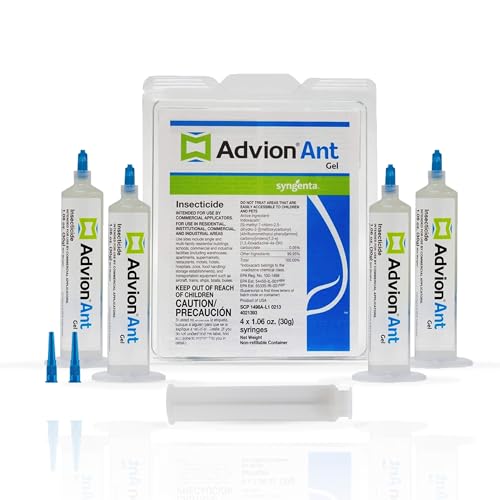
Four 30-gram syringes of indoxacarb gel bait for cracks, crevices, attics and crawl spaces, indoors or out.
Check price on Amazon$32.99 as of Oct 21, 2026 8:49 pm GMT+0000 — prices change; see Amazon for current price.Why we like it
- States its active ingredient and concentration
- Gel reaches cracks that stations can’t
- Names carpenter and Argentine ants
- Listed for attics and crawl spaces
- Non-repellent, so ants keep feeding
| Specification | Details |
|---|---|
| Format | Gel bait in four 30-gram syringe tubes |
| Active ingredient stated | Indoxacarb, 0.05 percent, described as non-repellent |
| Ants named | Major ant species, including Argentine and carpenter ants |
| Where to use | Indoors and outdoors: cracks, crevices, under appliances, attics, crawl spaces |
| Odor | Described as odorless |
| Model | Part number 53204 |
Syngenta Advion Ant Gel — 4 x 30 g syringes, 0.05% indoxacarb, non-repellent, indoor/outdoor crack-and-crevice use
The Only Listing That States Both Ingredient and Concentration
Of the 15 listings, only two name an active ingredient outright: the TERRO liquid baits (borax) and Advion (indoxacarb). Advion is the only one that also gives a concentration, 0.05 percent. For a homeowner trying to compare products or rotate baits after one stops working, that detail is genuinely useful.
The gel format is the other differentiator. Stations sit where you put them; a syringe lets you place a pea-sized dab inside the gap behind a backsplash, under a dishwasher kick plate or along a sill plate in the crawl space, which are the places the listing calls out. Three listings on the shelf name carpenter ants as a target (Advion, Amdro’s outdoor bait and Raid’s Ant & Roach spray), and Advion is the only one of those three that is an indoor bait. Ortho’s Orthene bait stations, by contrast, say plainly that they are not labeled for carpenter ants.
The listing makes broad safety claims about people and pets that a buyer should treat as marketing; the product label’s precautions are what count. It also doesn’t say how many placements a tube makes. Finally, carpenter ants inside a house are rarely just a bait problem, as the buying guide below explains.
Pros
- Active ingredient and concentration stated
- Precise placement in cracks and voids
- Names carpenter and Argentine ants
- Works indoors and outdoors
Cons
- Takes more care to apply than stations
- Placements per tube not stated
- Gel dots can be reached by pets on open surfaces
Check Syngenta Advion Ant Gel price on Amazon
3. Raid Ant Killer Baits — Best for Homes With Small Children

Eight indoor bait stations described as child-resistant, claimed to keep killing ants for up to three months.
Check price on Amazon$5.49 as of Oct 21, 2026 8:49 pm GMT+0000 — prices change; see Amazon for current price.Why we like it
- Only ant listing here stating child-resistant
- Claims up to three months per station
- Placement guidance for walls and entry points
- Colony-transfer bait, not a contact kill
| Specification | Details |
|---|---|
| Format | Enclosed bait stations, 8 per pack |
| Active ingredient stated | Not stated in listing |
| Child safety | Described as child-resistant |
| Where to use | Indoors in corners, along walls and near entry points |
| Duration claimed | Up to 3 months |
| Model | 697329 |
Raid Ant Killer Baits — 8 child-resistant stations, indoor use, up to 3 months claimed, active ingredient not stated
The Only Child-Resistant Claim Among 15 Listings
Every bait station on this shelf is enclosed to some degree, but only the Raid listing describes its stations as child-resistant. TERRO’s T334B takes a different route, using adhesive strips to get bait off the floor and away from pets and children. If a toddler or a curious dog has full run of the kitchen, the Raid stations are the lowest-risk floor-level option here.
The longevity claim is the other point of contrast. Raid says its stations keep working up to three months, which is the same claim Amdro makes for its outdoor granules. The TERRO liquid baits make no such claim and instead say they work as long as ants keep visiting, because liquid bait can dry out. A three-month station suits a slow, recurring spring ant problem better than a quick knockdown.
The trade-off is information. The listing does not name the active ingredient or the ant species it targets, so it is harder to judge whether it suits a sweet-feeding or grease-feeding ant. Eight stations is also the smallest count among the indoor station packs except TERRO’s four-pack.
Pros
- Child-resistant stations stated
- Up to three months claimed per station
- Clear indoor placement guidance
Cons
- No active ingredient named
- No target ant species listed
- Only 8 stations
- Child-resistant is not childproof; still place out of reach
Check Raid Ant Killer Baits price on Amazon
4. TERRO T334B Multi-Surface Liquid Ant Baits — Best for Mounting Off the Floor

Four liquid bait stations with adhesive strips for walls and cabinet undersides, keeping bait off floors and counters.
Check price on Amazon$6.34 as of Oct 21, 2026 8:49 pm GMT+0000 — prices change; see Amazon for current price.Why we like it
- Adhesive strips mount on walls and cabinets
- Keeps bait off the floor, away from pets
- Same liquid-bait approach as the T300B
- Discreet two-color housing
| Specification | Details |
|---|---|
| Format | Pre-filled liquid bait stations, 4 per pack |
| Mounting | Multi-surface adhesive strips for walls and cabinet undersides |
| Ants named | Common household ants, including ghost and pavement ants |
| Active ingredient stated | Not stated in this listing |
| Model | T334B |
TERRO T334B — 4 adhesive-mount liquid bait stations, indoor use, ghost and pavement ants named
The Only Bait Station Built to Stick to a Wall
Ant trails rarely stay on the floor. They run up cabinet sides, along the backsplash and under the sink, and a station on the floor can sit inches from the trail and still get ignored. The T334B is the only bait listing among the 15 with an adhesive mount, so a station can go exactly on the trail, including vertically, and out of the reach of a pet that would otherwise chew a floor station.
Unlike the T300B listing, this one does not mention borax, so we can’t confirm from the listing alone that the formula is identical. With only four stations it is best as a supplement: a pack of T300B for the floor and counter trails, plus a few T334B stations for the vertical runs and the spots where pets roam.
The listing names fewer species than the T300B (ghost and pavement ants, plus “common household ants”) and gives no control timeline. Expect the same slow, colony-level approach as other liquid baits.
Pros
- Mounts on walls and under cabinets
- Keeps bait away from floor-level pets
- Ready to use; peel and stick
Cons
- Only 4 stations
- Active ingredient not named in listing
- No control timeline stated
Check TERRO T334B price on Amazon
5. Amdro Ant Killer for Outdoor Home Perimeter — Best for Outdoor Perimeter Baiting

24-ounce granular ant bait for lawns and beds, listing 25 species including carpenter and pavement ants.
Check price on Amazon$17.97 as of Oct 21, 2026 8:49 pm GMT+0000 — prices change; see Amazon for current price.Why we like it
- Lists 25 ant species, carpenter ants included
- Baits ants before they reach the house
- Weather and timing guidance in the listing
- Claims up to three months of control
| Specification | Details |
|---|---|
| Format | Granular bait, 24-ounce shaker container |
| Ants named | 25 species, including acrobat, Argentine, carpenter, odorous house, pavement and Pharaoh ants |
| Where to use | Outdoors: lawns, landscaped areas, ornamental beds |
| Application limits | Not on wet ground, not within 24 hours of rain, not below 50°F |
| Duration claimed | Up to 3 months |
| Active ingredient stated | Not stated in listing |
Amdro Outdoor Perimeter — 24 oz granular bait, 25 species named, outdoor only, no wet ground or rain within 24 hr, above 50°F
The Widest Species List and the Only Outdoor Bait for Common Ants
Five outdoor products sit on this shelf, and four of them are fire-ant mound treatments or broadcast insecticide granules. Amdro is the only outdoor bait aimed at the everyday nuisance ants that find their way inside, and its 25-species list is the longest of any listing here, naming carpenter ants alongside pavement and odorous house ants.
It is also the only listing with practical weather limits: do not apply to wet ground, within 24 hours of rain or below 50°F, and in hot weather apply in the cool of morning or evening. On the Front Range that rules out the cold weeks of early spring and favors a dry late-spring morning, when ants are foraging and afternoon storms haven’t started.
The listing does not name an active ingredient or say how much area the 24 ounces covers. Amdro itself suggests pairing it with indoor stations, which matches how most homeowners get results: outdoor bait along the foundation, indoor bait on the trails.
Pros
- 25 species named, including carpenter ants
- Stops ants before they come inside
- Clear temperature and rain limits
- Up to 3 months claimed
Cons
- Outdoor use only
- Coverage area not stated
- Active ingredient not named
- Wasted if it rains within 24 hours
Check Amdro Outdoor Perimeter Bait price on Amazon
6. Ortho Home Defense Max Indoor Insect Barrier — Best Doorway and Baseboard Barrier

One-gallon ready-to-use spray with an extended-reach wand, claimed to protect nonporous indoor surfaces up to 365 days.
Check price on Amazon$22.26 as of Oct 21, 2026 8:49 pm GMT+0000 — prices change; see Amazon for current price.Why we like it
- Extended wand sprays without bending
- Longest residual claim among ant sprays
- Also covers roaches, spiders, fleas, ticks
- Indoor rooms plus outdoor foundations
| Specification | Details |
|---|---|
| Format | Ready-to-use liquid, 1 gallon (128 fl oz), extended-reach wand |
| Pests named | Ants, roaches, spiders, fleas, ticks and other listed bugs |
| Where to use | Kitchens, bathrooms, basements, around doors and windows; outdoor foundations |
| Residual claimed | Up to 365 days indoors on nonporous surfaces |
| Active ingredient stated | Not stated in listing |
| Model | 4600810 |
Ortho Home Defense Max Indoor — 1 gal RTU with wand, up to 365-day indoor residual on nonporous surfaces, multi-pest
The Longest Residual Claim, With an Important Condition
Four listings on the shelf are general-purpose insect sprays that include ants: two Ortho Home Defense wands, Raid’s Ant & Roach aerosol and STEM. The two Ortho products both claim up to 12 months of protection; Raid claims up to 13 weeks. This Max Indoor version is the one designed primarily for indoor rooms, with an extended wand so baseboards and thresholds can be treated standing up.
The condition is in the wording: the 365-day claim applies to nonporous surfaces indoors. Carpet, unsealed wood and concrete absorb more product, so real-world residual on those surfaces is not stated. A barrier spray is a prevention tool for entry points, not a colony killer. Spraying a trail that leads to bait stations will kill the foragers that would otherwise carry bait home, so use the spray at doorways and windows and leave the bait trails alone.
The listing does not name the active ingredient. As with any indoor spray, the label’s directions for keeping people and pets out of treated areas until surfaces dry are what to follow.
Pros
- Up to 365-day residual claim on nonporous surfaces
- Wand reaches baseboards standing up
- Covers several common household pests
Cons
- Does not reach the colony
- Can undermine nearby bait stations
- Active ingredient not named
- Heavy one-gallon jug
Check Ortho Home Defense Max Indoor price on Amazon
7. STEM Kills Ants, Roaches and Flies — Best Plant-Based Contact Spray

A 12-ounce botanical insecticide spray for ants, roaches and flies, indoors or out, with no added dye or fragrance.
Check price on Amazon$6.99 as of Oct 21, 2026 8:49 pm GMT+0000 — prices change; see Amazon for current price.Why we like it
- Plant-based active ingredient, per the listing
- No added dye or fragrance
- Indoor and outdoor use
- Handles a scout ant without a full treatment
| Specification | Details |
|---|---|
| Format | 12 fl oz spray |
| Active ingredient stated | Plant-based botanical extracts (specific ingredient not named in listing) |
| Pests named | Ants, roaches and flies |
| Where to use | Indoors and outdoors |
| Residual | Not stated in listing |
STEM — 12 fl oz botanical contact spray, ants/roaches/flies, indoor/outdoor, no added dye or fragrance, residual not stated
The Only Botanical Product on the Ant Shelf
Of the 15 listings, STEM is the only one built around a plant-based active ingredient. It is a contact spray, so it kills the ants it hits and nothing more; the listing makes no residual or colony claim. That is a narrow job, but a real one: a handful of scouts on a windowsill, or ants on a patio table where a homeowner would rather not use a conventional insecticide.
The listing says the product is entomologist tested and safe around people and pets when used as directed, but it does not name the botanical ingredient or say how long treated surfaces stay effective. Plant-based does not mean label-free; read the precautions as carefully as for any other insecticide.
Use STEM to handle what you see while baits handle the colony. Spraying it directly on a bait trail has the same drawback as any contact spray.
Pros
- Only plant-based option on the shelf
- No added dye or fragrance
- Indoor and outdoor use
Cons
- Contact kill only; no colony effect
- Ingredient not named in listing
- No residual claim
- Small 12 oz can
Check STEM Plant-Based Spray price on Amazon
Bait, gel, granule or spray: matching the format to the ant problem
Most ant products fall into four formats, and choosing the right one matters more than choosing a brand.
- Liquid bait stations (TERRO, Raid, Ortho Orthene stations) are the default for ants trailing across kitchens and bathrooms. Workers drink the bait and share it with the colony. Expect fewer ants within days and control over one to four weeks, according to the listings.
- Gel baits (Advion) do the same job in places a station can’t reach: cracks, voids, under appliances and in crawl spaces.
- Outdoor granular baits (Amdro) intercept foragers in the yard before they reach the foundation.
- Contact and barrier sprays (Ortho Home Defense, Raid Ant & Roach, STEM) kill on contact and, for the conventional ones, leave a residual barrier at entry points. They do not reach the nest.
The common mistake is mixing them in the wrong order. Spraying a trail kills the workers that would carry bait home and can push the colony to find a new route. Bait first, wait, and use sprays only at thresholds and outside the trail.
Fire-ant mound treatments (four of the 15 listings) are a separate category. They are labeled for fire ant mounds in lawns; unless the ants have been identified as fire ants, they are the wrong tool for a kitchen trail.
Reading the label: the part of any ant killer that actually matters
The EPA is direct about this: every pesticide label carries the statement that using the product in a manner inconsistent with its labeling violates federal law. In the EPA’s words, the label is the law. That label, not the Amazon listing, tells you where the product can go, how much to use, how long to keep children and pets away and how to store it.
Three label checks are worth the minute they take:
- An EPA registration number. The EPA says pesticides must be registered unless they qualify as minimum risk pesticides, a category the agency exempts from registration because it poses little to no risk. None of the 15 listings we reviewed prints a registration number in its text, so look for “EPA Reg. No.” on the package itself.
- The site list. Indoor-only, outdoor-only and indoor-and-perimeter products are not interchangeable. TERRO’s Ant Killer Plus granules, for example, are outdoor only.
- The target pest list. Orthene bait stations say outright that they are not labeled for carpenter, fire or harvester ants. If your ant isn’t on the label, the product may not work on it.
For storage, the EPA advises keeping baits and sprays locked away from children in their original containers, resealing child-resistant packaging after every use, and posting the Poison Control hotline, 1-800-222-1222, near the phone. Place stations behind appliances or inside cabinet bases rather than in the open where a toddler or pet can reach them.
Prevention first: why ants keep coming back
The EPA’s guidance on whether you really need a pesticide comes down to three steps: starve them out, dry them out, keep them out. For ants that means sealing food in containers, cleaning up crumbs and spills right away, not leaving pet food out overnight, keeping a tight lid on trash, fixing leaky faucets and dishwashers, and sealing cracks along baseboards, behind sinks and around pipes and windows.
The EPA’s integrated pest management principles take the same view. They call for identifying the pest, setting a threshold for action, preventing access and choosing the least risky effective control first, with broadcast spraying of non-specific pesticides as a last resort. A single ant on the counter in June doesn’t call for a gallon of barrier spray.
On the Front Range, ant activity tends to pick up as soil warms in spring and slows with the first hard freezes. Ants often follow moisture inside during dry spells, so a trail that keeps returning to the same sink or bathroom can point to a plumbing leak worth chasing down.
When ants are an inspection finding, not a DIY job
Most sugar ants are a nuisance. Carpenter ants are different. They excavate galleries in damp or damaged wood, and a steady indoor population, especially in winter, can mean a nest inside the structure. Our carpenter ant guide covers the signs, including piles of coarse sawdust-like frass near window frames, sill plates and decks. Baits like Advion can reduce foragers, but the wet wood that attracted them needs a repair, not just a treatment.
Winged ants also get mistaken for termites. If you find swarmers indoors, compare them against our termite swarmer identification guide and the other signs of termites before assuming it’s an ant problem. Termites need a professional treatment; for DIY spot products and why they don’t replace one, see our termite killer roundup.
For buyers, ant activity noted during a showing is a reason to ask for a wood-destroying insect inspection alongside the general inspection. Our guide to pairing a home inspection with a termite inspection explains how the two reports differ, and the specialty inspections hub covers the other add-on inspections worth considering. More on vetting inspectors sits in our hiring process section.
Call a licensed pest professional when baits haven’t reduced activity after four weeks, when you see carpenter ants indoors repeatedly, when ants are nesting in walls or insulation, or when you’d rather not handle insecticides around young children. If you’re buying or selling on the Front Range and want ant damage, moisture and wood condition checked as part of the deal, contact us to connect with a vetted local inspector.
Frequently asked questions
What is the best ant killer for indoor ants?
For ants trailing across kitchens and bathrooms, a slow-acting bait usually works better than a spray because workers carry it back to the colony. Liquid bait stations such as TERRO suit sweet-feeding ants; a gel bait such as Advion reaches cracks and voids. Leave the ants feeding and give the bait one to four weeks.
Should I spray ants that are feeding on bait?
No. Spraying or wiping up ants at a bait station kills the workers that would carry bait to the queen and the nest. Let them feed, keep the area otherwise clean and use barrier sprays only at doorways and windows away from the bait trail.
Are ant baits safe around kids and pets?
Baits are pesticides, so follow the label. The EPA advises keeping pesticides out of children's reach, resealing child-resistant packaging and keeping the Poison Control number handy. Choose enclosed or child-resistant stations, or wall-mounted ones, and place them behind appliances or inside cabinets.
How long does it take ant bait to work?
Listings on this shelf describe fewer ants within days and complete control in roughly one to four weeks, depending on colony size. Outdoor perimeter baits and some stations claim to keep working for up to three months.
When do ants mean I need a professional?
Repeated carpenter ants indoors, ants nesting in walls or insulation, winged insects that may be termites, or baits that haven't worked after about four weeks all call for a licensed pest professional. Buyers who see ant activity should consider a wood-destroying insect inspection.
References
- Introduction to Pesticide Labels — U.S. Environmental Protection Agency
- Pesticides Must be Registered with EPA — U.S. Environmental Protection Agency
- Do You Really Need to Use a Pesticide? — U.S. Environmental Protection Agency
- Integrated Pest Management (IPM) Principles — U.S. Environmental Protection Agency
- Reduce Your Child’s Chances of Pesticide Poisoning — U.S. Environmental Protection Agency
- Minimum Risk Pesticides Exempted from FIFRA Registration — U.S. Environmental Protection Agency