Best Termite Killers (2026): 7 DIY Treatments Compared

The best termite killer a homeowner can buy is the right product for a small, specific job: foaming a gallery of termites you have exposed in a door frame, treating a woodpile or fence post, or setting monitoring stakes along a foundation. What no retail bottle does is replace a professional soil or bait treatment for an active infestation in the structure, or a wood-destroying insect (WDI or WDO) inspection when a home is being bought or sold. Below are seven DIY picks, each matched to the task it suits, followed by a buying guide on how termite treatments actually work, what the label allows, how to tell termites from carpenter ants, and when a licensed pest professional and a termite inspection are the answer.
Part of our Specialty Home Inspections guide — start there for the full picture →
As an Amazon Associate we earn from qualifying purchases.
How we compared: we compared 14 current Amazon listings returned for termite killers on what each listing states: product form, termite species named, stated duration, coverage, where it may be applied and any limits the seller states. Thirteen are termite or wood-destroying insect products (foams, aerosols, ready-to-use sprays, concentrates, granules, a wood treatment and detection stakes in two pack sizes); one is a general indoor and perimeter bug spray that does not list termites, which we set aside. We did not lab-test or apply any of these products. Prices and availability change often, so check the current listing and the product label before buying.
Quick picks: the best termite killers by use case
| Product | Best for | Key features | Price | Buy |
|---|---|---|---|---|
| Spectracide Terminate Foam | Best spot treatment in wood |
| $8.10as of Oct 21, 2026 1:30 am GMT+0000 | Buy now →Check current price |
| Ortho Termite and Bug Concentrate | Best DIY perimeter trench |
| $33.99as of Oct 21, 2026 1:30 am GMT+0000 | Buy now →Check current price |
| Nisus Bora-Care | Best for bare-wood treatment |
| $89.91as of Oct 21, 2026 1:30 am GMT+0000 | Buy now →Check current price |
| Spectracide Terminate Stakes (15) | Best for monitoring the yard |
| $53.99as of Oct 21, 2026 1:30 am GMT+0000 | Buy now →Check current price |
| BioAdvanced Termite Granules | Best granular perimeter option |
| $53.49as of Oct 21, 2026 1:30 am GMT+0000 | Buy now →Check current price |
| TERRO Termite Aerosol T1901SR (2) | Best for wall voids and entry points |
| $18.99as of Oct 21, 2026 1:30 am GMT+0000 | Buy now →Check current price |
| TERRO Termite Spray T1100 | Best crack spray for crawl spaces |
| $12.95as of Oct 21, 2026 1:30 am GMT+0000 | Buy now →Check current price |
Prices are Amazon’s listed prices as of the time shown and change often; check Amazon for today’s price. As an Amazon Associate we earn from qualifying purchases.
The seven picks, compared listing by listing
1. Spectracide Terminate Termite Killing Foam, 16 oz — Best Spot Treatment in Wood
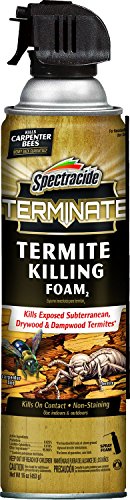
Foaming aerosol that expands into galleries and voids to kill exposed subterranean, drywood and dampwood termites.
Check price on Amazon$8.10 as of Oct 21, 2026 1:30 am GMT+0000 — prices change; see Amazon for current price.Why we like it
- Foam expands into tunnels and hollow wood
- Only listing naming drywood and dampwood termites
- Works behind veneers and trim
- Also treats carpenter bee tunnels
| Specification | Details |
|---|---|
| Form | Foaming aerosol |
| Species named | Subterranean, drywood and dampwood termites; carpenter bees |
| Action | Kills exposed termites on contact |
| Where | Voids, channels in damaged wood, behind veneers, cracks; indoor and outdoor |
| Size | 16 fl oz |
| Use type | Spot treatment only |
Spectracide Terminate HG-53370 — termite killing foam, 16 oz, subterranean/drywood/dampwood, spot treatment, indoor/outdoor
The Only Product Here That Names All Three Termite Types
Four listings name subterranean termites. Only this foam also names drywood and dampwood termites, and it is the only foam on the shelf. That combination is why it ranks first for the most common DIY moment: you pull off a piece of baseboard or window trim, find live termites in the wood, and want to treat that gallery before the professional visit.
Foam expands into tunnels and voids where a liquid spray would run off. The listing is explicit about the job: spot treatment of exposed termites and active carpenter bee tunnels. It kills what it touches; it does not claim to protect the structure or reach the colony in the soil.
That limit matters. The EPA says a product whose label does not include directions to control termites and protect the structure is not intended for structural protection. Use this foam on a spot you can reach, then get a professional inspection to find out how far the activity goes.
Pros
- Expands into galleries and voids
- Names subterranean, drywood and dampwood
- Indoor and outdoor spot use
Cons
- Spot treatment only; no structural protection
- Kills only termites it contacts
- Active ingredient not stated in listing
Check Spectracide Terminate Foam price on Amazon
2. Ortho Home Defense Termite and Destructive Bug Killer Concentrate, 16 oz — Best DIY Perimeter Trench

Concentrate for subterranean termites and other wood-destroying pests, with a trenching use rated up to 5 years.
Check price on Amazon$33.99 as of Oct 21, 2026 1:30 am GMT+0000 — prices change; see Amazon for current price.Why we like it
- Longest stated termite control at up to 5 years
- Describes a trench barrier around the perimeter
- Also sprays woodpiles, fences and stumps
- States people and pets stay out until dry
| Specification | Details |
|---|---|
| Form | Liquid concentrate (mix with water) |
| Species named | Subterranean termites, carpenter ants, carpenter bees, other listed pests |
| Application | Trench around the perimeter with a watering can; hose-end or tank sprayer for outdoor spraying |
| Stated duration | Termite control in treated areas up to 5 years (trenching use) |
| Restrictions | Trenching use not in MA, NY or RI |
| Size | 16 oz |
Ortho Home Defense 0200010 — termite and destructive bug concentrate, 16 oz, trench use up to 5 years, outdoor
The Longest Stated Termite Control on the Shelf
No other listing claims termite control longer than this concentrate’s up to 5 years in treated areas, a figure tied to the trenching use. The listing describes the job: dig a trench around the perimeter, mix the concentrate with water and pour it in with a watering can. It also covers spraying woodpiles, fences and stumps with a hose-end or tank sprayer.
That makes it the closest thing on the shelf to the conventional soil barrier a professional applies. It is not the same. Professional barrier work can involve drilling through slabs and applying larger volumes of a termiticide specifically labeled for structural barrier use. The EPA warns that improperly conducted barrier treatments can contaminate the home and nearby drinking water wells and fail to protect against termites, which is why it recommends a licensed, trained professional for that work.
For a homeowner, this concentrate fits preventive trenching around a detached shed, deck posts or a garden structure, or a perimeter treatment on a house with no active infestation, done strictly by the label. Keep people and pets off treated areas until dry.
Pros
- Up to 5 years stated for trench use
- Covers multiple wood-destroying pests
- Flexible outdoor application methods
Cons
- Trenching is real digging work
- Not a substitute for a professional structural treatment
- State restrictions on trench use
Check Ortho Termite and Bug Concentrate price on Amazon
3. Nisus Bora-Care Wood Treatment Concentrate, 1 Gallon — Best for Bare-Wood Treatment

Concentrate applied directly to bare wood to protect against termites, wood-boring beetles and decay fungi.
Check price on Amazon$89.91 as of Oct 21, 2026 1:30 am GMT+0000 — prices change; see Amazon for current price.Why we like it
- Treats the wood itself, not the soil
- Lists termites, carpenter ants, beetles and decay fungi
- One gallon covers about 800 sq ft
- For new builds and existing homes
| Specification | Details |
|---|---|
| Form | Liquid concentrate for wood surfaces |
| Targets | Drywood and subterranean termites, carpenter ants, wood-boring beetles, decay fungi |
| Application | Applied to wood; 2-foot band treatment described |
| Coverage | About 800 sq ft per gallon of concentrate |
| Timing | New construction at dried-in stage, or existing homes |
| Active ingredient | Not stated in listing |
Nisus Bora-Care — wood treatment concentrate, 1 gal, about 800 sq ft, termites/beetles/decay fungi, new or existing construction
The Only Wood Treatment on the Shelf
Every other pick here treats soil, insects or voids. Bora-Care is the only listing applied to the wood itself, and the only one that also lists wood-boring beetles and decay fungi. The EPA lists wood treatments among approved termite treatment types and notes that borates are commonly sprayed on during new home construction to protect wood. That is the setting where this product makes the most sense: an exposed framing package, a crawl space with accessible joists, or attic framing during a remodel.
The listing describes treating a 2-foot band of wood and says one gallon of concentrate covers about 800 square feet. Its claims of protection for the life of the structure are the seller’s; we cannot verify them, and treatment only reaches wood you can get to. Finished, painted or sealed wood typically has to be bare for a surface treatment to soak in, so check the label.
It is a concentrate meant for careful mixing, and the package is heavy at about 11 pounds. If your concern is powder post beetles in old framing rather than termites, our guide to powder post beetles covers how to tell the damage apart.
Pros
- Treats wood directly
- Covers beetles and decay fungi too
- About 800 sq ft per gallon
Cons
- Needs bare, accessible wood
- Long-term claims are the seller’s own
- No warranty stated in listing
Check Nisus Bora-Care price on Amazon
4. Spectracide Terminate Termite Detection and Killing Stakes, 15 Count — Best for Monitoring the Yard
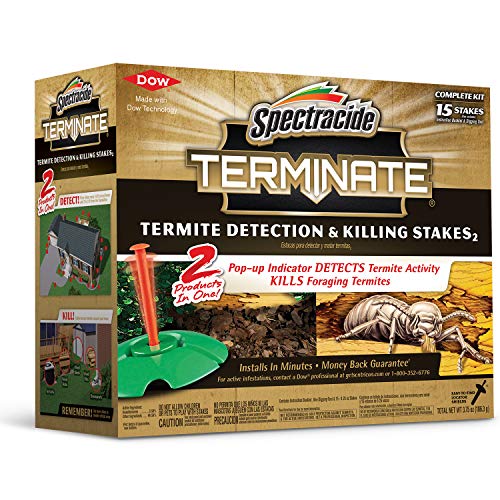
In-ground stakes with pop-up indicators that show termite activity and kill foraging termites.
Check price on Amazon$53.99 as of Oct 21, 2026 1:30 am GMT+0000 — prices change; see Amazon for current price.Why we like it
- Only product that also detects activity
- Pop-up indicator shows when termites feed
- Kit includes locator shields and a digging tool
- Replacement 5-packs are sold separately
| Specification | Details |
|---|---|
| Form | In-ground detection and killing stakes |
| Count | 15 stakes with locator shields |
| Spacing | 2 to 3 ft from the house, no more than 10 ft apart |
| Indicator | Pop-up flag shows termite activity |
| Included | Instruction booklet and digging tool |
| Active ingredient | Not stated in listing |
Spectracide Terminate HG-96115 — detection and killing stakes, 15-count, pop-up indicators, 2–3 ft from home, 10 ft spacing
The Only Listing That Shows You Whether Termites Are Present
Two listings sell these stakes: the 15-count kit and a 5-count replacement pack. They are the only products among the 14 with a detection function. Everything else assumes you already know where termites are; the pop-up indicator tells you when termites have found a stake.
The stated spacing, 2 to 3 feet from the house and no more than 10 feet apart, means 15 stakes covers roughly 150 feet of perimeter. Check them on a schedule and treat a triggered stake as a reason to call for an inspection rather than proof the house is protected.
Keep expectations realistic. The EPA describes professional termite bait systems as cellulose baits with a slow-acting insecticide, used as part of an inspection, monitoring and baiting program. The listing does not describe how these stakes compare with those systems, does not name an active ingredient and pitches them for decks, sheds and woodpiles.
Pros
- Detects termite activity
- Simple install with tools included
- Refills sold separately
Cons
- Not a professional bait system
- Needs regular checks
- Active ingredient not named
Check Spectracide Terminate Stakes (15) price on Amazon
5. BioAdvanced Termite Killer Granules, 9 lb — Best Granular Perimeter Option

Ready-to-use granules for subterranean termites; sprinkle around the foundation, water in, cover up to 200 linear feet.
Check price on Amazon$53.49 as of Oct 21, 2026 1:30 am GMT+0000 — prices change; see Amazon for current price.Why we like it
- No mixing; sprinkle and water in
- Names subterranean termites
- Coverage stated as 200 linear feet
- Sized for an average foundation perimeter
| Specification | Details |
|---|---|
| Form | Ready-to-use granules |
| Species named | Subterranean termites |
| Coverage | Up to 200 linear feet |
| Application | Sprinkle around the perimeter, then water in |
| Size | 9 lb bottle |
| Stated duration | Not stated in listing |
BioAdvanced 700350 — termite killer granules, 9 lb, subterranean termites, 200 linear ft, sprinkle and water in
The Only Termite-Specific Granule With Linear-Foot Coverage
Two BioAdvanced granule bottles are on the shelf, and they are easy to confuse. This one names subterranean termites and gives coverage in linear feet of foundation, 200. The other, sold in the same size bottle, lists termites among general insects, offers 30 days of outdoor protection and gives coverage in square feet. For a termite-focused perimeter, this is the one to look for, and the item number on the label is the way to tell them apart.
Granules are the easiest perimeter product here: no trench, no sprayer, no mixing. Sprinkle along the foundation, water in, done. That convenience comes with limits. Granules sit at the surface and soak in with watering, which is shallower than a trenched or rodded treatment.
The listing states no duration of control, which makes it hard to compare with the Ortho concentrate. Treat it as a supplemental perimeter tool rather than structural protection.
Pros
- Easiest perimeter application
- 200 linear feet per bottle
- No mixing equipment
Cons
- No stated duration
- Surface treatment, not a deep barrier
- Easy to confuse with the general-insect version
Check BioAdvanced Termite Granules price on Amazon
6. TERRO Carpenter Ant, Termite and Carpenter Bee Aerosol T1901SR, 2-Pack — Best for Wall Voids and Entry Points
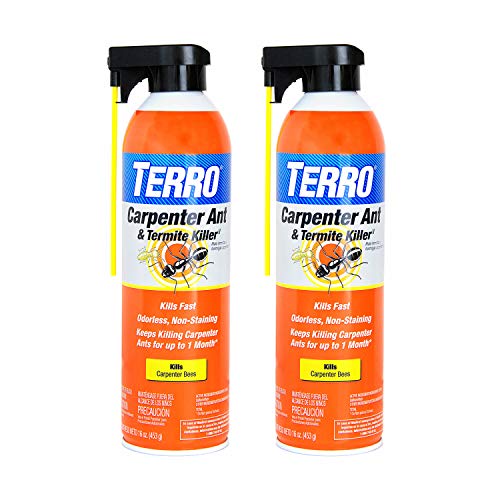
Two aerosol cans with a two-way nozzle for broad spraying or crack and crevice work, with up to one month of residual.
Check price on Amazon$18.99 as of Oct 21, 2026 1:30 am GMT+0000 — prices change; see Amazon for current price.Why we like it
- Two-way nozzle: broad spray or pinpoint stream
- Wall voids and infested wood named
- Odorless, non-staining formula
- Listing itself recommends a professional inspection
| Specification | Details |
|---|---|
| Form | Ready-to-use aerosol |
| Targets | Termites, carpenter ants, carpenter bees |
| Residual | Up to one month |
| Where | Windows, doors, entry points, wall voids, infested wood; indoor and outdoor |
| Nozzle | Two-way, broad or crack and crevice |
| Size | 2 cans, 32 oz total |
TERRO T1901SR — termite and carpenter ant aerosol, 2 x 16 oz, two-way nozzle, wall voids, up to one month residual
The Only Listing That Says It Should Not Be Your Sole Termite Protection
One listing out of the 14 says out loud what this whole category needs to hear: TERRO states the aerosol is not recommended as sole protection against termites and that active infestations call for a professional inspection. That candor, plus a nozzle that switches between broad spray and a crack-and-crevice stream, makes it the pick for treating entry points, the gap around a window frame or a void behind an outlet where you have seen activity.
The stated residual, up to one month, is the shortest of the sprays here. TERRO’s own ready-to-use T1100 claims up to 4 months, and the Spectracide liquid claims up to 9 months against carpenter ants. Use this aerosol for quick, targeted hits, not ongoing protection.
Because it also lists carpenter ants and carpenter bees, it suits the common case where a homeowner is not sure which wood-destroying insect is responsible. Identification still matters before spending money on a full treatment.
Pros
- Two-way nozzle for voids and cracks
- Covers termites, carpenter ants and bees
- Honest about its limits
Cons
- Only one month of residual
- Contact and surface treatment only
- Aerosol cans run out fast
Check TERRO Termite Aerosol T1901SR (2) price on Amazon
7. TERRO Carpenter Ant and Termite Killer T1100, 32 oz — Best Crack Spray for Crawl Spaces

Ready-to-use trigger spray for cracks, crevices and crawl spaces; kills on contact, up to 4 months stated.
Check price on Amazon$12.95 as of Oct 21, 2026 1:30 am GMT+0000 — prices change; see Amazon for current price.Why we like it
- Only listing that names crawl spaces
- Ready to use; no mixing
- Up to 4 months of continued kill stated
- Covers wood wasps and carpenter bees too
| Specification | Details |
|---|---|
| Form | Ready-to-use trigger spray |
| Targets | Termites, carpenter ants, carpenter bees, wood wasps, other insects |
| Where | Cracks and crevices, crawl spaces, ant hills and trails; indoor and outdoor |
| Stated duration | Continues to kill up to 4 months |
| Size | 32 oz bottle |
| Species detail | Termite type not stated in listing |
TERRO T1100-6 — ready-to-use termite and carpenter ant spray, 32 oz, crack and crevice, crawl spaces, up to 4 months
The Only Listing That Names Crawl-Space Use
Crawl spaces are where a lot of termite and wood-destroying insect findings start, and this is the only listing among the 14 that names them. A ready-to-use trigger bottle is practical down there: no mixing in a cramped space, and the bottle reaches sill plates, joist ends and cracks in the foundation wall where you have seen activity.
Its stated up to 4 months of continued kill sits between the TERRO aerosol and the longer-lasting perimeter products. It does not name a termite species, and at 32 ounces of ready-to-use spray, it treats spots, not a perimeter.
Before spraying in a crawl space, look for the mud tubes subterranean termites build up foundation walls and piers; our guide to termite mud tubes shows what to look for. Wear gloves and eye protection, ventilate and follow the re-entry directions on the label.
Pros
- Names crawl-space use
- No mixing required
- Up to 4 months stated
Cons
- Spot treatment only
- Termite species not specified
- Small volume for large areas
Check TERRO Termite Spray T1100 price on Amazon
What a DIY termite product can and cannot do
The EPA groups termite treatments into four types: liquid soil-applied termiticides, termite baits, building materials impregnated with termiticides, and wood treatments. The two most common are conventional soil barriers and bait systems. It also says that in most cases termiticide application can only be properly performed by a trained pest management professional, and that firms offering termite services must be licensed by the state.
The retail products above fit around those professional treatments:
- Spot treatments (the foam and both TERRO sprays) kill termites you can reach. They do not reach the colony in the soil.
- Perimeter products (the Ortho concentrate and BioAdvanced granules) put a treated zone around a structure. They are lighter-duty than a professional soil barrier.
- Monitoring stakes tell you termites are foraging nearby. They are an early warning, not a cure.
- Wood treatment (Bora-Care) protects wood you can reach before or during construction or a remodel.
We also left out two professional-style concentrates on the shelf, a cypermethrin product and a bifenthrin product. Both list an active ingredient, and both chemicals appear on the EPA’s list of common termiticide active ingredients, but their listings say almost nothing about use directions. Products like these are typically applied by professionals at label rates with proper equipment, so read the label before considering them.
For a sense of what a full professional treatment involves and costs, see our guide to termite treatment cost.
Read the label: it decides what a product can claim
The EPA states that pesticide labels are legally enforceable and that using a product in a manner inconsistent with its labeling violates federal law. For termites it adds a specific test: if the label does not include directions to control termites and protect the structure, the product is not intended to protect the structure and should not be used that way. Many listings say “kills termites” because they kill termites on contact; that is not the same as a label for structural protection.
The EPA also notes that many termiticides are highly toxic, making it critical to follow label directions with added care, and that re-entry times vary by product and appear on the label. At home, that means:
- Use only EPA-registered products and keep them in their original containers.
- Mix and apply at label rates; more is not better.
- Keep children and pets off treated soil and surfaces for the time the label specifies.
- Store pesticides locked and out of children’s reach, as the EPA advises for all household pesticides.
- Do not apply soil treatments near a private well or where runoff can reach water unless the label permits it.
Termite or carpenter ant? Identify before you treat
Several picks here target both termites and carpenter ants, but treatment plans differ, so identification comes first. The EPA’s quick test for winged swarmers: ants have front wings longer than the hind wings and antennae bent at a 90-degree angle; termites have wings of roughly equal length and straight antennae. Carpenter ants push out coarse sawdust-like debris, while subterranean termites leave mud tubes and tunnels packed with soil.
Our guides to signs of termites, termite swarmers and carpenter ants walk through the differences with photos. Swarmers indoors in spring are worth reporting to a professional even if they die quickly, since the EPA notes most people only learn they have termites when they see a swarm or find damage.
Prevention that matters more than any product
The EPA’s prevention list is mostly about moisture and wood-to-soil contact, and it applies directly to Front Range homes with crawl spaces, decks and landscaped foundations:
- Keep soil around the foundation dry with proper grading, working gutters and downspouts that discharge away from the house.
- Fill cracks in concrete foundations and seal around utility penetrations with cement, grout or caulk.
- Fix leaks promptly and keep vents clear of plants.
- Keep shrubs and trees from growing against exposed wood.
- Do not stack firewood or wood debris against the house.
- Inspect periodically so colonies do not become established.
Watering a foundation bed every evening through a dry Colorado summer, or piling firewood against the siding before winter, undoes most of what a perimeter product can do.
When to call a pro, and why buyers need a WDO inspection
Call a licensed pest professional when you find live termites in the structure, mud tubes on the foundation or piers, damaged wood that sounds hollow when probed, or a swarm inside the house. The EPA recommends choosing a company carefully, asking to see its state license, getting a copy of the product label and confirming when it is safe to return to the house. A professional can treat the soil at the foundation, install a monitored bait system and give a written service agreement, none of which a retail bottle offers.
For a home sale, a DIY treatment does not replace a wood-destroying insect inspection. Lenders, purchase contracts and buyers can ask for a WDO report from a licensed inspector, and a bottle of foam in the garage does not answer the question of whether termites are active or have damaged framing. Our guide to the termite inspection process explains what is checked, and combining a home inspection with a termite inspection covers timing during a purchase. Our specialty inspections hub lists the other add-ons. Buyers and owners on the Front Range who want a vetted local inspector to check for termites and other wood-destroying insects can reach out through our contact page.
Frequently asked questions
What is the best termite killer a homeowner can buy?
It depends on the job. A foaming termite spray suits a spot of exposed termites in wood, a trench concentrate or granules suit a perimeter, and detection stakes give early warning. None replaces a professional soil or bait treatment for an active infestation in the structure.
Can you treat termites yourself?
Homeowners can spot-treat termites they can reach and apply perimeter products by the label. The EPA says that in most cases termiticide application can only be properly performed by a trained pest management professional, and improper soil treatments can contaminate homes and wells.
Do termite stakes work?
Retail stakes combine a pop-up indicator with a killing component, so they can show termites are foraging nearby. They are an early-warning tool, not a structural treatment. A triggered stake is a reason to schedule a professional termite inspection.
How do you tell termites from carpenter ants?
The EPA notes that swarming ants have front wings longer than the hind wings and bent antennae, while termites have wings of roughly equal length and straight antennae. Termites also leave mud tubes and soil-packed tunnels, while carpenter ants push out sawdust-like debris.
Does a DIY termite treatment replace a termite inspection when selling a home?
No. A DIY product does not show whether termites are active or have damaged the structure. Buyers, lenders and contracts often ask for a wood-destroying insect report from a licensed inspector, and a professional treatment with a service agreement carries more weight.
References
- Termites: How to Identify and Control Them — U.S. Environmental Protection Agency
- Introduction to Pesticide Labels — U.S. Environmental Protection Agency
- Reduce Your Child’s Chances of Pesticide Poisoning — U.S. Environmental Protection Agency
- Integrated Pest Management (IPM) Principles — U.S. Environmental Protection Agency