What’s the Difference Between Mold and Black Mold
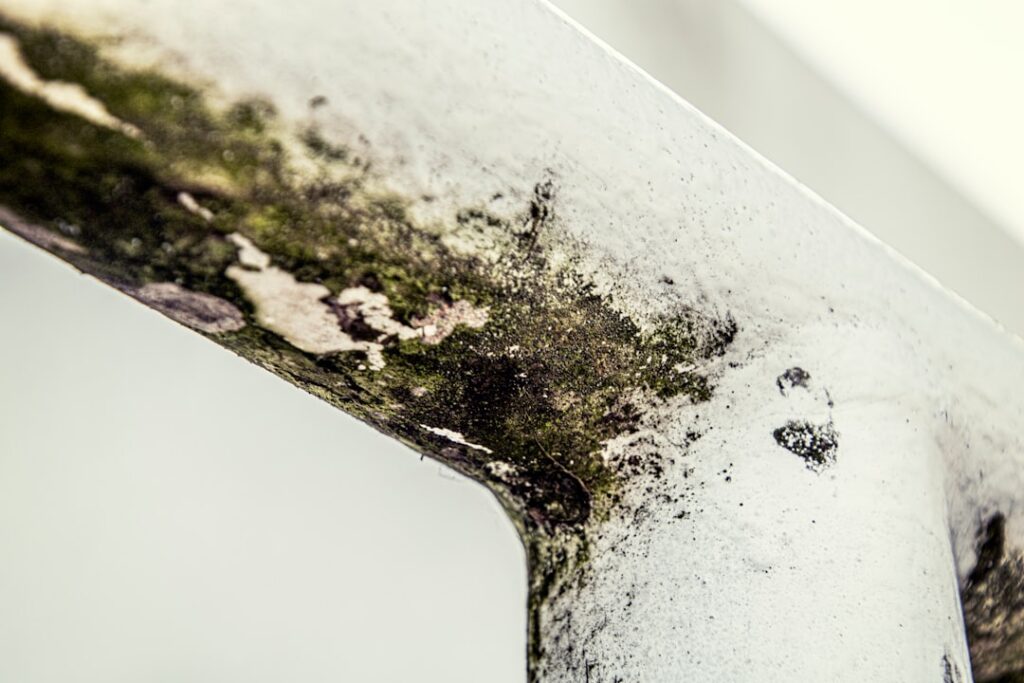
What’s the difference between mold and black mold is one of the most-searched mold questions, and the honest answer is mostly about terminology rather than biology. “Mold” is the umbrella term for fungal colonies that grow on substrates in homes. “Black mold” is colloquial shorthand — sometimes for Stachybotrys chartarum specifically, but more often for any dark-colored mold a homeowner spots on drywall or grout. The technical distinction matters less than the homeowner action, which is the same for both: identify the source of moisture, contain the spread, and remediate when the area exceeds the EPA’s 10-square-foot DIY threshold. This guide summarizes EPA and CDC guidance current as of 2026. For health symptoms tied to suspected exposure, consult your physician, and for any large or persistent patch, defer to an IICRC-certified remediation professional.
Part of our Black Mold & Your Health guide — start there for the full picture →
Is this mold, asbestos, or water damage? Get a free instant screen
Upload a clear photo of the suspect area. You'll get an instant AI screening opinion and what to do next. This is screening guidance, not a professional determination.
Screening guidance only. AI can be wrong. Confirm asbestos, mold type, or lead with lab testing or a licensed professional before acting.
What’s the Difference Between Mold and Black Mold
“Mold” is the everyday name for thousands of species of fungi that produce filamentous colonies on damp organic substrates. “Black mold” is colloquial — it doesn’t map cleanly to a single species. In casual usage it usually refers to Stachybotrys chartarum, but homeowners use the term for any dark-colored mold colony regardless of species. Aspergillus niger reads brownish-black. Cladosporium leans olive-green-to-near-black. Chaetomium can present as cottony grey-black. All of these get called “black mold” in homeowner conversation.
The EPA’s mold guidance is explicit on this point: visual identification cannot reliably distinguish toxigenic species from harmless dark molds. The agency recommends remediation of any indoor mold growth regardless of species, which removes the practical need for species ID in most homeowner decisions. For the broader walkthrough on identifying, testing, and remediating, the mold inspection and testing hub covers the full decision path.
Why “Black Mold” Became Shorthand for Stachybotrys
Stachybotrys chartarum got popular attention in the 1990s through a series of news stories linking the species to indoor air-quality issues, infant pulmonary hemorrhage cases, and high-profile insurance claims. The greenish-black slimy appearance of mature Stachybotrys colonies on water-damaged drywall made “black mold” a memorable shorthand that stuck in public vocabulary. The CDC later refined the science around Stachybotrys-specific health effects, concluding that the original infant hemorrhage link was not strongly supported by subsequent research, though dampness and mold exposure generally remain associated with respiratory issues.
Today, “black mold” persists as homeowner vocabulary even though the term carries no rigorous biological definition. Pest-control marketing, remediation-company branding, and news coverage all keep the term in circulation. Homeowners searching for “black mold” usually mean: “the dark patch in my bathroom or basement that I’m worried about.” That working definition is more useful than the species-specific one.
Mold: The Umbrella Term
Mold colonies share several common features regardless of species. They require moisture, food (typically organic cellulose), and limited airflow. They reproduce through microscopic spores that are present in essentially all indoor environments at low background concentrations. They become problematic when colonies establish on building materials and produce visible growth, MVOCs (musty smells), and elevated airborne spore counts.
Common indoor mold genera include Cladosporium (the most common indoor mold worldwide), Aspergillus (a large genus with both common indoor species and a few medically significant ones), Penicillium (associated with food spoilage and water-damaged buildings), Alternaria (common outdoor mold that also colonizes damp indoor surfaces), and Stachybotrys (the “true black mold” species most associated with chronic water damage on cellulose substrates). All produce spores. All can trigger allergic responses in sensitized individuals. All warrant remediation when found in active colonies indoors.
Black Mold: A Colloquial Category
“Black mold” as a homeowner category captures any colony that visually presents as dark. The category’s diagnostic value is low — you can’t tell from looking which species you have — but its action value is high, because dark colonies on damp substrates almost universally warrant remediation regardless of species. A homeowner who calls a remediator about “black mold in my basement” is communicating useful information about scope and apparent severity even if the species ID is wrong.
The term has also accumulated some misconception baggage. Not all “toxic mold” is black; not all black mold is toxic. Stachybotrys does produce mycotoxins under specific growth conditions, but so do several Aspergillus and Penicillium species that aren’t visually black. The species-to-toxicity mapping is weaker than the homeowner conversation usually implies.
Visual Identification Is Unreliable
Both EPA and CDC are explicit that homeowners can’t reliably distinguish dark mold species visually. The same Stachybotrys colony can appear different on different substrates and at different growth stages — greenish-black on wet drywall, charcoal-grey on dried wood, almost-black on painted surfaces. Aspergillus niger, Cladosporium sphaerospermum, and Chaetomium globosum can all look indistinguishable to the eye despite belonging to different genera.
Laboratory identification through air sampling or tape-lift sampling is the only reliable species call. The cost of lab ID is typically $50-150 per sample plus inspector time. For most homeowner remediation decisions, the species ID doesn’t change the action plan: address moisture, contain spread, remediate per EPA guidance. Lab testing is most useful for documentation in insurance disputes or pre-purchase inspections where the seller’s history matters.
When the Distinction Actually Matters
Several specific situations make species ID worth pursuing. Pre-purchase inspections where the seller is required to disclose known mold issues benefit from documented species ID. Insurance disputes where the claim hinges on whether the mold resulted from a covered peril versus a maintenance issue benefit from documented species and growth-stage assessment. Health-related claims (workplace exposure, persistent symptoms in a specific household member) sometimes require species ID for medical context, though the link from species to specific health effect is weaker than popular coverage suggests.
For routine homeowner decisions — “I see dark mold, what do I do?” — the species rarely changes the answer. The EPA’s 10-square-foot DIY threshold and the moisture-source-first remediation principle apply identically across species.
Health Implications: Where Species Does and Doesn’t Matter
The CDC’s position is that indoor dampness and mold growth are associated with respiratory symptoms — particularly worsened asthma — across many studies. The agency stops short of attributing specific symptoms to specific species in most contexts. NIEHS guidance follows the same pattern: indoor mold is treated as a category-level health concern rather than a species-by-species risk-stratification exercise.
Where species ID does start to matter is at the extremes of immunocompromise. People undergoing chemotherapy, organ transplant recipients, and patients with cystic fibrosis can develop invasive Aspergillus infections that don’t apply to the general population. For those households, professional indoor environmental assessment is worth the extra cost regardless of how the mold looks visually. For the typical homeowner without high-risk medical conditions, the species ID is academic and the remediation action is the primary lever.
Pricing Implications: Lab Testing vs Surface Remediation
Homeowners curious about species ID should know roughly what it costs. A single tape-lift sample analyzed by a qualified lab runs $50-100. Air sampling for spore count comparison typically runs $150-300 for indoor-versus-outdoor reference pairs. A full mold inspection with sampling typically costs $300-600 in the Front Range. Surface remediation for a small DIY patch costs essentially nothing beyond cleaning supplies. Professional remediation for a moderate patch (10-30 square feet) runs $1,500-4,000 in most markets.
The math: spending $300 on lab ID to potentially avoid $1,500 in remediation rarely makes sense unless the homeowner has specific reason to doubt that mold is present. Skipping the lab ID and going directly to remediation is the more common path for a reason.
Mold vs Mildew: A Related Distinction
“Mildew” is another colloquial term that homeowners often use alongside “mold.” Technically, mildew refers to certain plant-pathogen fungi that don’t typically grow indoors on building materials. In everyday homeowner usage, “mildew” often refers to the lightweight surface film that forms on shower tile, grout, and damp fabric — typically Cladosporium or related species in their early surface-growth stage. Mildew wipes off; established mold tends to return after wiping because the substrate beneath stays wet. The distinction is about growth depth rather than species, and the cleaning approach reflects that: mildew surfaces respond to standard household cleaners; mold patches usually need substrate evaluation alongside surface treatment.
For a deeper visual comparison covering this territory, the black mold versus mold breakdown walks through the species range and homeowner action thresholds.
Where the Confusion Comes From
Several factors keep the mold-versus-black-mold confusion alive in homeowner conversation. Media coverage in the 1990s and 2000s linked Stachybotrys with infant health emergencies and large insurance settlements; the imagery and headlines stuck. Remediation marketing emphasizes “toxic black mold” because the term moves the needle on lead generation more than “Cladosporium colonization.” Real-estate disclosure forms in some states call out “toxic mold” specifically, which keeps the term in legal context. Online forums and social-media posts amplify the most dramatic cases, which reinforces homeowner fear and the term’s popular currency.
The information ecosystem isn’t going to settle on a more accurate term anytime soon, so homeowners are better served by understanding what the term actually conveys (a dark mold patch worth investigating) and what it doesn’t (a definitive Stachybotrys species ID).
What Homeowners Should Do With This Distinction
The practical takeaway: don’t get hung up on whether a patch is “black mold” specifically. Get hung up on three other questions. Is the area larger than 10 square feet? Is the moisture source identifiable and fixable? Are any household members in higher-risk health categories (asthma, immune compromise, infants, elderly)? Those three questions drive the right action plan regardless of which species occupies the patch. Homeowners who spend hours trying to identify Stachybotrys versus Aspergillus often delay the remediation calls that would actually solve the problem.
When to Call a Pro
The EPA’s 10-square-foot threshold applies the same way across species. Add to that: any growth on HVAC components, any cavity-side growth where the visible patch is small but indirect indicators suggest a larger colony, and any situation where household members have asthma or immune-compromising conditions. For Front Range homeowners ready to escalate from homeowner-assessment to professional inspection, reach out through our contact page for a same-week appointment. A professional inspection brings tooling — moisture meters, boroscope cameras, sometimes thermal imaging — that homeowners rarely have on hand, and the assessment usually identifies hidden moisture sources that drive the remediation scope and prevent recurrence after the visible patch is cleaned up.
Whatever vocabulary the search query happens to use — “mold,” “black mold,” “toxic mold,” or any of the dozens of related terms — the homeowner action sequence remains stable: identify the moisture source, contain the affected area, decide DIY versus professional based on size and risk factors, and address both the visible colony and the cavity-side growth that may accompany it. Getting hung up on the terminology distinction delays the work that actually solves the problem; getting clear on the action sequence accelerates resolution regardless of which dark mold species occupies the patch.
References
- EPA Mold Cleanup in Your Home — U.S. Environmental Protection Agency
- CDC Basic Facts About Mold and Dampness — Centers for Disease Control and Prevention
- HUD Healthy Homes Mold Guidance — U.S. Department of Housing and Urban Development
- NIEHS Mold Health Topic — National Institute of Environmental Health Sciences
Frequently asked questions
What's the difference between mold and black mold technically?
Mold is the umbrella term for thousands of fungal species that grow on damp substrates. Black mold is colloquial — usually referring to Stachybotrys chartarum but applied loosely to any dark-colored mold colony. The EPA and CDC note that visual species ID is unreliable; remediation guidance is the same regardless of species.
Is all black mold dangerous?
No. The term covers many species with widely varying health implications. Stachybotrys produces mycotoxins under specific growth conditions, but several other dark molds don't. The CDC recommends remediation of indoor mold regardless of species rather than risk-stratifying by visual appearance.
How can homeowners tell the difference between mold and black mold?
Visually, they can't reliably. The EPA explicitly notes that visual identification cannot distinguish toxigenic species from harmless dark molds. Laboratory tape-lift or air sampling is the only reliable species ID. For most homeowner decisions, the species doesn't change the remediation action.
Does the distinction between mold and black mold change remediation?
Rarely. The EPA's 10-square-foot DIY threshold and moisture-source-first remediation principle apply identically across species. The distinction matters mostly for insurance disputes, pre-purchase disclosures, and specific health-claim documentation.
Front Range homeowners weighing the homeowner-vs-professional remediation call can get in touch through our contact page for a same-week assessment.