White Mold vs Black Mold: A Homeowner Comparison
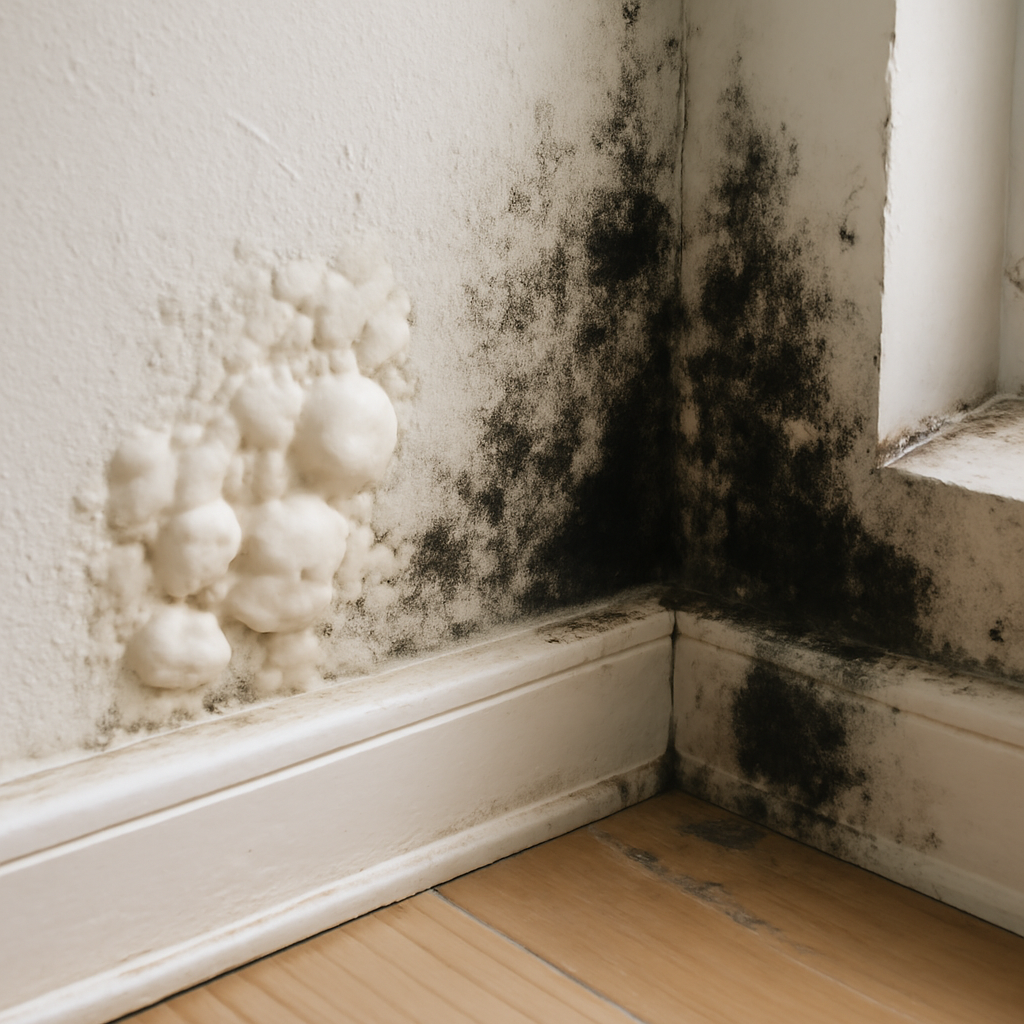
Walk into a damp basement or pull back a baseboard and the color of what you find shapes your reaction. White, fuzzy patches feel less threatening than the dark stains people associate with “toxic black mold.” But color tells only part of the story, and the assumptions homeowners make about white mold vs black mold often steer them wrong on both risk and removal. This comparison lays out how the two differ in appearance, health impact, habitat, and cost, and where they are actually the same. This guide summarizes EPA and CDC guidance current as of 2026 and is educational only; consult a physician about symptoms and a certified professional for testing and remediation decisions.
Is this mold, asbestos, or water damage? Get a free instant screen
Upload a clear photo of the suspect area. You'll get an instant AI screening opinion and what to do next. This is screening guidance, not a professional determination.
Screening guidance only. AI can be wrong. Confirm asbestos, mold type, or lead with lab testing or a licensed professional before acting.
White Mold vs Black Mold: The Short Answer
Neither “white mold” nor “black mold” is a single species — both are color descriptions covering many fungi. White mold typically refers to early-stage or surface growth of genera like Penicillium, Aspergillus, Cladosporium, or Acremonium, often appearing powdery or cottony before pigment develops. Black mold usually means Stachybotrys chartarum, a darker, slimier mold that needs sustained heavy moisture, though many harmless dark molds look black too.
The practical bottom line from the EPA is that the response is the same regardless of color: find and fix the moisture, then remove the mold using the same methods. Color does not change the cleanup procedure, and it is not a reliable guide to toxicity. Where color does help is in reading the situation — what stage the growth is at, what surface it favors, and how deep it may have gone. For the broader framework on assessing any mold, start with our mold inspection and testing hub.
Appearance: How to Tell Them Apart
White Mold
White mold often looks powdery, fluffy, or cottony, and can be hard to distinguish from efflorescence — the crystalline salt deposit that forms on concrete and masonry. The quick field test: efflorescence dissolves in water and feels gritty, while white mold does not dissolve and feels soft or filamentous. White mold frequently appears on wood framing, in crawl spaces, on stored items, and in early colonization before spores darken. Some white growth is simply young mold that will turn green, gray, or black as it matures.
Black Mold
Stachybotrys typically presents as dark green to black, with a slimy or wet sheen when actively growing, drying to a powdery soot-like texture. It favors cellulose-rich materials that have stayed wet for days — saturated drywall, ceiling tiles, cardboard, and wood. Plenty of other molds also look black, including Cladosporium, so a dark color alone never confirms Stachybotrys. Our visual reference on identifying black mold by sight shows the range, and only a lab can confirm species.
Health Risk: Is Black Mold Really Worse?
This is where myth and evidence diverge. The popular belief that black mold is uniquely “toxic” while white mold is harmless overstates both. The CDC states there is no proven link between common indoor mold of any color and serious illness in healthy people, and it does not recognize a distinct “toxic mold” syndrome from typical household exposure.
What is well established: damp, moldy environments are associated with respiratory symptoms — coughing, wheezing, congestion, eye and throat irritation — and can worsen asthma and allergies, per the American Lung Association. People with asthma, allergies, weakened immune systems, or chronic lung conditions are more vulnerable to any mold. Some Aspergillus species (often white or green) can cause infections in immunocompromised people, while Stachybotrys produces mycotoxins under certain conditions. In short, both colors warrant prompt removal, and neither should be judged safe or deadly by color alone. Our piece on reported symptoms of mold exposure covers the health discussion in more depth.
Texture, Smell, and Other Field Clues
Beyond color, a few observable traits help you read what you are looking at, even though none confirm a species on their own.
Texture. White mold often appears cottony, powdery, or stringy, while actively growing black mold tends to look wet, slimy, or greasy. As any mold dries, it can turn powdery, so texture shifts with conditions and is only a rough guide.
Smell. Both produce the musty, earthy odor of microbial volatile organic compounds. A strong, persistent musty smell concentrated in one area suggests an established, active colony rather than a light surface dusting, regardless of color.
Location and spread. Mold that radiates outward from a wet spot and concentrates near a moisture source behaves like a living colony. Deposits that sit uniformly on a cool surface without a clear moisture origin may be efflorescence or dust instead.
The water test. A drop of water on a white deposit that dissolves and feels gritty points to efflorescence; one that beads or has no effect, on a soft filamentous growth, points to mold. None of these replace lab analysis, but together they help you decide how seriously to treat what you have found.
Where Each Tends to Grow
Habitat is one place where the two colors genuinely diverge, because the species behind them have different moisture needs.
White mold tolerates lower, intermittent moisture and shows up in crawl spaces on joists, on basement framing, on leather and stored fabrics, on houseplant soil, and inside cabinets. It can colonize wood without the constant saturation Stachybotrys requires, which is why it often appears first.
Black mold needs prolonged, heavy wetting and a cellulose food source. It concentrates where water has pooled or leaked for days to weeks — behind leaking plumbing, under failed roofing, on chronically damp drywall, and in flooded basements. If you find Stachybotrys, you almost certainly have a significant, ongoing water problem, not just high humidity. Our crawl-space guidance and notes on black mold on concrete show how surface and moisture conditions dictate which color appears.
Removal: Process and Cost Compared
The cleanup method is identical in principle — contain, remove, dry, verify — but the scale and cost often differ because of where each mold tends to be found.
White Mold Removal
Because white mold often appears early and on accessible surfaces, it is frequently caught while small. Surface growth on nonporous or semi-porous materials under roughly 10 square feet can usually be cleaned by a homeowner with detergent, water, and thorough drying, wearing an N95, gloves, and eye protection. Crawl-space white mold on framing, however, can be extensive and may require professional cleaning, encapsulation, and a vapor barrier — pushing costs into the low thousands.
Black Mold Removal
Black mold’s preference for saturated cellulose means the affected materials — drywall, insulation, carpet — often cannot be salvaged and must be removed. That raises both labor and disposal costs. Professional remediation of a black-mold problem behind a wall or across a flooded basement commonly runs from the low thousands to well over $10,000 depending on extent and structural repairs.
Typical Cost Ranges
Industry estimates put small contained jobs of either color at roughly $500 to $1,500, mid-size projects at $2,000 to $6,000, and large or structural remediation above $10,000. The driver is rarely the color itself but the square footage, how saturated and porous the materials are, accessibility, and whether the moisture source needs its own repair. Our detailed breakdown of the average cost of mold remediation itemizes these factors so you can read an estimate critically.
How Each Affects a Home Sale or Purchase
Mold color carries weight in real estate even when the science says it should not. Buyers who see a dark patch and hear “black mold” often react more strongly than the situation warrants, and that perception can affect negotiations regardless of the actual species or extent. Understanding the distinction helps both buyers and sellers respond proportionately.
For buyers, the smarter focus is on what the mold reveals about moisture and building condition, not its pigment. A small white patch in a crawl space may simply mean the vapor barrier needs attention; an extensive black colony on basement drywall signals a chronic water problem that could involve foundation or grading work. A home inspection that flags either should prompt a moisture investigation rather than a panic over color. Documenting the finding, identifying the source, and pricing the genuine repair gives a buyer real leverage, while reacting to the word “black” alone does not.
For sellers, the worst approach is cosmetic — painting over visible mold to hide it before listing, which traps the growth, fails to disclose a known issue, and can resurface as a far larger problem and a liability after closing. Remediating properly, fixing the moisture, and documenting the work protects the sale and the seller. In both roles, the lesson mirrors the rest of this comparison: judge by moisture, extent, and condition, and treat the color as a prompt to investigate rather than a verdict in itself.
Testing: When It’s Worth Paying For
Homeowners often ask whether to pay for lab testing to identify white versus black mold. The EPA’s position is that sampling is usually unnecessary if visible mold is present, because the remediation is the same regardless of type — visible mold should simply be cleaned up and the moisture fixed. Testing earns its cost in specific situations: confirming a suspected hidden problem when there is a persistent musty smell but no visible growth, documenting conditions for a real estate transaction or insurance claim, or verifying that remediation succeeded. When testing is warranted, use an independent assessor rather than the same company doing the remediation, to avoid a conflict of interest.
Prevention: The Same Defense for Both
Because both white and black mold need moisture, the prevention strategy is identical and comes straight from EPA guidance: control water and humidity. Keep indoor relative humidity below 60 percent — ideally 30 to 50 percent — using ventilation and dehumidifiers. Fix leaks the day you find them, since mold of any color can begin growing within 24 to 48 hours of a surface getting wet.
Address the specific habitats each prefers. For white mold, that means keeping crawl spaces dry with a vapor barrier and good drainage, improving airflow in closets and around stored items, and not letting basements stay damp. For black mold, it means eliminating the sources of prolonged saturation — failing plumbing, roof and flashing leaks, and foundation water intrusion — before they soak materials for days. Improve circulation by pulling furniture a few inches from exterior walls, vent bathrooms and kitchens outdoors, and insulate cold surfaces that collect condensation. A home kept consistently dry rarely develops either color in quantity.
Which One Should Worry You More?
If forced to rank them, the honest answer is that the situation matters more than the color. A small white patch caught early on an accessible surface is usually the easier, cheaper problem — you have likely intervened before serious damage. An established black colony on saturated drywall is the more serious finding, not because Stachybotrys is uniquely deadly, but because it signals prolonged, heavy water intrusion that has probably damaged materials and may be ongoing.
That said, do not let a white appearance lull you into inaction. Extensive white mold across a crawl space or wall cavity can be just as costly to address as a black colony, and some white-appearing Aspergillus species carry real risk for immunocompromised people. The reverse is also true: a small black patch from a one-time, already-dried leak may be a quick cleanup. Judge by extent, recurrence, saturation, and who lives in the home — not by the pigment alone. This is the same conclusion the EPA reaches by advising identical treatment for all indoor mold.
When to Call a Professional
Regardless of color, bring in a qualified professional when the affected area exceeds about 10 square feet, when mold is in the HVAC system, when growth follows sewage or contaminated-water flooding, when it recurs after cleaning, or when occupants have respiratory or immune conditions. A finding of extensive black mold is a strong signal of a serious water intrusion that needs both remediation and a moisture repair. White mold across an entire crawl space similarly calls for professional treatment and a long-term moisture strategy. The cost of professional help is almost always lower than the cost of a spreading problem caught late.
Common Myths About the Two Colors
A handful of persistent myths shape how people respond to mold color, and correcting them saves both worry and money.
Myth: black mold is always toxic and white mold is always harmless. Neither holds. Color does not determine toxicity, many dark molds are benign common species, and some white-appearing Aspergillus species pose real risk to immunocompromised people. Both deserve prompt removal.
Myth: you must identify the species before doing anything. The EPA explicitly advises that sampling is usually unnecessary when mold is visible, because the cleanup is the same regardless of type. Paying for species identification rarely changes what you should do.
Myth: white growth on concrete is mold. Often it is efflorescence, a harmless salt deposit that dissolves in water. Mistaking it for mold leads to unnecessary remediation.
Myth: killing the mold ends the problem. Dead mold still contains allergens and must be physically removed, and the moisture that grew it must be fixed or it returns. A spray that “kills” mold but leaves it in place on porous material has not solved anything.
Seeing past these myths lets you respond to the actual situation — extent, saturation, recurrence, and occupant health — rather than to the color’s reputation.
The Bottom Line on White Mold vs Black Mold
Treat color as a clue, not a verdict. White mold often means you caught a problem early or have intermittent moisture; black mold usually means prolonged, heavy water intrusion. Both can affect health, especially for sensitive people, and both are removed the same way: stop the water, remove the growth safely, dry the materials, and verify. The dollars and the difficulty come down to extent and saturation far more than to pigment. Whichever color you are looking at, the durable fix is moisture control — the one principle the EPA returns to again and again.
A Quick Decision Framework
Faced with mold of either color, a simple set of questions cuts through the confusion. Is it actually mold, or could it be efflorescence, dust, or soot? Is the area larger than about 10 square feet? Has it returned after previous cleaning? Is there a known leak, flood, or chronic dampness behind it? Does anyone in the home have asthma, allergies, or a weakened immune system?
If it is a small, first-time patch of either color on an accessible surface with no health concerns, a careful DIY cleanup and a moisture fix usually suffice. If two or more of those questions raise a flag — large area, recurrence, active water source, or vulnerable occupants — that is the point to bring in a professional, regardless of whether the mold is white or black. This framework keeps the decision grounded in the factors that actually predict difficulty and risk, rather than in the pigment that draws the eye first.
References
- Mold Cleanup in Your Home — U.S. Environmental Protection Agency
- About Mold and Your Health — Centers for Disease Control and Prevention
- Mold and Dampness — American Lung Association
- A Brief Guide to Mold, Moisture and Your Home — U.S. Environmental Protection Agency
Unsure what’s growing in your home or how far it has spread? Front Range homeowners can get in touch through our contact page to connect with a vetted local inspector for an objective assessment.