Water Heater Shut-Off Valve: Location, Leaks and Replacement

When a water heater starts leaking, the first few minutes matter. Knowing where to find the shut off valve water heater installers put on the cold supply, and how to cut the gas or electricity safely, can turn a flooded basement into a damp spot on the floor. Many homeowners discover too late that the valve is seized, hidden behind boxes, or not where they expected. This guide covers where the cold-water inlet valve usually sits and how gate and ball valves differ, how to turn off gas and electric water heaters, what to do during a leak, why the temperature and pressure relief valve is not a shut-off, how valves are replaced, how isolation valves work on tankless units, and when a valve problem is really a sign the heater itself is near the end of its life. Cost figures are general 2026 ranges that vary by region and installation.
Part of our Plumbing & Water guide — start there for the full picture →
Plumbing problem? Talk to a local plumber now.
📞 Call (877) 637-1527Where the Water Heater Shut-Off Valve Is Located
On a typical tank-type water heater, two pipes connect at the top: a cold-water inlet and a hot-water outlet. The shut-off valve is almost always on the cold-water inlet line, usually within a few feet of the tank and often just above it. Inlets are commonly marked with a blue ring or the word “cold” on the tank near the connection, and the cold line typically leads back toward the main water supply.
Turning off this valve stops new water from entering the tank. It does not drain the tank, and it does not stop hot water already in the tank from leaking out of a failed tank or fitting. It also cuts off hot water to every fixture in the house, since the heater cannot refill.
Some installations also have a valve on the hot-water outlet. That is useful for servicing but not required everywhere. If you cannot find any valve on the cold inlet, the fallback is the home’s main water shut-off, which along the Front Range is usually in the basement or crawl space where the service line enters, or near the meter.
Gate valves vs ball valves
Gate valves have a round wheel handle that you turn clockwise several times to close. Inside, a wedge-shaped gate drops into the flow path. They are common in older homes. Over time, mineral buildup and corrosion can make them hard to turn, and the internal gate can separate from the stem, so the handle spins but the valve never fully closes.
Ball valves have a lever handle that turns a quarter turn. When the lever is parallel to the pipe, the valve is open; when it is perpendicular, it is closed. Ball valves are generally more reliable for emergency shut-off, and you can tell at a glance whether they are open or closed. Many plumbers now install full-port ball valves on water heater inlets.
Shutting Off Gas and Electric Power to the Heater
Stopping the water is only half the shutdown. A water heater with no incoming water can still heat whatever is left, and an electric heater whose tank drains with the power on can burn out its elements.
Gas water heaters
Gas units have a manual gas shut-off valve on the gas supply line near the appliance, usually a quarter-turn valve with a lever handle. Turning the handle perpendicular to the pipe closes it. The heater’s control valve also has a setting, often labeled “off” or “pilot,” that stops the burner. For a planned shutdown, turning the control to off or pilot is usually enough; for a leak, flood or suspected gas problem, close the appliance gas valve as well.
If you smell gas near the heater, do not operate valves, switches or the control. Leave the house and call the gas utility or 911 from outside. Our guide to gas line leak detection covers warning signs and what technicians check.
Electric water heaters
Electric heaters are typically on a dedicated 240-volt double-pole breaker in the main panel, often labeled “water heater” or “WH.” Turn it off before draining or working on the heater. CPSC’s guidance on adjusting electric water heater thermostats similarly starts with shutting off current to the heater by turning off the circuit breaker or removing the fuse. Some installations also have a local disconnect switch near the heater.
Heat pump water heaters
Heat pump models are electric and are shut off at the breaker, but check the owner’s manual for any vacation or standby mode, and for condensate drain issues that can look like a tank leak.
Best Water Heaters: our top 3 picks
| Product | Best for | Key features | Price | Buy |
|---|---|---|---|---|
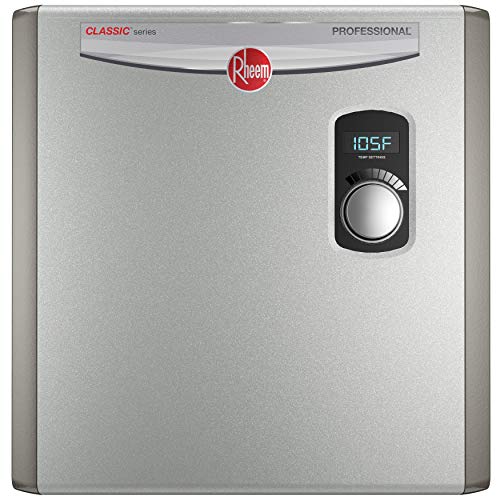
| Rheem PROE50 M2 RH95 | Best overall whole-house tank |
| $771.99as of Oct 28, 2026 8:46 am GMT+0000 | Buy now →Check current price |
| Rheem RTG 7.0 Indoor | Indoor gas tankless upgrade |
| $653.77as of Oct 28, 2026 9:10 am GMT+0000 | Buy now →Check current price |
| Rheem RTEX-24 | All-electric home, no venting |
| $549.00as of Oct 28, 2026 9:14 am GMT+0000 | Buy now →Check current price |


Prices are Amazon’s listed prices as of the time shown and change often; check Amazon for today’s price. As an Amazon Associate we earn from qualifying purchases.
What to Do When the Water Heater Is Leaking
Leaks range from a slow drip at a fitting to a ruptured tank. A calm sequence helps.
- Find the source if you can do so safely. Water on top of the tank, at the inlet or outlet connections, at the drain valve, from the relief valve discharge pipe, or from the bottom of the tank all mean different things.
- Turn off the energy source. Close the gas valve or set the control to off, or switch off the breaker for an electric unit.
- Close the cold-water shut-off valve. If it will not turn or does not stop the flow, close the main water shut-off for the house.
- Relieve pressure if needed. Opening a hot-water faucet somewhere in the house can reduce pressure in the system.
- Contain the water. If the tank itself is leaking, connect a garden hose to the drain valve and route it to a floor drain or outdoors, keeping in mind the water may be scalding.
- Call a plumber. A leaking tank generally means replacement; leaks at fittings or valves may be repairable.
Our water heater leaking guide breaks down causes by location, and if a supply line or fitting has actually burst, the burst pipe repair guide covers immediate steps and drying out.
Water damage from a failed heater can add up quickly. EPA’s WaterSense program notes that household leaks can account for more than 9,300 gallons of water wasted every year in the average home, and that common leak sources include dripping faucets and other leaking valves. A slow drip at the water heater valve is easy to ignore, but it can rot subfloors, rust the tank base and feed mold in a finished basement.
The T&P Relief Valve Is Not a Shut-Off
Every tank-type water heater should have a temperature and pressure (T&P) relief valve, usually on the top or upper side of the tank with a discharge pipe running down toward the floor. It opens automatically if temperature or pressure inside the tank gets too high, releasing water to prevent a dangerous failure.
It is easy to confuse with a shut-off because it has a lever, but it is a safety device, not a valve for controlling flow. Never cap, plug or remove the discharge pipe, and never try to stop a dripping T&P valve by blocking it. A T&P valve that drips repeatedly can indicate high water pressure, thermal expansion in a closed system, an overheating thermostat or a worn valve.
Thermal expansion is a frequent culprit in homes with a check valve or pressure-reducing valve on the main line. As water heats, it expands, and without somewhere to go, pressure climbs. A properly sized and charged water heater expansion tank on the cold inlet, typically near the shut-off valve, gives that water somewhere to go.
Temperature matters too. CPSC urges users to set water heaters to 120 degrees Fahrenheit and warns that most adults will suffer third-degree burns from two seconds of exposure to 150-degree water, six seconds at 140 degrees or thirty seconds at 130 degrees. Water from a leaking or relieving heater can be that hot, so keep hands and feet clear of the discharge.
Seized, Leaking or Failing Shut-Off Valves
Valves that sit untouched for years often fail when they are finally needed. Common problems include:
- Seized handles on gate valves that will not turn without excessive force. Forcing them can snap the stem or crack the valve body.
- Packing nut leaks, where water seeps around the stem when the valve is turned. Sometimes a gentle tightening of the packing nut stops it.
- Internal failure, where the handle turns but water keeps flowing.
- Corrosion at threaded connections, especially where copper meets steel without a proper dielectric fitting, leaving green or white crusts.
Exercising the valve once or twice a year, turning it closed and back open, helps keep it usable. If a valve is already stiff, it is often wiser to leave it alone until a plumber is available rather than risk breaking it outside business hours.
Replacement options: soldered, threaded and push-fit
Replacing a water heater shut-off valve requires closing the main water supply, draining down the line and sometimes partly draining the heater. The connection type affects the job.
- Soldered (sweat) valves are permanently joined to copper pipe with a torch. They are durable but require skill and fire precautions, especially near wood framing and the water heater’s flue.
- Threaded valves screw onto threaded nipples or fittings. They are common on galvanized and some copper installations and need appropriate thread sealant.
- Push-fit valves slide onto copper, PEX or CPVC and lock with internal teeth and an O-ring. They install quickly without a torch, though some local codes and manufacturers limit where they may be used, such as in concealed spaces, and pipe ends must be cut cleanly and deburred.
- PEX crimp or expansion valves are used where the supply is PEX.
A licensed plumber typically charges somewhere around $150 to $450 to replace a single shut-off valve, depending on access, connection type and whether the visit is an emergency. If the heater is old, replacing the valve during a heater replacement is usually more economical than doing it separately.
Other Fittings Around the Valve Worth Checking
The shut-off valve sits in a cluster of parts that tend to age together. While you are looking at it, a quick visual check of the neighboring components can catch problems early.
- Flexible water connectors. Many heaters connect to the house piping with corrugated stainless or copper flex lines. Kinks, crusty corrosion or bulging indicate they should be replaced, and replacing them alongside the valve is usually inexpensive.
- Dielectric fittings and heat-trap nipples. Where copper piping meets the steel tank, corrosion at the nipples or unions shows up as rust streaks, green crust or white mineral deposits at the top of the tank.
- Drain pan and drain line. A pan under the heater, ideally piped to a drain, catches small leaks before they reach finished flooring. Pans are especially useful in finished basements, closets and attics.
- Leak sensors and automatic shut-off valves. Battery or Wi-Fi water sensors placed beside the heater can alert you to a leak. Some systems pair a sensor with a motorized valve that closes the supply automatically. Results depend on correct installation and periodic testing.
- Gas venting and the sediment trap on gas models, which a plumber or HVAC technician can check during service.
Labeling the valve with a tag that reads “water heater cold supply” and noting the main shut-off location on the same tag saves time for anyone else in the household during an emergency.
Draining, Flushing and Shutting Down for Maintenance
The shut-off valve is also part of routine maintenance. Flushing sediment from a tank usually involves turning off power or gas, closing the cold inlet, opening a hot tap to let air in, and draining through the drain valve at the bottom. Hard water in parts of Colorado can leave sediment that makes tanks noisy and less efficient. Our step-by-step water heater flush guide covers the process and the cautions around old plastic drain valves, which can leak or break when opened.
Before restarting, refill the tank with a hot tap open until water runs steadily, then restore gas or power. Turning on an electric heater with an empty tank can ruin the elements within seconds.
Isolation Valves on Tankless Water Heaters
Tankless water heaters are often installed with a pair of isolation valves, one on the cold inlet and one on the hot outlet, each with a small service port. Closing both valves and opening the ports lets a technician circulate a descaling solution through the heat exchanger. These valve kits frequently include a pressure relief valve as well. If a tankless unit lacks isolation valves, descaling is harder, and adding them is a common upgrade. See our tankless water heater guide for maintenance intervals and installation considerations.
When a Valve Problem Means It Is Time to Replace the Heater
A failing shut-off valve is not necessarily a sign the water heater is failing, but the two often show up together on older equipment. Rust at the inlet and outlet connections, corroded nipples, sediment-filled tanks and leaks at the base point toward replacement. Tank-type heaters commonly last somewhere around 8 to 12 years, though water quality and maintenance shift that range; our water heater lifespan guide explains how to read the serial number to estimate age.
ENERGY STAR encourages homeowners to plan ahead for water heater replacement so there is time to research and select the right technology before it becomes an emergency, noting that installers may need time to order the proper model. A planned replacement is also the right time to install a new ball valve, expansion tank and drain pan. Our water heater replacement cost guide covers typical price ranges for tank, tankless and heat pump models.
Shut-Off Valves in a Home Inspection
Home inspectors look at the water heater, its connections, the T&P valve and discharge pipe, venting for gas units, and visible signs of leaks or corrosion. However, under the ASHI Standard of Practice, inspectors are not required to operate shut-off valves and manual stop valves. That means a home inspection usually confirms that a valve is present and notes visible leaks or corrosion, but it does not prove the valve will close when needed.
After moving in, it is worth locating and testing the water heater shut-off and the main water shut-off while things are calm, and labeling them. Our plumbing and water inspections section and the main guide to hiring a home inspector explain what plumbing checks typically include and which specialty services go further.
References
- Avoiding Tap Water Scalds — U.S. Consumer Product Safety Commission
- Fix a Leak Week — U.S. Environmental Protection Agency WaterSense
- High Efficiency Gas Storage Water Heaters — ENERGY STAR
- ASHI Standard of Practice for Home Inspections — American Society of Home Inspectors
Frequently asked questions
Where is the shut-off valve on a water heater?
It is usually on the cold-water inlet pipe at the top of the tank, within a few feet of the heater. It may be a round gate valve handle or a quarter-turn ball valve lever. If there is no valve there, use the home's main water shut-off.
Does turning off the water heater shut-off valve stop a leak?
It stops new water from entering the tank, which limits a leak from the inlet side. It does not stop water already in the tank from draining out of a failed tank. Turn off the gas or power, then drain the tank to a safe location if the tank itself is leaking.
Is the T&P valve a shut-off valve?
No. The temperature and pressure relief valve is a safety device that opens automatically if temperature or pressure gets too high. Never cap or plug its discharge pipe. A dripping T&P valve can signal high pressure, thermal expansion or a worn valve.
How much does it cost to replace a water heater shut-off valve?
A plumber often charges roughly $150 to $450, depending on access, pipe material, connection type and whether it is an emergency call. These are general 2026 ranges and vary by region.
Should I turn off the water heater if the water is shut off?
For a long shutdown or if the tank may drain, yes. Turn the gas control to off or pilot, or switch off the breaker for an electric heater, so the burner or elements do not run on a partly empty tank.
Moving into a Front Range home and not sure whether the water heater valves, expansion tank and venting are in good shape? Get in touch and we will help you find an inspector who looks closely at the plumbing before closing.