Thermal Imaging Inspection Fort Collins, CO | InspectandTest

An infrared camera sees what the human eye cannot, and in Fort Collins that often means hidden water and wasted energy. A thermal imaging inspection in Fort Collins uses an infrared camera to read surface-temperature differences across walls, ceilings, and floors, revealing hidden moisture, missing insulation, and electrical hot spots without opening any walls. It is useful across Larimer County’s varied housing: pre-1920s Old Town homes with patchy insulation, CSU rentals with humidity and ventilation problems, and tightly sealed new builds along the Harmony corridor that trap moisture. This guide explains how the technology works, why local conditions make it valuable, what it costs, and how to choose a certified inspector. Thermal imaging is a screening tool, not a diagnosis; confirm any finding with further testing.
Part of our Thermal Imaging for Homes guide — start there for the full picture →
Thermal imaging inspection in Fort Collins: what to know
An infrared camera does not see moisture, mold, or radon directly. It maps temperature differences on a surface. Wet drywall holds and releases heat differently than dry drywall, so a damp area shows as a distinct thermal signature before any stain appears. Missing insulation reads as a temperature streak across an exterior wall, and a loose or overloaded electrical connection glows hot.
In Fort Collins, that screening power has clear uses. Snowmelt from the Cache la Poudre raises basement moisture, and a scan can find dampness behind finished basement walls in Old Town and Midtown homes. Sealed new builds trap humidity, which infrared can help locate. The technology shines in winter, when the large indoor-to-outdoor temperature difference makes insulation gaps and air leaks easy to image.
The camera has real limits, and an honest inspector explains them. Infrared reads surface temperature, not the actual contents of a wall, so interpretation is everything. A wall warmed by afternoon sun, a register blowing conditioned air, or a recently used appliance can all create signatures that mimic a defect. That is why a competent Fort Collins inspector controls for conditions, notes them in the report, and confirms any suspected moisture with a meter before calling it a problem. A scan in the hands of someone without thermography training can produce as many false alarms as real findings.
How infrared imaging works in a Fort Collins home
Every surface emits infrared energy in proportion to its temperature, and a thermal camera turns that energy into a color image where warmer and cooler areas stand out clearly. The inspector walks each room watching the live image, pausing to document anything that breaks the expected pattern. The bigger the temperature difference between inside and outside, the more the camera reveals, which is why Fort Collins winters, with their cold days and large indoor-to-outdoor gaps, are ideal scanning conditions.
For moisture, the underlying principle is evaporative cooling: a damp area gives up heat faster than the dry material around it, so it shows as a cooler patch. For insulation, the camera maps where conditioned air escapes or outdoor cold seeps in, exposing gaps, settling, and voids. For electrical issues, the heat generated at a loose or overloaded connection glows on the image before it becomes a hazard. None of these readings replaces hands-on verification; they point the inspector to exactly where to look closer, which is valuable in an Old Town home where opening walls blindly is expensive.
Why Fort Collins homes benefit from thermal imaging
The housing mix creates different problems that the same camera can catch. Old Town homes built before insulation codes often have missing or settled insulation and aging wiring that an infrared scan reveals as cold streaks and hot spots. The CSU rental stock near Campus West tends to have ventilation and humidity issues from high occupancy, and thermal imaging can find the resulting moisture behind walls.
New builds north and east along Harmony are sealed tightly for energy efficiency, which is good for utility bills but traps interior humidity and can hide construction-stage moisture or insulation gaps behind new finishes. Across all of these, the Cache la Poudre snowmelt and a wet spring drive basement dampness that surfaces as mold if left undetected. Larimer County also sits in EPA Radon Zone 1; while thermal imaging does not measure radon, the foundation cracks and gaps it can reveal are the same pathways that let soil gas in.
Thermal imaging is usually an add-on to a full inspection rather than a standalone service; our guide to a Fort Collins home inspection shows how it fits the broader visit.
What a Fort Collins thermal imaging inspection covers
A standard scan typically reveals:
- Hidden moisture behind walls, under windows, and around plumbing, including snowmelt intrusion in basements.
- Missing or settled insulation in attics, sloped ceilings, and exterior walls of older homes.
- Air leaks around windows, doors, and rim joists that raise heating costs in Fort Collins winters.
- Electrical hot spots at panels and outlets, a warning sign of loose or overloaded connections.
- Radiant-heat and plumbing issues, including in-floor heating loops and supply-line leaks.
The camera flags an anomaly; a moisture meter confirms whether it is actually wet. If a scan repeatedly finds basement dampness, follow up with mold evaluation; see our guide to mold inspection in Fort Collins.
When a Fort Collins thermal scan is most worthwhile
Timing and purpose determine the payoff. For a buyer, scheduling the scan during the inspection objection window means any finding feeds directly into a repair request or price negotiation, which often recovers far more than the scan costs. A hidden basement leak or a wall of missing insulation, caught before closing, becomes the seller’s problem to address rather than yours to discover later.
For an owner, the scan answers specific questions cheaply. If your winter heating bills are high in an older Old Town home, the camera shows exactly where insulation is missing and where air leaks, so you spend money where it counts instead of guessing. If you had a past basement leak from Poudre snowmelt, a scan confirms whether the moisture is truly gone or quietly continuing behind the finish. For a new build along Harmony still under builder warranty, an infrared scan can surface construction-stage moisture or insulation gaps in time to have the builder fix them. In each case, the scan turns an invisible problem into a documented, actionable one.
Thermal imaging inspection cost in Fort Collins
A standalone infrared scan in the Fort Collins area generally runs from about $150 to $400, while adding thermal imaging to a full home inspection typically adds $75 to $200 to the inspection fee. Larger homes and multi-level properties sit at the higher end because they take longer to scan room by room.
Ask whether the quote includes a written report with annotated infrared images, since a scan without documentation is hard to act on or use in a negotiation.
The value of the scan depends on what it finds and when. For a buyer, an infrared scan that uncovers a hidden basement leak or a wall of missing insulation during the inspection window can support a repair request worth far more than the scan fee. For an owner, the scan pinpoints exactly where to spend on insulation or air sealing rather than guessing, which can pay back in lower heating bills over a few Fort Collins winters. And for anyone worried about a past water problem, a scan that confirms the moisture is truly gone, or catches that it is not, can prevent a far costlier mold or rot problem down the line. Bundled with a full inspection, the added cost is small relative to what a hidden defect would cost to discover later.
Fort Collins regulations and disclosure
Colorado does not license home inspectors, so the credential to check is certification, not a state permit. Look for ASHI or InterNACHI membership plus dedicated infrared thermography training, because interpreting a thermal image correctly takes practice and the right conditions.
Colorado requires a Seller’s Property Disclosure and radon disclosure in residential transactions, with CDPHE administering the radon program. A thermal scan can uncover conditions, such as past water intrusion, that bear on disclosure. In pre-1978 Old Town homes, any repair that disturbs old materials can involve lead and asbestos rules, including CDPHE Regulation 8, so a finding that prompts a wall opening should be approached carefully.
Because thermal imaging is unregulated and easy to do badly, the certification you verify matters more here than the camera the inspector carries. Anyone can buy an infrared camera; far fewer have trained to interpret the images and to control for the false positives that sun, drafts, and appliances create. Ask specifically about thermography training, not just general inspection credentials, and ask to see a sample report so you can judge whether findings are documented clearly with both infrared and standard photos. On a Fort Collins home, a scan is only as good as the person reading it, so the credential and the documentation are where your due diligence should focus.
Neighborhoods and areas served
Inspectors offering thermal imaging in Fort Collins commonly cover Old Town, Midtown, Campus West, the Harmony corridor, and the newer subdivisions north and east. Service usually extends to Loveland, Timnath, Wellington, and Windsor in Larimer County. A local inspector knows which thermal patterns are normal for a 1915 Old Town home versus a 2021 Harmony-area build and can tell a true defect from a sun-warmed wall.
Reading the images correctly depends on knowing the home type. In a pre-insulation-era Old Town home, cold streaks across exterior walls are expected and the inspector is looking for the worst gaps rather than flagging every minor variation. In a tightly sealed Harmony-corridor build, the same cold streak would be abnormal and worth investigating. An inspector who scans Fort Collins homes regularly carries that context, so the report distinguishes a genuine defect from a quirk of the construction era. Without that local read, a scan can either raise false alarms in an old home or miss a real problem in a new one.
How to choose a Fort Collins thermal imaging provider
Confirm ASHI or InterNACHI certification and ask specifically about infrared thermography training, since a cheap camera in untrained hands produces misleading results. Ask how the inspector controls for false positives from sunlight and recently run appliances.
Request a sample report so you can see how findings and annotated images are presented. Treat the scan as one layer of due diligence and pair it with broader vetting; see our guide to hiring a home inspector. If the scan flags chronic moisture, an indoor air quality monitor can help you track conditions afterward. Ask too whether the inspector schedules scans during cold weather, since the right conditions make the difference between a revealing scan and an inconclusive one.
More Questions About Thermal Imaging in Fort Collins
How long does a Fort Collins thermal imaging inspection take?
Most Fort Collins thermal imaging inspections take roughly 60 to 120 minutes on site for an average home. A compact Old Town bungalow can be scanned quickly, while a two-story Harmony-corridor build with a finished basement takes longer because every exterior wall, ceiling, and the attic hatch is checked.
When the scan is bundled with a full home inspection, it usually adds under an hour to the appointment. The written report with annotated infrared images typically follows within a day or two, leaving time to act on findings inside a Larimer County purchase contract.
Can thermal imaging spot knob-and-tube wiring problems in Old Town homes?
Thermal imaging can flag overheating connections in old wiring, but it cannot confirm whether knob-and-tube wiring is present. Many pre-1920s Old Town Fort Collins homes were originally wired with knob-and-tube, and some still have active runs hidden in walls and attics, often buried under later insulation.
Infrared only shows heat when a circuit carries load, so a hot spot at a splice, outlet, or panel connection is a warning sign worth acting on. Identifying the wiring type, its condition, and whether it is safe to keep requires a licensed electrician. Insurers often ask about knob-and-tube before writing a policy.
Should a CSU student or renter get a thermal scan before signing a lease?
A thermal scan is rarely necessary for a renter, but it can make sense for a CSU-area rental with a musty basement, visible stains, or unusually high winter utility bills. Older rentals near Campus West and Midtown often have high occupancy and weak ventilation, which drives indoor humidity and condensation.
Renters generally need the landlord’s permission to bring in an inspector. A cheaper first step is asking for past utility bills and any documented water or mold history. If moisture is suspected, Colorado’s warranty of habitability law gives tenants a process for requesting repairs, and an infrared report provides useful evidence.
Can a thermal scan find what causes ice dams on Fort Collins roofs?
Yes, a winter thermal scan is one of the clearest ways to find what causes ice dams. Ice dams form when warm air escaping into the attic melts roof snow, which then refreezes at the colder eaves. Fort Collins gets repeated snow-and-thaw cycles, so homes with attic heat loss can build ice along the gutters most winters.
Infrared shows warm streaks at the ceiling plane, around attic hatches, recessed lights, and bath fans, and along the roof deck from outside. Air sealing those leaks and adding attic insulation usually reduces ice dams more effectively than heat cables alone.
Is thermal imaging useful for a Fort Collins Utilities efficiency upgrade?
Thermal imaging is very useful when planning an efficiency upgrade, because it shows exactly where to air seal and insulate before money is spent. Fort Collins Utilities has run home efficiency and rebate programs, so check its current offerings, along with Colorado state incentives, before starting work.
The federal 25C energy-efficient home improvement credit ended for work completed after December 31, 2025, so local utility and state programs are now the main source of help. A before-and-after infrared scan also verifies that new insulation filled the wall cavities and attic evenly, rather than leaving voids behind finished surfaces.
References
- Infrared Thermography Certification — InterNACHI
- Find a Certified Inspector — American Society of Home Inspectors
- ENERGY STAR: Seal and Insulate — U.S. Environmental Protection Agency (ENERGY STAR)
- Indoor Air Quality Program — Colorado Department of Public Health and Environment
Frequently asked questions
Can thermal imaging find mold in a Fort Collins basement?
Not directly. The camera detects temperature differences caused by hidden moisture, and moisture is what mold needs. An inspector confirms suspect areas with a moisture meter, and you may need separate mold testing if dampness from Poudre snowmelt or a leak turns up behind a finished basement wall.
Is thermal imaging useful for new builds along Harmony?
Yes. New homes are sealed tightly, which traps humidity and can hide insulation gaps or construction-stage moisture behind new finishes. An infrared scan can reveal those issues during your inspection window before they cause damage.
When is the best time for a thermal scan?
Cold weather. The large indoor-to-outdoor temperature difference in Fort Collins winters makes insulation gaps and air leaks show up clearly. Inspectors often schedule scans on cold mornings and note any sun exposure that could distort readings.
Do I need a separate appointment for thermal imaging?
Usually not. Most Fort Collins inspectors offer infrared scanning as an add-on to a full home inspection. Confirm the inspector holds infrared thermography certification, since correct interpretation requires training and the right conditions.
Does a thermal scan replace radon testing in Larimer County?
No, a thermal scan never replaces radon testing in Larimer County, which falls in EPA Radon Zone 1, the highest potential category. An infrared camera cannot detect radon gas. Fort Collins buyers and owners should run a separate radon test and consider mitigation when results reach the EPA action level of 4 pCi/L.
Can thermal imaging find a leak in a Fort Collins sprinkler or water line?
Thermal imaging can often trace a leaking water line inside walls or under floors, because escaping water cools nearby surfaces. Buried irrigation lines in a yard are harder to image. In Fort Collins, sprinkler lines left full before a hard freeze commonly crack, so a fall blowout helps prevent leaks that can wet basement walls.
Does thermal imaging work in a Fort Collins summer?
Thermal imaging works in summer for moisture and electrical problems, but energy-loss findings are weaker. Summer scans are best run early in the morning or with air conditioning running, so there is enough contrast between indoor and outdoor surfaces. Fort Collins' dry summer air helps damp spots stand out once contrast is adequate.
Can a drone thermal scan check a Fort Collins roof?
A drone thermal scan can map trapped moisture under low-slope or flat roofs, typically flown in the evening after the roof warms all day. It is less useful on steep shingle roofs common in Fort Collins neighborhoods. Drone operators flying for hire need an FAA Part 107 certificate, so ask to see it.
If you own or are buying a Fort Collins home and want infrared scanning paired with a full evaluation, reach out through our contact page to connect with a vetted Larimer County inspector.
Thermal imaging cameras
Infrared cameras reveal hidden moisture, missing insulation, and air leaks. Phone-attachment models are the budget entry point; standalone units have higher resolution.
| Product | Why | Buy |
|---|---|---|
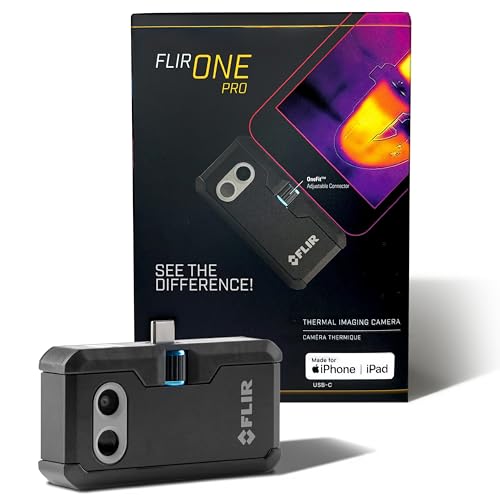 FLIR ONE Pro (phone) | Plugs into iPhone/Android; inspector favorite. | Amazon — $296.65 |
 Topdon TC001 | High-res phone module at a low price. | Amazon — $249.00 |
 FLIR C5 Compact | Standalone pocket camera with Wi-Fi. | Amazon — $593.99 |