Where to Buy a Moisture Meter: 5 Channels Compared
The right place to buy a moisture meter depends on one thing: whether you need it for an occasional spot check or for readings people will act on. A homeowner confirming a dried-out drywall patch and an inspector documenting moisture behind a shower wall are buying from the same shelves but need very different assurances about authenticity, warranty, and calibration. Below are the five channels that sell moisture meters in North America, what each does well, and where each one quietly costs you money.
Part of our Moisture Meters & Water Damage Detection guide — start there for the full picture →
The five channels at a glance
| Channel | Typical price | Return window | Warranty support |
|---|---|---|---|
| Big-box retail (Home Depot, Lowe’s, Menards) | $20–$150 | 30–90 days | Manufacturer only |
| Online marketplaces (Amazon, eBay) | $15–$400 | 14–30 days | Depends on seller |
| Specialty inspection suppliers | $40–$1,000+ | 14–30 days | Full, plus repair |
| Test-and-measurement dealers (Acme, Grainger, Tequipment) | $60–$1,500+ | 30 days | Full, consistent |
| Manufacturer-direct (Lignomat, Wagner, Delmhorst, FLIR) | MSRP | 30 days | Full, factory service |
Big-box retail: fastest, but a shallow shelf
Home Depot, Lowe’s, and Menards typically stock four to eight pin and pinless models at a time — usually a General Tools MMD4E or MMH800, a Klein Tools ET140, a Calculated Industries AccuMaster, and a Lignomat mini-Ligno. Expect roughly $25 for a basic pin meter up to about $150 for a pin/pinless combo.
The trade-off is that professional lines from Delmhorst, Wagner Meters, and FLIR are rarely on the shelf, and no big-box store offers calibration service. Because returned units often get re-shelved without inspection, open the box on the spot: confirm the pins are straight and present, the battery contacts are clean, and the manual and any calibration reference block are inside. If you only measure a few times a year, this channel is the right answer — grab a $30–$80 pin meter and go.
Online marketplaces: widest choice, most counterfeits
Amazon and eBay carry the broadest range and the widest price spread, and that spread is exactly the problem. The same model appears from a dozen sellers, and grey-market or counterfeit units cluster at the low end. Buy only from listings that read “Ships from and sold by [Manufacturer]” or a named authorized dealer; a third-party seller with no such designation may sell a unit the manufacturer will not honor under warranty.
When you read reviews, filter to the last 12 months so you are judging the current hardware revision, and skim for the words that predict field failure — “calibration drift,” “inaccurate on the second battery,” “reads high on hardwood.” A wall of five-star reviews about fast shipping tells you nothing about whether the meter measures correctly.
Specialty inspection suppliers: depth and someone to ask
Suppliers built for home inspectors and restoration techs — the same outlets that sell borescopes and thermal cameras — carry the full ladder from $40 entry pin meters to $1,000-plus inspection kits. Their advantage is a salesperson who can tell you whether you actually need a hammer probe, plus post-sale services big-box never offers: calibration certificates traceable to NIST, replacement pin sets, deep-wall and hammer-probe accessories, and factory-authorized repair. If clients or insurers will see your numbers, this is where documented traceability comes from. For a wider view of how meters fit alongside imaging tools, see the home inspection tools hub.
Test-and-measurement dealers: one cart for a whole kit
Dealers serving the electrical and industrial trades — Acme Tools, Grainger, Tequipment, Test Equipment Depot — treat moisture meters as one line in a large diagnostics catalog, so their inventory leans toward Extech, FLIR, and Klein models that cross over into electrical work. The reason to use them is one-stop shopping when you also need clamp meters, anemometers, or a thermal camera in the same order. Pricing tracks MSRP closely, and return and warranty handling is professional and predictable.
Manufacturer-direct: the authenticity guarantee
Lignomat, Wagner Meters, Delmhorst, and FLIR all sell from their own sites. You pay MSRP and wait for shipping, but you get the full warranty, factory calibration paperwork, and access to service without any question about the seller. Manufacturers also sell refurbished stock — often 60–80% of new price with fresh calibration and a warranty — which is a far safer used route than a stranger on Craigslist whose meter’s calibration history is unknown.
Match the channel to the buyer
- Occasional homeowner: big-box, $30–$80 pin meter, built-in calibration check is enough.
- Serious remodeler or flooring installer: a $150–$400 pin/pinless combo with species correction from a specialty supplier or manufacturer-direct — worthwhile once you are reading maple, oak, and walnut on the same job.
- Working inspector or restoration tech: the $400–$1,000+ tier from a specialty supplier with NIST-traceable calibration and hammer-probe capability.
- Commercial buyer: a test-and-measurement dealer bundle with a recurring calibration contract.
What actually matters at any price point
Two specifications separate a useful meter from a decorative one. First, species (or material) correction: wood density changes the reading, and meters calibrated only to Douglas fir will misread denser hardwoods. Second, a stated accuracy referenced to a standard — reputable wood meters cite ASTM D4442 (oven-dry reference) or D4444 (field meters), which is your signal the numbers mean something.
Know the thresholds those numbers feed into. Wood reaches its fiber saturation point near 28–30% moisture content, and framing lumber in a heated home usually settles far lower — in the arid Colorado Front Range, equilibrium moisture content commonly sits around 6–9%, so a stud reading 20% is telling you something is wet now. Because sustained dampness is what drives mold, the EPA advises drying wet building materials within 24–48 hours; a meter is how you confirm you got there. Both InterNACHI and the ASHI Standards of Practice treat the meter as a documentation tool, not a verdict — a reading flags a spot, it does not find the source.
Costs that arrive after the sticker price
Annual calibration verification at a NIST-traceable lab runs about $50–$150 per meter; some manufacturers include the first one free. Pin sets wear out and cost $10–$30 to replace, usually user-installable. Hammer probes and deep-wall probes for thick lumber or wall cavities add $100–$300 and are typically offered only on the professional tier. For casual use, a 9V battery once or twice a year is the whole recurring cost — which is why an inexpensive big-box meter is genuinely the correct buy for most homeowners.
When the meter isn’t the answer
A moisture meter reads one spot at one moment. When a reading is high and the source isn’t obvious, that is the point to bring in a credentialed inspector who pairs the meter with thermal imaging and a borescope to trace hidden moisture inside walls and floor systems. If you want to understand what your readings are actually reporting before you buy, start with what a moisture meter does and the differences among digital pin and pinless meters.
More Questions About Buying a Moisture Meter
Should you buy a pin or pinless moisture meter?
A pin moisture meter is the better buy for confirming exact readings in wood and drywall at a specific spot, while a pinless meter is better for quickly scanning large areas without leaving holes.
Pin meters measure electrical resistance between two probes pushed into the material, so they read at the probe depth. Pinless meters use an electromagnetic sensor that reads roughly 3/4 inch deep and is affected by dense materials or metal behind the surface. Many inspectors carry both, or buy a combination meter that switches between modes.
How much does a good moisture meter cost?
A good homeowner moisture meter typically costs about $30 to $80, while professional-grade meters used by inspectors and restoration contractors usually run $150 to $500 or more.
Budget meters are fine for spot-checking firewood, drywall, or a suspected leak. Higher-priced models add features such as material scales for different wood species, reference modes for drywall and masonry, data logging, replaceable pins, and better accuracy. For mold-related checks, consistency and a reference scale matter more than a large display.
Can a moisture meter detect mold?
No, a moisture meter cannot detect mold directly; it only measures moisture in materials. However, it is one of the most useful tools for finding where mold is likely, since mold needs sustained moisture to grow.
Elevated readings near a musty smell, a stain, or a leak point to a likely problem area inside a wall or under flooring. Comparing the reading against a dry area of the same material helps judge how wet the spot is. Visual inspection or sampling is needed to confirm actual growth.
What moisture meter reading means drywall is wet?
On many meters’ drywall or reference scales, readings below about 1 percent on gypsum, or in the low range of a relative scale, indicate dry drywall, while readings that climb well above a dry reference area suggest moisture.
Because scales differ between models, the practical method is to take a baseline reading on a known-dry part of the same wall and compare. Readings that stay elevated over several days usually point to an ongoing leak. Drywall that stays wet beyond 24 to 48 hours is at higher risk of mold growth.
Can you rent a moisture meter instead of buying one?
Some tool rental shops and equipment rental centers rent moisture meters, but availability is spotty, and the rental fee for a few days can approach the price of a basic meter.
For a one-time check, a budget meter purchase is often simpler. Renting makes more sense for expensive equipment like thermal imaging cameras, which pair well with a moisture meter for finding hidden leaks. Restoration companies and home inspectors also bring calibrated meters as part of their service.
Frequently asked questions
Is it safe to buy a moisture meter on Amazon?
Yes, if the listing reads 'Ships from and sold by' the manufacturer or a named authorized dealer. Unbranded third-party sellers at the bottom of the price range are where grey-market and counterfeit units show up, and those fall outside the manufacturer warranty. Filter reviews to the past 12 months so you're judging the current hardware revision.
Do I need a NIST-traceable calibration certificate?
Working inspectors and restoration pros usually do, because clients and insurers may ask for documented measurement traceability. Homeowners doing occasional spot checks do not — the built-in calibration check that ships with the meter is sufficient for personal use.
What does a $200 meter give me that a $40 one doesn't?
Built-in species or material correction, a stated accuracy tied to ASTM D4442 or D4444, a wider measurement range, longer battery life, and often the ability to accept a hammer probe for deep readings in thick lumber. If you only check drywall after a leak, the $40 meter is fine.
How often should a moisture meter be recalibrated?
Most manufacturers recommend verifying against a known reference at least once a year, with factory adjustment when the check fails. Heavy daily professional use can justify more frequent verification; casual homeowners can rely on the built-in calibration check before each session.
How long does a moisture meter last?
A well-kept moisture meter often lasts many years. Pins wear or bend over time but are replaceable on many models, and batteries usually need changing once or twice a year depending on use. Storing the meter dry and checking it against a calibration block keeps readings consistent.
Is a moisture meter worth it for a home buyer?
A moisture meter can help home buyers spot suspicious areas during showings, such as below windows, around tubs, or at basement walls, but it does not replace a professional inspection. It is best used as a quick screening tool to decide what to ask the inspector to look at closely.
Can a moisture meter read through tile?
A pinless moisture meter can sometimes detect elevated moisture beneath tile, especially thinner tile over drywall or backer board, but readings through dense ceramic or stone are less reliable. Readings on adjacent grout lines, drywall, or baseboards often give clearer evidence of a leak behind tile.
This guide reflects EPA moisture guidance and ASTM measurement standards; product availability and pricing were current at publication and vary by seller.
Moisture meters for home inspection
Pin meters read deep but leave marks; pinless meters scan surfaces non-destructively. Many inspectors carry both.
| Product | Why | Buy |
|---|---|---|
 Klein Tools ET140 Pinless | Non-destructive scanning; affordable. | Amazon — $49.22 |
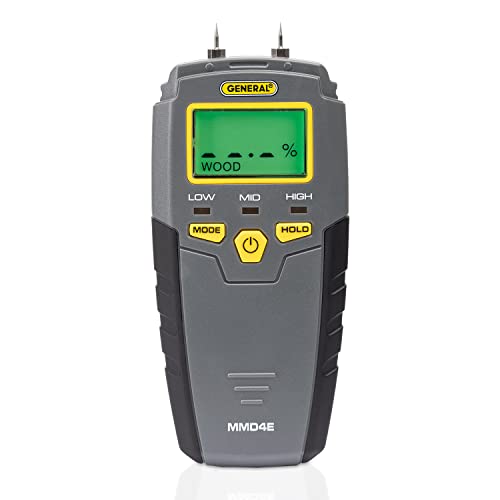 General Tools MMD4E | Best-selling pin meter for drywall/wood. | Amazon — $39.98 |
 Lignomat Mini-Ligno | Trusted by woodworkers; species-calibrated. | Amazon — $83.20 |