Black Mold on Skin Pictures: What Homeowners Need to Know
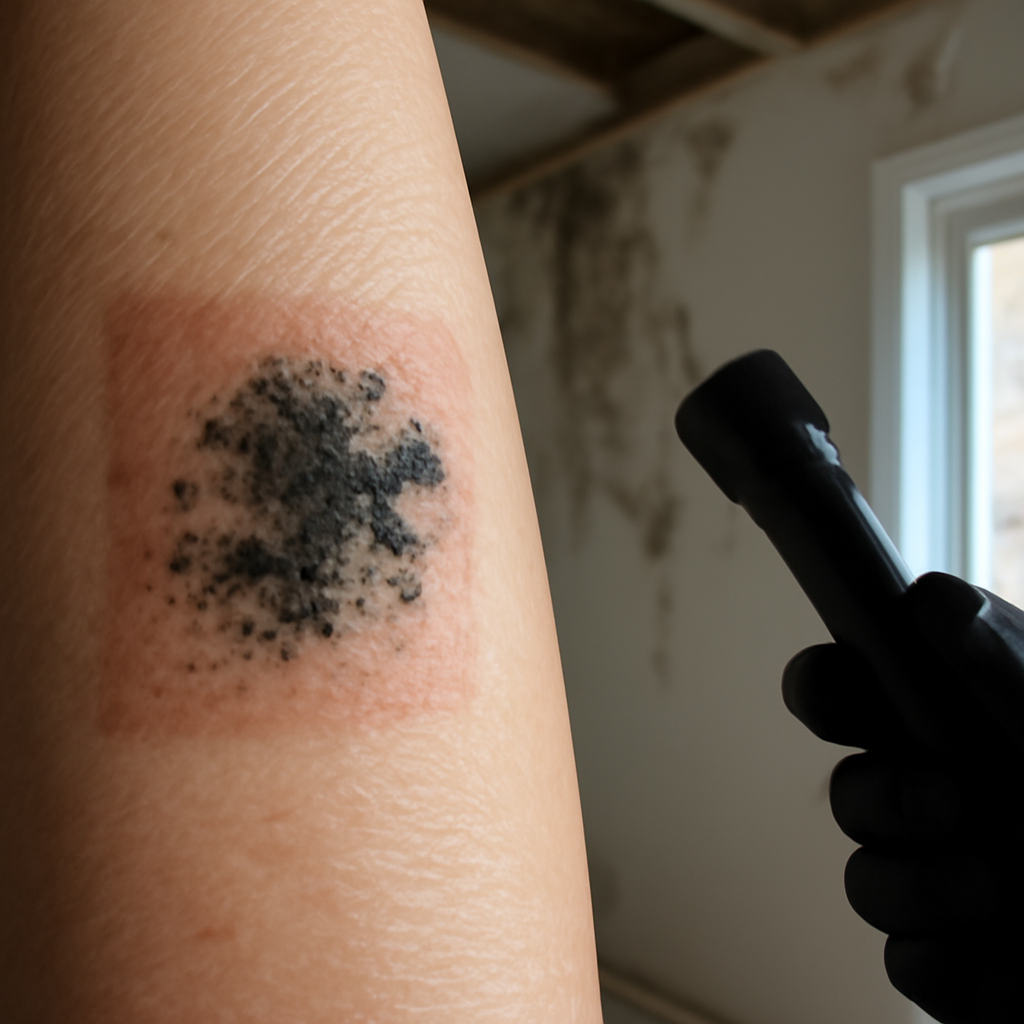
Searches for black mold on skin pictures usually come from a real worry: a new rash, itchy patches, or irritation that appeared after time in a damp, musty room. It helps to clear up a common misconception first — black mold does not typically grow on human skin the way it grows on drywall, and most “black mold on skin” images online actually show contact-dermatitis reactions, fungal skin infections, or unrelated rashes. This guide summarizes EPA, CDC, and NIH guidance current as of 2026 and is educational only; consult a physician for any skin symptom and a certified professional for home mold testing.
Is this mold, asbestos, or water damage? Get a free instant screen
Upload a clear photo of the suspect area. You'll get an instant AI screening opinion and what to do next. This is screening guidance, not a professional determination.
Screening guidance only. AI can be wrong. Confirm asbestos, mold type, or lead with lab testing or a licensed professional before acting.
Does black mold actually grow on skin?
Environmental molds like Stachybotrys chartarum — the species most people mean by “black mold” — colonize wet building materials such as drywall paper, wood, and ceiling tiles. Human skin is generally too warm, too dry, and too well-defended by the immune system for these molds to take hold. So when people search for black mold on skin pictures expecting to see a fuzzy black colony growing on an arm, that is not what mold-related skin issues look like.
The mental image of mold “growing” on skin comes from how mold behaves on walls and food, where a visible fuzzy patch spreads over a surface. Skin does not work that way. It constantly sheds cells, maintains an acidic protective barrier, and is patrolled by an immune system, all of which make it a hostile environment for the molds that thrive on damp drywall. What people actually experience and photograph is the skin’s reaction to something — an allergen, an irritant, or a skin-adapted fungus — not a colony of building mold taking root. Getting this straight matters, because it changes the question from “how do I remove mold from my skin” to “what is causing this skin reaction,” which is the question a clinician can actually answer.
What does appear is a reaction. The CDC and NIEHS describe mold exposure causing allergic responses, and the skin can be involved through irritation or an allergic contact reaction. Separately, fungal infections of the skin do exist — athlete’s foot, ringworm, and yeast infections — but these are caused by dermatophytes and yeasts adapted to skin, not by the household molds that grow on building materials. The two get conflated constantly online.
This matters for anyone searching image galleries, because the photos are not a reliable diagnostic tool. A picture labeled “black mold on skin” might show contact dermatitis, an allergic rash, ringworm, eczema, a heat rash, or something else entirely, and there is no way to be certain from an image. Skin conditions that look alike to the eye can have completely different causes and treatments, which is exactly why clinicians examine the skin directly and sometimes take a sample rather than diagnosing from a photo. Matching your rash to an online image can easily send you toward the wrong conclusion and the wrong remedy.
What mold-related skin reactions look like
Rather than relying on potentially mislabeled pictures, it is more useful to understand the patterns. Mold-associated skin reactions tend to appear as:
- Red or pink patches that may be raised, similar to other allergic rashes.
- Itching that worsens with continued exposure to a damp environment.
- Dry, flaky, or irritated skin in people with existing eczema, which mold exposure can aggravate.
- Hives in some sensitized individuals.
These are nonspecific — they look like many other rashes, which is exactly why photos are unreliable for self-diagnosis. A genuine fungal skin infection like ringworm tends to form a distinct circular, scaly ring with clearer skin in the middle, while contact dermatitis usually appears where skin touched an irritant. Only a clinician can tell these apart reliably, often with a simple exam or skin scraping. Our overview of mold on skin symptoms and causes goes deeper into how these reactions present.
What causes skin symptoms around mold
There is also a meaningful difference between an allergic reaction and a true infection, and the two are often confused under the “mold on skin” umbrella. An allergic or irritant reaction is the immune system or skin reacting to mold or its byproducts; it is uncomfortable but not an infection, and it resolves once exposure stops and any inflammation is treated. A fungal skin infection, by contrast, involves organisms actually colonizing the skin and requires antifungal treatment. Household black mold causes neither an infection of the skin in healthy people nor a colony growing on it; at most it can contribute to an allergic or irritant response. Keeping these mechanisms distinct prevents the wrong treatment from being applied.
When skin symptoms do track with a moldy environment, a few mechanisms are usually at play. Allergic sensitization is the most common: repeated exposure to mold spores primes the immune system, and later contact triggers itching, redness, or hives. People with allergies, asthma, or eczema are more prone to this, according to the CDC. Direct irritation is another route, where physical contact with heavily contaminated material — pulling up moldy carpet, handling water-damaged drywall — leaves skin red and itchy.
Damp environments also harbor more than one allergen. Dust mites, bacteria, and other microbes thrive alongside mold in wet conditions, so a skin reaction in a damp basement is not always mold specifically. The practical takeaway is that the moisture problem matters more than pinning the symptom on one organism. Reducing dampness reduces the whole mix of irritants at once, which is why the most effective long-term step for environment-linked skin symptoms is usually controlling moisture rather than chasing a single suspected organism.
Timing offers a clue worth tracking. If skin symptoms flare after time in a particular room — a damp basement, a bathroom with visible growth, a closet against an exterior wall — and ease elsewhere or outdoors, the environment is a reasonable suspect. Keeping a simple log of where and when symptoms appear gives a clinician useful information and helps separate an environmental trigger from an unrelated skin condition. That said, a single damp-room exposure rarely explains a persistent or spreading rash, which points back toward seeing a doctor rather than assuming mold is the cause.
When to see a doctor
Skin symptoms warrant medical attention rather than internet picture-matching. See a clinician if a rash spreads, blisters, weeps, or shows signs of infection like increasing redness, warmth, or pus; if itching disrupts sleep; or if symptoms persist despite leaving the suspected environment. Anyone with a weakened immune system should be especially prompt, since the NIH notes some molds can cause more serious infections in immunocompromised people.
A doctor can distinguish allergic dermatitis from a fungal infection from an unrelated condition, and prescribe the right treatment — which differs completely between the three. Self-treating a presumed “mold rash” with an antifungal cream, for example, does nothing for an allergic reaction. Bring details about your home environment to the appointment, since a damp-home history is useful context.
Checking your home for mold
If skin symptoms ease when you leave home and return when you are back, the building is worth investigating. Look in the usual moisture zones — bathrooms, basements, around windows, under sinks, and near any past leaks. Visible growth, a musty odor, peeling paint, or warped materials all point to a moisture problem. Keeping indoor humidity below about 50 percent and fixing leaks promptly addresses the root cause.
For visible growth under roughly 10 square feet, careful DIY cleanup with gloves and an N95 respirator is reasonable; larger areas or hidden growth call for professional assessment. If you are unsure whether what you are seeing is mold at all, our color-by-color reference at the mold inspection and testing hub helps homeowners tell growth apart from staining and other discoloration.
If anyone in the household handles moldy materials during cleanup, protecting the skin directly is sensible regardless of whether a reaction has occurred. Long, non-porous gloves keep mold and cleaning chemicals off the hands, long sleeves cover the arms, and washing thoroughly afterward removes residue. People with eczema, allergies, or asthma are better off not doing the cleanup themselves, since handling contaminated material is one of the more direct ways to provoke a skin or respiratory reaction. The goal is to address the moisture and the growth while keeping vulnerable skin out of contact with both the mold and the products used to remove it.
How the common skin conditions differ
Since pictures are unreliable, understanding the categories that get mislabeled as “black mold on skin” is more useful than scrolling galleries. Allergic contact dermatitis appears where the skin touched a trigger, often as red, itchy, sometimes weepy patches with edges that roughly match the contact area. A fungal skin infection like ringworm forms a distinctive ring — a scaly, raised border with clearer skin inside — and is caused by skin-adapted fungi, not building mold. Eczema tends to be chronic, dry, and recurring in characteristic locations like the inside of the elbows or behind the knees. Hives come and go quickly as raised welts. Each looks different to a trained eye and, crucially, calls for a different treatment.
This is why self-diagnosis from a photo so often goes wrong. Reaching for an antifungal cream because a rash was labeled “mold” does nothing for an allergic reaction or eczema, and applying a steroid cream to a genuine fungal infection can make it worse. The treatments are not interchangeable, and the only reliable way to know which condition you have is a clinical exam, sometimes with a quick skin scraping examined under a microscope. The time spent matching a rash to internet images is better spent describing the symptoms and your home environment to a clinician who can actually tell them apart.
When to call a professional
Bring in a mold inspector when symptoms persist, when you can smell mold but cannot find it, or when growth covers a large area or has entered the HVAC system. An independent assessor uses moisture meters and, where warranted, sampling to confirm whether mold is present and where it is hiding. Pairing a home assessment with a medical evaluation gives you both halves of the picture — the environmental cause and the health response — instead of guessing from pictures.
The two professionals serve different roles, and using both gives the clearest answer. A physician evaluates and treats the skin condition itself, determining whether it is allergic, fungal, or something unrelated. A mold inspector determines whether the home actually has a moisture and mold problem that could be contributing. Neither alone completes the picture: treating the skin while ignoring a damp home invites recurrence, and remediating the home while ignoring a misdiagnosed infection leaves the symptom untreated. For a recurring rash that seems tied to a damp environment, that two-track approach beats any amount of photo-matching.
References
- About Mold and Your Home — Centers for Disease Control and Prevention
- Mold and Health — U.S. Environmental Protection Agency
- Mold and Indoor Air Quality — National Institute of Environmental Health Sciences
- Mold and Dampness — American Lung Association
Front Range residents who suspect a damp-home problem behind recurring symptoms can get in touch with a vetted inspector through our contact page for an objective look.