Best Paint Sprayers (2026): 7 Airless and HVLP Picks Compared

The best paint sprayer for your house depends less on brand than on what you are painting. Repainting a two-story exterior, a long cedar fence or a garage interior calls for an airless sprayer that pulls paint straight from a 5-gallon bucket. Refinishing a dresser, a set of shutters or interior doors is a job for a handheld HVLP gun with a cup. Buying the wrong type means either a machine you spend more time cleaning than spraying, or a cup gun that takes all weekend to cover one wall. Below are seven picks, four airless and three handheld, each matched to a homeowner job, followed by a buying guide on airless versus HVLP, tip sizes and the safety points that matter.
Part of our Structure & Exterior guide — start there for the full picture →
As an Amazon Associate we earn from qualifying purchases.
How we compared: we compared 11 current Amazon listings for paint sprayers, six stand or cart airless units and five handheld cup guns, on what each listing states: pump type, pressure, flow, supported hose length, tips and nozzles, recommended project size and cleanup features. We did not lab-test these sprayers or use them hands-on. Prices and availability change, so check the current listing before buying.
Quick picks: the best paint sprayers by job
| Product | Best for | Key features | Price | Buy |
|---|---|---|---|---|
| Graco Magnum X5 | Best overall for whole-house DIY |
| $303.00as of Nov 15, 2026 8:06 am GMT+0000 | Buy now →Check current price |
| Graco Magnum X7 Cart | Multi-story exteriors |
| — | Buy now →Check current price |
| Graco Project Painter Plus | Entry-level airless |
| — | Buy now →Check current price |
| VEVOR 750W Stand Airless | Value airless with stated flow |
| $166.90as of Nov 15, 2026 8:06 am GMT+0000 | Buy now →Check current price |
| DEKOPRO 700W Airless | Airless kit with two tips |
| $139.99as of Nov 15, 2026 8:06 am GMT+0000 | Buy now →Check current price |
| HomeRight Super Finish Max | Handheld HVLP for furniture |
| $57.00as of Nov 15, 2026 8:06 am GMT+0000 | Buy now →Check current price |
| LUDERIGNITE 1000W HVLP | Most nozzle choices |
| — | Buy now →Check current price |
Prices are Amazon’s listed prices as of the time shown and change often; check Amazon for today’s price. As an Amazon Associate we earn from qualifying purchases.
The seven picks, compared listing by listing
1. Graco Magnum X5 — Best Overall for Whole-House DIY Painting

3000 PSI airless with adjustable pressure, bucket suction and up to 75 ft of hose, sized for 10-gallon projects.
Check price on Amazon$303.00 as of Nov 15, 2026 8:06 am GMT+0000 — prices change; see Amazon for current price.Why we like it
- Sprays paint and stain unthinned at adjustable pressure
- Draws directly from a 1 or 5-gallon bucket
- Hose reach for second stories and peaks
- Aimed at homeowners and remodelers, not pros
| Specification | Details |
|---|---|
| Type | Stand airless sprayer |
| Pressure | 3000 PSI maximum, fully adjustable |
| Project size | Recommended for projects up to 10 gallons |
| Hose support | Up to 75 ft of paint hose |
| Paint supply | Flexible suction tube into a 1 or 5-gallon bucket |
| Weight / warranty | About 15 lb; one-year warranty against defects |
Graco Magnum X5 262800 — 3000 PSI airless, adjustable pressure, bucket suction, 75 ft hose support, 15 lb, 1-yr warranty
The Middle Graco: Twice the Project Size of the Project Painter Plus
Three of the six airless listings are Graco Magnum models, and they form a clear ladder. The Project Painter Plus is rated for projects up to 5 gallons and 50 ft of hose, the X5 doubles that to 10 gallons and 75 ft, and the cart-mounted X7 steps up to 125 gallons a year and 100 ft. For a homeowner repainting a ranch-style exterior, a basement and a fence over a couple of seasons, the X5 sits in the right spot: enough reach for a second-story gable without the bulk of a cart.
Like the other Gracos, it sprays unthinned at adjustable pressure, which matters because thinning exterior latex to suit a weak pump can reduce coverage and durability. The stand design keeps it light at about 15 lb.
The listing does not state flow rate, tip size included, or pump material, and it does not mention a reversible tip or a garden-hose flush adapter, both of which the X7 listing names. Plan to buy a spare tip and a filter.
Pros
- Right size for most DIY house projects
- Sprays unthinned paint and stain
- 75 ft hose support reaches second stories
Cons
- Flow rate and included tip not stated
- No cleaning adapter or reversible tip listed
- One-year warranty only
Check Graco Magnum X5 price on Amazon
2. Graco Magnum X7 Cart — Best for Multi-Story Exteriors

Cart airless with stainless piston pump, reversible tip, garden-hose flush adapter and up to 100 ft of hose.
Check price on AmazonWhy we like it
- Longest supported hose on the shelf at 100 ft
- Reversible tip clears clogs without stopping
- Flush adapter connects to a garden hose
- Cart rolls around the house on the job
| Specification | Details |
|---|---|
| Type | Cart airless sprayer, 110 V |
| Pump / pressure | Stainless steel piston pump; 3000 PSI, adjustable |
| Annual use | Up to 125 gallons per year |
| Hose support | Up to 100 ft; listed for second and third-story homes |
| Tip / cleanup | RAC IV reversible SwitchTip; PowerFlush garden-hose adapter |
| Weight / warranty | About 26 lb; one-year warranty against defects |
Graco Magnum X7 262805 — cart airless, stainless piston, 3000 PSI, 100 ft hose support, reversible tip, PowerFlush, 26 lb
The Only Listing With Both a Reversible Tip and a Garden-Hose Flush
Clogged tips and slow cleanup are the two complaints that make homeowners give up on airless sprayers. The X7 is the only listing among the 11 that names a reversible tip (Graco’s RAC IV SwitchTip, which you flip to blow out a clog) and the only one that names a garden-hose flush adapter. It is also the only one that names a stainless steel piston pump; the VEVOR 650W mentions a piston pump without stating the material.
Its 100 ft of supported hose is the longest on the shelf, and the listing explicitly targets second and third-story homes. Front Range houses with walkout basements often have a three-story back wall, which is exactly where hose length starts to matter.
The trade-offs are size and weight. At about 26 lb on a cart, it is overkill for a bedroom or a single fence run, and the listing still offers only a one-year warranty. It does not state flow rate.
Pros
- Longest hose support and highest annual rating here
- Reversible tip and garden-hose flushing
- Stainless steel piston pump named
Cons
- Heaviest and bulkiest pick
- More machine than small jobs need
- Flow rate not stated
Check Graco Magnum X7 Cart price on Amazon
3. Graco Magnum Project Painter Plus — Best Entry-Level Airless
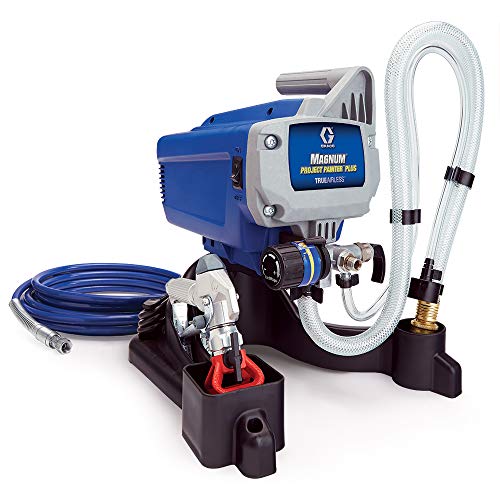
Compact airless for projects up to 5 gallons; sprays unthinned from the bucket with up to 50 ft of hose.
Check price on AmazonWhy we like it
- Sized for a room, a shed or a fence
- Sprays paint and stain unthinned
- Bucket suction, no cup refills
- Same Graco pressure control as larger models
| Specification | Details |
|---|---|
| Type | Stand airless sprayer |
| Pressure | Fully adjustable; maximum PSI not stated in listing |
| Project size | Recommended for projects up to 5 gallons |
| Hose support | Up to 50 ft of paint hose |
| Paint supply | Flexible suction tube into a 1 or 5-gallon bucket |
| Weight / warranty | About 15 lb; one-year limited warranty |
Graco Magnum Project Painter Plus 257025 — airless, adjustable pressure, up to 5-gal projects, 50 ft hose support, 15 lb
The Smallest Airless Rating on the Shelf
Among the six airless listings, the Project Painter Plus has the most modest rating: projects up to 5 gallons and up to 50 ft of hose. That makes it a sensible first airless for someone who wants to spray a garage, a basement or a privacy fence once or twice a year without buying a bigger pump than they will use.
It keeps the Graco features that matter most: adjustable pressure, unthinned spraying and suction straight from the bucket. The X5 listing shows the same 15 lb weight, so the step up to the X5 buys more reach and capacity without extra bulk.
The listing does not state a maximum pressure, flow rate or included tip, and it is the only Graco here without a PSI figure in the title. If you expect to paint a full exterior, the X5’s doubled rating is worth the step.
Pros
- Simple, homeowner-scale airless
- Sprays unthinned from the bucket
- Same weight as the X5
Cons
- Lowest project and hose ratings among the Gracos
- No PSI or flow figure in listing
- Limited for full exteriors
Check Graco Project Painter Plus price on Amazon
4. VEVOR 750W Stand Airless — Best Value Airless With a Stated Flow Rate

750W stand airless rated to 3000 psi and up to 1.2 LPM, with a detachable pump body, metal frame and extension pole.
Check price on Amazon$166.90 as of Nov 15, 2026 8:06 am GMT+0000 — prices change; see Amazon for current price.Why we like it
- States both pressure and maximum flow
- Pump body detaches for cleaning
- Extension pole for ceilings and low work
- Variable motor speed for different coatings
| Specification | Details |
|---|---|
| Type | Stand airless sprayer, 750 W motor |
| Pressure / flow | Up to 3000 psi; up to 1.2 liters per minute |
| Speed control | Stepless motor speed adjustment |
| Cleaning | Detachable pump body; cleaning brush included |
| Frame / weight | Full-metal frame; about 19.6 lb |
| Hose length / warranty | Not stated in listing |
VEVOR 750W Stand Airless RP8626 — 3000 psi, 1.2 LPM, stepless speed, detachable pump, extension pole, 19.6 lb
One of Only Two Airless Listings That Give a Flow Rate
Flow rate, how much paint the pump can move, is a better predictor of real-world speed than motor wattage, yet only two of the six airless listings state it: this VEVOR at up to 1.2 liters per minute and the DEKOPRO at 0.3 gallons per minute (roughly 1.1 liters). None of the three Graco listings gives a flow figure. That makes the VEVOR one of the easier non-Graco units to compare on paper.
The detachable pump body is a practical cleaning feature, and stepless speed control lets you slow the pump for thinner stains. The full-metal frame adds weight; at about 19.6 lb it is heavier than both stand-style Gracos.
The listing does not state hose length, included tip size, supported hose length or warranty terms, and VEVOR parts and tips may be harder to find locally than Graco’s. Speed claims such as “5 times faster than rolling” are marketing comparisons, not measurements.
Pros
- Pressure and flow both stated
- Detachable pump for cleanup
- Extension pole included
Cons
- Hose length, tip and warranty not stated
- Heavier than the stand Gracos
- Replacement parts less common locally
Check VEVOR 750W Stand Airless price on Amazon
5. DEKOPRO 700W Stand Airless — Best Airless Kit With Two Tips

2900 PSI, 0.3 GPM stand airless with 311 and 515 tips, two extension rods, hose and goggles in the box.
Check price on Amazon$139.99 as of Nov 15, 2026 8:06 am GMT+0000 — prices change; see Amazon for current price.Why we like it
- Two tip sizes for fine and wide work
- Two tip extension rods included
- Goggles come in the box
- Lists water-based, oil-based, primer and stain use
| Specification | Details |
|---|---|
| Type | Stand airless sprayer, 700 W motor |
| Pressure / flow | Up to 2900 PSI; 0.3 gallons per minute |
| Tips included | 311 and 515 |
| Hose | 1/4 in high-pressure hose, about 24.6 ft |
| Extras | Two 11.8 in extension rods, wrenches, brush, goggles, needle |
| Weight / warranty | Not stated in listing |
DEKOPRO 700W DKPAPSX300C1 — 2900 PSI, 0.3 GPM, 311 + 515 tips, 24.6 ft hose, two extension rods
The Only Airless Listing That Ships Two Different Tips
Tip size controls both fan width and how much paint comes out, so one tip rarely suits every job. The DEKOPRO is the only airless listing on the shelf that includes two tips: a 311 for narrower work such as trim and doors, and a 515 for walls and siding. The VEVOR 650W lists a single 517, and none of the Graco listings name an included tip.
It also bundles two tip extension rods and a pair of goggles. Its 0.3 GPM flow and 2900 PSI rating are in the same range as the VEVOR 750W.
The included hose is short at about 24.6 ft, so a two-story exterior means buying more hose, and the listing does not say how much hose the pump supports. Weight and warranty are not stated.
Pros
- Two tips cover trim and walls
- Flow rate stated
- Eye protection included
Cons
- Short included hose
- Supported hose length not stated
- Weight and warranty not listed
Check DEKOPRO 700W Airless price on Amazon
6. HomeRight Super Finish Max — Best Handheld HVLP for Furniture and Trim

Handheld HVLP with three brass tips and three patterns, built to need less thinning than the original Finish Max.
Check price on Amazon$57.00 as of Nov 15, 2026 8:06 am GMT+0000 — prices change; see Amazon for current price.Why we like it
- Three brass tips and three patterns
- Needs less thinning than the Finish Max
- Light at about 3.3 lb
- Built for furniture, cabinets, crafts and trim
| Specification | Details |
|---|---|
| Type | Handheld HVLP cup sprayer |
| Tips / patterns | Three brass tips; three spray patterns |
| Materials | Stains, sealers and latex paint |
| Thinning | Less thinning required than the Finish Max |
| Weight | About 3.3 lb |
| Model / power | C800971; wattage not stated in listing |
HomeRight Super Finish Max C800971 — handheld HVLP, 3 brass tips, 3 patterns, less thinning, 3.3 lb
The Only Brand-Name Handheld HVLP on This Shelf
Five of the 11 listings are handheld cup guns, and three of those call themselves HVLP. HomeRight is the only established handheld brand among the five; the rest are lesser-known sellers with similar-looking guns. That matters for parts: replacement tips, gaskets and cups for a known model are easier to source when a seal wears out mid-project.
The listing’s main claim is that the Super Finish Max needs less thinning than HomeRight’s own Finish Max. That is a relative claim, not a promise of unthinned spraying, so expect to thin latex for any handheld cup gun. For a full comparison of handheld HVLP options aimed at cabinet doors, see our best paint sprayer for cabinets roundup.
The listing does not state wattage, cup size or warranty, and it is not the tool for siding or a whole room of walls.
Pros
- Known brand with available parts
- Three tips and patterns
- Light and easy to control
Cons
- Cup size, wattage and warranty not stated
- Still needs some thinning
- Too slow for walls and siding
Check HomeRight Super Finish Max price on Amazon
7. LUDERIGNITE 1000W HVLP — Best for the Most Nozzle Choices

1000W handheld HVLP with six nozzles from 0.5 to 2.5 mm, a 47 oz cup, trigger flow control and one-press front detach.
Check price on AmazonWhy we like it
- Six nozzles, the most on the shelf
- Large 47 oz cup means fewer refills
- Flow adjusts at the trigger
- Front assembly detaches with one press
| Specification | Details |
|---|---|
| Type | Handheld HVLP cup sprayer, 1000 W |
| Nozzles | Six, from 0.5 mm to 2.5 mm |
| Patterns | Vertical, horizontal and circular |
| Cup | 1400 ml (47 oz) |
| Cleaning | One-press front detach; brush, pin, viscosity cup, strainers |
| Weight / warranty | Not stated in listing |
LUDERIGNITE BS-LYH910 — 1000W HVLP, 6 nozzles 0.5–2.5 mm, 3 patterns, 47 oz cup, trigger flow control
Six Nozzles Where Every Other Handheld Has Three or Four
Among the five handheld guns, HomeRight lists three tips, WIBENTL, LESONJOY and TINKFTLY list four each, and LUDERIGNITE lists six. The extra small sizes, down to 0.5 mm, are useful for thin stains, sealers and clear coats, while the 2.5 mm end handles thicker latex once thinned.
The 47 oz cup is at the large end for a handheld, which cuts refills on a fence section or a set of shutters. The listing also says flow control sits at the trigger and the front assembly detaches with one press, both helpful when switching colors.
The title claims stains and sealers spray unthinned, which is plausible for thin coatings; latex will still need thinning. Weight, warranty and seller support are not stated, and a full 47 oz cup adds noticeable weight at arm’s length.
Pros
- Widest nozzle range among handhelds
- Large cup for fewer refills
- Quick front detach for cleaning
Cons
- Lesser-known brand; parts uncertain
- Weight and warranty not stated
- Latex still needs thinning
Check LUDERIGNITE 1000W HVLP price on Amazon
Airless vs HVLP: which type fits your project
An airless sprayer uses a piston or diaphragm pump to push paint at very high pressure (typically around 3000 PSI on the units here) through a small tip, which atomizes it into a fan. It moves a lot of paint quickly, draws straight from the bucket and usually sprays house paint without thinning. The downsides are overspray, a lot of masking, and paint left in the pump and hose that must be flushed after every session. It shines on large, simple surfaces: siding, fences, ceilings, empty rooms and outbuildings.
An HVLP sprayer (high volume, low pressure) uses a fan or turbine to blow a large volume of low-pressure air through the gun, carrying paint from a cup. Less paint bounces back, so it wastes less and is easier to control on detailed pieces. It is slower, the cup needs refilling, and most latex has to be thinned. It suits furniture, doors, shutters, trim, cabinet doors and stain on small projects. Some cheaper handheld guns on the shelf do not say HVLP at all; they work similarly but with fewer specs listed.
A rough rule: if the job is measured in gallons, buy airless; if it is measured in pieces, buy HVLP.
How to read sprayer specs
Tip size on an airless
Airless tips are labeled with three digits. Double the first digit for the fan width in inches at about 12 inches from the surface, and the last two digits give the orifice size in thousandths of an inch. A 515 sprays roughly a 10 in fan through a 0.015 in hole, a common size for interior latex. A 311 gives a 6 in fan for trim and doors. Thicker coatings need larger orifices; stains and lacquers use smaller ones. Tips wear, and a worn tip sprays a narrower, uneven fan, so budget for replacements.
Pressure, flow and project rating
Nearly every airless listing advertises about 3000 PSI, so pressure alone does not separate them. Flow rate, when stated, and the manufacturer’s project or annual-gallon rating say more about whether the pump suits your workload. Supported hose length matters if you plan to leave the pump on the ground and spray a second story; a longer hose than the pump supports will drop pressure at the gun.
Nozzles and thinning on HVLP
Handheld HVLP guns list nozzle diameters in millimeters. Smaller nozzles (0.5 to 1.5 mm) suit stains, sealers and clear coats; larger ones (2.0 to 2.5 mm) suit latex and chalk paint. Most come with a viscosity cup: you time how long the cup takes to drain and thin until it matches the manual’s target. Skipping this step is the main reason handheld guns spit and orange-peel.
Safety, lead paint and Front Range conditions
Operate any sprayer according to the manufacturer’s instructions, which is one of OSHA’s basic rules for power tools along with using the right personal protective equipment and inspecting tools for damage before use. For airless units in particular, never point the gun at skin, keep the trigger lock on when not spraying, and relieve pressure before changing or cleaning a tip. OSHA also advises disconnecting tools before servicing, cleaning or changing accessories.
Prep on older houses deserves extra care. The EPA warns that renovation and painting projects in pre-1978 homes with lead-based paint can create dangerous lead dust, and scraping and sanding peeling exterior paint before spraying is where that dust is made. Test first with one of the kits in our best lead paint test kit roundup, and read our guide on sanding lead paint before you power-sand old siding. The EPA’s guidance for do-it-yourselfers recommends plastic sheeting, misting surfaces before scraping, an N-100 respirator and HEPA cleanup.
Spraying also puts more paint in the air than rolling. The EPA notes that paints release VOCs during and after use and recommends increased ventilation. Wear a respirator suited to the coating indoors, especially with oil-based primers.
Colorado weather shapes the schedule. Afternoon wind along the Front Range carries overspray onto cars, roofs and neighbors’ siding, so spray exteriors in calm morning hours and use a shield. Low humidity and strong high-altitude sun make paint dry fast, which can cause dry spray and lap marks on hot south and west walls; follow the shade around the house. Our guide to exterior painting covers temperature windows and prep, and if your project is a fence or deck, compare coatings in our best deck stain roundup first.
When to hire a painter or call an inspector
A sprayer makes the painting fast; it does not fix what is under the paint. Peeling that keeps returning on one wall often points to moisture behind the siding, failed flashing or a missing vapor path, and fresh paint will fail the same way. Large areas of alligatored or chalking paint on a pre-1978 house may be better handled by a lead-safe certified contractor. If you are buying or selling and want siding, trim and painted surfaces evaluated, our structure and exterior hub explains what inspectors look for, and Front Range homeowners can get in touch through our contact page to connect with a vetted local inspector.
Frequently asked questions
What type of paint sprayer is best for homeowners?
For whole rooms, exteriors and fences, an airless sprayer is usually best because it sprays house paint unthinned straight from the bucket. For furniture, doors, trim and cabinets, a handheld HVLP sprayer gives more control and less overspray. Many homeowners who do both types of work end up owning one of each.
Do you have to thin paint for a paint sprayer?
Most airless sprayers can spray latex house paint unthinned at adjustable pressure. Most handheld HVLP sprayers need latex thinned to the viscosity in the manual, which you check with the included viscosity cup. Thin stains and sealers often spray without thinning in either type.
What size tip should an airless sprayer use for interior walls?
A 515 or 517 tip is a common choice for interior latex walls, giving a 10 in fan through a 0.015 or 0.017 in orifice. Use a narrower tip such as a 311 or 313 for doors and trim. Check the paint can and sprayer manual for recommended tip sizes.
Is a paint sprayer faster than a roller?
Spraying itself is much faster than rolling on large surfaces, but masking, setup and cleanup take time. For a single small room, a roller may finish sooner overall. Sprayers pay off on exteriors, fences, ceilings, empty rooms and detailed pieces like shutters or spindles.
Can you use a paint sprayer on a house with lead paint?
Spraying new paint over intact surfaces does not itself disturb old paint, but the scraping and sanding prep usually does. In homes built before 1978, test for lead first and follow EPA lead-safe practices: contain the area, mist before scraping, avoid dry power sanding and clean with a HEPA vacuum. Consider a lead-safe certified contractor for large areas.
Can you use a paint sprayer indoors?
Yes, paint sprayers can be used indoors with thorough masking and ventilation. Cover floors, windows, fixtures and anything that should not get paint, and seal off adjacent rooms against drifting overspray. HVLP sprayers produce less overspray than airless units, which makes them easier to manage in occupied homes. Wear a respirator and keep windows open.
How long does a paint sprayer last?
A homeowner-grade paint sprayer typically lasts several years of occasional use when it is cleaned well after every job and stored with pump protector. Neglected cleanup can ruin a pump in a single season. Replaceable parts such as tips, filters and packings wear out first, so check that spare parts are sold for the model before buying.
Is airless or HVLP better for exterior siding?
An airless sprayer is usually better for exterior siding because it moves thick paint quickly over large areas. HVLP guns produce a finer finish but work slowly and often require thinning, which suits trim, doors and furniture instead. For tall siding, a cart-style airless with a long hose reduces how often the unit must be moved.
More Questions About Paint Sprayers
How much paint does a paint sprayer waste compared with a roller?
A paint sprayer typically uses noticeably more paint than a roller for the same area, often about 20 to 30 percent more for airless outdoors, based on industry estimates. Overspray drifts into the air and onto masking, and some paint stays in the hose and pump at cleanup. HVLP sprayers transfer more paint to the surface than airless units, so they waste less on small projects. Choosing the right tip size, holding the gun about 12 inches from the surface and avoiding spraying in wind all reduce waste. Budget extra paint before starting a large sprayed job.
How long does it take to clean a paint sprayer?
Cleaning an airless paint sprayer after latex paint typically takes about 20 to 45 minutes, while a small HVLP gun usually takes 10 to 20 minutes. Airless units need paint pumped back into the can, water or solvent circulated through the pump and hose until it runs clear, and the tip and filters cleaned separately. Skipping or rushing cleanup lets paint dry in the pump and hose, which is the most common reason sprayers clog or fail early. Use pump-protection fluid before storing an airless unit for weeks or over winter.
Do you still need to back-roll after spraying paint?
Back-rolling after spraying is recommended on many exterior surfaces and on rough or porous materials, but often unnecessary on smooth interior walls. Rolling over freshly sprayed paint pushes it into wood grain, stucco and masonry pores for better adhesion and more uniform coverage. On new drywall, back-rolling the first coat helps even out texture differences between mud and paper. Smooth trim, cabinets and furniture sprayed with an HVLP are usually left as sprayed to keep the finish free of roller texture. Check the paint label, as some manufacturers specify back-rolling.
What protective gear is needed when using a paint sprayer?
Spraying paint calls for a properly fitted respirator rated for paint mist, eye protection, gloves and covering clothing. A simple dust mask does not stop fine paint particles or solvent vapors; a half-face respirator with particulate filters, plus organic vapor cartridges for solvent-based products, is the common setup. Airless sprayers also carry an injection risk: the high-pressure stream can pierce skin, so never put a hand in front of the tip, and keep the trigger lock on when not spraying. Any injection injury needs emergency medical care, even if it looks minor.
References
- Lead-Safe Renovations for DIYers — U.S. Environmental Protection Agency
- Lead Renovation, Repair and Painting Program — U.S. Environmental Protection Agency
- Volatile Organic Compounds’ Impact on Indoor Air Quality — U.S. Environmental Protection Agency
- Hand and Power Tools (OSHA 3080) — Occupational Safety and Health Administration