Best Paint Roller for Walls (2026): 7 Picks Compared
The best paint roller for walls is mostly a question of nap. A cover with the wrong pile length either starves a textured wall of paint or leaves orange-peel stipple on a smooth one, and no frame or tray can fix that. After nap comes reach, because rolling a 9-foot wall or a ceiling from a stepladder is slow and tiring. This guide sorts current roller kits, replacement covers and mini rollers by the job each suits, explains how to match nap to wall texture, and covers the prep and lead-safety steps that matter in older Front Range homes.
Part of our Structure & Exterior guide — start there for the full picture →
As an Amazon Associate we earn from qualifying purchases.
How we compared: we compared 14 current Amazon listings for paint rollers, roller kits and replacement covers on what each listing states: roller widths, nap length, cover material, frame material, extension-pole reach and what else comes in the box. We did not test any roller or use these products hands-on, and prices and availability change, so check the current listing before buying.
Quick picks: the best paint rollers for walls by job
| Product | Best for | Key features | Price | Buy |
|---|---|---|---|---|
| Pro Grade 10-Piece Kit | Best all-round wall kit |
| $17.79as of Oct 21, 2026 2:46 am GMT+0000 | Buy now →Check current price |
| ROTESONNE 28-Piece Kit | Kit with extension pole |
| $32.99as of Oct 21, 2026 2:46 am GMT+0000 | Buy now →Check current price |
| RYMTOX 33-Piece Kit | Most complete move-in kit |
| $32.99as of Oct 21, 2026 2:46 am GMT+0000 | Buy now →Check current price |
| Bates 19-Piece Kit | Kit with prep tools |
| $17.25as of Oct 21, 2026 2:46 am GMT+0000 | Buy now →Check current price |
| Amazon Basics 9 in (12-pack) | Covers for smooth walls |
| $16.84as of Oct 21, 2026 2:46 am GMT+0000 | Buy now →Check current price |
| Pro Grade 9 in 1/2 in (5-pack) | Covers for drywall texture |
| $11.50as of Oct 21, 2026 2:46 am GMT+0000 | Buy now →Check current price |
| Mister Rui 4 in Mini Kit | Cutting in and touch-ups |
| $9.98as of Oct 21, 2026 2:46 am GMT+0000 | Buy now →Check current price |
Prices are Amazon’s listed prices as of the time shown and change often; check Amazon for today’s price. As an Amazon Associate we earn from qualifying purchases.
The 7 picks, compared listing by listing
1. Pro Grade Paint Roller Kit (10 Pieces) — Best All-Round Kit for Walls

Two frames, four 1/2 in nap microfiber covers, a tray and three brushes, sold for smooth to semi-rough walls.
Check price on Amazon$17.79 as of Oct 21, 2026 2:46 am GMT+0000 — prices change; see Amazon for current price.Why we like it
- States the nap length, unlike most kits
- 9 in for walls, 4 in for trim
- Brushes cover cutting in and sash work
- Interior and exterior use
| Specification | Details |
|---|---|
| Rollers | One 9 in frame, one 4 in mini frame |
| Covers | Two 9 in and two 4 in microfiber covers, 1/2 in nap |
| Brushes | 1 in flat, 1.5 in angle sash, 2 in angle sash |
| Tray | One plastic tray; no liners listed |
| Surfaces | Smooth to semi-rough; ceilings and trim |
| Extension pole | Not included |
Pro Grade X4-TH3P-5EYW — 10 pieces, 9 in + 4 in frames, 4 x 1/2 in microfiber covers, 3 brushes, tray
The Only Full Kit Here That States Its Nap Length
Five of the 14 listings are full kits with both a 9 inch and a 4 inch roller. This is the only one of those five that tells you the nap: 1/2 inch microfiber on both sizes of cover. The other four describe “microfiber” covers without a pile length, which leaves you guessing whether they suit smooth plaster or knockdown drywall.
Half-inch nap is a sensible default for typical textured drywall found in many Front Range homes built in recent decades, and the listing’s “smooth to semi-rough” range matches that. For very smooth walls in a high-sheen finish, a 3/8 inch cover leaves less texture, which is why we pair this kit with the Amazon Basics covers below.
The kit does not include tray liners, a drop cloth or an extension pole. The threaded end of a standard roller frame takes most poles, but the listing does not say so.
Pros
- Nap length clearly stated
- Both wall and trim rollers
- Three useful brush shapes
Cons
- No extension pole
- No tray liners
- Only two covers per size
Check Pro Grade 10-Piece Kit price on Amazon
2. ROTESONNE Paint Roller Kit With Extension Pole (28 Pieces) — Best Kit With an Extension Pole

Flip-lock aluminum pole from 21 to 45 in, steel 9 in and 4 in frames, 12 microfiber covers, tray and liners.
Check price on Amazon$32.99 as of Oct 21, 2026 2:46 am GMT+0000 — prices change; see Amazon for current price.Why we like it
- Flip-lock pole reaches ceilings from the floor
- Steel frames resist bending
- Six covers per roller size
- Three liners for quick color changes
| Specification | Details |
|---|---|
| Extension pole | Aluminum, 21 to 45 in, flip-lock, EVA foam grip |
| Rollers | 9 in and 4 in steel frames |
| Covers | Six 9 in and six 4 in lint-free microfiber; nap not stated |
| Tray | One 9 in polypropylene tray, three liners |
| Brushes | Three long-handle angled brushes plus flat brushes |
| Paints | Latex, acrylic and water-based (title also names oil paints and stains) |
ROTESONNE 28-piece — 21–45 in flip-lock pole, steel 9 in/4 in frames, 12 microfiber covers, tray + 3 liners
The Only Pole Listing That Describes Its Locking Mechanism
Three kits on the shelf include an extension pole: this one, Rhibak (23 to 47 in) and RYMTOX (2 to 4 ft). All three land in the same reach range, enough to roll an 8 or 9 foot wall top to bottom and most standard ceilings without a ladder. ROTESONNE is the only one that describes how the pole locks, a flip-lock clamp, and the only one that mentions a foam grip.
That matters because cheap twist-lock poles slip under pressure on a ceiling. The listing also says the pole fits other threaded tools, such as dusters and scrapers, which makes it useful well after the paint job.
What the listing does not give is the nap length of its microfiber covers. Check the cover on arrival; if it is short and the walls are heavily textured, buy 1/2 inch covers separately.
Pros
- Flip-lock pole with grip
- Plenty of covers for multiple rooms
- Steel frames and three liners
Cons
- Nap length not stated
- 45 in max is short for vaulted ceilings
- One tray only
Check ROTESONNE 28-Piece Kit price on Amazon
3. RYMTOX Complete Paint Roller Kit (33 Pieces) — Best Complete Move-In Kit
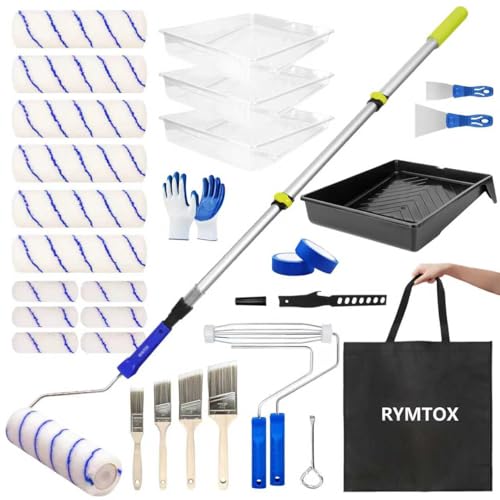
Rollers, brushes, tray, liners, tape, gloves, scraper, stir stick, can opener and a 2 to 4 ft pole in a carry bag.
Check price on Amazon$32.99 as of Oct 21, 2026 2:46 am GMT+0000 — prices change; see Amazon for current price.Why we like it
- Most pieces of any kit on the shelf
- Includes tape and gloves
- Carry bag keeps supplies together
- Pole for ceilings and high walls
| Specification | Details |
|---|---|
| Rollers | 9 in and 4 in microfiber covers; nap not stated |
| Extension pole | Adjustable 2 to 4 ft |
| Extras | Tape, gloves, scraper, stir stick, can opener, liners |
| Storage | Carry bag included |
| Piece count | 33 pieces; individual quantities not listed |
RYMTOX RY01 — 33 pieces, 9 in + 4 in microfiber rollers, 2–4 ft pole, tape, gloves, scraper, carry bag
The Only Kit With a Storage Bag
At 33 pieces, RYMTOX has the highest piece count on the shelf, ahead of ROTESONNE’s 28 and Rhibak’s 27. It is also the only kit that includes a carry bag and one of two (with Bates) that include painter’s tape. That makes it a reasonable buy for a new homeowner repainting several rooms after moving in, when you have none of these tools yet.
Piece counts flatter kits, though, because each liner, brush and stir stick counts as one. The listing does not break down how many covers of each size are included, the cover nap, or the frame material, all of which matter more than the bag.
The pole’s 2 to 4 ft range is similar to the other pole kits.
Pros
- Tape, gloves and scraper included
- Carry bag for storage between rooms
- Pole included
Cons
- Cover counts and nap not stated
- Frame material not stated
- Piece count inflated by small items
Check RYMTOX 33-Piece Kit price on Amazon
4. Bates Paint Roller Kit (19 Pieces) — Best Kit With Prep Tools

Kit with 9 in and 4 in rollers, a 6 x 9 ft drop cloth, three scrapers, a sanding block, tape and four brushes.
Check price on Amazon$17.25 as of Oct 21, 2026 2:46 am GMT+0000 — prices change; see Amazon for current price.Why we like it
- Only kit with a drop cloth and sanding block
- Three scrapers for surface prep
- Four brushes including two angled
- Tape and can opener included
| Specification | Details |
|---|---|
| Rollers | 9 in and 4 in frames with matching microfiber covers |
| Prep tools | Three scrapers, sanding block, 6 x 9 ft plastic drop cloth |
| Brushes | 2 in foam, 1 in, 1.5 in angle, 2 in angle |
| Extras | Plastic tray, paint mixer, can opener, painter’s tape |
| Nap / pole | Nap not stated; no extension pole |
Bates le23 — 19 pieces, 9 in + 4 in rollers, drop cloth, 3 scrapers, sanding block, tape, 4 brushes
The Only Kit Built Around Prep as Well as Painting
Bates is the only kit on the shelf that includes a drop cloth and a sanding block, and the only one with three scrapers. Prep is where most of the time on a repaint goes: scraping loose paint, sanding glossy spots, patching and cleaning. A kit that covers it saves a hardware-store trip.
Those same tools are exactly the ones that create lead dust in an older home. In a house built before 1978, test before scraping or sanding, and follow the lead-safe steps in the buying guide below. A 6 x 9 ft plastic drop cloth is a start but is small for the floor coverage EPA’s lead-safe guidance describes.
The listing does not state nap length or whether the frame accepts a pole.
Pros
- Prep and cleanup tools included
- Four brush styles
- Wall and trim rollers
Cons
- No pole
- Nap not stated
- Small drop cloth for a full room
Check Bates 19-Piece Kit price on Amazon
5. Amazon Basics Microfiber Roller Covers (9 in x 3/8 in, 12-Pack) — Best Covers for Smooth Walls

Twelve 9 x 3/8 in shed-resistant microfiber covers for walls, ceilings and siding on smooth to semi-smooth surfaces.
Check price on Amazon$16.84 as of Oct 21, 2026 2:46 am GMT+0000 — prices change; see Amazon for current price.Why we like it
- 3/8 in nap suits smooth walls
- Twelve covers for a whole-house job
- Shed-resistant microfiber
- Pre-soak tip to remove loose fibers
| Specification | Details |
|---|---|
| Size / nap | 9 in long, 3/8 in nap |
| Material | Microfiber, shed resistant |
| Quantity | 12 covers |
| Surfaces | Smooth and semi-smooth; walls, ceilings, siding |
| Paints | All paints and stains, interior and exterior |
| Prep tip | Soak 2 minutes in water, spin out before use |
Amazon Basics DSEG-PR010 — 12 x 9 in x 3/8 in microfiber covers, shed resistant, washable
The Largest 9-Inch Cover Pack on the Shelf
Three listings state a 3/8 inch nap: this 12-pack, a Bates 3-pack and an Amazon Basics 4 inch 24-pack. This is the only one that offers twelve full-size covers, which lets you use a fresh cover for each color or each room instead of washing out latex at midnight.
The listing’s instruction to soak a new cover for 2 minutes and spin it out before use is worth following with any microfiber cover. It removes loose fibers that would otherwise end up in the first wall you roll.
It does not include a frame, and the listing makes no claim about heavier wall textures, which a 1/2 inch nap handles better.
Pros
- Twelve covers per pack
- Nap and surfaces clearly stated
- Washable and reusable
Cons
- Covers only, no frame
- Too short for heavy texture
- No pole or tray
Check Amazon Basics 9 in (12-pack) price on Amazon
6. Pro Grade Paint Roller Covers (9 in x 1/2 in, 5-Pack) — Best Covers for Textured Drywall

Five 9 in x 1/2 in nap no-shed microfiber covers that fit standard 9 in frames, for walls and ceilings inside and out.
Check price on Amazon$11.50 as of Oct 21, 2026 2:46 am GMT+0000 — prices change; see Amazon for current price.Why we like it
- 1/2 in nap for drywall texture
- No-shed, lint-free microfiber
- Fits standard 9 in frames
- Washable for repeated use
| Specification | Details |
|---|---|
| Size / nap | 9 in long, 1/2 in nap |
| Material | Microfiber, shed resistant and lint-free |
| Quantity | 5 covers |
| Surfaces | Rough, smooth and semi-smooth (title); drywall named |
| Fit | Standard 9 in roller frames |
Pro Grade ZW-ZTLA-PYEF — 5 x 9 in x 1/2 in microfiber covers, no-shed, standard frame fit
The Only 9-Inch Replacement Covers With a 1/2-Inch Nap
Three listings on the shelf state a 1/2 inch nap, all from Pro Grade: the 10-piece kit above, a 4 inch mini kit, and this five-pack. It is the only set of full-size replacement covers at that nap, which makes it the natural refill for the kit and the right choice for orange-peel and knockdown walls.
The listing claims the covers work on rough, smooth and semi-smooth surfaces. That is generous; a 1/2 inch nap on a very smooth wall in semi-gloss can leave more stipple than a 3/8 inch cover. On the other hand, it carries more paint per dip, which speeds up flat and eggshell walls.
Five covers are enough for a few rooms if you wash them between colors.
Pros
- Right nap for most textured drywall
- Shed-resistant microfiber
- Refills the Pro Grade kit
Cons
- Covers only
- More stipple on very smooth walls
- Five-pack is smaller than the Basics 12
Check Pro Grade 9 in 1/2 in (5-pack) price on Amazon
7. Mister Rui 4 Inch Mini Paint Roller Kit (12 Pieces) — Best for Cutting In and Touch-Ups

Four-inch kit with 6 mm and 9 mm microfiber sleeves, a snap-in liner with airtight cover, and a 1.5 in angled brush.
Check price on Amazon$9.98 as of Oct 21, 2026 2:46 am GMT+0000 — prices change; see Amazon for current price.Why we like it
- Two nap depths for smooth and textured walls
- Airtight cover keeps paint overnight
- Snap-in liners for color swaps
- Fits behind toilets and above doors
| Specification | Details |
|---|---|
| Roller | 4 in, snap-fit ergonomic handle |
| Sleeves | Four 9 mm nap (textured) and two 6 mm nap (smooth) microfiber |
| Tray | 4 in deep tray, two reusable liners, airtight liner cover |
| Brush | 1.5 in angled |
| Surfaces | Drywall, wood, concrete; walls, ceilings, trim, cabinets |
Mister Rui 12-pc — 4 in roller, 9 mm + 6 mm microfiber sleeves, liners with airtight cover, 1.5 in brush
The Only Listing That Pairs Two Nap Depths in One Kit
Most covers on the shelf come in one nap or none stated. Mister Rui’s 12-piece kit includes both 9 mm (about 3/8 inch) sleeves for textured surfaces and 6 mm (about 1/4 inch) sleeves for smooth ones. It is also the only listing with an airtight liner cover, which keeps paint usable overnight on a multi-day project.
A 4 inch roller does not paint walls efficiently on its own. Its job is the space between a brush and a 9 inch roller: rolling right up to cut-in lines so brush texture does not show, behind radiators and toilets, above doors and on narrow strips of wall between windows. Two foam mini kits on the shelf (Mister Rui and Bates) target cabinets and doors instead.
No extension pole or full-size roller is included.
Pros
- Two nap depths stated
- Airtight overnight storage
- Compact for tight spots
Cons
- Too small for whole walls
- Small tray capacity
- No 9 in roller
Check Mister Rui 4 in Mini Kit price on Amazon
Matching nap length to your walls
Nap, the length of the fibers on a roller cover, controls how much paint the roller carries and how far it reaches into texture. Only 7 of the 14 listings state a nap at all, so it is often up to you to check.
- 1/4 inch (about 6 mm): very smooth surfaces such as doors, cabinets, plaster and new smooth drywall, especially in satin or semi-gloss.
- 3/8 inch (about 9 mm): smooth to lightly textured drywall; the common default for interior walls and ceilings.
- 1/2 inch: orange-peel and knockdown textures that are common in Colorado tract homes, plus flat ceilings.
- 3/4 inch and up: stucco, brick, block and rough exterior surfaces. None of the covers on this shelf go that long.
- Foam: very smooth finishes on doors, cabinets and furniture; not a good choice for walls, where foam can leave bubbles.
Sheen interacts with nap. A higher sheen shows roller stipple and lap marks more, so pair semi-gloss with a shorter nap. Our guide to paint sheen explains which finish suits each room.
Frames, poles and trays
Frames
A 9 inch frame is the standard wall roller. Look for a sturdy steel cage that holds the cover without slipping and a threaded handle end for a pole. Two of the kits here say their frames are steel; the rest do not state the material.
Extension poles
An extension pole is the most underrated tool in a paint kit. It lets you roll a full-height wall in one pass with even pressure and keeps you off a ladder for ceilings. The three poles on this shelf top out between about 45 and 48 inches, which handles 8 to 9 foot ceilings. Vaulted living rooms in many newer Front Range homes need a longer pole, often sold separately.
Trays and liners
Liners make color changes and cleanup faster. A 5-gallon bucket with a roller grid is another option on big jobs, since it holds more paint than any tray.
How to roll a wall
- Prep first. Clean grease and dust, fill holes, sand glossy patches, and mask trim; our best painters tape roundup compares tapes by clean-removal window. If walls show mold spots, address the moisture first; our guide on whether you can paint over black mold explains why painting alone does not fix it.
- Cut in. Brush a 2 to 3 inch band along ceilings, corners and trim, then roll close to it while it is still wet.
- Load evenly. Roll the cover in the tray well, then on the ribbed slope until it is full but not dripping.
- Work in sections. Roll a W or M pattern about 3 feet wide, then fill it in without lifting the roller, and finish with light top-to-bottom strokes.
- Keep a wet edge. Overlap into wet paint to avoid lap marks. Colorado’s dry air shortens drying time, so work in smaller sections, close windows on breezy afternoons and avoid painting in direct sun on exterior walls.
- Clean and store. Wash latex out of covers with warm water, spin them dry, and store standing on end so the nap does not flatten.
For very large or high exterior areas, a sprayer can be faster; our best paint sprayer roundup covers when spraying makes sense.
Lead safety and ventilation
Rolling fresh paint over intact paint creates little dust. The hazard comes during prep in older homes. The EPA notes that federal law banned lead-based paint for homes in 1978 and that about three-quarters of US homes built before then still contain some lead-based paint; friction surfaces such as doors and window sills are where it most often turns into dust and chips. If your home was built before 1978, the EPA’s lead-safe guidance for do-it-yourselfers says to determine whether lead paint is present first, ideally with a certified inspector or risk assessor, and to assume it is if you cannot confirm the build year.
When lead may be present, EPA’s DIY steps include removing furniture and rugs, covering floors with plastic sheeting, sealing doors, turning off forced-air heating and cooling, misting before scraping or sanding, using wet-dry sandpaper, and cleaning with a HEPA vacuum. Our guides on homes built before 1978 and sanding lead paint go further. Anyone paid to disturb paint in pre-1978 housing must be lead-safe certified under the EPA’s RRP Rule.
Ventilation is the second safety step. The EPA notes that paints contain organic solvents that release VOCs, and that indoor levels can spike during and after painting. EPA guidance is to bring in as much outdoor air as possible while painting, by opening windows and running exhaust fans, and to follow label precautions.
When to hire a painter or call an inspector
DIY rolling makes sense for most interior walls. Hire a painter for tall stairwells, vaulted ceilings, exterior siding on a two-story house and any pre-1978 job with heavy scraping. Call an inspector when peeling paint keeps returning in the same spot, when walls show water stains, or when you are buying an older home and want to know about lead before planning a repaint.
Front Range buyers and homeowners can reach out through our contact page to connect with a vetted local inspector.
Frequently asked questions
What is the best paint roller for walls?
For most interior walls, a 9 inch roller with a 3/8 or 1/2 inch microfiber cover works best. Use 3/8 inch on smooth or lightly textured drywall and 1/2 inch on orange-peel or knockdown textures. Add an extension pole so you can roll full-height walls and ceilings without a ladder.
What nap roller should I use for walls?
A 3/8 inch nap is the common default for smooth to lightly textured interior walls. Choose 1/2 inch for heavier drywall texture and flat ceilings, and 1/4 inch or foam for very smooth surfaces like doors and cabinets. Higher-sheen paints show texture more, so lean shorter with semi-gloss.
Are microfiber or foam rollers better for walls?
Microfiber is usually better for walls because it holds more paint and releases it evenly into texture. Foam rollers suit very smooth surfaces such as cabinets, doors and furniture, where they leave a fine finish, but they can leave bubbles on walls.
How do you avoid roller marks on walls?
Load the roller evenly, roll in overlapping sections about 3 feet wide, and always roll back into wet paint to keep a wet edge. Finish each section with light, top-to-bottom strokes. In dry Colorado air, paint dries faster, so work in smaller sections and avoid drafts or direct sun.
Do I need to worry about lead paint when repainting walls?
If your home was built before 1978, test before scraping, sanding or removing painted trim. The EPA recommends a certified inspector or risk assessor and lead-safe work practices such as plastic sheeting, misting before sanding and HEPA cleanup. Rolling new paint over intact paint without sanding creates little dust.
References
- Lead-Safe Renovations for DIYers — U.S. Environmental Protection Agency
- Lead Renovation, Repair and Painting Program — U.S. Environmental Protection Agency
- Volatile Organic Compounds’ Impact on Indoor Air Quality — U.S. Environmental Protection Agency
- Improving Indoor Air Quality — U.S. Environmental Protection Agency