Asbestos Paint: What Homeowners Need to Know
Painted surfaces in older houses can carry more than lead. For several decades, manufacturers added asbestos fibers to certain coatings to improve fire resistance, texture, and durability. The phrase asbestos paint covers a range of products, from textured wall and ceiling finishes to industrial fireproofing and roofing coatings. If you live in a home built before the early 1980s, knowing where these coatings turn up — and how to handle them without releasing fibers — matters for your family’s long-term health. This guide summarizes EPA and CDC guidance current as of 2026; it is educational only, not a diagnosis, and you should consult a certified asbestos professional before disturbing any suspect coating.
Part of our Asbestos in the Home guide — start there for the full picture →
Is this mold, asbestos, or water damage? Get a free instant screen
Upload a clear photo of the suspect area. You'll get an instant AI screening opinion and what to do next. This is screening guidance, not a professional determination.
Screening guidance only. AI can be wrong. Confirm asbestos, mold type, or lead with lab testing or a licensed professional before acting.
What Is Asbestos Paint and Where Was It Used?
Asbestos paint is a broad, informal label for coatings and surface treatments that contained chrysotile or amphibole asbestos fibers as a filler or reinforcing agent. The fibers were valued because they resisted heat, added body to thick textured finishes, and helped coatings cling to surfaces without cracking. The result was a product that performed well for builders but created a lasting hazard for the people living with it decades later.
Several product categories fall under this umbrella. Textured ceiling and wall coatings — the bumpy “popcorn” or stippled finishes common from the 1950s through the late 1970s — sometimes contained asbestos in the texturing compound. Roof and foundation coatings, often a thick black bituminous paint, used asbestos to bridge small gaps and resist weathering. Fire-retardant paints applied to steel beams and boiler rooms relied on asbestos for their heat performance. Even some decorative and joint-sealing compounds carried trace fibers.
The U.S. Environmental Protection Agency banned spray-applied asbestos surfacing materials in 1973, which removed many of the worst products from the market. Other asbestos-containing coatings lingered on store shelves and in contractor inventories for years afterward. Because of that long tail, a home built in 1980 can still contain asbestos coatings even though the most dangerous spray products were already restricted. The pre-1978 housing stock across the Front Range — older neighborhoods in Denver, Englewood, and parts of Boulder County — is where these materials most often surface.
Is Asbestos Paint Dangerous?
The danger from any asbestos product depends almost entirely on whether the fibers can become airborne. Asbestos causes harm only when microscopic fibers are inhaled, where they can lodge in lung tissue and, over decades, contribute to asbestosis, lung cancer, and mesothelioma. Paint that is intact, sealed, and undisturbed binds its fibers inside a hardened film. In that state, the coating is generally considered low-risk and is often best left alone.
Problems begin when the coating is damaged or disturbed. Sanding, scraping, sandblasting, power-washing, or grinding a painted surface can shatter the film and send fibers into the air. Peeling, flaking, and chalking from age and weather also release fibers gradually. A coating in good condition is far safer than the same product cracking and crumbling on a basement wall. The CDC and EPA both emphasize that condition and the likelihood of disturbance — not the mere presence of asbestos — should drive your decisions.
There is no safe minimum exposure that has been firmly established for asbestos. Health agencies treat it as a substance where lower exposure is always better, and where occupational exposure over years carries the highest documented risk. Homeowners who do a single careful removal job face a different risk profile than a tradesperson sanding coatings daily, but caution is warranted in both cases. The latency period between exposure and disease can stretch twenty to forty years, which is why prevention now protects you long into the future.
Best Asbestos Test Kit: our top 3 picks
| Product | Best for | Key features | Price | Buy |
|---|---|---|---|---|
| Seeml Labs Asbestos Inspector in a Box | Verifiable lab accreditation |
| $22.00as of Nov 5, 2026 2:42 pm GMT+0000 | Buy now →Check current price |
| SLGi 1-Pack (5 Day) | Single sample with return postage |
| $35.00as of Nov 5, 2026 1:36 pm GMT+0000 | Buy now →Check current price |
| Asbestos-Sampling.com 2-Sample | Type and percentage in the result |
| $59.95as of Nov 5, 2026 1:36 pm GMT+0000 | Buy now →Check current price |


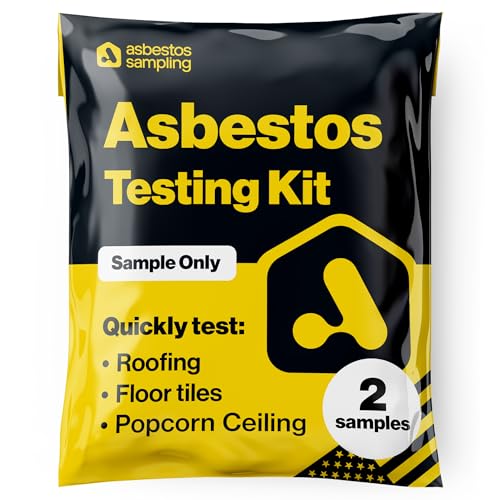
Prices are Amazon’s listed prices as of the time shown and change often; check Amazon for today’s price. As an Amazon Associate we earn from qualifying purchases.
How to Tell If Paint Contains Asbestos
You cannot identify asbestos in a coating by looking at it. The fibers are microscopic, and asbestos-containing paint looks identical to ordinary paint of the same era. Color, sheen, and texture tell you nothing reliable. Anyone who claims to spot asbestos by eye is guessing.
The only dependable method is laboratory analysis. A certified inspector collects a small sample of the coating, often including the substrate beneath it, and sends it to an accredited lab that uses polarized light microscopy or transmission electron microscopy to identify and quantify fibers. The federal threshold that defines an asbestos-containing material is more than one percent asbestos by weight, though many professionals treat any detectable amount as a reason for caution.
Age and product type are useful clues for deciding whether to test. A textured ceiling in a 1965 ranch home, a black foundation coating on a mid-century basement, or fireproofing in an old boiler room all warrant testing before any work. If you are weighing the broader question of identification across building materials, our overview of how to identify asbestos in a home walks through the visual cues and the limits of guessing. When the coating is on something you plan to renovate, testing first is almost always cheaper than abating contamination afterward.
Sampling Safely
If a professional is not collecting the sample, follow EPA guidance to limit fiber release: lightly mist the area with water, wear a properly fitted respirator rated for asbestos, take a small piece with a clean tool, and seal it in a labeled zip bag inside a second bag. Avoid creating dust. Many homeowners skip the do-it-yourself sampling entirely and hire an inspector, which also produces documentation that buyers and contractors trust.
What to Do If You Have Asbestos Paint
The right response depends on the coating’s condition and your plans for the surface. Three general paths exist: leave it in place, encapsulate it, or remove it.
Leave it alone. Intact, well-bonded coatings in areas that will not be disturbed are frequently the safest and least expensive option. EPA guidance often favors managing asbestos in place rather than removing it, because removal is the activity most likely to release fibers. Monitor the surface periodically for new cracking or flaking.
Encapsulate. Encapsulation seals the existing coating under a bonding product or a new layer designed to lock fibers in place. This is common for textured ceilings and foundation coatings that are still sound but might be bumped or weathered over time. Encapsulation costs less than full removal and avoids the dust generated by stripping.
Remove. When a coating is badly deteriorated, or when a renovation will inevitably disturb it, professional abatement is the answer. Licensed abatement contractors set up containment, use negative-air filtration, wet the material, and dispose of waste at approved facilities. They also document the work, which protects you when you sell. Choosing the right firm matters; our guide to vetting asbestos abatement companies covers licensing, insurance, and the questions to ask before signing.
What you should never do is dry-sand, grind, sandblast, or power-wash a suspect coating. Those methods produce the highest fiber counts and are the most common way homeowners contaminate an entire house. If a coating is failing and you are unsure of the next step, stop work and call a professional before disturbing it further.
Front Range Rules and Disposal
Colorado regulates asbestos work through the Colorado Department of Public Health and Environment. Projects above certain size thresholds require permits, certified workers, and proper disposal, even in residential settings. Local landfills will not accept asbestos waste mixed with regular trash; it must go to a facility licensed to receive it. Verifying these requirements before work begins keeps you on the right side of state rules and prevents fines.
The state’s thresholds matter because they determine whether a job is a permitted abatement project or a smaller homeowner task. Single-family residential work that a homeowner performs on their own dwelling sometimes falls outside the certification requirement, but the disposal rules still apply, and the moment a contractor is hired or the quantity crosses the trigger, certification and notification requirements engage. Many homeowners are surprised to learn that the same coating they might legally scrape themselves becomes a regulated activity the instant they pay someone to do it. When in doubt, a quick call to the state program clarifies which category a specific job falls into before any tools come out.
Documentation is the other reason to follow the rules even on small jobs. Keeping the lab report that identified the material, the disposal receipt from the licensed facility, and any contractor paperwork creates a paper trail that protects you when you eventually sell the home. Buyers and their inspectors increasingly ask about past asbestos work, and a clean record of professional handling and proper disposal removes a point of friction at closing. Skipping the paperwork to save a little time can resurface as a negotiating problem years later.
How Asbestos Paint Compares to Other Painted Hazards
Older coatings often carry more than one hazard at once. Lead-based paint, banned for residential use in 1978, frequently coexists with asbestos in homes of the same vintage. A flaking wall in a 1960s home could contain both. Because the abatement methods differ, testing for both substances before a renovation gives you the full picture. Lead is typically confirmed with XRF analysis or lab paint-chip testing, while asbestos requires microscopy.
Texture and roofing coatings deserve particular attention because they are easy to overlook. A homeowner replacing a roof or scraping a ceiling for an update may never think to test the coating first. Treating any pre-1980 textured or industrial coating as suspect until proven otherwise is the conservative, protective approach. For the wider context on how these materials fit into older-home risk, the asbestos and lead hazard guide for pre-1978 housing ties the testing, handling, and disposal steps together.
Cost is another point of comparison. Encapsulation of a textured ceiling might run a few hundred to a couple thousand dollars depending on area, while full removal of multiple surfaces can climb into the thousands. Testing a handful of samples is comparatively inexpensive and almost always the right first investment, because it tells you which of those far more expensive paths you actually need.
Health Effects and Who Is Most at Risk
The diseases linked to asbestos share a common mechanism and a long delay. When inhaled fibers lodge in the lungs and the lining around them, they cause chronic inflammation and scarring that the body cannot clear. Over decades, that damage can develop into asbestosis, a stiffening of lung tissue that impairs breathing; into lung cancer; or into mesothelioma, a rare and aggressive cancer of the lung or abdominal lining that is strongly associated with asbestos exposure. The CDC notes that the risk rises with the amount and duration of exposure, and that smoking dramatically multiplies the lung-cancer risk for someone also exposed to asbestos.
The people most at risk historically were workers in trades with heavy daily exposure: insulators, shipyard workers, boiler operators, and demolition crews. For homeowners, the realistic exposure scenario is more limited but not negligible. A single aggressive sanding job on an asbestos-containing coating can release a burst of fibers into a home that lingers in dust for a long time, and family members can be exposed secondhand from contaminated clothing. This is why health agencies emphasize avoiding the activities that generate dust rather than fixating on the mere presence of an intact coating.
Children warrant particular care. They breathe faster relative to body size, spend more time close to floors where settled dust accumulates, and have more years ahead in which a long-latency disease could develop. A renovation that disturbs an asbestos coating in a home with young children deserves extra caution, including keeping the family out of the area entirely while professional work is underway.
What to Do If You Already Disturbed Asbestos Paint
Many people only learn about asbestos coatings after they have already scraped or sanded one. If that describes your situation, the immediate priority is to stop the activity and avoid spreading the dust further. Do not sweep or vacuum with an ordinary household vacuum, because both actions launch settled fibers back into the air; a standard vacuum’s filter does not capture them and simply blows them around the room.
Limiting further spread is the next step. Close off the area, turn off forced-air heating or cooling that could distribute dust through the home, and avoid tracking debris into other rooms. Damp wiping of hard surfaces with disposable cloths, followed by sealing those cloths in double bags, captures some settled material without raising it into the air. For anything beyond a very small, contained mess, a professional cleanup using HEPA-filtered equipment is the safe choice, and it is what abatement contractors are equipped to perform.
On the health side, a single accidental exposure is generally a low-probability event for serious disease, given that risk scales with repeated, heavy exposure over years. That said, anyone concerned about an exposure should speak with a physician, who can note it in the medical record and advise on any monitoring. The educational guidance here is not a substitute for that conversation, and no article can diagnose the consequences of a specific exposure.
References
- Protect Your Family from Exposures to Asbestos — U.S. Environmental Protection Agency
- Asbestos Health Information — Centers for Disease Control and Prevention
- Asbestos Regulations and Permits — Colorado Department of Public Health and Environment
- Asbestos and Indoor Air Quality — American Lung Association
Frequently asked questions
Can you tell if paint has asbestos just by looking?
No. Asbestos fibers are microscopic and asbestos-containing paint looks identical to ordinary paint of the same era. The only reliable way to confirm it is laboratory analysis of a sample using polarized light or electron microscopy.
Is it safe to paint over asbestos paint?
Painting over an intact asbestos coating can serve as a form of encapsulation, sealing fibers under a new film. It is generally safer than sanding or scraping. Avoid any prep work that abrades the old coating, and consider a product designed for encapsulation.
What years was asbestos used in paint?
Asbestos appeared in coatings from roughly the 1920s through the early 1980s. The EPA banned spray-applied asbestos surfacing in 1973, but other asbestos coatings remained available for years, so even some early-1980s homes can contain them.
Should I remove asbestos paint myself?
Health agencies generally advise against do-it-yourself removal. Sanding, scraping, or power-washing releases fibers. Intact coatings are often best left in place or encapsulated, and deteriorated coatings should be handled by licensed abatement professionals.
Front Range homeowners who suspect an older coating contains asbestos can connect with a vetted local inspector for testing guidance before any renovation by getting in touch through our contact page.