Best HEPA Air Purifiers (2026): True HEPA vs HEPA-Type

The best HEPA air purifier is one whose listing proves the HEPA claim instead of just using the word. “HEPA” appears in the title of nearly every purifier sold online, yet the numbers behind it vary from a clear 99.97% at 0.3 microns to “high efficiency” with no figure at all, or a percentage that only applies in Sleep Mode. This guide sorts the shelf by how well each listing backs up its filter claim, then by sizing, noise and ozone safety. Six picks follow, from an AHAM-verified living-room unit to compact bedroom models, with a buying guide on reading HEPA language, CADR and filter costs.
Part of our Heating, Cooling & Ventilation guide — start there for the full picture →
As an Amazon Associate we earn from qualifying purchases.
How we compared: we compared 13 current Amazon listings for HEPA room air purifiers on exactly what each listing states about its filter (term used, efficiency percentage, particle size, H13 grade), along with CADR or AHAM room size, coverage, noise, ozone disclosures and warranty. We did not lab-test any unit or use them hands-on; filter claims are the manufacturers’ own. Prices and availability change often, so check the current listing before buying.
Dealing with mold or water damage? Talk to a remediation pro now.
📞 Call (833) 723-1134Quick picks: the best HEPA air purifiers by use
| Product | Best for | Key features | Price | Buy |
|---|---|---|---|---|
| Winix 5520 | Best overall True HEPA purifier |
| $179.99as of October 18, 2026 | Buy now →Check current price |
| Purivortex PX500 | Best for bedrooms |
| $26.99as of October 18, 2026 | Buy now →Check current price |
| ECOSELF HAP604 | Best textbook HEPA rating |
| $59.99as of October 18, 2026 | Buy now →Check current price |
| MOOKA KJ190H | Best for living rooms in smoke season |
| $79.97as of October 18, 2026 | Buy now →Check current price |
| FULMINARE H13 | Best compact unit with night light |
| $22.49as of October 18, 2026 | Buy now →Check current price |
| AIRTOK AP0601 2-pack | Best two-room starter set |
| $69.99as of October 18, 2026 | Buy now →Check current price |
Prices are Amazon’s listed prices as of the time shown and change often; check Amazon for today’s price. As an Amazon Associate we earn from qualifying purchases.
The six picks, compared listing by listing
1. Winix 5520 — Best Overall True HEPA Purifier
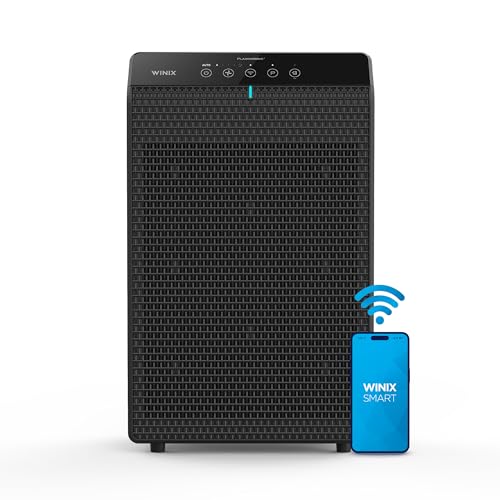
True HEPA and carbon purifier, AHAM Verified at 392 sq ft, with air quality monitor, Auto mode and Winix app.
Check price on Amazon$179.99 as of October 18, 2026 — prices change; see Amazon for current price.Why we like it
- AHAM Verified room size named: 392 sq ft
- Uses the term True HEPA, not HEPA-type
- Deodorizing carbon filter plus washable mesh pre-filter
- Light sensor switches it to Sleep Mode automatically
- Remote control through the Winix Smart App
| Specification | Details |
|---|---|
| Rated room size | AHAM Verified at 392 sq ft; 470 sq ft in 15 minutes and 1,882 sq ft in one hour per listing |
| Filter claim | True HEPA, 99.99% of allergens down to 0.01 micron (asterisked; footnote not shown) |
| Other stages | High-deodorization carbon filter; washable fine-mesh pre-filter |
| Sensors / modes | Air quality sensor with LED indicator; Auto mode; light-activated Sleep Mode |
| Noise | 23.5 dB on slowest speed |
| Certifications / size | AHAM Verified, UL Certified; about 13.6 x 8.3 x 22.7 in; 13.3 lb |
Winix 5520 — AHAM 392 sq ft, True HEPA + carbon + washable pre-filter, auto + light-sensing sleep, 23.5 dB, app, UL / AHAM
One of Two Listings That Pair True HEPA With an AHAM-Verified Room Size
Six of the 13 listings use the phrase True HEPA. Four listings mention AHAM verification. Only two do both: this Winix 5520 and its near-twin, the Winix 5510. The 5520 gets the nod because its title adds an air quality monitor and its listing is otherwise identical on filtration, so you get the same verified 392-square-foot rating with a clearer readout of when the air is dirty.
AHAM’s room size is derived from CADR, which makes it the most trustworthy coverage number a listing can give. By the EPA’s sizing chart, 392 square feet corresponds to a smoke CADR of roughly 255, a living room or open kitchen-family space with 8-foot ceilings. That is very different from the 1,882-square-foot “one hour” figure in the title, which describes a much slower rate of cleaning.
The filter claim needs one footnote. Winix says 99.99% down to 0.01 micron but asterisks it without the qualifier appearing in the listing, so lean on the AHAM rating and the True HEPA term rather than that headline percentage. The listing does not state a warranty term or replacement filter interval.
Pros
- AHAM-verified room size stated
- True HEPA plus carbon and pre-filter
- Automatic dark-room Sleep Mode
- App control
Cons
- Headline efficiency claim has an unexplained asterisk
- Warranty and filter interval not stated
- Large at nearly 23 inches tall
Check Winix 5520 price on Amazon
2. Purivortex PX500 — Best for Bedrooms

Bedroom HEPA purifier rated 99.97% down to 0.1 micron, with a 6-inch filter, carbon layer and ozone-free design.
Check price on Amazon$26.99 as of October 18, 2026 — prices change; see Amazon for current price.Why we like it
- States 99.97% filtration down to 0.1 micron
- Filter is 6 inches tall versus a typical 4 inches
- Ozone free per listing title
- Coverage tested in an ISO 17025 lab per listing
| Specification | Details |
|---|---|
| Stated coverage | About 215 sq ft in 15 minutes; up to 880 sq ft in one hour |
| Filter claim | Pre-filter, HEPA filter and activated carbon; 99.97% of pollutants down to 0.1 micron |
| Filter size | 6-inch-tall cylinder made of FSC-certified paper |
| Controls | Sleep, low, medium and high; 4, 8 or 12-hour timer; four night light modes |
| Certifications named | ETL, FCC, CARB; SGS laboratory testing |
| Size / warranty | About 7.2 x 7.2 x 11.4 in; 3.2 lb; 2-year warranty |
Purivortex PX500 — HEPA + carbon, 99.97% to 0.1 µm, 6-in filter, 215 sq ft in 15 min, ozone free, ETL / CARB, 2-yr warranty
The Most Conservative Coverage Claim Among the Compact Units
Compact purifiers on this shelf routinely claim more than 1,000 square feet: the FULMINARE says 1,086, the VOOPNU 1,076 and the ECOSELF 1,500. The Purivortex claims 880 for one hour and, more usefully, about 215 square feet in 15 minutes, which works out to roughly four air changes per hour in a normal bedroom. That faster figure is the one that matters for sleep, and it is credible for a unit of this size.
The filter claim is also specific. Purivortex states 99.97% of pollutants down to 0.1 micron and describes a filter that is about one and a half times taller than the 4-inch filters common in small cylinders. More media generally means less airflow restriction and a slower decline in performance as the filter loads.
The PX500 is also one of two listings on the shelf to mention ozone at all, calling itself ozone free in its title. The listing does not give a CADR or AHAM rating, and it does not use the phrase True HEPA, which is a fair reason to compare its stated numbers rather than its labels.
Pros
- Specific efficiency and particle-size claim
- Larger filter than typical compact units
- Ozone free, CARB named
Cons
- No CADR or AHAM rating
- Does not use the True HEPA term
- Night light colors are decoration only
Check Purivortex PX500 price on Amazon
3. ECOSELF HAP604 — Best Textbook HEPA Rating

H13 True HEPA purifier stating 99.97% at 0.3 micron, with a brushless motor, 20 dB Sleep Mode and filter indicator.
Check price on Amazon$59.99 as of October 18, 2026 — prices change; see Amazon for current price.Why we like it
- States the standard rating: 99.97% at 0.3 micron
- Names both H13 and True HEPA
- Brushless motor; about 0.35 kWh per day stated
- 20 dB Sleep Mode, child lock and filter indicator
| Specification | Details |
|---|---|
| Filter claim | 3-stage with H13 True HEPA; up to 99.97% of particles as small as 0.3 micron |
| Stated coverage | Up to 1,500 sq ft per hour |
| Motor / energy | Brushless motor; power use as low as 0.35 kWh per day |
| Controls | Four fan speeds, 2 to 8-hour timer, 7-color light that can be switched off, child lock |
| Filter life | Replace every 3 to 6 months per listing |
| Size / warranty | About 7.2 x 7.2 x 13.9 in; 3.6 lb; 1-year-plus warranty |
ECOSELF HAP604 — H13 True HEPA 99.97% @ 0.3 µm, 3-stage, brushless, 0.35 kWh/day, 20 dB sleep, 3–6 month filter
One of Three Listings That State the Classic 0.3-Micron Benchmark
The EPA describes a HEPA filter as able to remove at least 99.97% of particles at 0.3 microns, the size that is hardest for a filter to catch. Only three of the 13 listings tie a 99.97% figure to the 0.3-micron size: the Levoit Core 300-P, the Coway AP-1512HH and this ECOSELF. Of those three, the HAP604 is the only one that also calls itself both H13 and True HEPA, which makes its listing the cleanest match to the textbook definition on this shelf.
It also brings practical details that many compact units skip: an energy figure, a brushless motor, a child lock and a stated filter interval. Those make ownership costs easier to predict.
Two weak spots. The 1,500-square-foot coverage claim has no CADR or AHAM rating behind it, so treat this as a bedroom or office unit regardless of the number. And the listing names “EPA” among its certifications; the EPA states that it does not certify air cleaning devices, so that line should be read as marketing rather than an endorsement.
Pros
- Standard HEPA rating stated plainly
- H13 and True HEPA both named
- Energy use and filter interval given
Cons
- No CADR to support 1,500 sq ft
- Lists an EPA certification that EPA does not issue
- Short 3 to 6 month filter interval
Check ECOSELF HAP604 price on Amazon
4. MOOKA KJ190H — Best for Living Rooms in Smoke Season

Large-room HEPA purifier with PM2.5 display and Auto mode, aimed at wildfire smoke, stating no ozone and no UV light.
Check price on Amazon$79.97 as of October 18, 2026 — prices change; see Amazon for current price.Why we like it
- Auto mode ramps up when it detects smoke
- States no ozone release and no UV light
- Energy figure given: 0.63 kWh per 24 hours at max
- Filter reminder at 2,000 hours of use
| Specification | Details |
|---|---|
| Stated coverage | Up to 2,200 sq ft (rate and CADR not stated) |
| Filter claim | 3-stage: washable pre-filter, HEPA filter, activated carbon pellets; no efficiency percentage stated |
| Sensor / modes | PM2.5 sensor with digital display; Auto mode; four speeds; timer |
| Noise / energy | 20 dB in Sleep Mode; 0.63 kWh per day at maximum speed |
| Certifications named | CARB, ETL, DOE; no ozone, no UV light |
| Size / warranty | About 12.2 x 6.1 x 15.75 in; 6.7 lb; 2-year limited warranty |
MOOKA KJ190H — HEPA + carbon + washable pre-filter, PM2.5 Auto mode, 20 dB sleep, 0.63 kWh/day max, no ozone / UV, 2-yr warranty
One of Two Listings That Address Ozone, and the One Built Around Smoke
Only two of the 13 listings mention ozone: the Purivortex and this MOOKA. The KJ190H goes further by stating it has no UV light, which matters because the EPA notes that UV lamps without adequate coatings, along with ionizers and plasma devices, may have the potential to emit ozone. It is also the listing most clearly written for wildfire smoke, describing an Auto mode that steps up when smoke drifts in.
For a living room on a smoky August evening, the useful combination here is a PM2.5 readout, Auto mode and a washable pre-filter that catches ash and dust before they load the main filter. The listing also states its energy use at maximum speed, a detail few compact and mid-size listings provide.
The HEPA claim is the weak point, and it is why this ranks fourth in a HEPA roundup. The listing says HEPA filter but never gives an efficiency percentage or particle size, and it offers no CADR for its 2,200-square-foot claim. That puts it in the “HEPA-type” category until MOOKA publishes a rating.
Pros
- No ozone and no UV stated
- PM2.5 Auto mode suited to smoke events
- Energy use and filter reminder stated
Cons
- No HEPA efficiency rating stated
- No CADR behind the coverage claim
- Aroma pad is scent, not filtration
Check MOOKA KJ190H price on Amazon
5. FULMINARE H13 (PU-P05) — Best Compact Unit With a Night Light
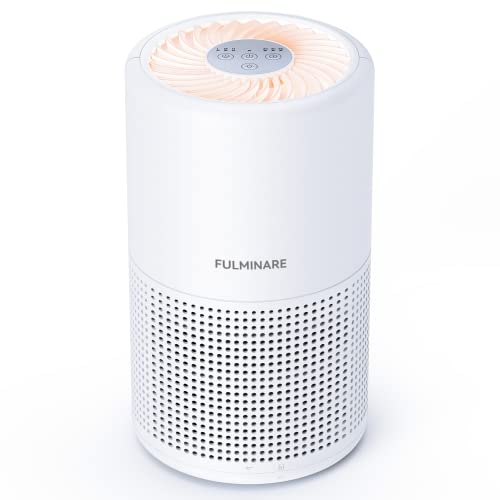
Compact H13 True HEPA purifier with an independent night light, five timer settings and a 20 dB low setting.
Check price on Amazon$22.49 as of October 18, 2026 — prices change; see Amazon for current price.Why we like it
- H13 True HEPA named in the title
- Night light works independently of the fan
- Five timer options from 2 to 12 hours
- Lightest pick at 1.85 lb
| Specification | Details |
|---|---|
| Filter claim | H13 HEPA filter; no efficiency percentage stated in bullets |
| Stated coverage | Up to 1,086 sq ft, described as based on 5 air changes per hour |
| Noise | Around 20 dB on low in Sleep Mode |
| Extras | Independent night light; 2, 4, 8, 10 and 12-hour timers |
| Filter life | Replace about every 3 months |
| Size / power | About 5.7 x 5.7 x 7.9 in; 1.85 lb; plug-in adapter, no battery |
FULMINARE PU-P05 — H13 HEPA, 20 dB low, independent night light, 5 timers, 3-month filter, 1.85 lb plug-in
The Smallest H13 Unit on the Shelf, With a Coverage Claim to Ignore
Three listings on the shelf name the H13 grade: FULMINARE, ECOSELF and AIRTOK. The FULMINARE is the smallest and lightest of the three, at under 2 pounds and under 8 inches tall, and its independent night light and long timer options make it a reasonable nursery or nightstand unit.
Its coverage claim, however, does not hold up to the EPA’s math. Five air changes per hour across 1,086 square feet would require a CADR far beyond what a fan this size can move; the EPA chart calls for about 700 cfm of CADR for a room of that size. Read it as a personal-zone purifier for the space immediately around a bed or crib.
The listing uses H13 and True HEPA in its title but does not state an efficiency percentage or particle size in its feature bullets. A filter change about every three months is the shortest stated interval among these picks, which adds up over a year.
Pros
- Tiny, light and quiet
- Useful independent night light
- H13 grade named
Cons
- Coverage claim is not credible for its size
- No efficiency figure in bullets
- Filters every 3 months
Check FULMINARE H13 price on Amazon
6. AIRTOK AP0601 2-Pack — Best Two-Room Starter Set

Two compact purifiers with carbon and high-efficiency filters, sized for about 100 sq ft each, CARB and ETL listed.
Check price on Amazon$69.99 as of October 18, 2026 — prices change; see Amazon for current price.Why we like it
- Two units for two small rooms
- Honest sizing: about 100 sq ft each
- Lifetime warranty with genuine replacement filters
- CARB Certified and ETL Listed
| Specification | Details |
|---|---|
| Recommended room | Spaces around 100 sq ft, such as home offices or bedrooms |
| Filter claim | Title: H13 True HEPA, 99.9% to 0.1 micron; bullet: 99% of 0.1-micron particles or larger on sleep mode |
| Other stages | Pre-filter layer and activated carbon in a 4-in-1 filter |
| Power / noise | 10W brushless DC motor; under 50 dB on high, near 25 dB on low |
| Filter life | About 3 to 4 months (replacement B09QWXXHVM) |
| Size / warranty | About 6.3 x 6.3 x 10.2 in each; lifetime warranty with genuine filters |
AIRTOK AP0601 — 2 units, 4-in-1 filter with carbon, about 100 sq ft each, 10W, 25–50 dB, CARB / ETL, lifetime warranty
The Clearest Example of a Title and Listing That Disagree
The AIRTOK earns a place for its honest sizing and its warranty. It is the only listing on the shelf to recommend a room as small as about 100 square feet, and its lifetime warranty, conditional on using genuine filters, is the longest stated here. As a pair, the units can cover a child’s bedroom and a home office without carrying one purifier back and forth.
It is also a useful lesson in reading HEPA claims. The title says H13 True HEPA and 99.9% to 0.1 micron. The feature bullet describes “a combination of an activated carbon and high efficiency filter” capturing 99% of 0.1-micron particles or larger on sleep mode. Those are different promises, and neither is the standard 99.97% at 0.3 micron. The listing’s own detail is the one to trust.
The listing does not give a CADR, and at 10 watts each the units are personal-space cleaners. Budget for replacement filters every three to four months for two units.
Pros
- Realistic 100 sq ft sizing
- Two units in one purchase
- Lifetime warranty with genuine filters
Cons
- Title and bullet filter claims disagree
- No CADR stated
- Two filters to replace every 3 to 4 months
Check AIRTOK AP0601 2-pack price on Amazon
True HEPA vs HEPA-type: how to read the claim
HEPA stands for high efficiency particulate air. The EPA describes it as a pleated mechanical filter, as defined by the U.S. Department of Energy, that can theoretically remove at least 99.97% of dust, pollen, mold, bacteria and other particles at 0.3 microns. That size is the most penetrating particle size; particles larger or smaller are caught with even higher efficiency. So a claim of “99.97% at 0.1 micron” is not a stronger filter than one rated at 0.3; it is a measurement at an easier size.
On this shelf, the language falls into four groups:
- Standard rating stated: 99.97% tied to 0.3 micron. Three of 13 listings do this.
- True HEPA or H13 named: six listings use True HEPA and three name H13, but not all of them give a percentage.
- Conditional claims: the Levoit Core 300-P describes its filter as “HEPA-grade” while operating in Sleep Mode, based on an industry test method, rather than at every speed.
- Vague or partial rating: “HEPA filter” with no percentage, as on the MOOKA listing, or a percentage with no particle size, as on the VOOPNU “high efficiency filter” listing.
The H13 label comes from a European filter classification that is commonly used in listings. It is a helpful signal, but the stated efficiency and particle size, ideally confirmed by an AHAM or CADR rating, tell you more. For more background on terminology and filter types, see our guides to the HEPA air purifier and the HEPA filter itself.
Filter quality is only half the story: CADR and sizing
A perfect filter in a weak fan cleans very little air. That is why the EPA tells buyers to choose a portable air cleaner whose CADR is large enough for the room, and to use the smoke CADR for the smallest particles. The agency’s chart works out to about 65 cfm of CADR per 100 square feet with 8-foot ceilings: 130 cfm for 200 square feet, 260 for 400, 390 for 600.
Only 2 of the 13 listings publish CADR numbers, both Levoit, and two more, the Winix models, state an AHAM-verified room size. The rest give coverage figures with no method behind them. When a compact unit claims more than 1,000 square feet, assume the number reflects one air change per hour or less, which is far slower than the EPA chart assumes. Rooms with vaulted ceilings, common in Front Range ranch and split-level remodels, need even more CADR than the chart suggests.
Washable pre-filters matter more than they seem in dry, dusty climates. They catch hair and coarse dust that would otherwise clog the HEPA layer and cut airflow. Rinse them on schedule and let them dry completely before reinstalling.
Ozone, ionizers and certifications
A HEPA filter does not produce ozone, but some purifiers add stages that can. The EPA advises avoiding air cleaners that intentionally produce ozone and notes that ionizers, some electrostatic precipitators, plasma devices and UV lamps without adequate coatings may have the potential to emit it. Only two listings on this shelf, MOOKA and Purivortex, say anything about ozone. For any unit with extra technologies, look for the California Air Resources Board certification and a plain statement about ozone.
Be careful with certification lists. The EPA says it does not certify air cleaning devices and does not recommend particular brands, so an “EPA certified” line in a listing means little. AHAM verification relates to performance; CARB certification relates to ozone emissions; ETL and UL relate to electrical safety; ENERGY STAR, the EPA notes, covers energy efficiency only, not cleaning effectiveness.
Running costs and placement
Every listing here recommends the brand’s own replacement filters. Stated intervals range from about 3 months to 6 months for most compact units; some larger units do not state an interval. Over a year, filter costs can exceed what you paid for a small purifier, so compare filter prices before buying.
Place the unit in the room where you spend the most time, often the bedroom, and keep it clear of curtains and furniture, as the EPA advises. Run it continuously on a low or Auto setting rather than in short bursts, since the EPA notes longer run times increase the amount of air filtered.
When a HEPA purifier is not enough
HEPA filtration reduces airborne particles; it does not remove the source. Recurring musty odors usually mean moisture and mold growth, which the EPA says air cleaners cannot resolve. Our guide to a mold air purifier explains the limits, and HEPA filtration is only one part of the cleanup process described in our HEPA vacuuming for mold remediation guide.
Purifiers also cannot stand in for radon mitigation; our article on whether air purifiers help with radon explains why. If whole-house dust, odors or uneven airflow are the issue, a heating and cooling contractor can check filter fit and ductwork; see our guide to hiring heating and cooling pros. For a broader look at indoor air, moisture and ventilation during a home purchase, contact us to connect with a local inspector.
References
- What is a HEPA filter? — U.S. Environmental Protection Agency
- Guide to Air Cleaners in the Home — U.S. Environmental Protection Agency
- What is a MERV rating? — U.S. Environmental Protection Agency
- Ozone Generators that are Sold as Air Cleaners — U.S. Environmental Protection Agency
Frequently asked questions
What is the difference between True HEPA and HEPA-type?
True HEPA refers to a filter that meets the HEPA definition the EPA describes: at least 99.97% capture of particles at 0.3 microns. HEPA-type, HEPA-like or high efficiency filters make no such guarantee. Look for the percentage and particle size in the listing, not just the term.
Is H13 better than True HEPA?
H13 is a filter class from a European classification that many listings use. It is a useful signal, but what matters most is the stated efficiency, the particle size it applies to and whether the purifier has a CADR or AHAM rating large enough for the room.
Does a HEPA air purifier remove smoke?
A HEPA filter captures smoke particles, and the smoke CADR tells you how quickly a unit removes them. Smoke odors and gases need an activated carbon stage, and the EPA notes carbon works best when there is a substantial amount of it.
How often should HEPA filters be replaced?
Follow the manufacturer's interval. On this shelf, stated intervals for compact units range from about 3 to 6 months. A filter that looks heavily loaded or a unit whose airflow has dropped noticeably is due for a change regardless of the calendar.
Are HEPA air purifiers safe to run all day?
Mechanical HEPA filtration does not produce ozone, and running continuously increases the amount of air filtered. Avoid units with ozone-generating features and look for CARB certification on any purifier that adds ionizers, plasma or UV lights.
Want a straight answer on whether your indoor air problem is a filter issue or a moisture, ventilation or radon issue? Get in touch here to connect with a vetted Front Range inspector.