Best Air Purifier for Basement (2026): 6 Picks Compared
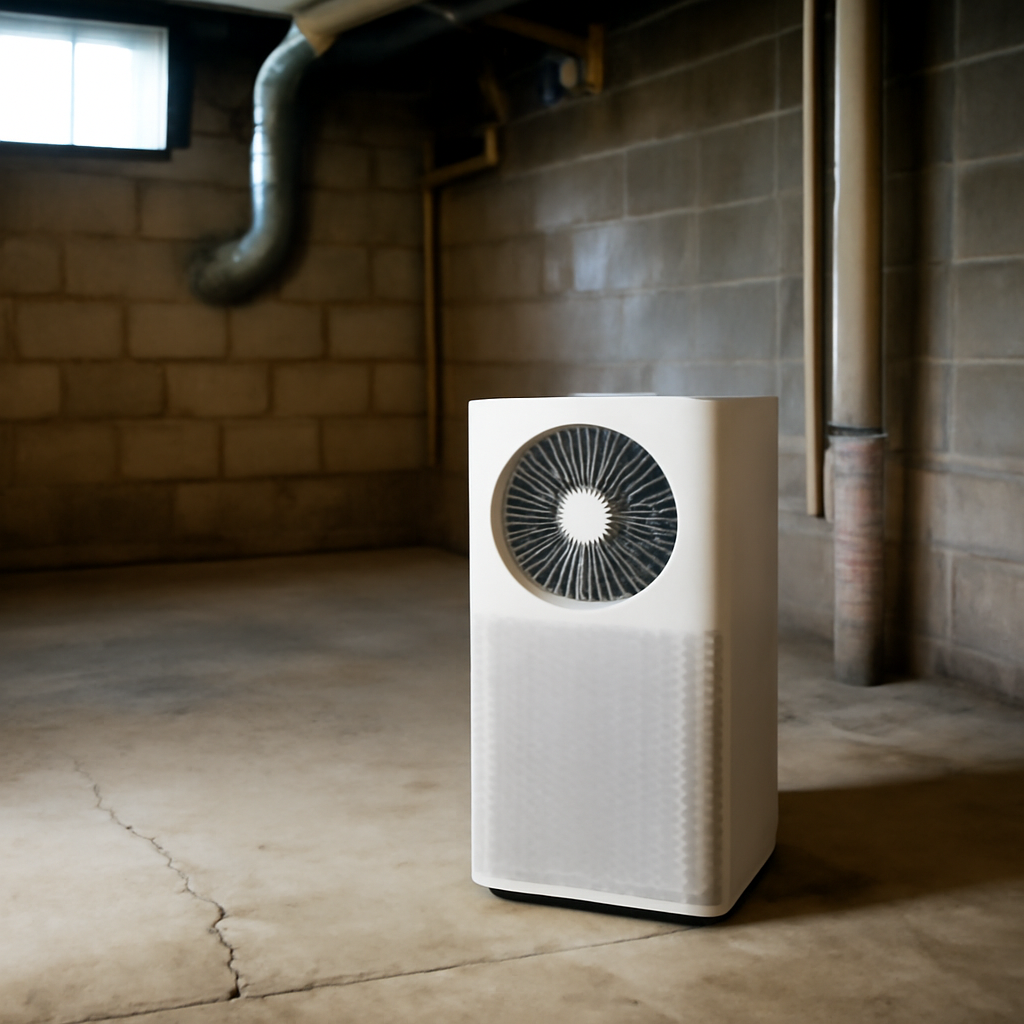
The best air purifier for basement air is the second thing to buy, not the first. Basements smell musty and feel stuffy mostly because of moisture: damp concrete, high humidity and the mold and dust mites that follow. A purifier can catch spores, dust and some odor, but it cannot dry the room, and it does nothing for radon, the invisible soil gas that collects in basements more than anywhere else in the house. This guide ranks six purifiers that suit below-grade rooms and explains where a dehumidifier, a radon test or a moisture fix has to come first. For the broader category, see our best air purifier guide.
Part of our Heating, Cooling & Ventilation guide — start there for the full picture →
As an Amazon Associate we earn from qualifying purchases.
How we compared: we compared 13 current Amazon listings for room air purifiers on what each listing states: CADR and AHAM verification, whether an activated carbon stage is named for musty odors, air-quality sensing, ozone statements, coverage claims and footprint. We did not lab-test these units or handle them. Three of the 13 listings name basements as a use, and none mentions mold, humidity control or radon. Prices and availability change, so check the current listing before buying.
Quick picks: the best air purifiers for basements by room type
| Product | Best for | Key features | Price | Buy |
|---|---|---|---|---|
| Levoit Vital 200S-P | Best overall for finished basements |
| $169.99as of Oct 19, 2026 8:58 pm GMT+0000 | Buy now →Check current price |
| KNKA APH4000 | Best for musty odor |
| $119.97as of Oct 19, 2026 8:58 pm GMT+0000 | Buy now →Check current price |
| GermGuardian AC4825E | Best slim tower for tight spaces |
| $80.74as of Oct 19, 2026 8:58 pm GMT+0000 | Buy now →Check current price |
| MOOKA KJ190H | Best for basement bedrooms |
| $73.67as of Oct 19, 2026 8:58 pm GMT+0000 | Buy now →Check current price |
| ECOSELF HAP603 | Best for big open rec rooms |
| $99.99as of Oct 20, 2026 2:59 am GMT+0000 | Buy now →Check current price |
| Winix 5520 | Best for monitoring from upstairs |
| $179.99as of Oct 19, 2026 8:58 pm GMT+0000 | Buy now →Check current price |
Prices are Amazon’s listed prices as of the time shown and change often; check Amazon for today’s price. As an Amazon Associate we earn from qualifying purchases.
The 6 picks, compared listing by listing
1. Levoit Vital 200S-P — Best Overall Air Purifier for Basements

AHAM Verified purifier with smoke, dust and pollen CADRs of 250, 254 and 289 cfm; listing names basements.
Check price on Amazon$169.99 as of Oct 19, 2026 8:58 pm GMT+0000 — prices change; see Amazon for current price.Why we like it
- Highest stated CADR on the shelf
- AHAM Verified with all three CADR figures listed
- Names basements and open-concept spaces as uses
- Extra U-shaped intake to resist clogging
- Air-quality monitor and smart control
| Specification | Details |
|---|---|
| CADR | Smoke 250 cfm, dust 254 cfm, pollen 289 cfm (AHAM Verified) |
| Coverage | Up to 1,875 sq ft claimed |
| Filtration | HEPA-grade filtration; carbon stage not stated in listing |
| Sensing / noise | Air-quality monitor; 27 dB stated for bedroom use |
| Size / weight | About 15.6 x 8.5 x 19.8 in; 13.2 lb |
| Model | LAP-V201S-WUS |
Levoit Vital 200S-P — AHAM CADR 250/254/289 cfm, 1,875 sq ft claim, air-quality monitor, 27 dB, 13.2 lb
The Highest Stated CADR on the Shelf, and It Names Basements
Only three of the 13 listings give a CADR at all, and the Vital 200S-P’s smoke CADR of 250 cfm is the highest of them, ahead of the KNKA in pick 2 at 226 cfm. Under the EPA’s two-thirds rule, 250 cfm covers a room of roughly 375 sq ft with an 8-foot ceiling, which fits a typical finished basement family room or a basement bedroom with space to spare. It is also one of three listings that name basements as a place to use it.
CADR matters more below grade than upstairs because basements trap what gets into them. Air moves less, windows are small or absent, and dust from the furnace, laundry and storage boxes settles and gets kicked up again. A purifier that can turn the air over several times an hour clears that load faster than one sized by a generous coverage claim.
The gap is odor. The listing does not name a carbon or gas-phase stage, so it will catch spores and dust particles but do little for a musty smell. If the basement smells, either pair this with a dehumidifier first, which removes the conditions behind the smell, or choose the carbon-equipped KNKA or GermGuardian below.
Pros
- Highest stated CADR among the 13 listings
- AHAM Verified with smoke, dust and pollen figures
- Listing names basement use
- Air-quality monitor built in
Cons
- No carbon stage named for musty odor
- Heavier than most picks at 13.2 lb
- Warranty term not stated in listing
Check Levoit Vital 200S-P price on Amazon
2. KNKA APH4000 — Best for Musty Basement Odor
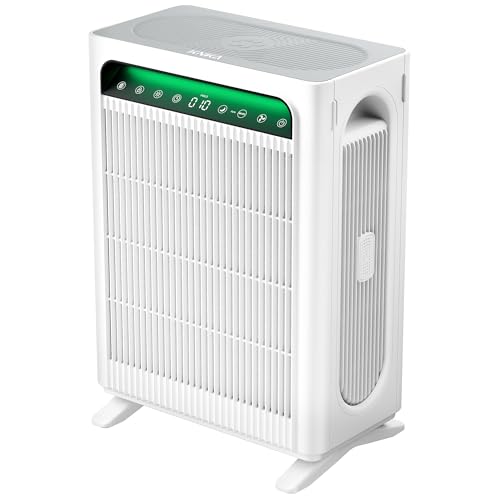
AHAM Verified dual-cartridge purifier with pre-filter, high-efficiency and activated carbon layers, CADR 226 cfm.
Check price on Amazon$119.97 as of Oct 19, 2026 8:58 pm GMT+0000 — prices change; see Amazon for current price.Why we like it
- Two cartridges, each with an activated carbon layer
- AHAM Verified with a stated 226 cfm smoke CADR
- ECO mode idles when the air is clean
- Real-time AQI display with color coding
| Specification | Details |
|---|---|
| CADR | Smoke/dust/PM2.5 226 cfm; pollen 244 cfm (AHAM Verified) |
| Filtration | Front and back cartridges: washable pre-filter, high-efficiency filter, activated carbon |
| Coverage | 4.8 air changes per hour at 350 sq ft; up to 1,695 sq ft once per hour |
| Modes | Auto, sleep (22–24 dB), PET, ECO standby; four fan speeds |
| Size / weight | About 17.1 in tall; 9.68 lb |
| Filter / warranty | Replace every 3–6 months; 2-year warranty |
KNKA APH4000 — AHAM CADR 226 cfm, dual 3-stage cartridges with carbon, 350 sq ft at 4.8 ACH, ECO mode, 2-yr warranty
The Only Listing With Both a Stated CADR and a Named Carbon Stage
Musty basement smell is a gas problem as much as a particle problem: much of it is volatile compounds given off by mold and damp materials. The EPA notes that particle filters do nothing for gases and that you need activated carbon or another sorbent for them. Five of the 13 listings name carbon, and three give a CADR, but the KNKA is the only one that does both. Its two cartridges each carry a carbon layer, which means more sorbent than a single thin carbon sheet.
It also states its coverage the way the EPA suggests reading it: 4.8 air changes per hour in a 350 sq ft room. That is the number to plan around for a basement den or guest room, not the 1,695 sq ft one-change-per-hour figure. The ECO mode, which drops to standby when air quality reads excellent and restarts when it worsens, suits a basement room that sits empty much of the day.
What it cannot do is fix the source. If the smell comes back every time you turn the unit off, carbon is masking ongoing mold growth or damp materials, and the carbon will saturate faster than the 3–6 month interval suggests. Treat a persistent smell as a moisture problem to find, not an odor to filter.
Pros
- Carbon in both cartridges for odor
- AHAM-verified CADR stated
- Air-change basis given for room size
- ECO standby for rarely used rooms
Cons
- Two cartridges to replace
- Carbon saturates quickly if mold is active
- Smaller CADR than the Levoit
Check KNKA APH4000 price on Amazon
3. GermGuardian AC4825E — Best Slim Tower for Tight Spaces

22-inch HEPA tower with activated carbon, optional UV-C, Zero Ozone Verified and CARB; listing names stuffy basements.
Check price on Amazon$80.74 as of Oct 19, 2026 8:58 pm GMT+0000 — prices change; see Amazon for current price.Why we like it
- Only basement-naming listing that also names carbon
- Narrow 6.75-inch footprint fits beside stairs or a desk
- States Zero Ozone Verified and CARB certified
- Three-year warranty
| Specification | Details |
|---|---|
| Filtration | HEPA filter, activated carbon filter, optional UV-C |
| Coverage | 153 sq ft every 12.5 minutes; 743 sq ft once per hour |
| Controls | Three speeds including a quiet sleep setting |
| Certifications named | CARB, ETL, Zero Ozone Verified |
| Size / weight | 22 in tall, about 10.25 x 6.75 in base; 8.55 lb |
| Warranty | 3 years |
GermGuardian AC4825E — HEPA + carbon + UV-C tower, 153 sq ft at ~4.8 ACH, Zero Ozone Verified, 3-yr warranty
The Only Listing That Names Basements and a Carbon Filter
Three listings on the shelf say they suit basements: the Levoit in pick 1, the MOOKA PR1 and this GermGuardian. The GermGuardian is the only one of the three that names an activated carbon filter, which it describes as reducing scents. Its stated coverage, a 153 sq ft room every 12.5 minutes, works out to roughly 4.8 changes per hour, so it is honestly a small-room purifier: a basement office, craft room or guest room.
The tower shape is the practical advantage below grade. Basements are full of tight spots, under stairs, beside a desk, between storage shelves, and a 6.75-inch-wide tower fits where a box purifier will not. Keep the intake clear of walls and stored boxes, though; a tower against a damp foundation wall pulls in the dampest air in the room.
The UV-C lamp is optional. The EPA notes that research has not yet shown UV light removes gases effectively in portable residential cleaners, so it does nothing for musty odor; the carbon filter does that job. The zero-ozone statement matters because the EPA also flags UV lamps without adequate coatings as a possible ozone source.
Pros
- Carbon filter named for scents
- Slim tower fits tight basement spots
- Zero Ozone Verified and CARB
- Three-year warranty
Cons
- Small-room capacity only
- No air-quality sensor or auto mode
- UV-C bulbs are an extra replacement part
Check GermGuardian AC4825E price on Amazon
4. MOOKA KJ190H — Best for Basement Bedrooms

3-stage purifier with washable pre-filter, HEPA and activated carbon pellets, PM2.5 auto mode and 20 dB sleep mode.
Check price on Amazon$73.67 as of Oct 19, 2026 8:58 pm GMT+0000 — prices change; see Amazon for current price.Why we like it
- Activated carbon pellets named for odors
- Quiet 20 dB sleep mode with lights off
- PM2.5 sensor drives the auto mode
- States no ozone and no UV light
| Specification | Details |
|---|---|
| Filtration | Washable pre-filter, HEPA filter, activated carbon pellets |
| Coverage | Up to 2,200 sq ft claimed |
| Sensing / modes | PM2.5 sensor with display, auto mode, 4 speeds, 2/4/6/8 h timer |
| Noise | As low as 20 dB in sleep mode |
| Filter reminder | Lights after 2,000 hours of use |
| Certifications / warranty | CARB, ETL, DOE; 2-year exchange |
MOOKA KJ190H — pre-filter + HEPA + carbon pellets, PM2.5 auto mode, 20 dB sleep, 2,000 h filter reminder, CARB/ETL/DOE
The Only Listing That States Its Filter Interval in Run Hours
Basement bedrooms are common in Front Range homes, and they are also the rooms most likely to need a purifier running all night. The KJ190H combines a carbon pellet stage, a PM2.5 auto mode and a 20 dB sleep mode with no lights, which makes it the quiet-room pick here. Its filter reminder triggers after 2,000 hours of use, the only listing on the shelf that ties filter life to run time rather than a loose month range.
Run-hour tracking matters in a basement unit that runs around the clock: 2,000 hours is under three months of continuous use. That is a more honest picture than a 3–6 month range, and you can plan filter purchases around it.
Its 2,200 sq ft coverage claim has no stated air-change basis or CADR, so size it like a bedroom unit. It also states no ozone and no UV light, which is the reassurance you want in a closed sleeping room.
Pros
- Carbon pellets for musty odor
- Very quiet sleep mode with lights off
- Run-hour filter reminder
- No ozone, no UV stated
Cons
- No CADR or AHAM verification
- Coverage claim lacks an air-change basis
- Filter changes come fast with 24/7 use
Check MOOKA KJ190H price on Amazon
5. ECOSELF HAP603 — Best for Big Open Rec Rooms

True HEPA purifier with PM2.5 display, infrared sensing and auto mode; claims two air changes per hour at 2,400 sq ft.
Check price on Amazon$99.99 as of Oct 20, 2026 2:59 am GMT+0000 — prices change; see Amazon for current price.Why we like it
- Largest coverage claim with a stated air-change rate
- PM2.5 display plus infrared sensor
- 22 dB sleep mode for evening use
- ETL, FCC, CARB and DOE named
| Specification | Details |
|---|---|
| Filtration | True HEPA; carbon stage not stated in listing |
| Coverage | Two air changes per hour in up to 2,400 sq ft claimed |
| Sensing | PM2.5 display, infrared sensor, auto fan adjustment |
| Controls / noise | Timer, fan speeds, lock; 22 dB sleep mode |
| Size / weight | About 15.75 in tall; 7.04 lb |
| Certifications / warranty | ETL, FCC, EPA, CARB, DOE named; 1-year-plus warranty |
ECOSELF HAP603 — True HEPA, 2 ACH at 2,400 sq ft claimed, PM2.5 + infrared auto mode, 22 dB, 7.04 lb
The Only Listing Over 2,000 Sq Ft That States an Air-Change Rate
Five listings on the shelf claim more than 2,000 sq ft of coverage. The HAP603 is the only one of them that says how often it turns the air over at that size: twice an hour at 2,400 sq ft. That is still a manufacturer claim with no CADR behind it, but it is more transparent than a bare square-footage number, and it is the best match on the shelf for a wide-open basement rec room or a walkout with a bar and media area.
The PM2.5 readout is handy below grade. Basement particle levels jump when the furnace kicks on, when someone does laundry or when storage gets moved, and a live number shows you whether the unit is keeping up. The 7 lb weight also makes it easy to carry up and down stairs.
Like the Levoit, it names no carbon stage, so it is a particle machine. Pair it with a dehumidifier and keep the musty-odor job for a carbon unit or, better, for a moisture fix.
Pros
- Air-change rate stated with the coverage claim
- PM2.5 readout and auto mode
- Light enough to move between floors
Cons
- No carbon stage named
- No CADR or AHAM verification
- Shorter warranty than most picks
Check ECOSELF HAP603 price on Amazon
6. Winix 5520 — Best for Monitoring From Upstairs

AHAM Verified True HEPA purifier with a carbon odor filter, air-quality sensor, auto mode and Winix Smart App control.
Check price on Amazon$179.99 as of Oct 19, 2026 8:58 pm GMT+0000 — prices change; see Amazon for current price.Why we like it
- Smart app lets you check the basement remotely
- Carbon filter named for odors and VOCs
- AHAM Verified and UL Certified
- Washable mesh pre-filter for basement dust
| Specification | Details |
|---|---|
| Filtration | Washable pre-filter, carbon odor filter, True HEPA |
| Coverage | AHAM Verified at 392 sq ft; 1,882 sq ft per hour claimed |
| Sensing | Air-quality sensor, LED indicator, auto mode |
| Controls | Winix Smart App; light-sensing sleep mode |
| Size / weight | About 22.7 in tall; 13.3 lb |
| CADR / warranty | Not stated in listing |
Winix 5520 — pre-filter + carbon + True HEPA, AHAM Verified at 392 sq ft, sensor + app control, 13.3 lb
One of Two App-Connected Listings That Also Name Carbon
A basement purifier is often out of sight and out of mind. Three listings on the shelf are sold as smart or app-controlled units: the Levoit Vital 200S-P and two Winix models. The two Winix units are the only ones of those three that also name a carbon odor filter, and the 5520 is the newer listing. Being able to see the basement’s air-quality reading and filter status from upstairs makes it more likely the unit gets attention when the air turns bad or the filter is due.
The AHAM verification at 392 sq ft is the useful sizing figure; plan around that, not the one-hour coverage claim. Its light-sensing sleep mode is less useful in a windowless basement, where the room may read as dark all day, so check that it is not stuck in sleep mode.
The listing gives no CADR and no carbon weight. It is the largest and heaviest pick here, so it suits a room where it can stay put.
Pros
- Remote monitoring through the app
- Carbon filter named
- AHAM Verified and UL Certified
Cons
- Light-sensing sleep can misfire in dark basements
- No CADR figure stated
- Heaviest pick at 13.3 lb
Check Winix 5520 price on Amazon
Moisture first: the dehumidifier comes before the purifier
Most basement air problems start with water. Concrete wicks ground moisture, foundation walls stay cold and pull humidity out of the air as condensation, and any leak or seepage keeps materials damp. The EPA’s mold guidance is to keep indoor humidity below 60 percent, ideally between 30 and 50 percent, and to dry water-damaged materials within 24 to 48 hours to keep mold from growing. ENERGY STAR adds that if indoor humidity is consistently above 60 percent, a specific dehumidification strategy is needed, and that certified dehumidifiers remove the same moisture as conventional units while using about 20 percent less energy.
In practice, that means:
- Measure first. A cheap hygrometer tells you whether the basement is actually humid. Our guide to basement humidity levels explains what readings to expect by season.
- Dehumidify to 50 percent or below. A properly sized unit with a drain hose or pump does more for a musty smell than any purifier. See our basement dehumidifier guide for sizing.
- Then add a purifier to catch the spores, dust and dander that remain.
Front Range basements are often drier than basements in humid climates, especially in winter. If yours smells musty anyway, that is a stronger signal of a specific moisture source, such as a leak, a wet window well or a failing downspout, than of general humidity. Our musty basement smell guide walks through how to find it, and a moisture meter helps confirm damp drywall or framing.
Radon: what an air purifier will not do
Radon is a radioactive gas from uranium in soil and rock, and basements, being in contact with the soil, are where it enters and concentrates. The EPA calls radon the leading cause of lung cancer among non-smokers and the second leading cause overall, responsible for about 21,000 lung cancer deaths a year, and notes that smokers exposed to radon face a much higher risk.
No portable air purifier on this shelf, or any other, is a radon solution. The EPA’s guide to air cleaners notes that the CADR rating covers particles only, and none of the 13 listings mentions radon. The EPA’s consumer guide to radon reduction recommends methods that prevent radon from entering, chiefly soil suction systems that draw radon from beneath the slab and vent it above the roof, and says to fix the home if a confirmed test is 4 pCi/L or higher. If you are spending time in a basement and have never tested, test before buying a purifier.
Reading specs for a below-grade room
- CADR and the two-thirds rule. The EPA suggests a smoke CADR of at least two-thirds of the floor area for an 8-foot ceiling: about 260 cfm for 400 sq ft. Only three listings here give a CADR; for the rest, look for an air-change rate tied to a room size.
- Carbon for musty odor. Five of the 13 listings name activated carbon. More sorbent is better, so dual cartridges or pellets beat a thin carbon sheet.
- Pre-filters for dust. Basements are dusty from storage, laundry lint and furnace cycling. A washable pre-filter catches the large stuff and stretches HEPA life.
- Ozone and ionizers. Avoid ozone-producing devices in a closed basement. CARB certification or a zero-ozone statement is the minimum to look for.
- Placement. Keep units a foot or more from foundation walls and off bare slab where water may pool. Do not run a purifier in a room with active water; dry and fix it first.
When to call an inspector
A purifier is the right tool for a basement that is already dry, tested for radon and free of active leaks. Visible mold on walls or framing, efflorescence on foundation walls, water at the floor-wall joint, cracks that let in water, or a musty smell that persists with a dehumidifier running all point to problems a purifier will only mask. Those call for a look at grading, gutters, the foundation and, if the space is finished, behind the drywall. If you are buying, selling or finishing a Front Range basement and want moisture, radon and the foundation checked, reach out through our contact page to connect with a vetted local inspector.
References
- A Brief Guide to Mold, Moisture and Your Home — U.S. Environmental Protection Agency
- Dehumidifiers — ENERGY STAR
- Health Risk of Radon — U.S. Environmental Protection Agency
- A Consumer’s Guide to Radon Reduction — U.S. Environmental Protection Agency
- Guide to Air Cleaners in the Home — U.S. Environmental Protection Agency
Frequently asked questions
What is the best air purifier for a basement?
Pick a unit with a stated CADR sized to the room and, if the basement smells musty, a named activated carbon stage. In this comparison the Levoit Vital 200S-P is the top pick for its AHAM-verified 250 cfm smoke CADR, and the KNKA APH4000 is the pick for musty odor.
Do I need a dehumidifier or an air purifier for my basement?
Usually a dehumidifier first. The EPA recommends keeping indoor humidity below 60 percent, ideally 30 to 50 percent, to limit mold. A purifier catches airborne particles but cannot lower humidity, so it will not stop the conditions that cause mustiness.
Will an air purifier remove radon from my basement?
No. Radon is a gas, and room air purifiers are rated for particles. The EPA recommends testing and, if a confirmed result is 4 pCi/L or higher, a radon reduction system such as soil suction that vents radon from beneath the home.
Can an air purifier get rid of basement mold?
It can capture some airborne mold spores, but it cannot remove mold growing on surfaces or stop new growth. The EPA advises controlling moisture, drying wet materials within 24 to 48 hours and cleaning up mold at the source.
Where should I put an air purifier in a basement?
In the room you use most, with clear space around the intake and at least a foot from damp foundation walls. Keep it off bare slab where water may pool, and run a dehumidifier in the same space if humidity is above 50 percent.
Finishing or buying a home with a Front Range basement? Reach out through our contact page to have moisture, radon and the foundation checked by a vetted local inspector.