Elitech ILD-200 Refrigerant Leak Detector
Water & refrigerant leak detectors
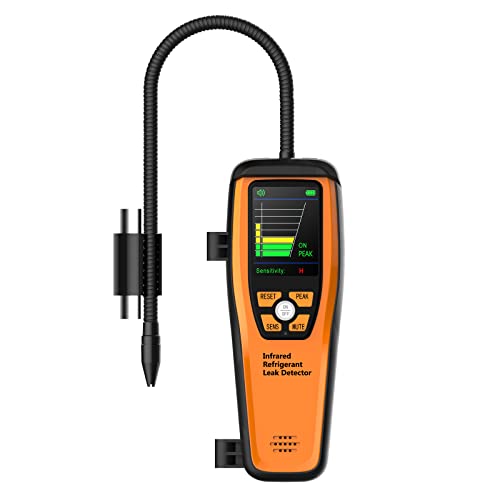
The Elitech ILD-200 is a handheld refrigerant leak detector that uses an infrared sensor rather than the heated-diode or corona sensors common in lower-cost sniffers.
The Elitech ILD-200 is a handheld refrigerant leak detector that uses an infrared sensor rather than the heated-diode or corona sensors common in lower-cost sniffers. It is built for HVAC and automotive AC work, and a homeowner can use it to check whether an air conditioner or heat pump is losing refrigerant before booking a service call. Its standout point is the sensor itself: the listing claims a sensor service life of about 10 years, paired with three sensitivity levels and a 2.8-inch screen that shows peak readings.
Specifications
| Specification | Details |
|---|---|
| Sensor type | Infrared, with a claimed sensor life of about 10 years |
| Sensitivity | High, medium and low settings; best rating listed as 0.14 oz/yr |
| Refrigerants | Halogenated refrigerants including CFCs, HCFCs, HFCs, HCs, HFOs and common blends such as R22, R410A and R1234yf |
| Display | 2.8-inch screen with a peak indicator to show leak direction |
| Power | Not stated in listing |
| Size / weight | About 7.9 x 3.3 x 1.5 in; 0.93 lb |
| Model / warranty | ILD-200; 1-year warranty |
Elitech ILD-200 — infrared refrigerant sniffer, 3 sensitivity levels down to 0.14 oz/yr, 2.8-inch peak display, 10-year sensor life claim, 1-year warranty
How It Compares
One of Only Two Infrared-Sensor Sniffers on This Shelf
Of the 12 similar listings pulled for comparison, nine are electronic refrigerant detectors; the others are two bubble solutions and a set of smart water-leak sensors. Among those nine, only Fieldpiece’s DR82 also uses an infrared sensor. Three are heated-diode units, two use metal-oxide semiconductor sensors one uses a corona sensor, and two do not name a sensor type. Infrared sensors are typically chosen for long sensor life, and the DR82 likewise claims about 10 years, while the heated-diode DR58 and Inficon 705-202-G1 list sensor lives of 300 and 100 hours.
On sensitivity, the ILD-200 sits mid-pack. Six of the nine comparison detectors publish a leak-rate figure; three of those claim finer detection than 0.14 oz/yr (the two Fieldpiece models and Elitech’s own heated-diode sniffer), and three claim coarser figures of 0.21 or 0.25 oz/yr.
The listing leaves out several basics. It does not say how the unit is powered, how long a charge or set of batteries lasts, how long it takes to warm up, or whether it is rated for A2L refrigerants. Its claim of better accuracy and interference resistance than heated-diode sensors is the maker’s own comparison, not an independent result.
Who It’s For — and Who Should Skip It
The ILD-200 suits technicians and committed DIYers who want an infrared sensor without stepping up to a premium brand, and who value a screen over beeps alone. Buyers who need to know exact battery runtime or A2L compatibility before buying should confirm those with the seller, and a homeowner checking a single visible fitting may find a bubble solution simpler.
Finding a leak is not the same as fixing it. EPA rules under Section 608 of the Clean Air Act require technicians who maintain, service, repair or dispose of equipment that could release refrigerant to be certified (EPA Section 608 technician certification). For a homeowner, this tool is for locating the problem; the repair and recharge belong to a certified technician.
Using It at Home
- Power it on in clean outdoor air away from the unit so it settles on a clean baseline.
- Begin on high sensitivity to find the general area, then step down to medium or low to isolate the exact joint.
- Work slowly along the outdoor condenser’s service valves and line-set connections, then the indoor coil, keeping the probe just below each joint.
- Pick a calm day. Wind across the open plains and foothills can carry a small leak away from the tip before the sensor sees it.
An alarm combined with symptoms such as warm supply air, ice on the line set or a short-cycling system points to a refrigerant problem that needs a certified technician. If you want the HVAC system and the rest of a house checked during a purchase, get in touch with us.
Pros
- Infrared sensor with a claimed 10-year life
- Three sensitivity levels, best listed at 0.14 oz/yr
- 2.8-inch screen with peak indication
- Covers a broad list of refrigerant families including HFOs
Cons
- Power source and runtime not stated
- Three comparison listings claim finer sensitivity
- No A2L rating mentioned
- Only a 1-year warranty listed
Related Guides
- Refrigerant leak detector guide
- AC leak detector guide
- Fieldpiece DR82 infrared refrigerant leak detector
- AC leak repair
- All leak detectors in our shop
As an Amazon Associate we earn from qualifying purchases. Product details come from the current Amazon listing; we have not lab-tested this unit, and prices and availability change.
$190.99 as of Nov 15, 2026 3:25 pm GMT+0000
Prices change often — check the live price on Amazon. As an Amazon Associate we earn from qualifying purchases.