What Is an Infrared Camera: A Plain-Language Guide
An infrared camera is a device that captures heat-based images instead of visible-light images. The category includes handheld inspection cameras used by home inspectors, smartphone attachments used by homeowners, drone-mounted thermal payloads, and large industrial systems used in utility and manufacturing inspection. This guide is a device-focused overview: what an infrared camera contains, the form factors available, how the major sensor types differ, and how the category fits home inspection and homeowner use. It does not endorse specific brands. A companion guide covers the physics of how these devices actually work; this one focuses on the device itself.
Part of our Thermal Imaging for Homes guide — start there for the full picture →
The category in one sentence
An infrared camera is a thermal imaging instrument that detects infrared radiation emitted by objects and converts that signal into a visible image — usually a false-color map where warmer areas appear in warm tones and cooler areas appear in cool tones. The image lets a trained user identify temperature differences across a scene that would otherwise be invisible.
The device is sometimes also called a thermal camera, thermal imager, infrared imager, or thermographic camera. The terms are largely interchangeable in common usage, though “infrared camera” is sometimes used more loosely to include night-vision devices that use a narrower portion of the infrared spectrum than thermal cameras do.
What is inside an infrared camera
A typical handheld infrared camera contains several core components.
The detector
The detector is the sensor that captures incoming infrared energy. Two major categories exist.
Uncooled microbolometer arrays. These are the detectors in virtually every consumer and prosumer thermal camera. They work at ambient temperature, are compact and durable, and have come down dramatically in price over the past two decades. Typical resolutions range from 80×60 in the cheapest smartphone attachments to 640×512 in mid-tier professional units. Higher-end models use 1280×1024 detectors.
Cooled photon detectors. These detectors require active cooling (typically to cryogenic temperatures) to achieve their best performance. They reach lower NETD, broader spectral range, and finer detail than uncooled detectors but are far more expensive and have shorter detector lifetimes. Cooled systems are common in industrial and defense-adjacent applications and very rare in residential inspection.
Optics
Thermal optics are typically made of germanium or chalcogenide glass because ordinary silica glass is opaque to long-wave infrared. The lens system focuses incoming infrared on the detector array. Focal length, field of view, and focus mechanism vary by intended use case.
Processing electronics
The electronics convert detector signals into temperature values, apply emissivity corrections, generate the pseudo-color image, and provide the user interface. Modern thermal cameras include onboard storage for images and video, USB or wireless output, and sometimes integration with phone apps or cloud services.
Visible-light camera (often)
Many modern thermal cameras include a visible-light camera alongside the thermal sensor. The visible image helps locate the thermal anomaly within the physical scene. Some models fuse the two images to overlay edges from the visible camera onto the thermal image, which improves location precision in mixed scenes.
Display and controls
Handheld units use built-in LCD screens (typically 2.5 to 4 inches diagonal) with physical buttons for navigation. Smartphone attachments use the phone’s display. Drone-mounted thermal sensors stream to the operator’s controller display.
Readers interested in the underlying physics can review the physics-focused explainer and the home inspection tools hub for category context.
Form factors
Smartphone attachments
Small thermal modules that plug into a phone’s USB-C or Lightning port. They use the phone’s processing, display, and storage. Resolution is typically 160×120 or 256×192. Prices range from about $150 to $400. Form factor strengths include portability and integration with phone-based workflows. Weaknesses include limited resolution, dependence on the host phone, and the ergonomic challenges of holding a phone steady at the right angle.
Handheld pistol-grip cameras
Standalone units with a pistol grip, integrated display, and physical controls. The dominant form factor for professional inspection work. Resolutions range from 160×120 in entry models to 640×512 or higher in professional units. Prices range from $400 to $5,000 and beyond. The ergonomics and stability of a dedicated handheld unit produce better imagery than smartphone attachments at every price point.
Pocket-sized compact units
Smaller standalone cameras designed for HVAC technicians, electricians, and inspectors who need a quick-deploy tool in addition to a primary unit. Lower resolution than full pistol-grip units, often around 80×60 to 160×120, with limited storage and analysis features. Prices from $200 to $700.
Drone-mounted thermal payloads
Thermal sensors integrated into drone airframes or available as swappable payloads on commercial drone platforms. Resolutions range from 256×192 in consumer drones to 1280×1024 in commercial units. The drone provides flight stability, navigation, and downstream processing.
Fixed and stationary thermal cameras
Industrial and security installations use thermal cameras mounted on poles, walls, or pan-tilt-zoom platforms for continuous monitoring. These are not typically used in residential inspection.
How the major sensor specifications affect device use
Resolution
The pixel count of the thermal sensor determines how much detail the image contains. A 160×120 sensor is suitable for finding gross thermal anomalies at close range. A 320×240 sensor handles most home inspection work. A 640×512 sensor adds the detail and working distance that professional inspection and forensic work needs.
Thermal sensitivity (NETD)
Noise-equivalent temperature difference measures the smallest temperature change the sensor can reliably detect. Lower is better. Consumer sensors are typically 50 to 100 mK; professional sensors reach 30 mK or better. NETD matters for situations where the temperature differences of interest are small — moisture detection, weak insulation gaps, and faint air leaks.
Temperature range
The range of temperatures the camera can measure. Most building diagnostic cameras cover -10 to 250 degrees Celsius or similar. Industrial cameras extend much higher (300 to 2000 degrees Celsius) for furnace and process inspection. Building inspectors rarely need the high-temperature extension.
Refresh rate
How fast the image updates. 9 Hz is the threshold below which devices are not subject to certain export controls in the United States. Most consumer and prosumer units operate at 9 Hz, which is adequate for static-scene inspection. Higher refresh rates (30 Hz or more) matter for dynamic-scene applications like vehicle or animal tracking.
Spectral range
Most thermal cameras operate in the long-wave infrared (LWIR) band, approximately 7 to 14 micrometers. Some specialty cameras use medium-wave infrared (MWIR), which performs better at long range and higher temperatures but requires cooled detectors. LWIR is the default for building diagnostic work.
How an infrared camera fits home inspection work
In residential building diagnostics, an infrared camera is a tool for finding things that visual inspection misses — hidden moisture, missing or settled insulation, air leakage paths, electrical hot spots on accessible components, and HVAC duct losses. It is not a primary diagnostic tool used alone; it is a screening tool that identifies anomalies for follow-up with moisture metering, visual inspection, or exploratory cuts.
A home inspector with a 320×240 or 640×512 handheld unit, training in image interpretation, and discipline about confirming findings with other tools produces reliable diagnostic value. An untrained user with the same camera produces images that look impressive but mean little.
What an infrared camera is not
Several common misconceptions appear regularly.
It is not an X-ray. The camera does not see through walls, floors, or objects. It images surface temperatures. Hidden conditions are inferred from how they affect surface temperatures.
It is not a moisture detector. The camera shows temperature differences. Moisture is one of many things that produce temperature differences. Confirmation with a moisture meter is required to distinguish moisture from air leaks, missing insulation, and other thermal anomalies.
It is not a substitute for inspection training. The image without context is just colors on a screen. Knowing what the colors mean requires building science knowledge, thermography training, and pattern recognition from accumulated work.
It is not a night vision device in the consumer sense. Consumer night vision uses image intensification of near-infrared and visible light. Thermal cameras use long-wave infrared and detect heat. The two technologies look superficially similar in their output but operate on different physical principles and excel at different tasks.
Where the category is heading
Several trends are shaping consumer and prosumer thermal cameras in 2026. Resolution at every price point continues to improve. Smartphone integration through dedicated apps has matured. AI-assisted analysis — automatic identification of common patterns like ductwork, electrical panels, and missing insulation — has appeared in mid-tier units. Pricing on 640×512 sensors has dropped enough that the previously-professional resolution is now reaching prosumer units.
For a homeowner considering buying a unit today, mid-range options offer dramatically more capability than the same price point did three years ago. For an inspector building a tool kit, the calculation now favors a single mid-tier unit with strong resolution over a stacked combination of one entry unit and one industrial system.
Accessories that matter
A thermal camera is often the start of a small accessory ecosystem rather than a standalone purchase. A few accessories meaningfully extend the camera’s diagnostic value.
External temperature reference. A small reference panel of known emissivity (often included with professional cameras) gives the operator a calibration point in the scene. Useful for verifying that camera readings are reasonable in a given environment.
Companion moisture meter. Discussed throughout the home inspection context: a moisture meter confirms what the thermal camera suggests. A handheld pin-and-pinless combo meter alongside the thermal camera is the standard inspector pairing.
Tripod or monopod. For longer exposures, repeatable measurements over time, or stable imaging of moving scenes, mounting the camera removes hand shake and produces cleaner images. Higher-end cameras include tripod sockets standardized to common mount sizes.
Carrying case. Thermal cameras are durable but the germanium lens is the most delicate component. A protective case with foam cutouts extends the useful lifetime of the equipment.
Spare batteries and charging accessories. Field inspection often runs all day. A spare battery and a 12-volt vehicle charger keep the camera running between site visits.
Lens cleaning supplies. Germanium lenses use specific cleaning materials. Lens cloths and cleaning fluids appropriate to optical surfaces are necessary; ordinary glass cleaners can damage the lens coating.
Software and report production
Beyond the hardware, software matters for any user beyond casual hobbyist use. Most professional thermal cameras come with companion software for image management, analysis, and report production. The software typically supports:
- Image annotation — adding temperature spot measurements, drawing region-of-interest boxes, overlaying visible-light images.
- Temperature analysis — adjusting emissivity, applying span and level corrections, exporting temperature data.
- Report generation — combining images, annotations, and narrative into client-ready PDFs.
- Image organization — sorting by project, date, location, or custom tags.
- Cloud sync — optional in many products; useful for multi-device workflows and team collaboration.
The quality of the software ecosystem matters because most of the time spent producing client deliverables happens in post-processing rather than at the camera itself. A camera with capable hardware and weak software is more frustrating to use professionally than a slightly less capable camera with strong software.
More Questions About Infrared Cameras
Is an infrared camera the same as night vision?
No, an infrared camera is not the same as night vision. Thermal infrared cameras detect heat emitted by objects and need no light at all. Most night vision and security cameras amplify faint light or use near-infrared illuminators, then record reflected light.
That difference matters for home use. A security camera’s night mode cannot show cold drafts, wet insulation, or hot breakers, while a thermal infrared camera can show those temperature patterns even in daylight.
What is the difference between an infrared thermometer and an infrared camera?
An infrared thermometer measures the average temperature of one small spot, while an infrared camera measures thousands of points at once and shows them as an image. Both use the same basic principle.
An infrared thermometer is inexpensive and fine for checking a register or a pipe. An infrared camera is far better for finding where a problem is, such as the exact edge of missing insulation or a hidden leak path, because it shows the whole pattern.
Can an infrared camera detect electrical problems?
Yes, an infrared camera can reveal overheating breakers, loose connections, overloaded circuits, and failing components as hot spots, which is one of its most valuable uses. The circuit must be carrying a load for the problem to show.
Open electrical panels should only be scanned by an electrician or trained inspector. A homeowner can safely scan closed panel doors, outlets, switch plates, and cords, and call an electrician about anything noticeably warmer than similar items.
Can an infrared camera see through smoke or fog?
An infrared camera can see through smoke much better than the human eye, which is why firefighters use thermal cameras to find people and hot spots. Long-wave infrared passes through most smoke particles.
Fog and heavy rain are a different story, because water droplets absorb infrared and reduce range and contrast. For building inspections, wet exterior surfaces also cool unevenly, so inspectors generally avoid scanning during or right after rain.
References
- ENERGY STAR: Seal and Insulate — U.S. Environmental Protection Agency (ENERGY STAR)
- Infrared Thermography Standards — InterNACHI
- Building Science Resources — ASHRAE
- Electrical Safety Standards — OSHA
Frequently asked questions
What is the difference between an infrared camera and a thermal camera?
In common usage, the terms are interchangeable. Both refer to devices that capture heat-based images using long-wave infrared detection. Some specialty contexts distinguish them by spectral range, but for residential inspection use the terms describe the same device category.
Can an infrared camera see through walls?
No. The image is surface temperature only. Hidden conditions produce surface temperature differences that the camera detects indirectly. Interpretation by a trained user is required to distinguish actual hidden conditions from harmless thermal variation.
What resolution do I need for home inspection?
320x240 handles most home inspection work. 640x512 adds detail and working distance for professional and forensic work. 160x120 and lower is suitable only for the most basic anomaly screening at close range.
Are smartphone thermal attachments good enough?
For occasional homeowner use, yes. For professional inspection work, the ergonomics, stability, and image quality of dedicated handheld units are noticeably better at any given sensor resolution. Smartphone attachments work best as a secondary or screening tool.
Do infrared cameras work in the dark?
Yes — better than they work in daylight, in fact. Thermal cameras detect heat emitted by objects rather than reflected visible light. They function in complete darkness. Solar loading during the day actually makes building diagnostics harder, not easier.
What is a radiometric infrared camera?
A radiometric infrared camera stores a temperature value for every pixel, so images can be analyzed later on a computer. Non-radiometric cameras only show a picture with perhaps a center-spot reading. Inspectors who write detailed reports usually prefer radiometric models.
What temperature range does a home infrared camera need?
For home inspection and DIY building work, an infrared camera range of about minus 4 to 250 degrees Fahrenheit, or similar, covers walls, ceilings, HVAC, plumbing, and most electrical checks. Higher ranges matter mainly for industrial, furnace, or engine work.
Does cold weather affect infrared camera performance?
Cold weather mainly shortens infrared camera battery life and can fog the lens when moving between cold and warm areas. Letting the camera acclimate for several minutes before scanning prevents condensation and drifting readings. The cold itself actually improves contrast for building envelope scans.
Thermal imaging cameras
Infrared cameras reveal hidden moisture, missing insulation, and air leaks. Phone-attachment models are the budget entry point; standalone units have higher resolution.
| Product | Why | Buy |
|---|---|---|
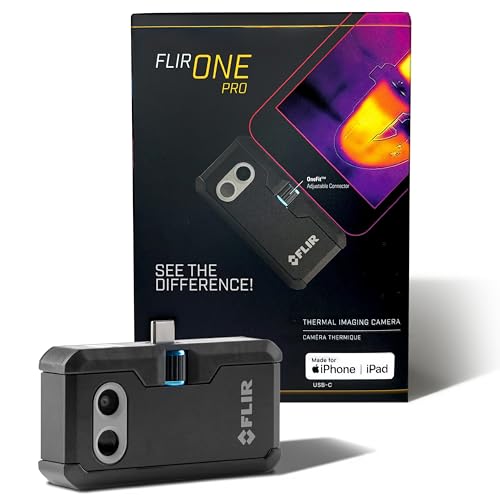 FLIR ONE Pro (phone) | Plugs into iPhone/Android; inspector favorite. | Amazon — $296.65 |
 Topdon TC001 | High-res phone module at a low price. | Amazon — $249.00 |
 FLIR C5 Compact | Standalone pocket camera with Wi-Fi. | Amazon — $593.99 |