Shortwave Infrared Camera: What Homeowners Need to Know

A shortwave infrared camera operates in a band of the electromagnetic spectrum (roughly 0.9 to 1.7 micrometers) that sits between visible light and the thermal long-wave band most home-inspection cameras use. The hardware is specialized, the use cases are mostly industrial, and the price is well outside the consumer thermography market. Homeowners researching shortwave-infrared imaging often arrive at it after seeing references in agricultural monitoring, art-restoration analysis, gas-leak detection, or semiconductor inspection. This guide explains what shortwave infrared imaging actually does, where it overlaps and diverges from the long-wave imaging used in residential inspection, and where homeowners should pivot to long-wave thermal instead.
Part of our Thermal Imaging for Homes guide — start there for the full picture →
What “shortwave” means on the infrared spectrum
The infrared portion of the electromagnetic spectrum spans roughly 0.7 micrometers (just past red visible light) out to about 1,000 micrometers (where microwaves begin). It is divided into bands: near-infrared (NIR, 0.7 to 1.4 micrometers), shortwave infrared (SWIR, 1.4 to 3 micrometers, with most cameras covering 0.9 to 1.7), midwave infrared (MWIR, 3 to 8 micrometers), and longwave infrared (LWIR, 8 to 14 micrometers). Different materials absorb, reflect, and emit differently across these bands, which is why each band has its own industrial niche. Home-inspection thermal cameras operate in LWIR because building materials emit thermal radiation peaks in that range at typical surface temperatures.
How a shortwave infrared camera differs from a thermal camera
A shortwave camera is mostly a reflectance imager. It sees materials by how they reflect or absorb shortwave light, similar to how a visible camera sees by reflectance, just at a wavelength the human eye cannot detect. Most shortwave applications require an active illuminator (a SWIR-band light source) because passive emission at these wavelengths is too low for the sensor at typical ambient temperatures. A long-wave thermal camera, by contrast, is a passive emission imager. It sees surfaces by the thermal radiation they emit at ambient temperatures and needs no illuminator. The two technologies look superficially similar (they both produce false-color images) but answer different questions about a surface.
Industrial uses for shortwave imaging
Gas-leak detection is one of the most-cited shortwave applications. Methane, propane, and several other hydrocarbon gases absorb shortwave wavelengths in specific narrow bands. A specialized shortwave camera tuned to those bands shows gas plumes as dark clouds against the background, which lets operators visualize leaks in real time. Oil and gas inspection, refinery monitoring, and chemical-plant safety patrols rely on this capability. Semiconductor inspection uses shortwave imaging to see through silicon wafers, which are opaque to visible light but transparent to certain shortwave wavelengths, enabling defect detection in chip manufacturing.
Art restoration and document analysis
Museums and conservators use shortwave imaging to see through paint layers and varnish to underdrawings, pigment patterns, and historical retouching that visible-light photography cannot reveal. Different pigments transmit or absorb shortwave wavelengths differently, which exposes layered artistic technique. The same technique works on historical documents and currency authentication because watermarks and security features become visible under shortwave illumination.
Agricultural moisture mapping
Aerial and ground-based shortwave imaging tracks crop moisture content because water has strong absorption peaks in the shortwave band, particularly around 1.4 to 1.5 micrometers. A field surveyed with a shortwave camera shows dry stress zones as bright reflectance and well-hydrated zones as darker reflectance. The same physics works on building materials, which is one reason shortwave imaging occasionally surfaces in residential moisture investigations. The catch is that the camera and active illumination required to make this work in a building are far more expensive than the long-wave thermal cameras that infer moisture from surface temperature.
Why shortwave is rarely used in home inspection
Two factors keep shortwave cameras out of the home-inspection toolkit. Cost is the first. A capable shortwave camera with an indium-gallium-arsenide (InGaAs) sensor typically runs $15,000 to $80,000 or more, well above the $300 to $5,000 range that covers most home-inspection thermal cameras. The illumination requirement is the second. Most shortwave applications need an active light source to produce a usable image, which adds bulk, power consumption, and complexity. Building inspectors using long-wave thermal cameras work passively, in real time, without any illumination — a workflow that matches the conditions inside houses far better than shortwave does.
What shortwave does that long-wave cannot
A few use cases genuinely require shortwave rather than long-wave. Through-silicon imaging for semiconductor work is unique to shortwave. Through-paint imaging for art restoration is unique to shortwave. Specific hydrocarbon-gas leak visualization works far better in shortwave than long-wave. Moisture mapping at the molecular-absorption level (rather than the surface-temperature level) requires shortwave. Outside those niches, long-wave thermal imaging produces more useful data at a fraction of the cost.
What long-wave thermal does that shortwave cannot
Long-wave thermal imaging is the right tool for almost every residential or commercial building investigation. The camera sees emissive temperature differences across roofs, walls, floors, ceilings, plumbing, and electrical panels without any illumination. It identifies heat-loss anomalies, missing or compressed insulation, plumbing leaks (cool spots where evaporation is occurring), electrical hotspots in panels, and HVAC duct leakage in real time. The cameras integrate into smartphone-based attachments and dedicated handheld units that fit a home inspector’s price range. Our home inspection tools hub covers long-wave thermal categories in more depth.
Common confusion: shortwave vs near-infrared
The phrase “shortwave infrared camera” sometimes gets used loosely to describe near-infrared cameras that operate just past visible light (0.7 to 1.0 micrometers). True shortwave imagers operate beyond near-infrared at 0.9 to 1.7 micrometers, and the sensor technology is different (InGaAs sensors versus silicon-based NIR sensors). Near-infrared cameras are far cheaper than true shortwave and have their own niches in security imaging, night vision, and certain agricultural applications, but they cannot do the gas-detection or through-silicon imaging that defines genuine shortwave use cases. Our IR camera night vision guide covers the NIR end of the spectrum in more detail.
When a homeowner should consider shortwave
Few residential scenarios justify the cost and complexity of a shortwave system. Specific hydrocarbon-gas leak situations where a long-wave thermal camera cannot detect the leak — for example, a propane line in a basement — might benefit from a hired professional with a SWIR gas-detection camera. Heritage restoration of a pre-1950 home with concealed mural work or wallpaper layers might benefit from a one-time SWIR survey. Outside these unusual situations, the right tool is a long-wave thermal camera, sometimes paired with a moisture meter and borescope.
Pricing and rental options
Shortwave cameras are usually rented rather than purchased for one-off use. Rental services through scientific-instrument companies typically charge $200 to $500 per day plus shipping and insurance. Some industrial-inspection firms offer SWIR scanning as a contracted service rather than equipment rental, which can be more cost-effective for a single survey. A homeowner considering SWIR for a specific question should describe the question to the rental or service provider in detail before committing — many residential questions that initially sound like SWIR jobs turn out to be long-wave thermal jobs at one-tenth the cost. Our broader digital infrared camera guide covers the camera categories side by side.
What the report looks like
A shortwave inspection report typically includes the camera model, sensor specifications (InGaAs format, pixel count, wavelength sensitivity range), the illumination source if used, and a series of false-color images. Annotation marks the features of interest. The report should explain what wavelengths were imaged and why those wavelengths reveal the feature, because the false-color images are not interpretable without that context. Reports from credentialed thermography providers (Level I, II, or III certification through industry-standards bodies) carry more weight than reports without credentials.
How to evaluate a shortwave service quote
Three filters help a homeowner evaluate a contracted shortwave survey. First, the provider should describe the question the survey will answer in plain language, not just the camera being used. A vendor who cannot articulate what shortwave reveals that long-wave cannot is selling capability rather than answers. Second, the deliverable should include both the false-color images and an explanatory narrative that ties the images to physical conditions. Third, the pricing should match the scope. A one-room survey should not cost the same as a whole-building scan. Vendors charging high day rates for short scopes often padding the bill with travel time and setup overhead that exceeds the actual imaging work.
Training and certification for thermography
Most industrial shortwave imaging happens in the hands of thermographers certified to Level I, II, or III standards by industry-standards bodies. The certification covers physics, equipment operation, image interpretation, and report writing. A homeowner hiring a shortwave service should confirm the operator’s credentials and ask for sample reports before contracting work. The same Level I/II/III certification framework applies to long-wave thermal imaging for building inspection, which is more relevant to residential clients. Front Range inspectors offering thermography services frequently hold Level I certification at minimum; Level II is common for inspectors with several years of experience. InterNACHI’s infrared thermography reference covers the credential structure in detail.
Sensor technology basics
The dominant sensor in shortwave cameras is indium-gallium-arsenide (InGaAs), which is sensitive to wavelengths roughly 0.9 to 1.7 micrometers. Cooled versions extend sensitivity further but add cost and complexity. Each pixel on the sensor captures shortwave photons and produces an electrical signal proportional to incoming intensity, which the camera converts to a grayscale or false-color image. Pixel counts typically range from 320×256 on lower-cost cameras to 1280×1024 on research-grade instruments. Long-wave thermal cameras use uncooled microbolometer sensors based on vanadium oxide or amorphous silicon, which work at room temperature and cost much less per pixel. The cost difference between InGaAs and microbolometer sensor production is a primary reason the two camera categories diverge so sharply in price.
Active versus passive illumination
Most shortwave imaging requires an active illuminator because the natural shortwave radiation reflected off most surfaces at room temperature is too low for the sensor. The illuminator can be a tungsten-halogen lamp, an LED array tuned to shortwave wavelengths, or a fiber-coupled laser source for specialized applications. The illumination geometry matters: oblique angles for surface texture, normal incidence for transmission imaging, and specific bandpass filtering for gas-leak work. Long-wave thermal cameras need no illuminator because building surfaces at typical temperatures emit enough long-wave radiation for direct passive imaging. The illumination requirement is part of why shortwave cameras stay in industrial workflows rather than residential ones.
Sample shortwave use case: water content in a wall
One specialty use that occasionally crosses into building investigation is direct moisture mapping with shortwave imaging. Water absorbs strongly at approximately 1.45 micrometers, so a shortwave camera tuned to that band can image wet versus dry zones on a wall surface with high contrast. The same wall imaged with a long-wave thermal camera might show the wet zone through evaporative cooling, which is an indirect measurement of moisture rather than a direct molecular-absorption measurement. The shortwave image is more diagnostic in some cases (a slow leak with minimal evaporation might escape a thermal camera but show on shortwave) but rarely justifies the cost difference for residential work. A long-wave thermal camera plus a moisture meter handles most residential water investigations at one-twentieth the cost.
References
- ENERGY STAR: Seal and Insulate — U.S. Environmental Protection Agency (ENERGY STAR)
- ASHRAE Standards on Building Energy Diagnostics — American Society of Heating, Refrigerating and Air-Conditioning Engineers
- InterNACHI Infrared Thermography Reference — International Association of Certified Home Inspectors
- ICC Building Standards and Code References — International Code Council
Thermal imaging cameras
Infrared cameras reveal hidden moisture, missing insulation, and air leaks. Phone-attachment models are the budget entry point; standalone units have higher resolution.
| Product | Why | Buy |
|---|---|---|
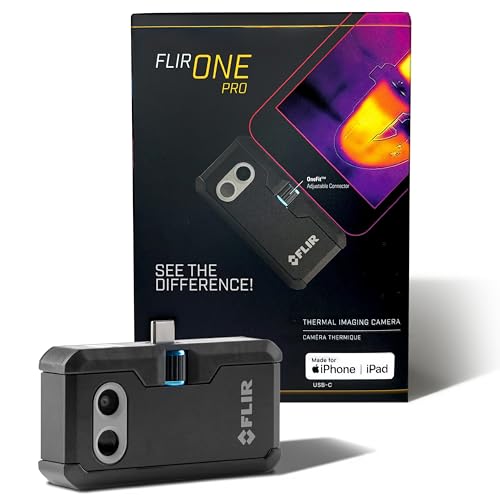 FLIR ONE Pro (phone) | Plugs into iPhone/Android; inspector favorite. | Amazon — $349.00 |
 Topdon TC001 | High-res phone module at a low price. | Amazon — $262.99 |
 FLIR C5 Compact | Standalone pocket camera with Wi-Fi. | Amazon — $649.00 |