Weatherheads and Service Masts: Drip Loops and Storm Damage
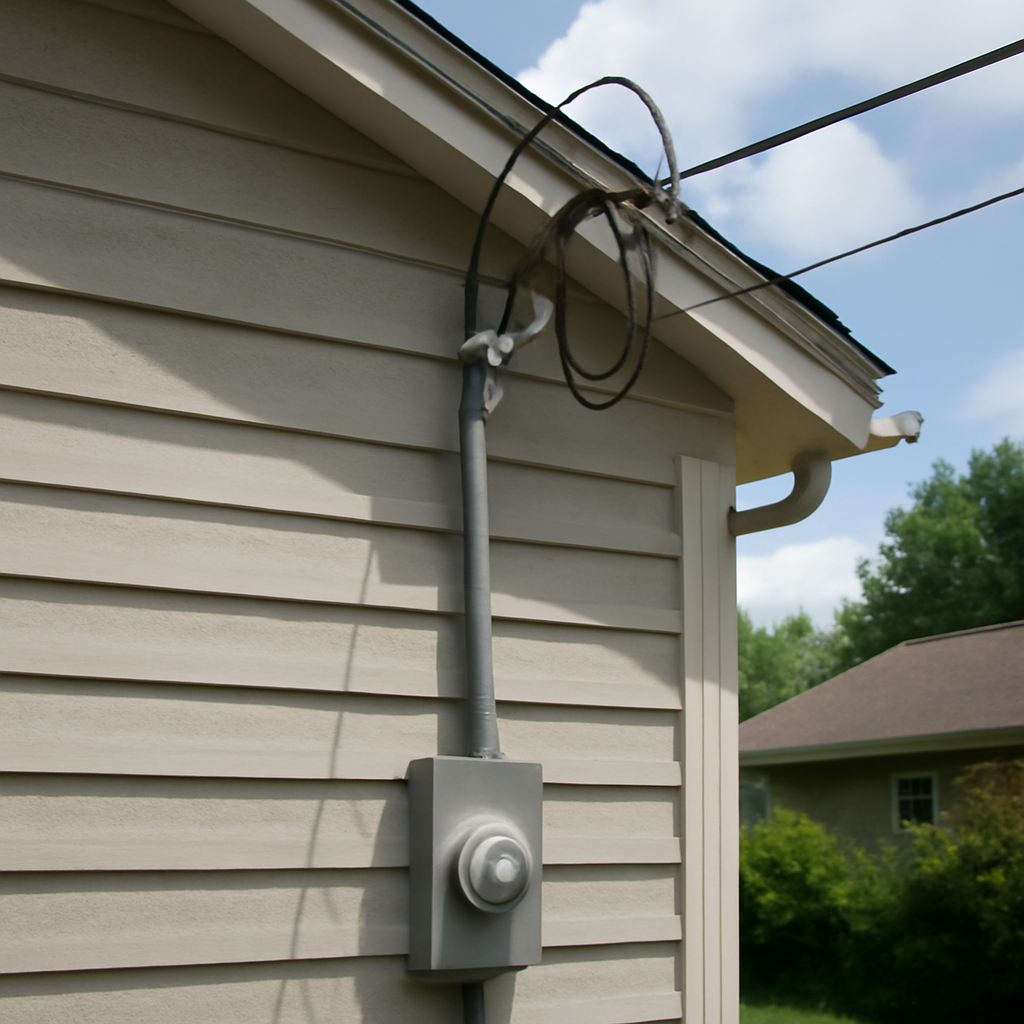
On a house with overhead electrical service, power arrives on a set of wires strung from a utility pole and attaches to the building at a fitting most people never look at twice. That fitting, the weatherhead, sits at the top of a pipe called the service mast or riser, and together they carry the utility’s power down into the meter and the main panel. They spend their whole lives exposed to wind, snow, ice, hail and falling branches, and when they fail, the result can range from a leaky meter base to a mast torn off the roof with live wires on the ground. This guide explains the parts of an overhead service, how drip loops keep water out, where the utility’s responsibility ends and the homeowner’s begins, what storm damage looks like, and what repairs typically involve on Colorado Front Range homes.
Part of our Home Electrical guide — start there for the full picture →
What a Weatherhead Is and How Overhead Service Works
A weatherhead, also called a service head or service cap, is a hooded fitting on top of the service entrance conduit or cable. Its job is to let the service entrance conductors exit the conduit while keeping rain and snow from running down inside the pipe. The conductors come out of the weatherhead through insulated openings that face downward or sideways, under a cap that sheds water.
A typical overhead service has these parts, from the pole to the house:
- The service drop. The overhead wires running from the utility pole or transformer to the house. On most homes this is a triplex cable: two insulated hot conductors twisted around a bare messenger that also serves as the neutral.
- The attachment point. An insulator or clevis bolted to the mast or to the structure, which takes the mechanical load of the drop.
- The drip loops. The sagging loops where the service drop conductors are spliced to the service entrance conductors coming out of the weatherhead.
- The weatherhead. The hooded cap at the top of the mast or riser.
- The service mast. A rigid metal conduit, commonly galvanized steel, that carries the conductors down to the meter base. On some homes the mast passes through the roof; on others it runs up the side of the wall.
- The meter base and meter. The socket enclosure that houses the utility meter. Our guides to the meter base and the electric meter cover those components.
From the meter, conductors continue to the service equipment and main disconnect, usually in the main panel.
Drip loops and why they matter
Water follows wires. Rain that lands on the service drop runs along the conductors toward the house. If the conductors entered the weatherhead going downhill, that water would run straight into the conduit and down to the meter. Drip loops solve this by forming each conductor into a low point below the weatherhead opening. Water runs down to the bottom of the loop and drips off, and the conductor then rises up into the weatherhead. A properly formed drip loop is one of the simplest and most effective pieces of weatherproofing on the whole house.
Drip loops that have been pulled tight by ice, a sagging drop or a tree limb, or that were never formed properly, can let water track into the weatherhead. That water then has a path down the mast and into the meter base, which is a common cause of rust and corrosion inside meter sockets.
Through-the-roof masts
Many Front Range ranches and bungalows have the mast running up the exterior wall and through the roof overhang, extending a few feet above the roof so the service drop clears the roof surface. Where the mast penetrates the roof, a roof jack or flashing boot with a rubber collar seals around it. That seal is a known weak point. The rubber dries, cracks and shrinks with sun exposure and freeze-thaw cycles, and a mast that has been pulled or bent can open a gap. Leaks at the mast boot can show up as stains on the soffit, rot in the overhang or water inside an exterior wall.
Roofers replacing shingles have to work around the mast and its boot. A reroof is a good time to replace the boot, and in some jurisdictions to check whether the mast itself meets current requirements.
Clearances and the Mast as a Support
Overhead service conductors have to clear the ground, driveways, decks and roofs by minimum distances set in the electrical code and in utility service requirements. Typical provisions call for more clearance over driveways and areas with vehicle traffic than over pedestrian-only areas, and specify how far conductors must clear a roof surface, with reduced clearances allowed in some cases for the short overhang portion near a through-the-roof mast. Exact distances depend on the code edition in effect, local amendments and the serving utility’s own rules, so the local building department and utility are the sources to check.
Clearance problems often appear after the original installation. A new garage, a raised deck, a second-story addition, a tall RV or a growing tree can all bring something closer to the drop than it was designed for. Lines that sag lower over time can also lose clearance. Buyers should look up when walking a property: wires that pass low over a deck, swing set, pool or driveway are worth flagging.
The mast carries a mechanical load
When the service drop attaches to the mast, the mast is not just a conduit. It becomes a structural support that takes the tension of the drop, plus wind and ice loads. Utilities commonly publish requirements for mast size, material, height above the roof and bracing, and those requirements may call for heavier pipe or guy wires when the mast extends far above the roof or carries a long span. A mast that is undersized, unbraced or attached only to roof sheathing can bend over time, pulling the weatherhead and drip loops out of position.
The mast should not be used to support anything else. Antennas, satellite dishes, cable TV lines and phone lines are commonly prohibited from attaching to it. Extra loads add stress, and other cables strapped to the mast can create clearance or bonding problems.
Storm Damage: Ice, Branches and Hail
Overhead services are vulnerable in ways underground services are not. Common sources of damage on the Front Range include:
- Ice and heavy snow. Spring snowstorms on the Front Range often drop wet, heavy snow onto trees that are already leafed out. Ice and snow loading on the drop adds tension to the mast, and loaded branches can come down onto the line.
- Falling limbs. A branch landing on the service drop can bend the mast, rip the weatherhead off, pull the meter base away from the wall or break conductors. Mature cottonwoods, silver maples and Siberian elms over older neighborhoods are frequent culprits.
- Wind. Chinook and downslope wind events along the foothills can whip lines and loosen attachments.
- Hail. Hail can crack weatherhead caps and insulators, split rubber roof boots and dent meter covers. The same storm that damages the roof often damages the boot around the mast. Our hail damage to roofs guide explains how adjusters evaluate roofing after a storm.
Warning signs after a storm
- A mast that leans, bends or has pulled away from its straps.
- A weatherhead cap that is cracked, missing or turned upward.
- Drip loops pulled taut or conductors rubbing on the roof edge, gutter or branches.
- Exposed or damaged insulation on the service conductors.
- A meter base pulled away from the wall, or water staining at the meter.
- Flickering lights, partial power loss or some circuits dead while others work, which can mean a damaged neutral or a loose connection at the drop.
Partial power, unusually bright or dim lights and appliances behaving erratically can signal a loose or broken neutral, which is a hazard and warrants a call to the utility right away.
Safety first around damaged lines
Downed or sagging service conductors should always be treated as energized. OSHA lists contact with power lines first among the most frequent causes of electrical injuries in its electrical hazard overview. FEMA’s guidance for returning home after a disaster advises looking outside for damaged power lines and other exterior damage before entering a home, turning the main electrical power off until it can be confirmed safe, and never turning power on or off or using electrical tools while standing in water. Ladders, pruning poles and roofing tools should stay well away from service conductors. Branches resting on lines should be left for the utility or a line-clearance tree crew.
Who Fixes What: Utility, Electrician and Permits
Responsibility for an overhead service is split, and the dividing line is a frequent source of confusion during storm cleanup.
The utility typically owns and maintains the service drop, the connections at the drip loops and the meter itself. If the drop is down, sagging or damaged, the utility is the party to call. In much of the Front Range that means Xcel Energy, while Colorado Springs Utilities, Fort Collins Utilities, Longmont Power and Communications and several rural electric cooperatives serve other areas.
The homeowner generally owns the weatherhead, the mast, the service entrance conductors, the meter base and everything downstream. When those are damaged, a licensed electrician makes the repair.
In practice, many storm repairs require both. A common sequence is that the utility disconnects the drop, the electrician repairs or replaces the mast, weatherhead and possibly the meter base, the local building department inspects the work, and then the utility reconnects. Most jurisdictions require a permit for service repairs, and utilities usually will not reconnect until the work has passed inspection or the jurisdiction notifies them. Exact rules vary between utilities and cities, so calling both before scheduling work saves time. Some utilities publish their own service and meter requirements, which electricians use alongside the electrical code.
Storm damage to the mast and weatherhead is often covered under a homeowners policy as part of the dwelling, subject to the deductible and policy terms. Photographs of the damage before repair help with a claim.
Repairs, Upgrades and Related Work
Typical repairs
- Replacing a cracked weatherhead cap or reforming drip loops. Relatively small jobs, though they still involve working near the service drop and usually require the utility to de-energize or coordinate.
- Replacing a roof boot around the mast. Often done by a roofer, ideally during a reroof.
- Replacing a bent or broken mast. Requires an electrician, a permit and utility disconnection and reconnection. The meter base may need to be replaced at the same time, especially if water has been entering it.
Costs
Prices depend on the region, roof access, mast height, whether the meter base needs replacing and the utility’s schedule. As a hedged 2026 guide:
- Minor weatherhead or drip loop repairs: often a few hundred dollars, though coordination with the utility can add time.
- Mast and weatherhead replacement: commonly ranging from several hundred to a couple of thousand dollars, including the permit.
- Mast, weatherhead and meter base together: typically more, often reaching into the low thousands.
- Full service upgrade: a different price bracket entirely.
When storm damage becomes an upgrade
If the mast has to be replaced anyway, it can be a natural time to consider a service upgrade. Older homes with 60- or 100-amp services that need more capacity for EV chargers, heat pumps or additions can sometimes fold that work into the repair. Our electrical panel upgrade guide covers what is involved. Some homeowners also choose to convert from overhead to underground service, which removes the mast entirely but involves trenching, utility coordination and higher cost.
Service work is also a good moment to check the grounding electrode system, which bonds the service to the earth. See our guides to electrical grounding and ground rods. A whole-house surge protector at the panel or meter is another common add-on, and homes adding backup power will need a generator transfer switch so a generator can never back-feed the utility lines through the service drop.
What Home Inspectors Look For
The ASHI Standard of Practice lists the service drop, service entrance conductors, cables and raceways, service equipment and main disconnects, and service grounding among the electrical components an inspector shall inspect. In practice, inspectors view the drop, weatherhead, mast and drip loops from the ground, and sometimes from the roof where safe, and note visible problems such as damaged insulation, a leaning mast, missing weatherhead caps, poor clearances, tree contact and water entry signs at the meter. They also describe the amperage rating of the service. They are not expected to touch or test the utility’s conductors.
The U.S. Fire Administration estimates that 24,200 residential building electrical fires were reported to U.S. fire departments in 2021, causing an estimated 295 deaths, 900 injuries and over $1.2 billion in property loss. USFA does not break those figures down by service equipment, and most residential electrical fires start inside the home. Still, water entering a meter base and loose or corroded connections at the service are conditions inspectors flag, because corrosion raises resistance at a connection and resistance produces heat.
A quick seasonal look from the ground
Homeowners do not need to climb anything to keep an eye on an overhead service. A look from the yard each spring and after any major storm can catch most problems early:
- Is the mast still straight and firmly strapped to the wall or roof?
- Is the weatherhead cap intact and facing down?
- Do the drip loops still hang below the weatherhead?
- Are any branches touching or hanging over the drop?
- Is there rust streaking below the meter or around the mast boot?
Binoculars help. Anything that looks off is a call to the utility or an electrician, not a ladder job.
Our electrical inspections section covers the rest of the electrical portion of an inspection, and the main guide to hiring a home inspector explains how to choose one.
References
- ASHI Standard of Practice for Home Inspections — American Society of Home Inspectors
- Electrical Safety Overview — Occupational Safety and Health Administration
- Tips for Returning Home Safely After a Disaster — Federal Emergency Management Agency
- Appliance and Electrical Fire Safety — U.S. Fire Administration
Frequently asked questions
What is a weatherhead on a house?
It is the hooded cap at the top of the service mast or riser where overhead electrical conductors enter. It lets the wires exit while shedding rain and snow so water does not run down the conduit into the meter.
Who is responsible for fixing a weatherhead?
The utility typically owns the service drop and meter, while the homeowner owns the weatherhead, mast and meter base. A licensed electrician repairs the homeowner side, usually with a permit, and the utility disconnects and reconnects the drop.
What is a drip loop?
A drip loop is a low sag in each conductor just below the weatherhead. Water running along the wires drips off at the bottom of the loop instead of following the conductors into the weatherhead and down to the meter.
What should be done if a storm damages the service mast?
Treat any downed or sagging line as energized, stay away and call the utility. Once the drop is disconnected, an electrician can repair the mast, weatherhead and meter base, followed by inspection and reconnection.
How much does it cost to replace a weatherhead and mast?
Small weatherhead or drip loop repairs often run a few hundred dollars, while replacing the mast and weatherhead commonly ranges from several hundred to a couple of thousand dollars including the permit. These are general 2026 ranges.
Not sure whether the mast and weatherhead on a home you are buying survived the last hailstorm? Send us a message and we will connect you with a Front Range inspector who checks the service from the drop to the panel.