Testo Combustion Analyzer: What to Know
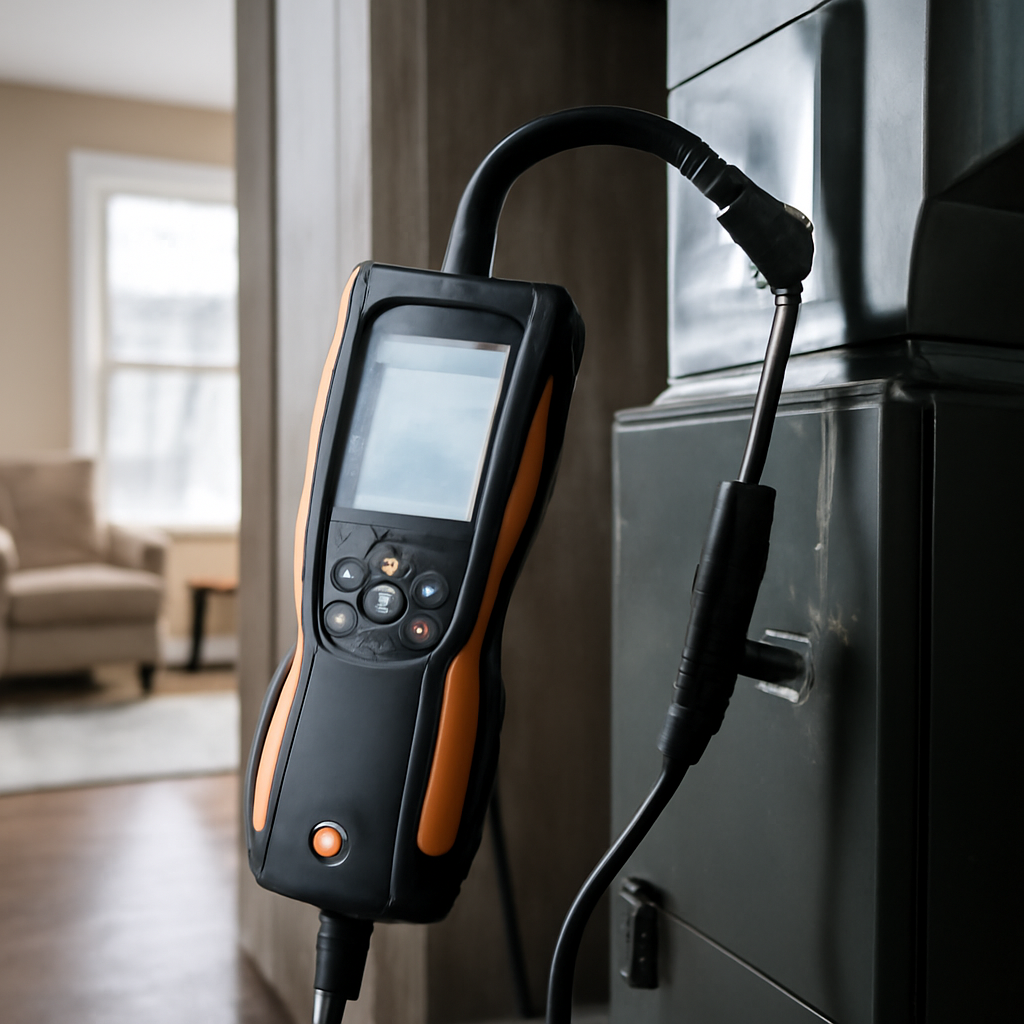
If a heating technician hands you a printout after a furnace tune-up that lists oxygen, carbon monoxide, and an efficiency percentage, the instrument behind those numbers is likely a combustion analyzer. A Testo combustion analyzer is among the most common professional tools for the job, used to read the gases leaving a gas furnace, boiler, or water heater and confirm the appliance is burning fuel cleanly and venting safely. Homeowners rarely operate one, yet knowing what it measures turns a confusing service report into useful information and helps you tell a thorough tune-up from a cursory filter swap. This guide breaks down the readings, the safety logic behind combustion testing, and where it fits in maintaining a Front Range home.
What a Testo combustion analyzer measures
A combustion analyzer draws a sample of flue gas through a probe inserted into the appliance’s exhaust and reports a set of values that describe the quality of combustion. On a typical Testo instrument the primary readings are oxygen (O2), carbon monoxide (CO), flue gas temperature, and a calculated combustion efficiency, with carbon dioxide and excess-air figures computed from the oxygen measurement.
Oxygen shows how much air is moving through the burner beyond what the fuel needs. Carbon monoxide is the safety-critical reading, because a properly tuned burner produces very little CO and a rising figure flags incomplete combustion or a venting fault. Flue temperature drives the efficiency calculation, since heat going up the chimney is heat not warming the house. The analyzer rolls these into an efficiency percentage that the technician compares against the manufacturer’s rating for that specific appliance. Different Testo models carry different sensor packages, so a basic unit may read O2 and CO while a higher-tier one adds nitric oxide or differential pressure for draft testing.
Why combustion testing matters for safety
The central reason combustion analysis exists is carbon monoxide. CO is invisible and odorless, and the CDC attributes hundreds of accidental deaths and many thousands of emergency-room visits to it each year in the United States. By sampling the flue, an analyzer detects CO production at the source, often before any reaches the living space, which makes it a more forward-looking safeguard than a room alarm by itself.
That said, a combustion analyzer and a household CO alarm do different jobs. The analyzer is a diagnostic snapshot taken during service; the alarm is continuous protection in occupied rooms. Both belong in a safe home. Our guide on whether a carbon monoxide detector will detect a gas leak helps clarify the distinct roles of CO sensing and fuel-gas sensing, a distinction many homeowners blur.
How the analyzer is used during service
Combustion testing follows a repeatable process. The technician accesses a flue test port, inserts the sampling probe, and waits for the appliance to reach steady-state operation before recording values. Those readings are then compared with the equipment specification, and the technician adjusts gas pressure, air mixture, or draft to bring efficiency up and CO down.
Reading the before-and-after
A quality report documents readings both before and after any adjustment, which demonstrates the value of the work. A meaningful drop in CO and a tightening of the excess-air figure toward target are the signs of a successful tune. If high CO persists despite adjustment, the technician should pivot to investigating the heat exchanger and the venting path rather than signing off.
Sensor calibration matters
Testo analyzers use electrochemical CO and O2 sensors that drift with age and need periodic factory calibration, generally yearly, to remain trustworthy. A drifted sensor can hide a genuine CO hazard or invent a false one. When you see a recent calibration date associated with the instrument, it is a small but real indicator that the contractor maintains their equipment properly.
Making sense of the readings as a homeowner
You do not have to interpret combustion data like a technician, but a few anchors help you read a report critically.
- Carbon monoxide (air-free CO): Lower is safer. Well-tuned residential equipment commonly runs in the low tens of parts per million air-free; readings sustained in the hundreds deserve scrutiny.
- Oxygen / excess air: A balanced figure shows enough combustion air without wasting heat. Extremes reduce efficiency and can affect safety.
- Efficiency: A percentage of fuel energy converted to usable heat. Compare it to the appliance’s own rating rather than to a modern condensing unit.
- Flue temperature: Excessively high readings indicate wasted heat or a fouled heat exchanger.
The line that should always catch your eye is a high CO reading that adjustment cannot correct. That points toward a heat-exchanger or venting problem and turns a routine tune-up into a safety decision worth a careful conversation with the technician.
The readings explained one by one
A combustion printout lists several values, and each describes a different aspect of how the appliance burns its fuel. Breaking them down makes the report far easier to read.
Oxygen and excess air
A burner needs more air than the chemically exact amount to burn fuel completely, and that surplus is the excess air. The oxygen reading shows how much surplus is present. Starve the flame of air and it makes carbon monoxide and soot; flood it with air and usable heat escapes up the flue. The technician tunes the gas-air mixture toward the manufacturer’s target, watching the oxygen figure as the primary guide.
Carbon monoxide, air-free
CO is usually reported air-free, a corrected figure that removes the diluting effect of excess air so appliances can be compared on equal footing. Well-tuned residential equipment commonly produces air-free CO in the low tens of parts per million. A reading climbing into the hundreds, or one that rises rather than settles as the appliance runs, signals incomplete combustion or a venting problem worth investigating.
Stack temperature and efficiency
Flue or stack temperature feeds the efficiency math, because heat leaving through the chimney is heat the home did not use. An unusually high stack temperature can point to a fouled heat exchanger or poor heat transfer. The efficiency percentage combines temperature and excess air into one number describing how much fuel energy becomes usable heat, and it should be judged against the appliance’s own rating rather than a modern condensing unit.
Combustion testing versus a room CO alarm
A wall-mounted CO alarm and a combustion analyzer protect against carbon monoxide at different points. The room alarm is the final safeguard, warning occupants once CO has already built up in the living space to the level the device detects. Combustion analysis is preventive, measuring CO at the source in the flue during service so a developing fault is caught before any CO reaches occupied rooms.
Both belong in a safe home. Standard residential alarms are designed to sound only above certain concentration-and-duration thresholds, so a basic alarm can miss chronic low-level CO that still affects occupants. A combustion test quantifies CO production directly. Homeowners worried about slow, sub-alarm exposure may want the added sensitivity described in our guide to the low-level carbon monoxide detector, while the analyzer remains the tool for diagnosing the appliance itself.
What combustion analysis does not cover
The test is precise but narrow. It evaluates how the burner combusts fuel and whether the flue gas is safe and efficient, but it is not a full appliance inspection. A clean combustion reading does not by itself certify an intact heat exchanger, confirm proper venting under all operating conditions, or rule out leaks in the supply piping.
A complete heating service pairs combustion analysis with a mechanical and visual inspection: examining the heat exchanger for cracks, verifying draft and venting, testing safety controls, and checking gas connections for leaks. The analyzer is one step in that workflow. When a test shows high CO that adjustment cannot fix, the technician should move on to those other systems rather than assuming the burner tune alone resolved the issue. Knowing this scope helps a homeowner ask whether the whole appliance was checked, not just the flue gas, and our broader explanation of CO versus gas-leak detection clarifies why combustion CO and a supply-line gas leak are separate concerns.
Where it fits in Front Range maintenance
Colorado’s heating season is long and its altitude changes the combustion-air picture, so proper burner tuning carries real weight along the Front Range. An annual combustion test built into a heating tune-up pays for itself through lower fuel use across a cold Denver winter and early detection of CO and draft problems that would otherwise go unseen.
For homeowners, the practical move is to ask whether combustion analysis is included in the service and to keep the readings on file year over year, since a trend tells more than a single snapshot. The analyzer is professional equipment, much like the comparable Bacharach combustion analyzer, and not a homeowner purchase. Understanding its output, however, lets you get full value from a service visit, and it dovetails with the broader instrument overview in our 2026 home inspection tools buyer’s guide.
Reading a combustion report with confidence
Knowing what the numbers mean pays off most when a technician hands over a printed or digital report. A homeowner who can read it asks sharper questions and can tell a thorough tune-up from a cursory one. A handful of habits help.
Start by checking for before-and-after readings. A report with only one set of numbers may reflect a quick measurement rather than an actual adjustment. Documented improvement, carbon monoxide and excess air pulled toward the manufacturer’s target, shows the technician tuned the appliance, not just metered it. Next, look at the carbon monoxide figure. A clean burner makes little CO, so a high or rising air-free reading that adjustment cannot resolve is the single most important line, and it should open a conversation about the heat exchanger and venting rather than a quiet sign-off.
Then ask whether the rest of the appliance was inspected. Combustion analysis evaluates flue gas, not the whole furnace, so a complete service also checks the heat exchanger for cracks, verifies draft and venting, tests safety controls, and inspects gas connections. A report listing only combustion values may have skipped these. Finally, keep reports across heating seasons. A multi-year trend reveals gradual decline that one snapshot hides and gives a new technician valuable context.
Why altitude matters for Colorado combustion tuning
Colorado’s elevation is not a footnote in combustion work; it changes the air the burner breathes. At higher altitude the air is thinner, carrying less oxygen per unit volume, which affects the fuel-air mixture a gas appliance needs to burn cleanly. Equipment installed and adjusted for sea level can run rich, producing more carbon monoxide, if not properly set up for the local elevation. This is one more reason combustion analysis matters on the Front Range and in the mountains, where a technician confirms the burner is tuned for the conditions it actually operates in. Pairing that with the long heating season makes annual combustion testing a sensible safeguard for both efficiency and safety in Colorado homes.
A final practical note concerns calibration. Because the analyzer’s electrochemical sensors drift with age and need periodic factory calibration, the trustworthiness of every reading depends on the instrument being current. A drifted sensor can mask a real carbon monoxide hazard or fabricate a false one, so a recent calibration date is a small but meaningful indicator that a contractor maintains their equipment. Homeowners who keep this in mind, and who keep their own copies of each year’s report, end up with both safer appliances and a useful maintenance history.
In the end, the analyzer gives a homeowner a view into something otherwise hidden: the chemistry of combustion inside a sealed appliance. It translates invisible flue gas into numbers that show how completely fuel burns and whether dangerous carbon monoxide is forming. For a Colorado home running gas heat through a long, high-altitude winter, that view is well worth obtaining once a year, since the modest cost of the test is small against the fuel savings and the safety confirmation it provides. Understanding the result, and filing it away, is how a homeowner captures the full value of the service.
References
- Carbon Monoxide Poisoning Prevention — Centers for Disease Control and Prevention
- Heating Safety (gas and fuel-burning equipment) — National Fire Protection Association
- Carbon Monoxide Hazards and Safe Levels — Occupational Safety and Health Administration
Frequently asked questions
What does a Testo combustion analyzer measure?
It samples flue gas through a probe and reports oxygen, carbon monoxide, flue temperature, and a calculated efficiency, with CO2 and excess-air figures derived from the readings. Technicians use it to tune the burner and verify safe venting.
Is a Testo combustion analyzer something homeowners should buy?
No. It is professional HVAC equipment that needs periodic calibration and training to use safely. Homeowners get more value from understanding the readings on a service report and keeping working CO alarms in the home.
Why is carbon monoxide the key combustion reading?
CO is colorless and odorless, and a clean burner produces very little of it. A rising flue CO reading signals incomplete combustion, a venting fault, or a cracked heat exchanger, letting a technician catch the problem at its source.
How often should a furnace get a combustion test?
Most professionals include it in an annual furnace or boiler tune-up. In Colorado's long, high-altitude heating season, yearly testing improves efficiency, lowers fuel bills, and catches CO and draft problems early.