Best Multimeter (2026): 7 Digital Meters Compared by CAT Rating
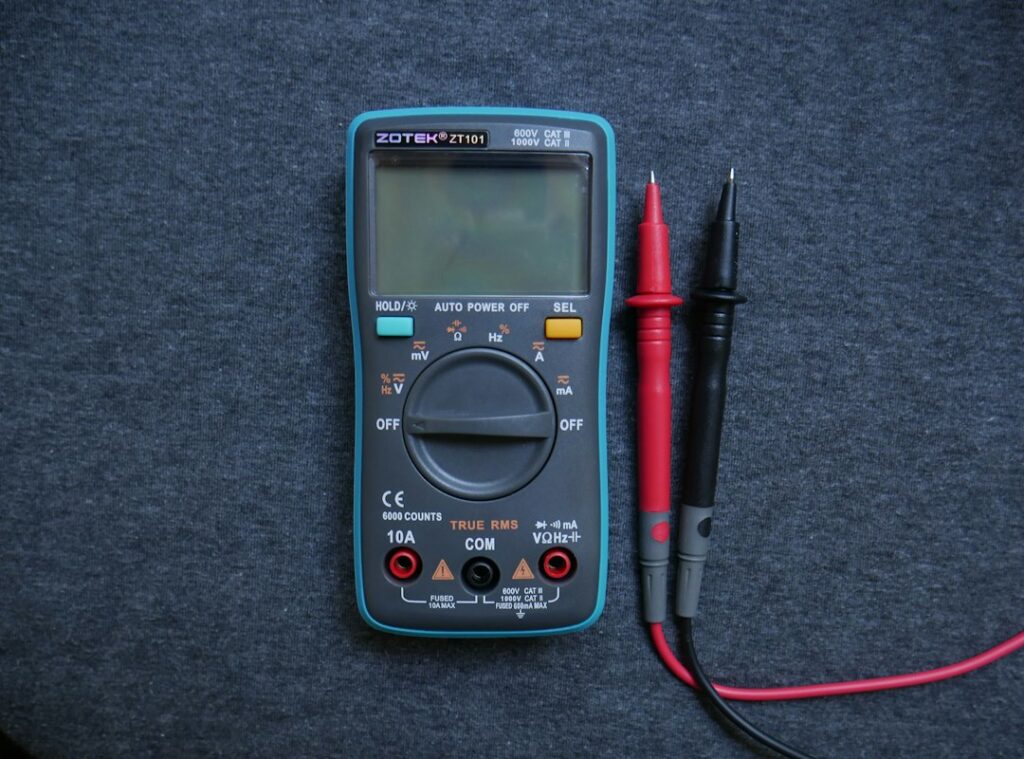
The best multimeter for a homeowner, a handyperson or a new home inspector is not the one with the most functions on the dial. It is the one with a credible safety category rating for the circuits you will touch, leads in good condition, and the handful of measurements you actually need: AC and DC voltage, continuity, resistance and maybe current or temperature. Cheap meters often skip the safety rating entirely, and that matters more than resolution. Below are seven picks from the current Amazon shelf, from a Fluke workhorse to budget meters and a clamp meter, followed by a guide to CAT ratings, test-before-touch practice and what a meter can and cannot tell you about a house.
Part of our Home Inspection Tools guide — start there for the full picture →
As an Amazon Associate we earn from qualifying purchases.
How we compared: we compared 14 current Amazon listings for digital multimeters, multimeter kits and a clamp meter on what each listing states: measurement category (CAT) rating, voltage and current ranges, True RMS, auto-ranging, counts, extra functions, fusing, lead protection, build and warranty. We did not test any meter or use it hands-on. Prices and availability change often, so check the current listing before buying.
Quick picks: the best multimeters by user
| Product | Best for | Key features | Price | Buy |
|---|---|---|---|---|
| Fluke 17B+ | Best overall for home systems |
| $144.08as of Oct 19, 2026 9:27 pm GMT+0000 | Buy now →Check current price |
| Klein MM420 | Auto-ranging True RMS pick |
| $61.01as of Oct 19, 2026 8:59 pm GMT+0000 | Buy now →Check current price |
| Klein MM325 | Manual-ranging basics |
| $29.98as of Oct 19, 2026 9:27 pm GMT+0000 | Buy now →Check current price |
| KAIWEETS KM100 | Budget meter with CAT III |
| $13.99as of Oct 19, 2026 8:59 pm GMT+0000 | Buy now →Check current price |
| AstroAI M4K0R | Built-in NCV and battery test |
| $18.99as of Oct 20, 2026 2:29 am GMT+0000 | Buy now →Check current price |
| AstroAI CM2K0R Clamp | Measuring AC current |
| $21.98as of Oct 19, 2026 8:59 pm GMT+0000 | Buy now →Check current price |
| Klein MM320KIT | Starter electrical test kit |
| $54.99as of Oct 20, 2026 2:29 am GMT+0000 | Buy now →Check current price |
Prices are Amazon’s listed prices as of the time shown and change often; check Amazon for today’s price. As an Amazon Associate we earn from qualifying purchases.
The seven picks, compared listing by listing
1. Fluke 17B+ Digital Multimeter — Best Overall for Home Systems

CAT III 600V digital multimeter measuring AC/DC voltage to 1000V, 10A current, capacitance and temperature.
Check price on Amazon$144.08 as of Oct 19, 2026 9:27 pm GMT+0000 — prices change; see Amazon for current price.Why we like it
- States a CAT III 600V safety rating
- AC/DC voltage to 1000V and current to 10A
- Temperature to 400 C with included thermocouple
- Capacitance, frequency and diode testing
| Specification | Details |
|---|---|
| Safety rating | CAT III 600V |
| Voltage / current | AC/DC to 1000V; to 10A |
| Other functions | Resistance, continuity, diode, capacitance, frequency |
| Temperature | Up to 400 C with included type K thermocouple |
| Weight | About 1 lb |
| True RMS / ranging | Not stated in listing |
Fluke 17B+ — CAT III 600V, 1000V AC/DC, 10A, capacitance, frequency, type K temperature to 400 C
The Widest Measurement Range Among the Meters With a CAT Rating
Six of the 14 listings name a measurement category rating at all. Among those six, the Fluke 17B+ is the only one from an established test-instrument maker that pairs CAT III 600V with a 1000V measurement range and a temperature probe in the box. The temperature function is practical for a home: checking supply and return air at a furnace, or the temperature rise across an electric water heater element.
A category rating describes how well a meter withstands voltage spikes in different parts of an electrical system, not just the highest voltage it reads. OSHA’s electrical safety rules for workplaces state that test instruments and their accessories must be rated for the circuits and equipment they will be connected to and designed for the environment where they will be used. Homeowners are not covered by OSHA, but the principle carries over.
What the listing omits: it does not say whether readings are True RMS or whether ranging is automatic, and it does not describe the leads or fusing. Those details are in Fluke’s own spec sheet; confirm them if they matter to you.
Pros
- Named CAT III 600V rating
- Temperature probe included
- Covers capacitance and frequency
Cons
- True RMS and ranging not stated
- No built-in NCV detector
- No CAT IV rating
Check Fluke 17B+ price on Amazon
2. Klein Tools MM420 — Best Auto-Ranging True RMS Meter

Auto-ranging TRMS meter with 600V AC/DC, 10A AC/DC, lead-alert LEDs, 6.6 ft drop rating and thermocouple.
Check price on Amazon$61.01 as of Oct 19, 2026 8:59 pm GMT+0000 — prices change; see Amazon for current price.Why we like it
- True RMS and auto-ranging
- Lead-alert LEDs show correct jack placement
- Rated for a 6.6-foot drop
- Leads ship with CAT III/CAT IV safety caps
| Specification | Details |
|---|---|
| Voltage / current | 600V AC/DC; 10A AC/DC |
| Resistance | To 50 megohms |
| Other functions | Continuity, temperature, capacitance, frequency/duty cycle, diode |
| Measurement | True RMS, auto-ranging |
| Build | 6.6 ft (2 m) drop; kickstand; lead holders |
| Meter CAT rating | Not stated in listing (lead caps described as CAT III/CAT IV) |
Klein MM420 — TRMS auto-ranging, 600V AC/DC, 10A AC/DC, 50 megohms, temperature, 2 m drop, lead-alert
One of Two Klein Meters With Lead-Alert LEDs, and the Only One With TRMS
Five listings claim True RMS, and six claim auto-ranging. The MM420 is one of only a handful that state both, alongside AstroAI, FNIRSI and ZMIWNIED models. Its distinguishing feature is lead-alert protection: LEDs light the correct input jacks for the selected function. Plugging a lead into the current jack and then probing an outlet is a classic way to blow a fuse or damage a meter, and only the two Klein MM-series listings describe a guard against it.
True RMS matters when measuring circuits with motors, dimmers, variable-speed drives or LED drivers, where the waveform is not a clean sine wave. An averaging meter can misread those loads.
The listing describes its leads as having CAT III/CAT IV safety caps but does not state the meter body’s category rating. Check the rating printed on the meter near the input jacks before using it in a panel.
Pros
- True RMS with auto-ranging
- Lead-alert guards against wrong-jack errors
- Drop-rated housing
Cons
- Meter CAT rating not stated in listing
- 600V maximum, not 1000V
- Warranty wording vague
Check Klein MM420 price on Amazon
3. Klein Tools MM325 — Best Manual-Ranging Basics
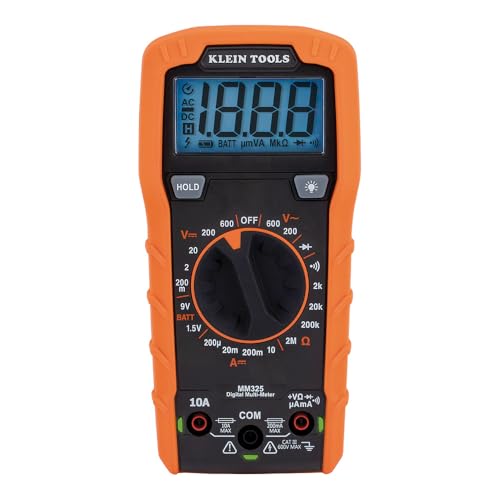
Manual-ranging meter for 600V AC/DC, 10A DC and 2 megohms, with lead-alert LEDs and a battery test mode.
Check price on Amazon$29.98 as of Oct 19, 2026 9:27 pm GMT+0000 — prices change; see Amazon for current price.Why we like it
- Lead-alert LEDs, like the MM420
- Battery test mode for household batteries
- Backlit display for panels and crawl spaces
- Kickstand and lead holders
| Specification | Details |
|---|---|
| Voltage / current | 600V AC/DC; 10A DC |
| Resistance | To 2 megohms |
| Other functions | Continuity, diode, battery test |
| Ranging | Manual |
| Weight | About 0.87 lb |
| CAT rating / AC current | Not stated in listing; no AC current function listed |
Klein MM325 — manual-ranging, 600V AC/DC, 10A DC, 2 megohms, continuity, diode, battery test, lead-alert
A Simpler Klein Meter That Keeps the Lead-Alert Feature
Manual ranging means you choose the range on the dial. That sounds old-fashioned, but it is quicker for repeated checks of the same kind and teaches what the numbers mean. The MM325 keeps the lead-alert LEDs of the MM420 while dropping True RMS, temperature and AC current.
For a homeowner, the MM325 covers the jobs that come up most: confirming 120V at an outlet, checking a fuse or a thermostat wire for continuity, testing a doorbell transformer, or seeing whether a battery is dead. The dedicated battery test mode loads the battery slightly, which gives a more honest answer than open-circuit voltage.
The listing does not state a CAT rating or an AC current function. If you need to measure what a circuit draws, pair it with a clamp meter such as pick 6.
Pros
- Lead-alert protection
- Battery test mode
- Simple dial for beginners
Cons
- No CAT rating stated
- No AC current measurement
- Not True RMS
Check Klein MM325 price on Amazon
4. KAIWEETS KM100 — Best Budget Meter With a Named CAT III Rating

Compact meter with IEC CAT III 600V rating, double fuses, overload protection and a carrying case.
Check price on Amazon$13.99 as of Oct 19, 2026 8:59 pm GMT+0000 — prices change; see Amazon for current price.Why we like it
- Names an IEC CAT III 600V rating
- Double fuses and overload protection
- Includes carrying case and batteries
- Compact, half-pound body
| Specification | Details |
|---|---|
| Safety rating | IEC CAT III 600V; CE and RoHS |
| Functions | AC/DC voltage, DC current, resistance, continuity, diode |
| Protection | Double fuses; overload protection on all ranges |
| Display | Backlit; data hold |
| In the box | Meter, 2 leads, case, 2 AAA batteries pre-installed |
| AC current | Not supported, per listing |
KAIWEETS KM100 — IEC CAT III 600V, double fuses, AC/DC V, DC A, resistance, continuity, diode, case included
A Budget Meter That Names Its IEC Category
Several budget meters on the shelf say “overload protection” or “double insulation” without naming a category rating. The KM100 names IEC CAT III 600V outright. Of the six listings that name a category, four claim CAT III 600V: Fluke, KAIWEETS and two AstroAI models.
Fusing is the other budget-meter tell. A meter that measures current must have a fuse in that input, and a proper high-energy fuse is what stops a mistake from turning into an arc in your hand. The KM100 states double fuses and overload protection on all ranges. It is upfront that it cannot measure AC current.
A rating claim on a low-cost meter is only as good as the testing behind it, and the listing does not name a certifying lab. For a homeowner checking outlets and appliances it is a reasonable starter; for panel work, a meter from a test-instrument maker with independent certification is the safer bet.
Pros
- Names IEC CAT III 600V
- Double fuses stated
- Case and batteries included
Cons
- No AC current
- No certifying lab named
- Manual functions only
Check KAIWEETS KM100 price on Amazon
5. AstroAI M4K0R TRMS Multimeter — Best With Built-In NCV and Battery Test

CAT III 600V True RMS auto-ranging meter with non-contact voltage detection and 1.5V, 9V and 12V battery tests.
Check price on Amazon$18.99 as of Oct 20, 2026 2:29 am GMT+0000 — prices change; see Amazon for current price.Why we like it
- CAT III 600V rating stated
- True RMS and auto-ranging
- Built-in non-contact voltage detection
- Battery tests for 1.5V, 9V and 12V
| Specification | Details |
|---|---|
| Safety rating | Overvoltage category III 600V |
| Ranges | 600V AC/DC; 10A; 40 megohms |
| Measurement | True RMS; 4000 counts; auto-ranging |
| Extras | NCV, battery test, capacitance, data hold, max, flashlight |
| Protection | Double ceramic fuses; silicone cover |
| Power | 2 AAA batteries included |
AstroAI M4K0R — CAT III 600V, TRMS, 4000 counts, auto-ranging, NCV, battery tests, double ceramic fuses
One of Two Meters Pairing Built-In NCV With CAT III and True RMS
Seven listings include a non-contact voltage function, either built in or as a separate pen in a kit. Only two meters combine built-in NCV with both a CAT III rating and True RMS: this M4K0R and the ZMIWNIED FS899L. The FS899L claims higher ratings, but it comes from an unfamiliar brand with a very thin spec trail, so the AstroAI gets the slot.
Its battery test modes for 1.5V, 9V and 12V cells are handy around a house: smoke alarm batteries, remotes, and a 12V garage door opener or sump backup battery. The light changes color for low versus adequate voltage.
Treat the built-in NCV the way you would treat any non-contact detector: a quick screen, not proof that a circuit is dead. The listing describes double ceramic fuses, a sensible detail at this level, but no lead category.
Pros
- CAT III, TRMS and NCV in one meter
- Practical battery test modes
- Ceramic fuses
Cons
- Lead rating not described
- 4000-count display, not 6000
- NCV is a screen, not a verification
Check AstroAI M4K0R price on Amazon
6. AstroAI CM2K0R Clamp Meter — Best for Measuring AC Current

Auto-ranging clamp meter for AC current plus AC/DC voltage, resistance, capacitance and NCV; CAT III 600V.
Check price on Amazon$21.98 as of Oct 19, 2026 8:59 pm GMT+0000 — prices change; see Amazon for current price.Why we like it
- Clamp jaw measures AC current without breaking the circuit
- Overvoltage category III 600V stated
- NCV with two-level alert
- Clear guidance on clamping one conductor
| Specification | Details |
|---|---|
| Type | Clamp meter, auto-ranging, 2000 counts |
| Current | AC only via clamp; no DC current |
| Other functions | AC/DC voltage, resistance, capacitance, diode, continuity, NCV |
| Safety rating | Pollution degree 2; overvoltage category III 600V |
| Extras | Data hold, max/min, flashlight, auto shut-off |
| Power | 2 AAA batteries included |
AstroAI CM2K0R — clamp meter, AC current, AC/DC V, NCV, CAT III 600V, 2000 counts, flashlight
The Only Clamp Meter on the Shelf
Every other listing measures current by putting the meter in series with the circuit, which means disconnecting a wire. The CM2K0R is the only clamp meter in the comparison: close the jaw around one conductor and it reads the AC current flowing through it. That makes it the right tool for checking what a space heater, window AC, sump pump or furnace blower actually draws.
The listing gets the most common mistake right: clamp one wire, not the whole cord. A cord carries current out and back, and the two cancel to roughly zero. It also warns not to use the jaw to measure voltage.
Its limits are stated too. It cannot measure DC current, and at 2000 counts its resolution is modest. Pair it with a standard meter if you need fine DC readings.
Pros
- Measures AC current safely without disconnecting wires
- CAT III 600V stated
- Built-in NCV and flashlight
Cons
- No DC current
- 2000-count resolution
- Bulkier than a pocket meter
Check AstroAI CM2K0R Clamp price on Amazon
7. Klein Tools MM320KIT — Best Starter Electrical Test Kit

Kit with MM320 meter, NCVT3P dual-range voltage pen, RT210 receptacle tester, ET45 tester and case.
Check price on Amazon$54.99 as of Oct 20, 2026 2:29 am GMT+0000 — prices change; see Amazon for current price.Why we like it
- Four testers in one case
- Dual-range NCVT3P pen with flashlight
- RT210 checks standard and GFCI outlets
- ET45 for quick plug-in voltage checks
| Specification | Details |
|---|---|
| Meter | MM320: 600V AC/DC, 10A DC, resistance, battery, diode, continuity |
| NCV pen | NCVT3P: 12–1000V AC or 70–1000V AC; flashlight |
| Receptacle tester | RT210: open ground, reverse polarity, open hot, open neutral, hot/ground reversed |
| Voltage tester | ET45: 28–240V AC, 32–330V DC |
| Extras | Carrying case and batteries |
| CAT rating | Not stated in listing for the meter |
Klein MM320KIT — MM320 meter + NCVT3P pen + RT210 receptacle tester + ET45 + case
The Most Complete Kit Among the Three Bundles
Two Klein kits appear on this shelf. The 69149P bundles a meter, an NCVT1P pen and an RT110 receptacle tester. The MM320KIT goes further with the dual-range NCVT3P pen, the RT210 receptacle tester that also handles GFCI outlets, and an ET45 two-lead voltage tester. The ZMIWNIED FS899L comes with 20 lead accessories but no separate testers.
For someone starting out, the combination makes sense because each tool answers a different question. The pen screens for voltage nearby, the receptacle tester checks outlet wiring in seconds, and the meter gives the actual reading. Home inspectors carry the same trio: ASHI’s article on essential inspection tools calls electrical testers vital for identifying electrical hazards and problems.
The listing’s spec of “2 ohm resistance” is almost certainly a typo for 2 megohms, which the 69149P listing states for the same meter family. No CAT rating is given for the meter.
Pros
- Four complementary testers
- GFCI-capable receptacle tester
- Organized case
Cons
- Meter CAT rating not stated
- Resistance spec contains a typo
- Meter is basic, no TRMS
Check Klein MM320KIT price on Amazon
CAT ratings explained
A meter’s measurement category, printed near the input jacks, describes the transient overvoltage it is built to survive in a given part of the electrical system. The closer to the utility service, the larger the possible spike.
| Category | Typical location | Home examples |
|---|---|---|
| CAT II | Plug-in loads and receptacle circuits | Appliances, outlets, extension cords |
| CAT III | Building distribution wiring | Breaker panel, feeders, hardwired appliances, permanently installed motors |
| CAT IV | Origin of the installation | Service drop, meter base, service entrance conductors |
A higher category at the same voltage is more robust, and the meter and leads together are only as good as the lower of the two ratings. On this shelf, only six of 14 listings name a category at all, and one (TESMEN TM-510) states CAT II 600V, which is not intended for panel work. OSHA requires workplace test instruments to be rated for the circuits they connect to; apply the same rule at home and match the meter to the job.
Safety: test before touch, and know your limits
Most meter accidents come from using the wrong function, damaged leads, or a meter with no meaningful protection on a high-energy circuit. Practical rules:
- Inspect leads first. OSHA requires test instruments, leads, probes and connectors to be visually inspected for external defects before use, and damaged items removed from service.
- Verify the meter on a known live source, test, then verify again. OSHA’s rules for de-energizing circuits require a qualified person to use test equipment to verify that parts are de-energized, and to check test equipment before and after the test on circuits over 600 volts. The same live-dead-live habit is good practice on any circuit.
- Shut off and lock the circuit. OSHA’s guide to controlling electrical hazards says the first step before inspection or repair is to turn the current off at the switch box and padlock it in the off position.
- Respect small currents. OSHA’s table of current effects describes 1 milliampere as a faint tingle and 5 milliamperes as a slight but disturbing shock, with painful shock and loss of muscle control at higher levels. A household circuit can deliver far more.
- Stay out of the panel unless qualified. NFPA’s home safety guidance is to have all electrical work done by a qualified electrician.
Which functions a homeowner actually needs
- AC voltage: Confirm 120V and 240V at outlets and appliance circuits.
- Continuity and resistance: Check fuses, heating elements, thermostat wiring and switches with power off.
- DC voltage: Batteries, doorbell transformers, low-voltage landscape lighting, automotive work.
- AC current (clamp): Measure appliance draw without disconnecting wires.
- Temperature: Furnace and AC temperature split checks.
- True RMS: Useful for motors, dimmers and electronics; not essential for basic outlet checks.
Counts (2000, 4000, 6000, 9999) describe display resolution. More counts help with small DC signals but do not make a meter safer. For the full inspection tool lineup, see our inspection tools hub.
Front Range use notes
Dry Colorado air and cold garages are hard on cheap leads, which stiffen and crack; replace them at the first sign of damage. Older Front Range homes may still have original panels, and some houses of the 1960s and 1970s have aluminum branch wiring. A meter can confirm voltage but cannot evaluate those systems; that needs an electrician. If you use a meter in winter, let it warm up indoors before relying on readings, as condensation on a cold meter brought inside can affect inputs.
When a meter is not enough
A meter tells you what is present at one point at one moment. It will not find a loose connection that only heats under load, an overloaded neutral, or a defective breaker that fails to trip. NFPA advises calling a qualified electrician for frequent tripping breakers or blown fuses, a tingling feeling when touching an appliance, discolored or warm outlets, a burning smell, flickering lights or sparks from an outlet. Those are not meter problems.
When buying a home, an inspection covers the visible electrical system, panel, receptacles and GFCI protection. Our home inspection tools guide explains what inspectors carry and why, and you can contact us to connect with a vetted local inspector.
Frequently asked questions
What is the best multimeter for home use?
Look for a meter that names a CAT III 600V rating, measures AC and DC voltage, resistance and continuity, and has fused current inputs. The Fluke 17B+ adds 1000V range and temperature. For measuring appliance current, a clamp meter is easier and safer than series current measurement.
What CAT rating do I need for a multimeter?
CAT II covers plug-in loads and outlets. CAT III covers building wiring such as panels, feeders and hardwired appliances, which is what most homeowners and inspectors encounter. CAT IV covers the service entrance. Choose a meter and leads rated for the highest category you will test.
Is True RMS necessary for a home multimeter?
Not for basic outlet and battery checks. True RMS gives accurate AC readings on distorted waveforms from motors, dimmers, variable-speed equipment and LED drivers. If you troubleshoot HVAC equipment or electronics, it is worth having.
Can a non-contact voltage tester replace a multimeter?
No. A non-contact tester only screens for the presence of AC voltage nearby and can miss voltage or give false readings. A multimeter with leads measures actual voltage and confirms a circuit is de-energized. OSHA's workplace rules require test equipment to verify that circuits are de-energized.
How do I safely use a multimeter on an outlet?
Inspect the leads, set the dial to AC voltage, confirm the meter on a known live outlet, then measure. Keep fingers behind the probe guards and never use the current jacks for voltage. If an outlet is warm, discolored or sparking, stop and call a qualified electrician.
References
- 1910.334 Use of Equipment — Occupational Safety and Health Administration
- 1910.333 Selection and Use of Work Practices — Occupational Safety and Health Administration
- Controlling Electrical Hazards — Occupational Safety and Health Administration
- Electrical Safety in the Home — National Fire Protection Association
- Essential Tools of the Trade — American Society of Home Inspectors