Spray Foam Insulation for a Crawl Space Guide
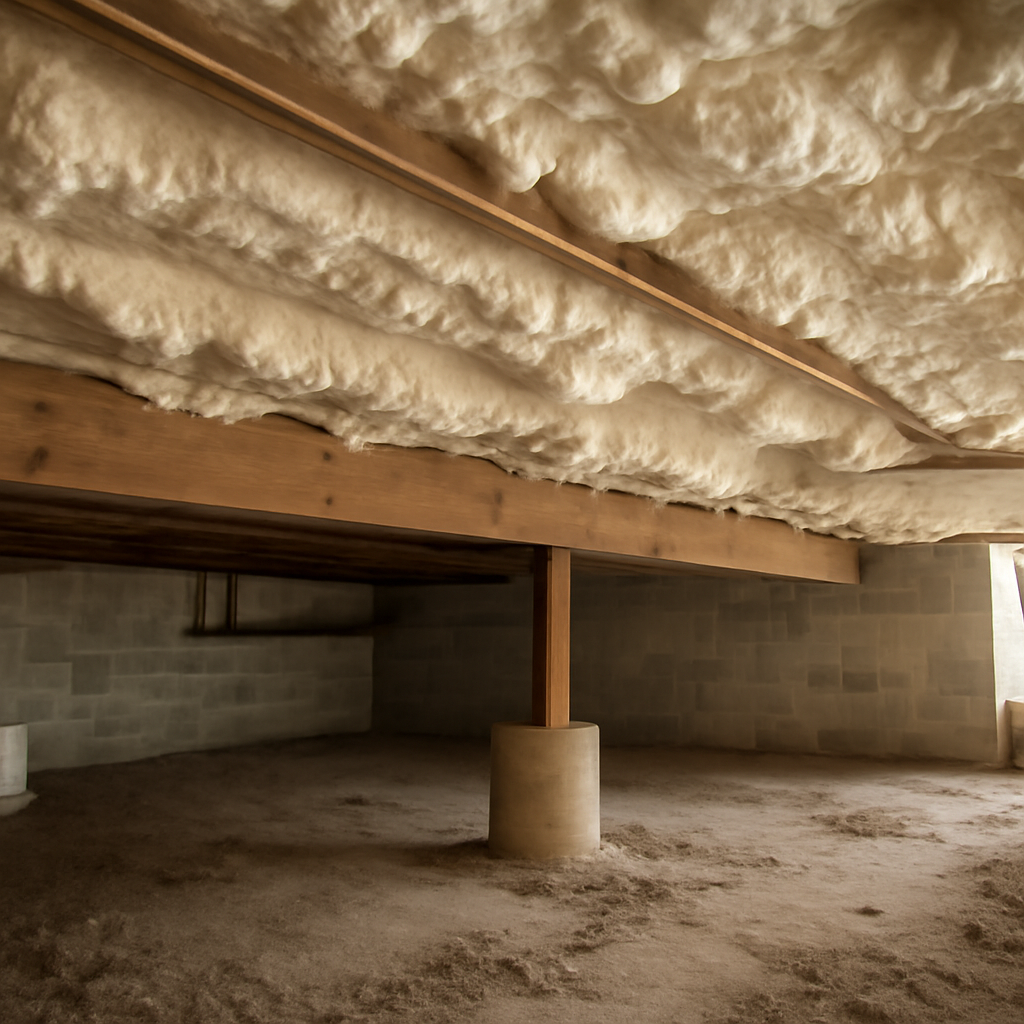
Few crawl space upgrades generate as much debate as spray polyurethane foam. Applied correctly, it seals air leaks and insulates the perimeter in a single pass, and it shrugs off the damp conditions that destroy fiberglass. Applied carelessly, it can trap moisture, off-gas during a botched cure, or violate fire code by leaving foam exposed. This guide covers spray foam insulation crawl space decisions from the ground up: the difference between open-cell and closed-cell, the R-value you get per inch, how each type handles vapor, what it costs, the code requirements, and why the safety and chemistry involved make this a job most homeowners should hand to professionals.
Is spray foam good for a crawl space?
Spray foam is one of the strongest performers for a sealed or encapsulated crawl space, and closed-cell foam in particular is a favorite for the rim joists and foundation walls. Its advantage is that it does three jobs at once. It insulates with a high R-value per inch, it seals air leaks as it expands into gaps, and closed-cell foam also acts as a moisture and vapor barrier. That combination is well suited to the humid, leak-prone environment under a house, where fiberglass tends to sag, absorb water, and grow mold within a few years.
The important qualifier is that spray foam belongs in a crawl space that has already been dried out and sealed, not one with an active water problem. Foam applied over damp wood or a wet foundation can seal moisture in against the structure. The DOE’s crawl space guidance treats moisture control as the precondition for any insulation strategy, so the correct order is to fix drainage and address ground moisture first, then apply foam. Homeowners deciding whether foam is even the right material for their situation should weigh it against other options in the overview of crawl space insulation approaches and the detailed comparison in the best insulation for a crawl space.
Open-cell versus closed-cell spray foam
Spray foam comes in two families, and the difference matters enormously in a crawl space. They are not interchangeable.
Closed-cell spray foam
Closed-cell foam is dense and rigid once cured. Its cells are sealed, which makes the material a vapor barrier as well as an insulator. It delivers roughly R-6 to R-7 per inch, the highest of any common crawl space insulation, so it hits a target R-value in less thickness. Because it resists water vapor, it is the standard choice for rim joists and foundation walls in a sealed crawl space, where controlling moisture is as important as controlling heat loss. It also adds a small amount of structural rigidity. The trade-off is cost: closed-cell is the more expensive of the two.
Open-cell spray foam
Open-cell foam is lighter and softer, with cells that are not fully sealed. It insulates at roughly R-3.5 to R-4 per inch, so it needs more thickness for the same performance, and critically it is vapor-permeable. That permeability is a problem in many crawl spaces, because it lets moisture migrate through the foam to cold surfaces where it can condense. For that reason, closed-cell is generally preferred for crawl space walls and rim joists, while open-cell sees more use in above-grade walls and attics where the moisture dynamics differ. In a damp crawl space, choosing open-cell to save money can undermine the whole point of the project.
How spray foam handles moisture and vapor
Moisture behavior is the reason spray foam wins or loses in a crawl space. Closed-cell foam at sufficient thickness functions as a vapor barrier, blocking the diffusion of water vapor from the ground and outside air into the wood framing. That is exactly what you want when sealing a foundation wall or a rim joist, provided the crawl space itself has been dried first. Sprayed directly onto the interior foundation walls, closed-cell foam creates a continuous, sealed thermal and moisture layer that fiberglass cannot match.
The risk lies in trapping water that is already there. If foam is sprayed over wood that is wet, over a foundation with active seepage, or in a crawl space without a proper ground vapor barrier, the sealed assembly can hold moisture against the structure and encourage hidden rot. This is why spray foam is best understood as the finishing layer of a moisture-controlled crawl space, applied after the ground is covered and drainage is handled. It complements a ground vapor barrier rather than replacing it; the pairing of a floor liner with sealed, insulated walls is what the guide to a crawl space vapor barrier and insulation describes as a complete system.
What spray foam costs in a crawl space
Closed-cell spray foam typically runs $3 to $7 per square foot installed at a code-appropriate thickness, and a full crawl space application often lands between $4,000 and $12,000 depending on size, thickness, access, and the amount of prep required. Open-cell is cheaper per board foot but needs more thickness to reach the same R-value, which narrows the real-world savings for crawl space use. The price is driven up by tight access, low clearance, the need to remove old insulation first, and any code-required ignition barrier over the finished foam.
Because spray foam sits in the upper-middle of the crawl space cost spectrum, it helps to see how it compares with fiberglass, foam board, and full encapsulation before committing. The companion guide on crawl space insulation cost breaks down each method’s per-square-foot range and total, which makes it easier to judge whether a foam bid is fair. Remember that a higher upfront number can still be the lower lifetime cost if it replaces a material that would fail in a damp environment.
Building code and safety requirements
Spray foam in a crawl space is governed by code, and the requirements exist for good reasons. Under the International Residential Code, foam plastic insulation such as spray foam generally must be separated from the interior of a building by a thermal barrier, and in unfinished spaces like crawl spaces an ignition barrier is typically required over exposed foam to slow its contribution to a fire. Skipping this barrier is a common way a cut-rate bid comes in low, and it is a genuine safety and code violation, not a technicality. Local building departments and the IRC specify the acceptable barrier materials.
The application itself carries safety considerations that are easy to underestimate. OSHA and manufacturer guidance flag the isocyanate chemistry in spray polyurethane foam as a respiratory and skin sensitizer during application, requiring proper ventilation, personal protective equipment, and a defined re-occupancy period while the foam cures and off-gasses. A poor mix ratio or inadequate ventilation can lead to foam that never cures correctly and continues to emit odors, a costly problem to remediate. These hazards are the core reason spray foam in a confined, poorly ventilated crawl space is professional work.
Why spray foam is usually a professional job
Everything above points to the same conclusion. Small DIY foam kits exist for sealing a rim joist or a few gaps, and for that limited scope a careful homeowner can use them. A whole-crawl-space application is different. It demands the correct product selection between open and closed cell, an even application at a controlled thickness, a proper mix ratio, adequate ventilation in a confined space, respiratory protection, adherence to the curing and re-occupancy window, and installation of a code-compliant ignition barrier afterward. A mistake in any of those areas is expensive to fix, and removing improperly cured foam is one of the most difficult remediation jobs in the trade.
Professionals also bring the diagnostic judgment that keeps foam from being applied over a wet problem. Because moisture missed at the start is the failure mode that hurts the most, hiring a contractor who inspects for water before spraying is worth the premium. Thermal imaging during or after a project can confirm the foam is continuous and free of gaps, which is one reason an inspector’s thermal imaging walkthrough pairs well with this kind of work. When you do hire, the vetting steps for finding a qualified crew are the same ones covered for any crawl space contractor.
Durability and long-term value
Part of spray foam’s appeal is how long it lasts once installed correctly. Unlike fiberglass, which sags and degrades in a damp crawl space and may need replacing within a few years, cured closed-cell foam is a rigid, moisture-resistant layer that can perform for the life of the structure. It does not settle, it does not provide a nesting medium for rodents the way batts do, and it maintains its R-value over time because its closed cells hold their insulating gas. That longevity is central to the value argument: a higher upfront cost spread over decades of service often beats a cheaper material that has to be torn out and redone.
The durability only holds if the moisture-first sequence was respected and the application was done at the right thickness with a proper cure. Foam installed over a wet space or applied poorly can fail early and is costly to remove, which flips the value equation entirely. The lesson is consistent across every section of this guide: with spray foam, the quality of the installation and the condition of the crawl space matter as much as the material itself.
Pros and cons at a glance
On the plus side, closed-cell spray foam offers the highest R-value per inch of any common crawl space option, seals air leaks that other materials leave open, resists moisture and mold, and doubles as a vapor barrier on walls and rim joists. It adheres to irregular surfaces and lasts far longer than fiberglass in damp conditions. On the minus side, it is among the more expensive methods, it is difficult and hazardous to install correctly without professional equipment, it requires a code-mandated ignition barrier, it can trap moisture if applied over a wet space, and it is expensive to remove if the application goes wrong. For a dried-out, sealed crawl space where long-term performance matters, the pros usually justify the cost. For a space with unresolved water, no insulation belongs there yet.
Where in the crawl space foam gets applied
Spray foam does not go everywhere in a crawl space; it goes where sealing and insulating together deliver the most benefit. The three common locations each serve a purpose.
The rim joist and band joist
The rim joist, the framing member that sits on top of the foundation wall around the perimeter, is one of the leakiest parts of a house and a prime target for closed-cell foam. Sealing and insulating it stops a significant amount of air infiltration and heat loss, and this is the one area where even a DIY foam kit can make sense for a careful homeowner. It is also where fiberglass performs worst, because air moves freely around loosely stuffed batts.
The foundation walls
In a sealed, encapsulated crawl space, closed-cell foam sprayed onto the interior foundation walls creates a continuous thermal and moisture layer from the sill down toward the floor. This is the location that turns a crawl space into a conditioned zone, and it pairs with the ground vapor barrier below to control moisture from both the walls and the earth.
The subfloor (vented spaces only)
In a vented crawl space that will stay vented, foam can be applied to the underside of the subfloor between the joists, insulating the living space above rather than the crawl space. This is less common with foam than with batts and is generally a lower-priority use, since the sealed-wall approach has become the preferred strategy in most climates.
Spray foam versus foam board and fiberglass
It helps to see where spray foam sits against the alternatives. Fiberglass batts are the cheapest at roughly $1 to $3 per square foot but absorb moisture, sag, and can fail within a few years in a damp crawl space, and they do nothing to stop air leakage. Rigid foam board resists moisture like spray foam and costs less at about $2 to $5 per square foot, and it is more DIY-friendly, but it cannot seal irregular surfaces or gaps the way sprayed foam can, so it needs separate air sealing to match foam’s performance. Spray foam’s edge is that it insulates, air-seals, and, in the closed-cell form, blocks vapor in one application, which is why it commands the higher price.
For a homeowner weighing these, the deciding factors are usually budget, whether the surfaces are irregular, and how much the air-sealing benefit matters. A crawl space with lots of penetrations, uneven block walls, and a leaky rim joist gets more value from spray foam. A clean, flat wall in a dry space may be served just as well by less expensive foam board. The full material comparison is laid out in the guide to the best insulation for a crawl space, which is worth reading alongside a foam quote.
Common mistakes with crawl space spray foam
Several avoidable errors turn a good material into a bad outcome. The first is spraying over a wet or unremediated space, which seals moisture against the wood and invites hidden rot; the fix is always to control drainage and ground moisture first. The second is choosing open-cell foam to save money in a location where its vapor permeability lets moisture reach cold surfaces and condense. The third is applying foam at the wrong thickness, either too thin to hit the target R-value or unevenly, which leaves gaps that thermal imaging later reveals. The fourth is skipping the code-required ignition barrier over exposed foam, which is both a safety hazard and a failed inspection. The fifth is inadequate ventilation and personal protection during application, which the OSHA guidance on spray polyurethane foam flags because of the isocyanate chemistry involved.
Nearly all of these mistakes trace back to either rushing past the moisture step or treating a professional application as a casual DIY job. A homeowner who respects the moisture-first sequence and hires a qualified crew for anything beyond a rim joist avoids the expensive failure modes. Because improperly cured or misapplied foam is one of the hardest materials to remove, the cost of getting it wrong is far higher than the premium for getting it right.
References
- Types of Insulation and R-Values — U.S. Department of Energy, Energy Saver
- Spray Polyurethane Foam and Isocyanate Safety — U.S. Occupational Safety and Health Administration
- Foam Plastic and Ignition Barrier Requirements — International Code Council
Spray foam rewards a careful, moisture-first installation, and the wrong crew can turn it into an expensive problem. If you want an experienced set of eyes on your crawl space before any foam is sprayed, you can connect with a local crawl-space and insulation professional through our contact page.