Radon Rock: Which Rocks Release Radon Into Homes
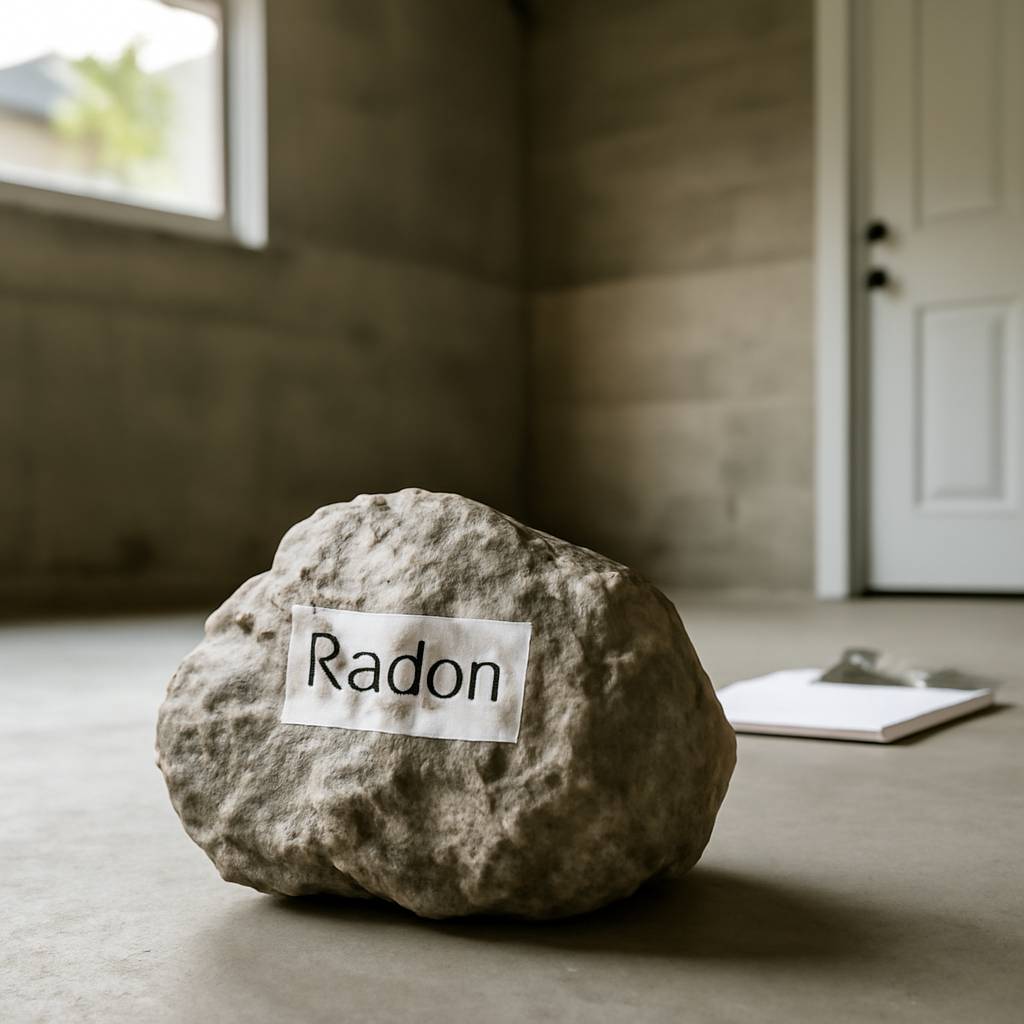
People searching for “radon rock” usually want to know one of two things: which kinds of rock give off radon, and whether the rock under or inside their own home is a problem. The short answer is that radon starts in rock, but it reaches most houses through the soil gas around the foundation, not through a decorative boulder or a kitchen counter. Geology sets the stage by deciding how much uranium sits beneath a neighborhood and how easily gas can move through the ground. The house itself then decides how much of that gas gets pulled indoors. This guide walks through the rock types that federal geologists associate with higher uranium content, what that means for the Colorado Front Range, how radon travels from bedrock into a basement, where granite countertops fit in, and why a test is the only way to know your own number. It summarizes USGS, EPA and CDC material current as of 2026 and is general information, not a site-specific assessment.
Part of our Radon Levels guide — start there for the full picture →
What “Radon Rock” Actually Means
There is no single mineral called radon rock. The phrase is shorthand for rocks that contain enough uranium to produce noticeable amounts of radon as that uranium breaks down. The U.S. Geological Survey’s booklet The Geology of Radon explains the chain: uranium decays very slowly, with a half-life of about 4.4 billion years, and eventually forms radium, which decays into radon. Radon itself has a half-life of only 3.8 days, so it does not last long, but rock keeps making more of it as long as uranium remains.
That short half-life matters for homeowners. Radon has to escape the rock grain where it forms, move through pore spaces in soil or cracks in bedrock, and reach a building before most of it decays. Rock that is rich in uranium but sealed in tight, wet clay may contribute less to a house than a modest uranium source sitting in dry, gravelly, highly permeable ground. So “radon rock” is really a combination of source strength and pathway.
The CDC describes radon in plain terms: an odorless, invisible radioactive gas naturally released from rocks, soil and water, which can get trapped inside homes and build up in the air. EPA’s A Citizen’s Guide to Radon adds that radon comes from the natural decay of uranium found in nearly all soils. Put together, the federal message is that almost every property has some radon source beneath it; the question is how much reaches the living space.
Why the rock matters less than the house
Two houses on the same street, built on the same formation, can test very differently. Foundation type, the number and size of openings, how much the house depressurizes in winter, and how the building was backfilled all change the result. Geology tells you the odds. It does not tell you the reading in a particular basement. That is why the guides on the radon testing pillar keep coming back to the same advice: test the house, not the map.
Which Rocks Tend to Contain More Uranium
The USGS booklet names the rock types that tend to carry higher than average uranium content. According to The Geology of Radon, these include light-colored volcanic rocks, granites, dark shales, sedimentary rocks that contain phosphate, and metamorphic rocks derived from those rocks. The booklet says these rocks and their soils may contain as much as 100 parts per million of uranium, and that the higher the uranium level in an area, the greater the chance of indoor radon problems.
A few of those categories deserve a closer look:
- Granites and granitic rocks. Many granites carry uranium-bearing minerals. The USGS points to granite cores, such as the Black Hills, as having high radioactivity compared with surrounding sedimentary rock. It also notes that granites in various parts of the country have produced high radon in groundwater feeding private wells.
- Dark or black shales. The booklet singles out uranium-bearing black shales, including the Chattanooga and New Albany shales in Ohio, Kentucky and Indiana and the Ohio Shale, as producing a distinctive radioactivity pattern.
- Phosphatic rocks. The USGS lists phosphatic rocks in Florida as high in phosphate and associated uranium.
- Metamorphic rocks. The Reading Prong, a band of uranium-rich metamorphic rock with numerous fault zones, is described as producing high radon in indoor air and in groundwater.
The same publication also shows the other side. It describes the Outer Atlantic and Gulf Coastal Plain, with unconsolidated sands, silts and clays, as having one of the lowest radon potentials in the country, and notes that wind in the Nebraska Sand Hills separated light quartz sand from the heavier minerals that usually hold uranium. Low-potential areas still produce some elevated homes, though, so low odds are not a reason to skip testing.
Soil inherits the rock’s signature
Most homes do not sit directly on bedrock. They sit on soil derived from weathered rock, glacial deposits, river gravels or windblown material. The USGS explains that soil generally reflects the uranium content of the rock it came from, and that glaciers can carry uranium-bearing material far from its source. It gives the example of black shale scooped up by glaciers and spread across west-central Ohio. That is one reason radon potential maps follow geology loosely rather than exactly.
Colorado and Front Range Geology
Colorado draws a lot of radon questions, and the geology is a big reason. In its summary of regional radon potential, the USGS describes the Rocky Mountains this way: granites and metamorphic rocks in these ranges contain more uranium than the sedimentary rocks to the east, resulting in high radon in indoor air and in groundwater. That broad description covers the mountain cores that rise directly behind Front Range communities.
Along the Front Range, homes sit on a patchwork. Some neighborhoods are built on or near crystalline rock in the foothills. Others sit on sedimentary formations, alluvial fans, and stream terraces made of gravel and sand washed down from the mountains. Gravelly, well-drained material can be quite permeable, and the USGS notes that homes in areas with drier, highly permeable soils and bedrock, including hill slopes, the mouths and bottoms of canyons, coarse glacial deposits and fractured bedrock, may have high indoor radon. Several of those settings describe common Front Range building sites.
None of this means every Colorado home is high, or that a plains home is automatically low. It means the background odds favor testing, and that a single neighbor’s result is weak evidence about your house. The radon levels hub collects guides on reading results, and the radon levels chart shows how readings compare with the federal action level.
Groundwater and private wells
The USGS booklet also discusses radon dissolved in groundwater. It says areas with high uranium in underlying rock are the most likely to have radon in groundwater, and it cites granites as a source of high radon in private water supplies. EPA’s Citizen’s Guide notes that radon sometimes enters a home through well water, and lists the water supply among the entry routes. For mountain and foothill homes on private wells, water is worth a separate conversation with a lab or certified professional, but soil gas still tends to be the bigger contributor to indoor air.
How Radon Moves From Rock Into a Home
Radon formed inside a mineral grain has to get out of that grain and into pore space before it can travel. From there, the USGS explains, movement depends on how much open space the ground has, how connected those spaces are, and how wet they are. Radon moves more readily through permeable soils such as coarse sand and gravel than through tight clays, and fractures in rock and clay can create fast lanes. Because radon moves more slowly through water than air, the USGS says it travels shorter distances in wet soils than in dry ones before decaying.
The house then does the pulling. The USGS describes three reasons soil air tends to flow toward a foundation: differences in air pressure between the soil and the house, openings in the foundation, and higher permeability around a basement, where a hole was dug, gravel laid under the slab, and the excavation backfilled. Warm indoor air rising and escaping through the upper house, exhaust fans, and combustion appliances can all lower pressure at the bottom of the building, which draws soil gas in.
EPA’s Citizen’s Guide states that radon from soil gas is the main cause of radon problems and lists the typical entry points:
- Cracks in solid floors
- Construction joints
- Cracks in walls
- Gaps in suspended floors
- Gaps around service pipes
- Cavities inside walls
- The water supply
Lower levels usually see the highest readings because they are closest to the soil. For more on that pattern, see the guide on radon levels in basements.
Radon Sources Compared
The table below compares the common sources people ask about. The “relative concern” column reflects the federal sources cited in this guide; where they do not rank a source directly, the wording is hedged.
| Source | How radon gets in | Relative concern |
|---|---|---|
| Soil gas from uranium-bearing rock and soil beneath the home | Pulled through slab cracks, joints, wall cracks, sumps, crawl space soil and gaps around pipes | The main cause of radon problems, per EPA’s Citizen’s Guide |
| Fractured or permeable bedrock and gravel (canyon mouths, hill slopes, coarse deposits) | Provides fast pathways that let soil gas reach the foundation before decaying | Associated with higher indoor radon in USGS material; varies house to house |
| Private well water from granitic or uranium-rich aquifers | Released into indoor air when water is used, especially in showers and appliances | Possible contributor in some homes; EPA says radon sometimes enters through well water |
| Building materials, including stone and granite countertops | Emanation from the material surface into room air | EPA says building materials rarely cause radon problems by themselves; CDC says some can release low levels |
| Decorative rocks and landscape stone outdoors | Releases into open outdoor air, where it dilutes quickly | Generally low for indoor air; outdoor radon is diluted, though all outdoor air has some radon per CDC |
Granite Countertops and Indoor Stone
Granite countertops are the “radon rock” most people actually have in the house, so they come up constantly. Some natural stone slabs do contain uranium-bearing minerals and can release small amounts of radon from their surface. The federal position is measured. The CDC radon page notes that some building materials can release low levels of radon. EPA’s Citizen’s Guide says that in a small number of homes the building materials can give off radon, but that building materials rarely cause radon problems by themselves.
Compare that with the soil under a house. A countertop is a thin slab with limited surface area, sitting in a kitchen that usually has more air exchange than a basement. The ground beneath a foundation is an essentially unlimited reservoir, and the house actively draws from it. If a home tests high, the soil pathway is by far the more likely explanation, and the fixes that work, such as sub-slab depressurization, target that pathway. The granite countertops guide covers stone questions in more detail.
A few practical points if stone is on your mind:
- Place a radon test in the lowest lived-in level as the kit directs, not on the countertop. A detector sitting on stone measures a very local condition rather than the air you breathe across the home.
- If a whole-house test is low, a countertop has not created a household radon problem.
- If a test is high, investigate and mitigate the soil pathway first. Removing stone is rarely the answer and is expensive.
- Specialty stone measurements exist, but they answer a different question than a home radon test. A certified radon professional can explain whether they add anything in a specific case.
Rock in landscaping, fireplaces and foundations
River rock in a yard, a moss-rock fireplace, or a stone retaining wall can all contain some uranium, but these features are rarely what drives an indoor reading. Outdoor stone releases into open air, which dilutes radon quickly. Interior stone veneers follow the same logic as countertops: a limited surface compared with the soil under the slab. Foundations set directly against fractured rock are a different matter, because the bedrock becomes part of the soil gas source. That is a geology issue that mitigation addresses at the slab or membrane, not by removing visible rock.
Testing: The Only Way to Know Your Number
Geology raises or lowers the odds, but EPA’s message is simple: test your home, and fix it if the radon level is 4 picocuries per liter (pCi/L) or higher. The Citizen’s Guide also says levels below 4 pCi/L still pose some risk and in many cases can be reduced. The CDC page adds that there is no known safe level of radon and that the goal should always be the lowest level achievable. It also notes that radon is the second leading cause of lung cancer deaths in the United States after cigarette smoke, and EPA’s guide says the risk is especially high for people who smoke and live with elevated radon.
Testing is not expensive or complicated. A short-term kit gives a quick snapshot; a long-term detector better reflects the year-round average. Practical details:
- Cost. Do-it-yourself kits are usually modest in price, and professional measurements cost more but come with documented protocols. The radon test cost guide breaks down the options.
- Timing. EPA defines short-term tests as 2 to 90 days and long-term tests as more than 90 days. The radon test time guide covers closed-house conditions and lab turnaround.
- Device type. Charcoal canisters, alpha-track detectors and continuous monitors all look different. The guide on what a radon detector looks like helps identify what came with a house or kit.
- Location. Test in the lowest level that is used or could be used as living space, away from drafts, high heat, high humidity and exterior walls, following kit instructions.
In a home sale, the buyer’s inspection window often drives the choice toward a short-term test or a continuous monitor. For a home you already own, a long-term test gives a better picture of what the geology and the house produce across seasons.
Mitigation When Geology Works Against You
Living on high-uranium ground does not mean living with high radon. Mitigation systems are designed to interrupt the pathway between soil gas and indoor air. The most common approach for homes with a basement or slab is sub-slab depressurization: a pipe is set through the slab into the gravel or soil beneath, and a fan draws soil gas from under the house and vents it above the roofline. Because the system lowers pressure under the slab relative to the house, gas that would have come indoors is captured and exhausted instead. The sub-slab mitigation guide explains the parts and how they work.
Crawl spaces are typically handled with a sealed plastic membrane over the soil and a suction point beneath it. Homes on fractured rock or with unusual foundations may need more than one suction point or additional sealing. Sealing cracks alone is usually not enough by itself, because new cracks form and tiny gaps are hard to close completely, but sealing does help a depressurization system work more efficiently.
After installation, retest to confirm the system is working, and keep testing periodically. The fan and manometer need occasional checks, and changes to the house, such as finishing a basement or adding an addition, can change how soil gas moves. Typical price ranges and what drives them are covered in the guide to radon mitigation system costs.
Questions to ask a mitigator
- Is the contractor certified or licensed as required in your state, and will they do a diagnostic check before quoting?
- Where will the suction point and exhaust go, and does the exhaust discharge above the roofline away from windows?
- How will the system’s operation be monitored, and what does the warranty cover?
- What post-mitigation testing is included, and who performs it?
Reading the Geology Without Overreading It
Geology maps and regional summaries are useful for setting expectations. They explain why some regions, including the Rocky Mountain front, have a reputation for radon, and they help public health agencies decide where to focus outreach. The USGS booklet is clear that you can get an idea of how concerned you should be by learning about the geology of your area. What maps cannot do is predict a single house. EPA’s Citizen’s Guide says any home may have a radon problem: new and old, well-sealed and drafty, with or without a basement.
Several common assumptions do not hold up:
- “There’s no granite under my house, so there’s no radon.” Uranium is found in nearly all soils, per EPA, and sedimentary deposits can carry material from distant sources.
- “My neighbor tested low.” Foundation details, backfill, and how each house depressurizes vary enough that a neighbor’s number is a weak predictor.
- “The countertop is the problem.” EPA says building materials rarely cause radon problems by themselves; soil gas is the main cause.
- “A newer house is safe.” Radon-resistant construction helps, but EPA says every new home should be tested after occupancy, even if it was built radon-resistant.
The practical takeaway is that geology is context, a test is evidence, and mitigation is the fix. Start with a test in the lowest lived-in level, follow up with a second test if the first is near or above the action level, and bring in a certified professional when numbers are high or the house is changing hands.
References
- The Geology of Radon — U.S. Geological Survey
- A Citizen’s Guide to Radon (2016) — U.S. Environmental Protection Agency
- Radon and Your Health — Centers for Disease Control and Prevention
Frequently asked questions
Which rocks give off the most radon?
The USGS lists light-colored volcanic rocks, granites, dark shales, phosphate-bearing sedimentary rocks and metamorphic rocks derived from them as having higher than average uranium content. More uranium generally means more radon, but soil permeability and the house itself decide how much reaches indoor air.
Do granite countertops cause high radon levels?
Rarely. The CDC notes some building materials can release low levels of radon, and EPA's Citizen's Guide says building materials rarely cause radon problems by themselves. Soil gas beneath the home is the main cause, so test the lowest lived-in level rather than the countertop.
Why does Colorado have so much radon?
The USGS describes granites and metamorphic rocks in the Rocky Mountains as containing more uranium than the sedimentary rocks to the east, resulting in high radon in indoor air and groundwater. Permeable gravels and fractured rock near the foothills can also help soil gas move.
Can decorative rocks in the yard raise indoor radon?
Outdoor stone releases radon into open air, where it dilutes quickly, so landscape rock is generally a minor factor. The ground beneath the foundation is the source that matters most for indoor readings.
If the geology is high-risk, should a home be tested even if a neighbor's result was low?
Yes. EPA says any home may have a radon problem, and results vary between neighboring houses because of foundation details and air pressure. Only a test in your own home tells you your level.
Wondering what the ground under a Front Range home means for testing or mitigation? Reach out to our team and we can help you plan the next step.
Test your home for radon
Radon is invisible and odorless, so a test is the only way to know your level. A short-term kit gives a first reading in days; a digital monitor tracks it over time.
| Product | Why | Buy |
|---|---|---|
 AirChek Charcoal Radon Test Kit AirChek Charcoal Radon Test Kit | Lab fee usually included; EPA short-term protocol. | Amazon — $21.95 |
 First Alert RD1 Radon Test Kit First Alert RD1 Radon Test Kit | Widely stocked; 48-hour charcoal test. | Amazon — $16.98 |
 Airthings Corentium Home Airthings Corentium Home | Digital monitor with a long-term average. | Amazon — $143.65 |