Ceiling Fan Direction: Summer vs Winter Settings Explained

Most ceiling fans have a small switch on the motor housing that nobody touches for years. That switch changes the ceiling fan direction, and flipping it with the seasons is one of the cheapest comfort adjustments a household can make. In warm weather the blades should push air straight down so occupants feel a breeze. In cold weather the fan can run slowly in reverse to stir warm air that collects near the ceiling without creating a chilly draft. This guide explains which way is which, why fans cool people rather than rooms, how vaulted ceilings and Colorado’s dry climate change the picture, how to fix a wobble, and what a home inspector typically notices about ceiling fans. Any savings and cost figures below are hedged, general estimates rather than promises for a particular home.
Part of our Home Electrical guide — start there for the full picture →
Which Way Should a Ceiling Fan Spin?
The short answer, based on ENERGY STAR’s ceiling fan usage tips: in summer, run the fan counterclockwise; in winter, reverse the motor and run it at low speed clockwise. Direction is judged while standing under the fan and looking up at the blades.
ENERGY STAR describes the summer setting as one where a person standing directly under the fan should feel a cool breeze, because the moving air creates a wind-chill effect that makes people feel cooler. For winter, the program says the clockwise, low-speed setting produces a gentle updraft that forces warm air near the ceiling down into the occupied space. In other words, the winter mode does not blow air at anyone. Air rises toward the ceiling, spreads outward along it, travels down the walls and returns across the floor.
A quick way to check the current setting
Turn the fan on at medium or high speed and stand underneath it. If a steady stream of air is landing on your face and shoulders, the fan is in downdraft (summer) mode. If you feel little or nothing directly below but the room air seems to move gently, it is likely in updraft (winter) mode. Watching the blades at low speed also works: note whether the leading edges sweep left to right across the top of your view (clockwise) or right to left (counterclockwise).
Some fans have blades pitched the opposite way, so the airflow test is more reliable than any label.
How to Change Ceiling Fan Direction
Changing direction is usually simple, but the method depends on the fan.
- Slide or toggle switch on the housing. Most standard AC-motor fans have a small switch on the motor housing, often just above the light kit or on the side of the switch cup. Turn the fan off and let the blades stop completely before flipping it. Changing direction while the blades are spinning can stress the motor and is a pinch hazard.
- Remote or wall control. Many newer fans, especially DC-motor models, have a reverse button on the remote or wall control. Some require holding the button for a few seconds.
- Smart and app-controlled fans. Direction may be set in a phone app or a smart-home routine, sometimes on a seasonal schedule.
A sturdy step ladder is the right tool for reaching the housing switch. Standing on a chair or the arm of a sofa is how many falls happen. If the fan is mounted high on a vaulted ceiling, a remote-controlled model or a long reach pole compatible with the fan’s controls avoids repeated ladder work.
If the switch does nothing, the fan may have a failed reversing switch or capacitor, or a remote receiver issue. Repairs inside the canopy involve line-voltage wiring, so power should be off at the breaker, not just at the wall switch, before anyone opens the housing.
Best Ceiling Fan: our top 3 picks
| Product | Best for | Key features | Price | Buy |
|---|---|---|---|---|
| ZMISHIBO BJ52 | Best overall for living rooms |
| $53.98as of Oct 30, 2026 2:40 am GMT+0000 | Buy now →Check current price |
| Amico 72 in | Large rooms and great rooms |
| $94.98as of Oct 30, 2026 2:40 am GMT+0000 | Buy now →Check current price |
| Fanbulous LY52D | High or sloped ceilings |
| $52.99as of Oct 30, 2026 2:40 am GMT+0000 | Buy now →Check current price |


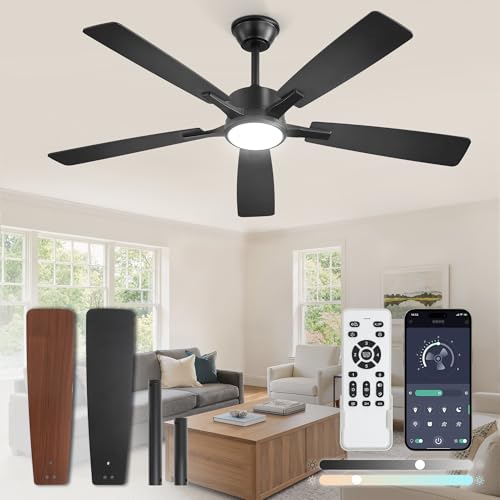
Prices are Amazon’s listed prices as of the time shown and change often; check Amazon for today’s price. As an Amazon Associate we earn from qualifying purchases.
Fans Cool People, Not Rooms
ENERGY STAR puts it plainly: ceiling fans cool people, not rooms, and if a room is unoccupied the fan should be turned off to save energy. This is the most misunderstood point about ceiling fans.
A fan does not lower air temperature. The motor actually adds a small amount of heat to the room. What it does is speed up evaporation of moisture from the skin and move the thin layer of warm air that surrounds a body, which is why moving air feels cooler than still air at the same temperature. Leaving a fan spinning in an empty bedroom all day does nothing for comfort and simply uses electricity.
Pairing a fan with the thermostat
The real energy opportunity comes from changing the thermostat. ENERGY STAR reminds users to adjust the thermostat when using a ceiling fan and says additional energy and dollar savings could be realized with that step. In practice that means raising the cooling setpoint a little in summer while the fan provides the breeze, or holding a slightly lower heating setpoint in winter while the fan mixes the air.
How much a household saves depends on climate, house size, insulation, equipment efficiency, utility rates and how many degrees the setpoint actually moves. Some households find they can raise the cooling setpoint a few degrees without losing comfort; others notice little difference. Treat any specific percentage seen online as a rough estimate rather than a guarantee.
Efficient fans use less power to move the same air
ENERGY STAR says ceiling fans that earn its label are up to 44 percent more efficient than conventional fans, using improved motors and blade designs. When a fan is being replaced anyway, checking for the ENERGY STAR label and comparing airflow per watt on the packaging is a reasonable step. DC-motor fans are often quieter and offer more speed steps, which helps with the slow winter setting.
Winter Mode, Vaulted Ceilings and Colorado Heat Stratification
Warm air rises. In a room with a standard 8-foot ceiling the temperature difference between floor and ceiling may be modest, but in a great room with a 16- or 20-foot vaulted ceiling, a noticeable layer of warm air can collect overhead while people sitting on the couch feel cool. This layering is called stratification.
Front Range homes built from the 1990s onward often feature exactly these spaces: two-story entries, open lofts and cathedral ceilings in living rooms. Forced-air systems in those houses may run longer than expected because the thermostat, mounted at about chest height, is sitting in cooler air while warm air pools near the ridge. A slow clockwise fan can help mix that air back toward the occupied zone.
Tips for winter operation
- Keep it slow. High speed in reverse can still create a perceptible draft, which defeats the purpose.
- Consider downrod length. On a tall ceiling, a fan hung too close to the peak may barely reach the occupied space; one hung too low can feel drafty. Manufacturers publish recommended downrod lengths by ceiling height.
- Watch for drafts near seating. If people still feel a chill, drop the speed or try a short trial at the summer setting on the lowest speed. Some households in tall rooms find a very slow downdraft works better than reverse.
- Pair with good air sealing. Mixing air helps, but warm air at the ceiling of a leaky house may simply be escaping through the attic. Fans do not fix air leaks or thin insulation.
Humidity and dry winter air
Colorado’s winter air is dry, and moving air across skin increases evaporation, which can make the room feel cooler and drier. That is one reason winter mode runs slowly and indirectly. Homes with a whole-house humidifier may want to review settings alongside fan use; our guide to the humidistat and winter humidity settings covers how to avoid condensation on windows while keeping air comfortable.
Ceiling Fans, Whole-House Fans and Zoning
Ceiling fans are one part of a broader comfort toolkit. They do not replace other strategies, and they work best alongside them.
Whole-house fans
A whole-house fan pulls cool evening air in through open windows and exhausts warm air through the attic. On the Front Range, where summer nights often cool off substantially, this approach can flush heat from a house quickly. A ceiling fan then keeps air moving across occupants during the day after windows close. For more on sizing, attic venting and backdraft concerns, see our guide to whole house fans and when they make sense.
Zoning and room-by-room comfort
Upstairs bedrooms that run hot in summer are a common complaint in two-story Colorado homes. Ceiling fans in those rooms help occupants feel cooler, but they do not move conditioned air from one floor to another. If one floor is consistently several degrees warmer than another, duct design, return air paths or zoning may be worth examining. Our overview of HVAC zoning, dampers and multi-thermostat setups explains the options.
Evaporative coolers and air conditioning
Many older Front Range homes use evaporative (swamp) coolers. A ceiling fan can help distribute cooled air, though the cooler itself already moves a large volume of air. With central air conditioning, running ceiling fans in occupied rooms is one common way households justify a higher setpoint. Either way, turn fans off in empty rooms.
Wobble, Noise and Balancing
A wobbling fan is one of the most common ceiling fan complaints. Some movement at high speed is normal, but noticeable shaking, clicking or a fan that sways visibly warrants attention.
ENERGY STAR’s installation tips outline a practical sequence. First, make sure all connections are properly aligned and tightly fastened. Next, check blade alignment by holding a yardstick vertically along the blade edges; a misaligned blade holder can sometimes be gently bent back into place. If all blades line up, a balancing kit, often included with the fan as clips and adhesive weights, can help locate and correct the imbalance. The program notes that manufacturers may send these kits free of charge.
Other causes of wobble and noise
- Loose screws where the blade irons attach to the motor or the blades attach to the irons.
- A canopy or downrod that is not fully seated in its mounting bracket.
- Warped blades, which can happen to particleboard blades in humid rooms or near sunny windows.
- A mounting box that is not rated for fan support or is loose in the ceiling.
- A light kit glass shade that rattles because its set screws are loose.
- Humming from using an ordinary dimmer as a fan speed control, which ENERGY STAR notes can cause the motor to hum.
Persistent wobble after balancing, or any movement of the mounting box itself, is a safety concern rather than a nuisance and should be checked before the fan is used again.
Installation Safety and What Inspectors Look For
Direction is a user setting, but the fan’s mounting and wiring are safety items. ENERGY STAR advises using an appropriate UL-listed metal box marked “For Use With Ceiling Fans,” notes that replacing a ceiling light fixture often means replacing the electrical box, recommends anchoring the fan to a ceiling joist where possible or using a fan-rated brace between joists, and points out that ceiling fans can weigh as much as 50 pounds. It also tells consumers to read and understand manufacturer instructions before attempting an installation.
A fan hung from a plastic light-fixture box with only drywall for support is a classic finding. So are fans where blade tips are too close to the floor, a sloped ceiling or a nearby wall. For the full installation picture, including box ratings, braces, wiring and clearances, see our guide to ceiling fan installation.
During a home inspection
The ASHI Standard of Practice calls for inspecting a representative number of installed lighting fixtures, switches and receptacles, along with GFCI and AFCI protection. In practice, an inspector will often operate ceiling fans at their controls and may note:
- Excessive wobble or noise during operation.
- A fan that does not respond to its wall switch, pull chain or remote.
- Loose or missing canopy covers, exposed wiring or a visibly sagging mount.
- Low blade clearance in walkways or above beds.
- Scorch marks or a burning smell at the housing or switch.
Inspectors generally do not test every speed and direction, disassemble the fan to confirm the box rating, or evaluate energy performance. Our electrical inspection hub outlines what is typically covered, and our broader guide to hiring a home inspector explains how to read the scope of an inspection agreement.
Costs: Running, Replacing and Installing a Fan
All figures here are broad, hedged estimates. Local labor rates, ceiling height, attic access and the condition of existing wiring all move the numbers.
- Operating cost. A ceiling fan generally uses far less electricity than a central air conditioner, often comparable to a few light bulbs at higher speeds and less at low speed. Actual cost depends on the fan’s wattage, hours of use and the household’s electricity rate; the wattage is usually listed on the packaging or the ENERGY STAR product finder.
- Replacing a fan on an existing fan-rated box. Fan prices range widely, from budget models under a hundred dollars to designer and smart fans costing several hundred or more. Professional installation on an existing, properly rated box may be a modest labor charge.
- Adding a fan where only a light was. Replacing the box with a fan-rated brace, adding a separate switch leg for the light and fan, or reaching a high ceiling can push labor into the low to mid hundreds of dollars or higher.
- New wiring runs. Installing a fan where no ceiling box exists, especially with finished ceilings above and no attic access, can cost considerably more because of drywall repair and wiring work.
- Balancing kits and parts. Balancing kits are inexpensive, and some manufacturers supply them at no cost. Replacement remote receivers, capacitors and switches typically run tens of dollars in parts, plus labor if an electrician does the work.
When hiring help, a licensed electrician is the usual choice for new circuits and boxes. Colorado requires electrical permits for many types of electrical work; check with the local building department for what applies to a particular project.
Seasonal Checklist for Ceiling Fans
A simple twice-a-year routine keeps fans quiet, efficient and safe.
- Late spring: switch to counterclockwise for summer downdraft. Wipe dust from blade tops, which also helps with balance. Check that blades are tight.
- Early fall: switch to clockwise and set the fan to low speed for winter. Confirm there is no draft at seating areas.
- Any time: turn fans off when leaving a room and revisit the thermostat after changing modes.
- After any ceiling work: confirm the canopy is tight and the fan is still secure, especially after drywall repair, roofing or attic insulation work above the room.
Getting the ceiling fan direction right takes about thirty seconds per fan, costs nothing, and makes both summer and winter comfort a little easier. The bigger savings come from what the fan allows: a slightly higher cooling setpoint, a slightly lower heating setpoint and a habit of switching off fans in empty rooms.
References
- Ceiling Fan Installation and Usage Tips — ENERGY STAR, U.S. EPA and U.S. DOE
- ENERGY STAR Certified Ceiling Fans — ENERGY STAR
- Ceiling Fan Accessories and Purchasing Choices — ENERGY STAR
- ASHI Standard of Practice for Home Inspection — American Society of Home Inspectors
Frequently asked questions
Which way should a ceiling fan turn in summer?
Counterclockwise when viewed from below. ENERGY STAR says standing under the fan in this mode should produce a cool breeze, creating a wind-chill effect that makes occupants feel cooler.
Which way should a ceiling fan turn in winter?
Clockwise at low speed. ENERGY STAR says this creates a gentle updraft that moves warm air near the ceiling down into the occupied space without blowing directly on people.
Does running a ceiling fan lower the room temperature?
No. Fans cool people, not rooms, so ENERGY STAR advises turning them off when a room is empty. Savings come from adjusting the thermostat setpoint while the fan provides comfort.
Is it worth reversing a ceiling fan in a room with a vaulted ceiling?
Often yes, because warm air can collect near a tall ceiling. Run the fan slowly so it mixes air without creating a draft, and choose an appropriate downrod length for the ceiling height.
Why does a ceiling fan wobble?
Common causes include loose blade screws, misaligned blade holders, warped blades or a loose mounting box. Tighten connections, check blade alignment and use a balancing kit; any movement of the box itself needs prompt attention.
Buying a home with tall ceilings, older fans or uncertain wiring? Reach out through our contact page and we can help you connect with a Front Range inspector who will look at fixtures, mounts and electrical safety before closing.