Humidistat: Setting Humidity for Colorado Winters and Summers
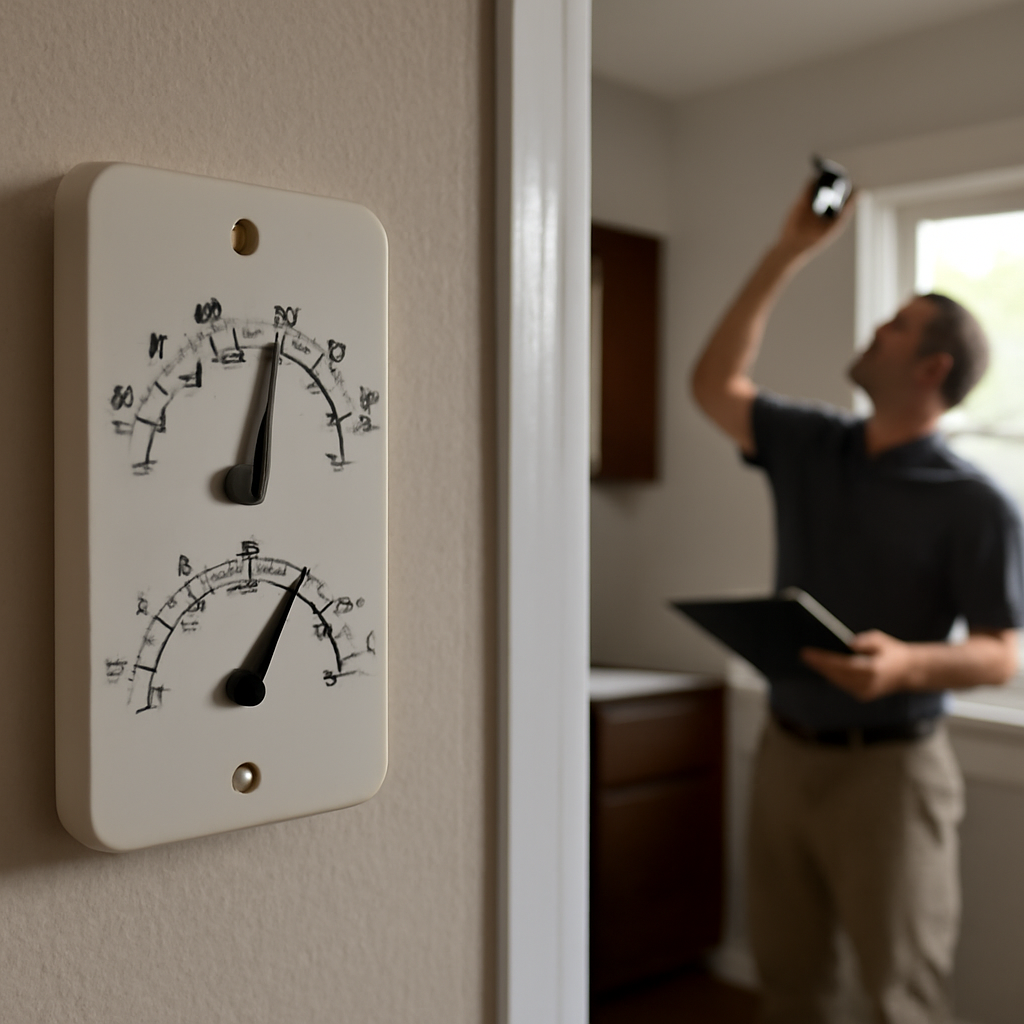
Along the Front Range, indoor air swings between two very different problems. In January a furnace running against single-digit outdoor temperatures can pull a Denver living room down to bone-dry levels, and in a wet July a basement in Littleton or Loveland can feel clammy. A humidistat is the small control that sits between those extremes. It reads relative humidity and switches a humidifier, dehumidifier or exhaust fan on and off to hold a target. Getting the setting right matters more than most homeowners expect, because the wrong number can fog windows, feed mold in wall corners, or leave a household with cracked lips and static shocks. This guide explains how humidistats work, which ranges federal guidance describes, how to adjust settings as the weather turns, and what a home inspector typically looks at when one is installed.
Part of our Heating, Cooling & Ventilation guide — start there for the full picture →
What a Humidistat Does and Where It Is Used
A humidistat is a humidity-sensing switch. Where a thermostat compares room temperature to a setpoint, a humidistat compares relative humidity (RH) to a setpoint and closes or opens a circuit to run equipment. Relative humidity is the amount of water vapor in the air compared with the most the air could hold at that temperature, which is why the same moisture content reads very differently in a warm upstairs bedroom and a cool basement.
Humidistats show up in several places in a typical Colorado house:
- Whole-house humidifiers. A bypass, fan-powered or steam humidifier on the furnace is usually wired to a wall-mounted or duct-mounted humidistat that calls for moisture only when the air is drier than the setting.
- Portable and whole-home dehumidifiers. ENERGY STAR notes that all of its certified dehumidifiers include a built-in humidistat that lets the owner choose the desired RH, and the unit cycles on and off automatically to hold it.
- Bathroom exhaust fans. Humidity-sensing fans and wall controls switch on when a shower raises the RH and keep running until it falls.
- Smart thermostats. Many connected thermostats include a humidity sensor and accessory terminals that can control a humidifier or dehumidifier directly, replacing a separate wall control.
The device itself is simple. Older mechanical humidistats used a strip of nylon, hair or other material that expands and contracts with moisture. Most current models use an electronic capacitive sensor and a small display. Either type is only as useful as its location and its setting, which is where most of the practical questions come from.
What Humidity Level Should a Humidistat Hold?
The starting point for most homeowners is the U.S. Environmental Protection Agency. In A Brief Guide to Mold, Moisture and Your Home, the EPA advises keeping indoor humidity below 60 percent relative humidity and, ideally, between 30 and 50 percent. The agency’s Care for Your Air guide repeats the 30 to 50 percent range and notes that high humidity keeps the air moist and increases the likelihood of mold. The EPA’s mold course for building professionals uses the same numbers and adds that low humidity may also discourage pests such as cockroaches and dust mites.
That gives a broad target band. The harder question is where inside that band to set the control in a given season.
Winter Settings and Window Condensation
Cold weather changes the math. Window glass, especially older double-pane units and aluminum frames, gets much colder than the room air in January. When warm, humid indoor air touches that cold surface, it can cool to its dew point and leave water on the glass. ENERGY STAR’s dehumidifier guidance states that in colder climates, during the heating season, humidity levels should be in the range of 30 to 40 percent RH to prevent window condensation.
Many humidifier manufacturers go a step further and publish charts that suggest lowering the humidistat setting as the outdoor temperature drops, sometimes to the low 30s or below on the coldest nights. Those charts vary by brand and are not federal guidance, so they are best treated as a starting point. A practical approach used by many homeowners looks like this:
- Start the heating season near 35 percent.
- Check windows on cold mornings, especially north-facing bedrooms and bathrooms.
- If water or frost forms on the inside of the glass, lower the setting by five points and check again after a few days.
- When a warmer stretch arrives, nudge the setting back up if the house feels uncomfortably dry.
The EPA lists condensation on windows, walls or pipes as a sign of high humidity and advises acting quickly to dry the wet surface and reduce the moisture source. Repeated condensation on sills can stain wood, peel paint and support mold around the frame.
Summer and Basement Settings
Summer reverses the job. On the Front Range, a dehumidifier is most often needed in basements and crawl spaces, where cool concrete raises relative humidity even when the rest of the house feels comfortable. A dehumidifier humidistat set around 45 to 50 percent keeps the space within the EPA’s ideal range without running the unit constantly. Setting it to 30 percent in a cool basement may keep the compressor running for hours with little benefit and higher electricity use. The basement humidity guide covers measuring and drying below-grade spaces in more detail.
Humidistats in Dry Colorado Winters
Colorado’s semi-arid climate means many homes along the Front Range drop well below 30 percent RH once the furnace starts running steadily. Cold outdoor air simply carries little moisture, and when it leaks into the house and is heated, its relative humidity plummets.
That is why so many Colorado houses have a humidifier mounted on the furnace plenum. The humidistat is what keeps that humidifier from overdoing it. Without a control, or with a control set too high, a humidifier can push moisture into exterior walls and attic spaces, where it may condense on cold sheathing or roof decking. The EPA’s mold course lists humidifiers among the sources that can raise humidity in a building and advises operating and maintaining in-duct humidification equipment strictly according to the manufacturer’s recommendations.
For homeowners comparing equipment types and installation questions, the guide to a whole-house humidifier explains bypass, fan-powered and steam models. Households fighting the opposite problem in a tightly sealed newer home, a busy kitchen or a damp lower level can find practical steps in how to lower humidity in a house.
Where to Mount the Control
A humidistat reads only the air around it. Placement guidelines from most manufacturers follow the same logic as thermostat placement:
- Mount wall controls on an interior wall in a commonly used area, away from bathrooms, kitchens and exterior doors.
- Keep the sensor out of direct sunlight and away from supply registers that blow warm, dry air.
- For duct-mounted humidistats, many installation manuals call for mounting on the return duct, upstream of the humidifier, so the sensor reads house air rather than freshly humidified supply air.
Placement errors explain many complaints. A control mounted next to a bathroom door may read high after every shower and shut the humidifier off while the rest of the house stays dry. A control above a supply register may read low and run the humidifier much longer than needed.
Manual, Automatic and Smart Humidistats
Humidistats fall into a few broad categories, and the choice affects how much attention the system needs through the winter.
Manual Dial Controls
The simplest wall humidistats have a dial marked in percentages. The homeowner sets a number and the control holds it until someone changes it. These are inexpensive and durable, but they depend on someone remembering to turn the setting down when an arctic front arrives.
Automatic Outdoor-Reset Controls
Some humidifier manufacturers sell controls with an outdoor temperature sensor, usually mounted on the north side of the house or in the outdoor air stream. The control lowers the target humidity automatically as outdoor temperatures fall and raises it again as temperatures climb. The homeowner usually adjusts only a window-protection or comfort dial. These controls address the condensation problem directly, which is why they are popular in cold climates.
Smart Thermostats with Humidity Control
Several smart thermostats can read indoor humidity and, when wired correctly, operate a humidifier or dehumidifier. Some pull outdoor temperature from an internet weather feed to adjust the target, much like an outdoor-reset control. The trade-off is wiring complexity. These thermostats typically need dedicated accessory terminals, and some humidifier setups require an isolation relay or a separate transformer.
Wiring a Humidistat with a Thermostat and Furnace
Most whole-house humidifiers run on 24-volt control power from the furnace. In a common bypass setup, the humidifier’s solenoid valve opens only when two conditions are met: the humidistat calls for moisture, and the furnace blower or burner is running. That interlock prevents water from running over the humidifier pad when no air is moving across it. Fan-powered and steam units have their own wiring arrangements, and some draw line voltage.
Because the interlock arrangement varies by furnace control board and humidifier model, wiring errors are common. Typical symptoms include a humidifier that runs water continuously, one that never runs, or a thermostat display showing a humidity call with no water flowing. Homeowners exploring their own controls can start with the overview of thermostat wiring and terminal labels, but it is sensible to shut off power at the furnace switch before opening any panel and to bring in a licensed HVAC technician for anything beyond swapping a like-for-like wall control. Some jurisdictions require permits for new humidifier installations, particularly when plumbing or line-voltage work is involved.
Dehumidifiers add another wrinkle. A portable dehumidifier uses its own built-in humidistat. A whole-home ducted dehumidifier usually has a dedicated wall control or a smart thermostat connection, and its drain line has to be routed correctly, a topic covered in the companion guide to the dehumidifier drain hose.
Bathroom Fan Humidistat Controls
A humidistat is not only for heating equipment. Bathroom exhaust fans with built-in humidity sensors, or wall switches with humidity sensing, start the fan when a shower raises the RH and shut it off once moisture falls back toward a set level. That automatic run time addresses a familiar problem: occupants switch the fan off as they leave the room while the mirror is still fogged.
The EPA notes that when mold in a shower or elsewhere in a bathroom keeps reappearing, increasing ventilation by running a fan or opening a window, along with more frequent cleaning, will usually prevent it from recurring or at least keep it to a minimum. Humidity-sensing controls are one way to make that ventilation happen without anyone remembering. A few cautions apply:
- In very dry Colorado winters, a sensor set high may never trip, because the bathroom never reaches the threshold even after a hot shower. Some controls offer an adjustable or self-learning threshold for that reason.
- In humid summer weather, a sensor set low may run the fan for long stretches.
- Humidity sensing works best combined with a manual on switch or a timer override.
The trade-offs between countdown timers, humidity sensors and occupancy sensors are compared in the guide to choosing a bathroom fan timer.
Signs a Humidistat Is Set Wrong or Failing
Humidistats rarely fail dramatically. More often, the setting drifts out of step with the season or the sensor slowly loses accuracy. Clues that something needs attention include:
- Water or frost on the inside of windows on cold mornings, often with dark staining or peeling paint on sills.
- Persistent musty odor in a basement or closet despite a dehumidifier that appears to be running.
- A humidifier that never seems to run even when the house feels very dry and a separate hygrometer reads in the teens or low 20s.
- Standing water or mineral crust around a furnace humidifier, which can indicate a stuck solenoid or a wiring issue rather than a control setting.
- A large disagreement between the humidistat display and an independent hygrometer.
A simple check is to place an inexpensive digital hygrometer next to the control for a day. The EPA describes humidity meters as small, inexpensive instruments that are available at many hardware stores. Consumer hygrometers have their own tolerance, so a difference of a few points is normal. A gap of ten points or more suggests that the sensor, its placement or its calibration deserves a closer look.
What Home Inspectors Look For
Under the American Society of Home Inspectors (ASHI) Standard of Practice, humidifiers and dehumidifiers are listed among the heating-system items an inspector is not required to inspect. Many inspectors still note what they see, such as a humidifier with heavy scale, a disconnected drain, water staining on the furnace cabinet, or a missing humidistat. The same standard does require inspectors to inspect kitchen, bathroom, laundry and similar exhaust systems, which is where humidity-sensing bath fan controls tend to come up in a report.
Buyers who want a closer look at humidification equipment can ask the inspector in advance whether it falls inside or outside the scope of the inspection, or schedule a separate HVAC service visit during the inspection period. The heating and cooling inspection hub explains how inspectors approach furnaces, boilers and related equipment, and the broader guide to hiring a home inspector covers scope questions to raise before booking.
Humidistat Costs and Replacement
Prices depend on the type of control, the brand and local labor rates, so the figures below are rough ranges rather than quotes. Basic manual wall humidistats for furnace humidifiers are often sold in the tens of dollars. Automatic controls with an outdoor sensor tend to cost more, frequently in the low hundreds. Replacing a bathroom switch with a humidity-sensing control is usually a modest parts expense, while a new fan with a built-in sensor costs more, especially if ducting changes are needed.
Labor is often the larger share. A service call to replace a wall humidistat may be bundled into routine furnace maintenance, while a full humidifier installation with plumbing, wiring and a new control generally runs several hundred dollars or more along the Front Range. Requesting written quotes from more than one licensed contractor is the most reliable way to understand local pricing.
How to Set and Maintain a Humidistat
A short seasonal routine keeps most systems on track:
- Fall startup: clean or replace the humidifier pad, confirm water supply and drain are working, and set the humidistat to a conservative level in the mid-30s.
- First cold snap: check windows and lower the setting if condensation appears.
- Midwinter: compare the control with a separate hygrometer and adjust if they disagree significantly.
- Spring shutdown: turn the humidistat to off, close the humidifier water valve, and close the bypass damper if the system has one.
- Summer: set basement or crawl space dehumidifiers to hold below 50 percent and empty or check drains regularly.
Keeping the numbers within the EPA’s 30 to 50 percent band most of the year, and toward the lower end during the coldest weeks, protects both comfort and the building.
References
- A Brief Guide to Mold, Moisture and Your Home — U.S. Environmental Protection Agency
- Care for Your Air: A Guide to Indoor Air Quality — U.S. Environmental Protection Agency
- Mold Course Chapter 2 — U.S. Environmental Protection Agency
- Dehumidifiers: Buying Guidance, Relative Humidity and Humidistats — ENERGY STAR (U.S. EPA)
- ASHI Standard of Practice for Home Inspections — American Society of Home Inspectors
Frequently asked questions
What should a humidistat be set to in winter?
ENERGY STAR says that in colder climates during the heating season, indoor humidity should be in the 30 to 40 percent range to prevent window condensation. Many households start near 35 percent and lower the setting if water or frost appears on the inside of windows on cold mornings.
What is the difference between a humidistat and a thermostat?
A thermostat senses temperature and controls heating or cooling equipment. A humidistat senses relative humidity and controls a humidifier, dehumidifier or exhaust fan. Some smart thermostats combine both functions in one wall unit.
What humidity level does the EPA recommend indoors?
The EPA advises keeping indoor relative humidity below 60 percent and ideally between 30 and 50 percent. Readings above that band raise the risk of condensation and mold, while very low readings can make a home uncomfortable.
Where should a humidistat be mounted?
Wall controls generally belong on an interior wall in a commonly used room, away from bathrooms, kitchens, exterior doors, sunlight and supply registers. Duct-mounted humidistats are typically installed on the return duct upstream of the humidifier, following the manufacturer's instructions.
Do home inspectors check humidistats and humidifiers?
Under the ASHI Standard of Practice, humidifiers and dehumidifiers are outside the required scope of a heating inspection, though many inspectors note visible problems. Buyers who want an evaluation can ask about scope in advance or schedule an HVAC technician.
Shopping for a Front Range home with a furnace humidifier or a damp lower level? Send us a note and we can point you toward a local inspector who will flag moisture and ventilation questions before closing.