Ceiling Fan Installation Cost: Typical Labor and Wiring Prices

Ceiling fan installation cost typically runs from about $100 to $300 in labor when a fan replaces an existing fan or light on a box that is already rated to hold it, and roughly $300 to $900 or more when an electrician has to run new wiring, add a wall switch or work on a high or vaulted ceiling. The fan itself is a separate cost, from inexpensive builder-grade models to several hundred dollars for large, smart or outdoor-rated fans. This guide breaks down the typical ranges by job type, explains what drives the price, covers when it makes sense to repair a fan instead of replacing it, shows how to read an electrician’s quote, and notes the safety details a home inspector looks at. All prices are typical national ranges for 2026, not quotes, so collect written local quotes before hiring.
Part of our Home Electrical guide — start there for the full picture →
Typical Ceiling Fan Installation Cost at a Glance
Electricians and handymen usually quote fan jobs per fan rather than by the hour, though a few charge an hourly rate with a minimum. The job type matters far more than the fan.
| Job type | What is usually involved | Typical national range, 2026 (get local quotes) |
|---|---|---|
| Swap an existing ceiling fan | Remove the old fan, hang the new one on the existing fan-rated box, connect wiring, balance | About $100 to $250 labor |
| Replace a light fixture with a fan | Remove the fixture, usually install a fan-rated box or brace, hang and wire the fan | About $150 to $400 labor |
| New location with no existing wiring | Cut in a fan-rated box, fish cable from a nearby circuit, add a wall switch | About $300 to $900 or more |
| Separate fan and light switching | Add a conductor or a dual control so the fan and light run independently | Often $75 to $300 extra |
| Vaulted or high ceiling (roughly 12 feet and up) | Taller ladder or scaffold, longer downrod, sloped-ceiling adapter | Often $50 to $250 extra |
| Outdoor porch or patio fan | Damp- or wet-rated fan, weatherproof box, GFCI-protected circuit where required | About $150 to $500 labor |
| Drywall or plaster patching after new wiring | Patch access holes; paint is often extra | About $100 to $400 |
A worked example
Consider a homeowner who wants fans in two bedrooms and a vaulted living room. Both bedrooms already have ceiling lights on wall switches, and the living room has no ceiling box at all. A typical quote might price the two bedrooms as fixture-to-fan conversions with new fan-rated braces, near the middle of the second row in the table, with a modest discount on the second room. The living room would be priced as a new location, with cable fished from a nearby switch, a new wall control, a longer downrod and ladder time for the vaulted ceiling. That one fan can easily cost as much as the two bedroom fans combined. The useful takeaway is that the per-fan average means little; the scope of each location drives the total.
Many homeowners install more than one fan at a time, and electricians often discount the second and third fans because the trip charge and setup are already covered. Bundling fans with other small electrical tasks on one visit is one of the simplest ways to lower the per-fan price.
For the step-by-step mechanics of what an installer does, including box types and downrod sizing, see our guide to ceiling fan installation.
What Drives the Price
A fan swap in a standard 8-foot ceiling with good attic access is one of the quickest jobs an electrician does. A new fan in the middle of a finished ceiling under a second floor is a very different job. These are the main cost drivers.
The electrical box
This is the single biggest hidden variable. A ceiling fan is heavy and it moves, so it needs a box designed to carry it. ENERGY STAR’s installation and usage tips tell consumers to use an appropriate UL-listed metal box marked “For Use With Ceiling Fans,” and note that when replacing a ceiling fixture, “most likely you will need to replace the electrical box.” The same page points out that ceiling fans can weigh as much as 50 pounds and says the fan should be anchored to a ceiling joist if possible, or to a special mounting bracket installed between joists when the joist is not centered in the room. Installing that brace through the existing hole, without opening the ceiling, is routine work but adds time and parts.
Existing wiring and switching
If a light fixture is already on a wall switch, the fan can usually use that circuit. If the homeowner wants the fan and light on separate switches, the installer may need to run an additional conductor between the switch and the ceiling or use a wireless control. A brand-new location without power requires fishing cable through finished walls and ceilings, which is where costs climb quickly.
Ceiling height and access
Vaulted ceilings need a longer downrod and often a sloped-ceiling adapter. Ceilings above roughly 12 feet often require a taller ladder or scaffolding and sometimes two workers. Finished second floors above the fan location remove the easy attic access route for wiring.
The fan itself
Fans with integrated LED lights, remote or smartphone controls and DC motors take a little longer to set up than a basic pull-chain model. Very large fans need extra attention to mounting and clearance. A fan purchased by the homeowner usually lowers the bill slightly, but some installers will not warranty customer-supplied fans.
Age of the home
Older homes may have cloth-insulated wiring, no ground conductor, plaster ceilings or boxes too small for modern fans. An electrician who finds brittle insulation or an overloaded box will often recommend correcting it before hanging a new fan. That is a legitimate added cost when the condition is real.
Permits
Whether a permit is needed depends on the jurisdiction and the scope. A straight swap on an existing box often does not need one; new circuits and new wiring runs often do. Check with your city or county building department before work starts, and ask the electrician whether the quote includes the permit.
Best Ceiling Fan: our top 3 picks
| Product | Best for | Key features | Price | Buy |
|---|---|---|---|---|
| ZMISHIBO BJ52 | Best overall for living rooms |
| $53.99as of Nov 17, 2026 6:11 pm GMT+0000 | Buy now →Check current price |
| Amico 72 in | Large rooms and great rooms |
| $119.99as of Nov 17, 2026 6:11 pm GMT+0000 | Buy now →Check current price |
| Fanbulous LY52D | High or sloped ceilings |
| $56.99as of Nov 17, 2026 6:11 pm GMT+0000 | Buy now →Check current price |


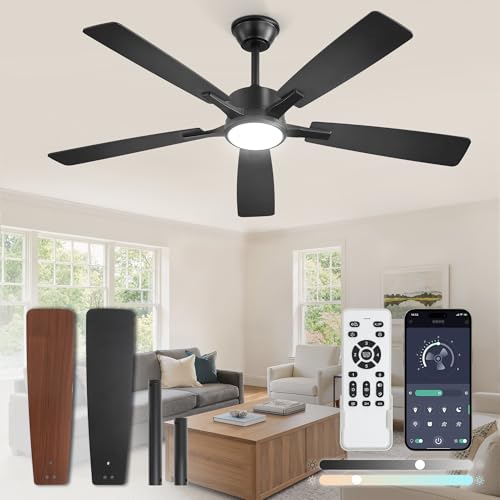
Prices are Amazon’s listed prices as of the time shown and change often; check Amazon for today’s price. As an Amazon Associate we earn from qualifying purchases.
Repair, Replace or Upgrade
Not every misbehaving fan needs replacing. A few rules of thumb, which are guidelines rather than formulas, help with the decision.
- Wobble. Most wobbly fans need balancing or tightening, not replacement. ENERGY STAR suggests checking that all connections are tight, checking blade alignment with a yardstick held vertically along the blade edges, and then using a balancing kit to find the problem blade. Our ceiling fan balance guide walks through that process.
- Humming, slow speeds or a fan that will not start. These can point to a failing capacitor, a bad wall control or a worn motor. A capacitor repair is often worth it on a good-quality fan; a worn motor on a builder-grade fan is usually a replacement.
- The light kit fails but the fan runs. Replacing the light kit or converting to an LED kit is often cheaper than a new fan. The ceiling fan light kit guide covers compatibility.
- Age and efficiency. If the fan is old, noisy and the repair would cost more than roughly half the price of a new installed fan, replacement usually makes more sense. Newer fans can also be much more efficient.
On efficiency, ENERGY STAR states that certified ceiling fans are up to 44% more efficient than conventional fans, using improved motors and blade designs. Its key product criteria rate fan efficiency in cubic feet per minute of airflow per watt (CFM/W), a weighted metric based on performance at multiple speeds and in standby, with minimum efficiency and airflow levels that scale with fan diameter. When comparing fans, the CFM/W figure on the product listing is a more useful efficiency comparison than motor wattage alone.
ENERGY STAR’s criteria also define a “hugger” ceiling fan as one whose lowest blade point is 10 inches or less from the ceiling, and note that huggers can be safely installed on low ceilings. That matters for older Front Range ranch homes and basements with lower ceilings, where a standard downrod fan would hang too low.
How to Read a Ceiling Fan Installation Quote
A fair quote for fan work is short and specific. Getting two or three written quotes is still worth it for anything beyond a simple swap, because the price for new wiring varies widely between contractors.
Line items that should be there
- Number of fans and the scope of each: swap, fixture-to-fan or new location.
- Whether a fan-rated box or brace is included.
- Any new wiring, switch or control, and roughly where the cable will run.
- Downrod or sloped-ceiling adapter if needed.
- Drywall patching, and whether painting is included or excluded.
- Permit, if one applies, and who pulls it.
- Removal and disposal of the old fan or fixture.
- Warranty on labor.
Red flags
- No mention of the box on a fixture-to-fan conversion. Hanging a fan on a light-fixture box is a common shortcut and a real hazard.
- Pressure to rewire the whole room or upgrade the panel for a single fan, without a specific condition being pointed out.
- Unlicensed work on new circuits. Swapping a fixture is one thing; running new circuits is electrical work that should be done by a licensed electrician where the state or city requires it.
- A very low phone price that grows once the installer sees the ceiling, without a clear reason.
- No written price before work begins.
Questions to ask
- Is the existing box rated for a ceiling fan, and if not, what will you install?
- Will the fan and light be on separate controls?
- Do you need a permit for this scope, and is it in the price?
- Will you balance the fan and test all speeds and the reverse function before leaving?
- How much does each additional fan cost on the same visit?
Front Range Factors
Ceiling fans are a universal product, but a few Colorado conditions do affect how homeowners use them and what an installation costs.
- Dry summers and cool nights. In much of the Front Range, low humidity and cool evenings mean many homes rely on fans and open windows for part of the cooling season. ENERGY STAR notes that fans cool people, not rooms, so turning them off in unoccupied rooms saves energy.
- Winter reverse mode. ENERGY STAR advises running the fan counterclockwise in summer for a wind-chill effect, and in winter reversing the motor and running it at low speed clockwise to create a gentle updraft that pushes warm air near the ceiling back down. Homes with tall great-room ceilings, common in newer Front Range construction, benefit most. Our guide to ceiling fan direction explains how to check the setting.
- Vaulted ceilings in newer subdivisions. Many homes built in Douglas, Arapahoe and El Paso counties have vaulted living rooms, which add downrod length and ladder or scaffold time to the quote.
- Covered patios and porches. Outdoor fans need to be rated for damp or wet locations depending on exposure to rain, snow and blowing dust. Readers comparing models can see our picks for the best outdoor ceiling fans.
- Older homes in Denver and Boulder. Plaster ceilings, cloth wiring and shallow boxes in older homes can turn a simple swap into a larger job.
Is DIY Installation Worth It?
A straight swap of one fan for another on an existing fan-rated box is a job many confident homeowners take on. ENERGY STAR’s own tips note that consumers should read and understand the manufacturer’s instructions before attempting to install a ceiling fan. The savings are the labor portion of the table above.
The risks are real, though. The circuit must be shut off at the breaker and confirmed dead with a tester. The box and brace must be rated for a moving fan. Connections have to be secure inside a crowded canopy. A fan that falls or a loose connection that overheats is far more expensive than the labor saved. New wiring, new switches and new circuits are best left to a licensed electrician, and in many jurisdictions they require a permit regardless of who does the work.
The U.S. Consumer Product Safety Commission’s electrical safety sheet suggests having a licensed electrician check a home’s electrical system for hazards if it has been more than 10 years since the last inspection, or if warning signs appear, including dimming or flickering lights, sizzling or buzzing sounds, the odor of overheated plastic, hot switch plates and outlet covers, and breakers that need resetting frequently. If any of those show up around a fan or its switch, stop using it and call an electrician.
How a Home Inspection Flags Ceiling Fan Problems
Under the ASHI Standard of Practice, a home inspector inspects a representative number of installed lighting fixtures, switches and receptacles, along with the service panel, conductors and overcurrent protection. In practice, that means operating fans and their lights with the normal controls, watching for heavy wobble, and noting obvious issues.
Common inspection notes include a fan that wobbles severely, a fan mounted on what appears to be a light-fixture box, missing canopy covers or exposed splices, fan blades too close to the floor or to a door swing, outdoor fans that are not rated for outdoor use, and switches that do not control what they should. Inspectors do not take fans apart or confirm box ratings above the canopy, so a flagged fan usually leads to an electrician’s evaluation.
For buyers, a single wobbly fan is minor. A pattern of amateur electrical work, such as several fans on fixture boxes or extension-cord style splices, is a reason to have an electrician look at the home more broadly. More guides to electrical costs and decisions are collected on our electrical hub.
Ways to Keep the Cost Down
- Install several fans on one visit rather than one at a time.
- Choose locations that already have a ceiling box on a switch.
- Pick a fan sized for the room and ceiling height so no special mounting hardware is needed.
- Ask whether a wireless remote can replace a new wall run for separate fan and light control.
- Handle drywall touch-up and painting yourself if the electrician’s quote separates it out.
- Compare ENERGY STAR CFM/W ratings so the fan pays back some of its cost in lower running costs.
When to Call an Electrician or Inspector
Call a licensed electrician for any new location, new switch or new circuit, for older homes with questionable wiring, or whenever a fan shows warning signs such as buzzing, a burning smell, a hot switch or a breaker that trips. For buyers and sellers, a home inspection is the right time to catch unsafe fan mounting and other amateur electrical work before closing.
Questions about electrical items in an inspection report, or about a Front Range home you are considering, can go to our team through the contact page.
More Questions About Ceiling Fan Installation Cost
How much does an electrician charge to install a ceiling fan?
An electrician typically charges about $100 to $300 in labor to install a ceiling fan on an existing fan-rated box, based on common industry estimates, with higher totals when a new box, brace or wiring is needed. Many electricians set a minimum service charge.
Rates vary by region, ceiling height and how much work is needed. Jobs that require running new cable, adding a wall switch, or working on tall or vaulted ceilings can push labor to several hundred dollars or more. Asking for a written quote that lists the fan, box, wiring and permit separately helps compare bids.
Does a handyman charge less than an electrician to install a ceiling fan?
A handyman often charges less than a licensed electrician to swap a ceiling fan for an existing fan or light on a fan-rated box. However, many states and cities restrict electrical work by unlicensed handymen, especially new wiring, circuits or switches.
Hiring someone without the required license can create problems with permits, insurance claims and future home sales. For straightforward replacements, some licensed handymen are allowed to do the work. For anything involving new wiring or a new fan-rated box, a licensed electrician is the safer and often legally required choice.
How much does it cost to replace a light fixture with a ceiling fan?
Replacing a light fixture with a ceiling fan commonly costs about $150 to $400 in labor, according to industry estimates, when the existing box must be upgraded to a fan-rated box or brace. If the box is already fan-rated, the cost may fall closer to a simple replacement.
Adding separate switching for the fan and light, or installing a new wall control, can increase the total. The fan itself is a separate cost. Older homes may have wiring that needs updating before installation, which an electrician will identify during the estimate.
How much does it cost to install a ceiling fan with a remote?
Installing a ceiling fan with a remote control usually costs about the same as a standard installation when the remote comes with the fan, since setting up the receiver adds only a little time. Adding a remote kit to an existing fan commonly adds a modest labor charge plus the kit price.
A remote can sometimes avoid the need to run new wiring for a separate fan and light switch, which may lower total costs. Smart controls that connect to home automation systems may cost more and take extra setup time. Confirming compatibility before purchase avoids return trips.
References
- Ceiling Fans — ENERGY STAR
- Ceiling Fan Installation and Usage Tips — ENERGY STAR
- Ceiling Fans Key Product Criteria — ENERGY STAR
- Electrical Safety (National Electrical Safety Month sheet) — U.S. Consumer Product Safety Commission
- ASHI Standard of Practice for Home Inspection — American Society of Home Inspectors
Frequently asked questions
How much does it cost to install a ceiling fan?
Typical national labor in 2026 is about $100 to $250 to swap an existing fan and about $150 to $400 to replace a light fixture with a fan. A new location that needs wiring and a switch often runs $300 to $900 or more, plus the fan itself.
Do you need a special box for a ceiling fan?
Yes. ENERGY STAR advises using a UL-listed metal box marked For Use With Ceiling Fans and notes that replacing a light fixture with a fan usually means replacing the box. Fans can weigh as much as 50 pounds and should be anchored to a joist or a rated brace.
Is it cheaper to install several ceiling fans at once?
Usually. The trip charge and setup are covered by the first fan, so many electricians price additional fans on the same visit lower. Bundling other small electrical tasks into the visit also helps.
Do ceiling fans help in winter?
They can. ENERGY STAR recommends reversing the motor in winter and running the fan clockwise at low speed to push warm air near the ceiling back down, which helps most in rooms with tall ceilings.
Does a home inspector check ceiling fans?
Inspectors operate a representative number of fixtures and switches, including fans, and note heavy wobble, exposed wiring or fans that appear to be on light-fixture boxes. They do not open the canopy, so flagged fans usually need an electrician's evaluation.
Is ceiling fan installation cheaper for replacement than new installation?
Replacing an existing ceiling fan is usually much cheaper than installing a fan in a new location, because the wiring, switch and fan-rated box are already in place. New locations often require running cable, adding a switch, installing a support brace, and patching drywall, raising labor costs significantly.
Does installing a ceiling fan lower energy bills?
A ceiling fan can lower cooling costs when it allows the thermostat to be set a few degrees higher while keeping occupants comfortable. Fans cool people, not rooms, so running them in empty rooms wastes energy. ENERGY STAR rated fans use less electricity than standard models.
Do ceiling fan installation costs include assembly?
Most professional ceiling fan installation quotes include assembling the fan, mounting it, wiring it and balancing the blades. Removing and disposing of the old fixture is often included but not always. Asking the installer what the price covers prevents unexpected extra charges after the job is done.
Buying a home on the Front Range and want the electrical system looked at by a qualified inspector before closing? Get in touch with our team.