Boiler Expansion Tanks: Waterlogged Tanks and Relief Valves
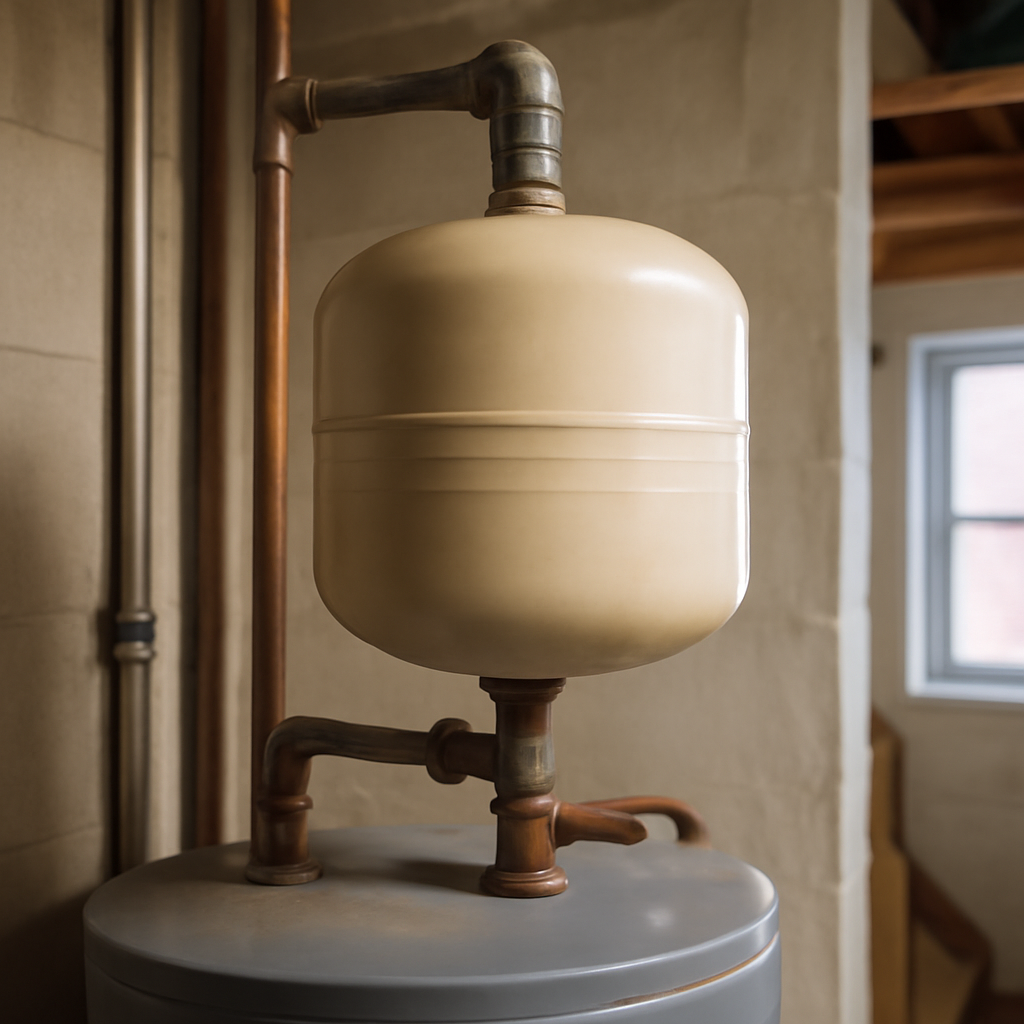
Water expands when it is heated, and in a closed hydronic heating system that expansion has nowhere to go. Without a place to absorb it, pressure climbs every time the boiler fires until the relief valve opens and dumps water on the floor. The boiler expansion tank is the part that prevents that. It is usually a small gray, blue or white tank hanging from the piping near the boiler, or, in older homes, a large steel tank strapped between the basement joists. When it stops working, the symptoms are easy to misread as a bad relief valve or a failing boiler. This guide explains how hydronic expansion tanks work, how diaphragm and older compression tanks differ, how to recognize a waterlogged tank, what normal gauge readings tend to look like, and how this tank differs from the one on a water heater. Pressure testing and tank replacement belong with a qualified hydronic or boiler technician.
Part of our Heating, Cooling & Ventilation guide — start there for the full picture →
Heating or cooling trouble? Talk to a local HVAC technician.
📞 Call (833) 491-1876What a Boiler Expansion Tank Does
A hot-water heating system, whether it feeds radiators, baseboard or radiant floor tubing, is a closed loop filled with water and kept under modest pressure. As the boiler heats that water from room temperature toward its operating temperature, the water’s volume grows. Because water does not compress, that extra volume has to go somewhere. The expansion tank provides a cushion of compressed air that the expanding water can push into, keeping system pressure within a safe band.
When the system cools, the air cushion pushes the water back into the piping. A healthy tank lets the pressure gauge rise modestly as the boiler heats and fall back as it cools. A failed tank lets pressure spike, sometimes to the relief valve’s setting, which on many residential boilers is 30 psi. That is the relief valve doing exactly what it is designed to do.
The tank also helps establish the point of no pressure change in the system, the location where the circulator’s pumping does not raise or lower static pressure. That is a design detail that affects whether air gets drawn into the system, and it is one reason installers pay attention to where the tank connects relative to the circulator pump.
Diaphragm Tanks vs. Steel Compression Tanks
There are two broad designs in Front Range homes, and they behave and fail differently.
Diaphragm and bladder tanks
Most systems installed or updated in recent decades use a diaphragm or bladder tank. A flexible rubber membrane separates the system water from a factory-charged air space. A Schrader valve, much like a tire valve, sits on the end of the tank opposite the water connection so the air side can be checked and adjusted. Because the air never touches the water, it does not dissolve into the system over time. These tanks are compact and can be mounted in almost any orientation the manufacturer allows.
They fail when the diaphragm ruptures or the air charge leaks out through the valve or the shell. Once the air side is gone, the tank fills with water and stops cushioning anything.
Steel compression tanks
Older systems, especially in pre-1970s homes in Denver neighborhoods and older parts of Boulder and Colorado Springs, often have a plain steel tank mounted horizontally near the ceiling. There is no membrane. Air sits on top of the water inside the tank and acts as the cushion. Over time, air is absorbed into the water and carried through the system, so the tank gradually waterlogs. These tanks usually have a drain fitting and sometimes a sight glass or a special fitting designed to drain and recharge them.
Compression tanks rely on the system being piped to send air back to the tank rather than eliminate it. Adding an automatic air vent or microbubble air separator to a system designed around a compression tank can actually make waterlogging worse, because it removes the air the tank depends on. Technicians often convert these systems to a diaphragm tank when they replace equipment.
Signs of a Waterlogged or Failed Tank
A waterlogged tank is one of the most common causes of relief valve discharge on a boiler. Typical signs include:
- Relief valve weeping or discharging. Water dripping from the relief valve’s discharge pipe, often only while the boiler is firing. Stains, mineral crust or a bucket placed under the pipe are clues.
- Large pressure swings. The gauge climbs sharply as the boiler heats, sometimes approaching or hitting the relief setting, then falls as it cools.
- Tank full of water. A diaphragm tank that feels heavy, sounds solid when tapped along its full length, or is warm at both ends rather than mostly at the water end.
- Water at the air valve. Briefly depressing the Schrader valve and seeing water instead of air means the diaphragm has failed. The tank needs replacement.
- Frequent automatic fill. Each relief discharge loses water that the fill valve replaces with fresh, oxygenated water, which can accelerate corrosion inside iron components over time.
Not every discharge points to the tank. A relief valve can also leak because of debris on its seat, an overfeeding fill valve, an undersized tank for the system’s water volume, or a failed indirect water heater coil that leaks domestic pressure into the boiler loop. Diagnosis means looking at the whole system.
Why a weeping relief valve matters
The relief valve is the last line of protection against excessive pressure. Never cap, plug or remove it, and never ignore it. Mineral deposits from repeated discharges can eventually keep it from seating or opening reliably. Our guide to the water heater pressure relief valve covers the basic principles of relief valves, discharge pipe rules and why the outlet must never be blocked. Boilers use a pressure relief valve rather than the combined temperature and pressure valve found on tank water heaters, but the safety logic is similar.
Reading the Gauge and Checking Precharge
Most boilers have a combination gauge, often called a tridicator, that shows pressure in psi, temperature and sometimes altitude or feet of head. Reading it at the right time is the key.
Typical cold pressure
In many single-family homes, the cold fill pressure on a residential hot-water boiler is set somewhere around 12 to 15 psi, which is enough to lift water to the top floor with some margin. Taller homes or systems with radiators on a third floor may need more. As the system heats, a modest rise of a few psi is common with a healthy, properly sized tank. These are general ranges; the right numbers for a given system depend on building height, fill valve setting, tank size and the manufacturer’s instructions.
Checking precharge on a diaphragm tank
The air charge on a diaphragm tank should usually match the system’s cold fill pressure. Many tanks ship from the factory precharged at roughly 12 psi. A technician checks it this way:
- Shut the boiler off and let the system cool.
- Isolate the tank from the system, if isolation valves are present, or relieve system pressure enough to take water pressure off the diaphragm.
- Check air pressure at the Schrader valve with a tire gauge.
- Add air with a pump or compressor to match the cold system fill pressure, then reopen the tank and restore system pressure.
Checking precharge with the tank still under system water pressure gives a misleading reading, because the gauge reads the water pressure pushing on the diaphragm rather than the actual air charge. That is a frequent DIY mistake.
Draining a compression tank
Older steel compression tanks can be drained and refilled with air to restore the cushion. The process involves closing the tank’s isolation valve, opening the drain and letting air in as water leaves, then refilling. It is a messy job with hot water and heavy tanks, and older valves often leak once disturbed, so many homeowners leave it to a technician.
Installation Details That Shorten Tank Life
Many tank failures trace back to how the tank was installed rather than to a defective product. A few details come up often.
Support and orientation
A full diaphragm tank can weigh considerably more than an empty one, and a waterlogged tank more still. Tanks hung from a single threaded nipple with no bracket put stress on the fitting and the piping, especially if the pipe is copper. Manufacturers typically list acceptable mounting orientations and may call for a strap or bracket on larger sizes. Some installers prefer mounting the tank with the air valve down or sideways to reduce trapped air and sediment at the diaphragm, while others follow the manufacturer’s diagram exactly. Either way, a sagging or unsupported tank is a reasonable item to flag.
Isolation and service valves
Without an isolation valve between the tank and the system, checking precharge accurately requires draining pressure from the whole loop. A small ball valve with a drain on the tank side makes service far easier. Some technicians add one when they replace a failed tank, which adds a modest amount to the job.
Fill valve interaction
The automatic fill valve, often called a pressure-reducing or feed valve, keeps the system at its cold fill pressure. If it is set too high, the system starts hot cycles with less room to expand, and even a healthy tank may not prevent relief discharge. If it leaks through, it can slowly overpressurize the loop. A backflow preventer on the fill line protects the potable supply from boiler water and is commonly required by local plumbing codes. Inspectors and technicians often check the fill valve setting and backflow device alongside the tank, because the three parts work as a team.
Boiler Tank vs. Water Heater Expansion Tank
Homes with boilers sometimes have two small expansion tanks that look nearly identical. They are not interchangeable.
- The boiler expansion tank sits on the closed heating loop. It handles thermal expansion of heating water at relatively low pressure, typically with a precharge near the boiler fill pressure.
- The water heater expansion tank sits on the cold-water supply to a tank water heater or indirect tank. It handles expansion of potable water in a home with a check valve or pressure-reducing valve, at a precharge matched to household water pressure, which is usually much higher. These tanks are rated for potable water.
Our guide to the water heater expansion tank covers that domestic side. A hydronic tank installed on potable water, or a potable tank set to the wrong precharge on a boiler, can fail early or let pressure climb.
How the Tank Fits Into the Whole Hydronic System
The expansion tank is one part of a system that includes the boiler, circulator, air separator, fill valve, relief valve and the terminal units that deliver heat. Problems in one often show up as symptoms in another.
- Boilers. A tank that waterlogs repeatedly can be a sign of a system issue the boiler technician should investigate. Our boiler repair guide covers common boiler faults and repair-or-replace decisions.
- Combi boilers. Many wall-hung combi boilers include a small internal expansion vessel. Systems with a large water volume may need an additional external tank, so sizing matters when a combi replaces an older cast-iron boiler.
- Radiators. Large cast-iron hot water radiators hold a lot of water, which increases the expansion volume the tank must absorb.
- Radiant floors. Radiant floor heating runs at lower water temperatures but can involve long tubing runs, mixing valves and glycol in some installations. Glycol expands differently than plain water, which affects tank sizing.
Tank sizing depends on total system water volume, operating temperature and pressure range. An undersized tank can behave like a waterlogged one even when it is working perfectly.
Safety and Efficiency Considerations
An expansion tank problem is mostly a pressure and water-damage issue, but boilers are combustion appliances and deserve a broader safety view. The EPA lists worn or poorly adjusted and maintained combustion devices, including boilers and furnaces, among the sources of carbon monoxide in homes. The CPSC recommends battery-operated or battery-backup CO alarms on every level of the home and outside sleeping areas, and advises getting to fresh air and calling 911 if CO poisoning is suspected. Annual boiler service is a reasonable time to check the tank, the relief valve and the combustion side together.
When an older boiler is being replaced, ENERGY STAR notes that certified gas boilers have AFUE ratings of 90 percent or greater and certified oil boilers 87 percent or greater, achieved with features such as electronic ignition and sealed combustion. A new tank and relief valve are commonly included with a boiler replacement.
Typical Costs
Prices depend on tank size, accessibility and whether other components need work, so treat these as rough 2026 ranges rather than quotes:
- Precharge check and adjustment. Often part of annual boiler service or a modest service-call fee.
- Diaphragm tank part. Common residential hydronic tanks often cost somewhere around $40 to $150, with larger tanks more.
- Installed tank replacement. Many homeowners see totals in roughly the $200 to $500 range, higher if isolation valves, a new relief valve or system draining and refilling are needed.
- Compression tank conversion. Converting an older steel-tank system to a diaphragm tank with an air separator typically costs more because of added piping and parts.
What a Home Inspection Covers
The ASHI Standard of Practice requires inspectors to open readily openable access panels and inspect installed heating equipment, vent systems and distribution systems. It lists items inspectors are not required to do, including inspecting heat exchangers and determining heat supply adequacy and distribution balance, and it does not require inspectors to operate shut-off valves or automatic safety controls. In practice, a home inspector may note relief valve discharge evidence, a missing or improperly terminated discharge pipe, gauge readings, corrosion on the tank or fittings, and the age of the boiler. Precharge testing is beyond the standard scope, so those findings are usually referred to a hydronic technician.
The heating and cooling inspection hub explains how inspectors approach boilers and other heating equipment, and the guide to hiring a home inspector covers what to ask before booking.
References
- ASHI Standard of Practice for Home Inspections — American Society of Home Inspectors
- Boilers — ENERGY STAR
- Carbon Monoxide’s Impact on Indoor Air Quality — U.S. Environmental Protection Agency
- Carbon Monoxide Information Center — U.S. Consumer Product Safety Commission
Frequently asked questions
How do I know if my boiler expansion tank is waterlogged?
Common signs are a relief valve that drips while the boiler fires, a pressure gauge that climbs sharply as the system heats, and a diaphragm tank that feels full and heavy. Water coming out of the tank's air valve means the diaphragm has failed.
What should boiler pressure be when cold?
Many residential hot-water systems are set somewhere around 12 to 15 psi cold, with a modest rise as they heat. The correct figure depends on building height and the manufacturer's instructions, so a technician should confirm it.
Can I add air to my boiler expansion tank?
A diaphragm tank's air charge can be adjusted at its Schrader valve, but only with the tank isolated or system pressure relieved so the reading is accurate. Many homeowners have a technician do it during annual service.
Is a boiler expansion tank the same as a water heater expansion tank?
No. The boiler tank serves the closed heating loop at low pressure, while the water heater tank serves potable water at household pressure and must be rated for drinking water.
How much does it cost to replace a boiler expansion tank?
As a rough 2026 range, many installed replacements fall around $200 to $500, with higher totals when valves, a relief valve or system draining are needed.
Looking at an older home with a boiler and a dripping relief valve? Contact us to connect with a Front Range inspector who looks at hydronic systems before you close.