Best Well Pressure Tanks (2026): 7 Picks by Size and Drawdown

The best well pressure tank is the one that keeps your pump from short-cycling and is built to touch drinking water. Capacity on the label is only part of the story. What matters is drawdown, the usable water delivered between the pump shutting off and turning back on, and whether the tank is certified for potable water. Some listings on this shelf state both. Others say nothing about drawdown, and two even warn their tanks are not suitable for drinking water. Below are seven picks sorted by size and job, then a guide to sizing, precharge, installation and when a well system needs a professional.
Part of our Plumbing & Water guide — start there for the full picture →
As an Amazon Associate we earn from qualifying purchases.
How we compared: we compared 16 current Amazon listings from a well pressure tank search on what each states: tank volume, drawdown, factory precharge, diaphragm or bladder design, connection size, drinking water certification and warranty. Fourteen are pressure tanks; one is a tank tee installation kit and one listing describes a lawn sprayer tank in its bullets despite a pressure tank title, so both were set aside as picks. We did not test or install any of these tanks. Prices and availability change often, so check the current listing before buying.
Quick picks: the best well pressure tanks by job
| Product | Best for | Key features | Price | Buy |
|---|---|---|---|---|
| Red Lion RL34A | Most homes, stated drawdown |
| $432.99as of Nov 10, 2026 10:37 pm GMT+0000 | Buy now →Check current price |
| WaterWorker HT-30B | Value with NSF 61 listing |
| — | Buy now →Check current price |
| Amtrol WX-202 | Long stated warranty |
| $327.99as of Nov 10, 2026 10:37 pm GMT+0000 | Buy now →Check current price |
| Amtrol WX-203 | Aggressive water |
| $588.00as of Nov 11, 2026 10:26 am GMT+0000 | Buy now →Check current price |
| Amtrol WX-302 | Large homes, high demand |
| $1,272.61as of Nov 11, 2026 10:26 am GMT+0000 | Buy now →Check current price |
| Red Lion RL20A | Smaller homes, tight space |
| $259.99as of Nov 11, 2026 10:26 am GMT+0000 | Buy now →Check current price |
| Red Lion 6AH | Pump-mounted shallow systems |
| $121.80as of Nov 11, 2026 10:26 am GMT+0000 | Buy now →Check current price |
Prices are Amazon’s listed prices as of the time shown and change often; check Amazon for today’s price. As an Amazon Associate we earn from qualifying purchases.
The seven picks, compared listing by listing
1. Red Lion RL34A (604683) — Best for Most Homes

34-gallon vertical tank with 10.8 gallons of drawdown at 30/50 psi, certified to NSF/ANSI 61 and 372.
Check price on Amazon$432.99 as of Nov 10, 2026 10:37 pm GMT+0000 — prices change; see Amazon for current price.Why we like it
- States drawdown, not just tank volume
- Certified NSF/ANSI 61 and 372
- Gives a clear precharge setup rule
- Base lifts tank off the floor
| Specification | Details |
|---|---|
| Size | 34 gallons, vertical |
| Drawdown | 10.8 gallons at 30/50 psi; about 11 fixtures at once |
| Certification | NSF/ANSI/CAN 61 and NSF/ANSI/CAN 372 |
| Build | 20-gauge steel, butyl diaphragm, propylene liner, 304 stainless connection |
| Precharge | 20 psi for shipping; set to 2 psi below switch cut-in |
| Connection | 1-inch FNPT elbow |
Red Lion RL34A — 34 gal, 10.8 gal drawdown @ 30/50, NSF/ANSI 61 + 372, butyl diaphragm, 1-in FNPT
One of Three Listings That State Drawdown
Only three of the 14 tank listings give a drawdown figure, and all three are Red Lion. Drawdown is the number that actually controls pump cycling, and the RL34A lists 10.8 gallons at a 30/50 psi switch setting. It also states how many fixtures it can serve at once, about 11, which helps match it to a house.
Five listings name NSF/ANSI 61, the standard for components in contact with drinking water: three Red Lion tanks and two WaterWorker tanks. Red Lion also names 372, the lead-free standard. The listing is clear on setup: the tank ships at 20 psi and must be topped up with a bicycle pump to 2 psi below the pressure switch cut-in. That instruction is often missed and causes early pump wear.
No warranty is stated in the listing.
Pros
- Drawdown and fixture count stated
- NSF/ANSI 61 and 372 named
- Stainless steel water connection
Cons
- Warranty not stated
- Precharge must be adjusted on install
- Drawdown given only at 30/50
Check Red Lion RL34A price on Amazon
2. WaterWorker HT-30B — Best Value With an NSF 61 Listing

30-gallon vertical diaphragm tank with 26-gallon capacity, listed under NSF/ANSI 61 and pre-charged to 25 psi.
Check price on AmazonWhy we like it
- Listed under NSF/ANSI Standard 61
- Seamless butyl diaphragm design
- Polypropylene liner isolates the steel
- 5-year warranty
| Specification | Details |
|---|---|
| Size | 30-gallon tank, 26-gallon capacity |
| Drawdown | Not stated in listing |
| Certification | Listed by NSF under ANSI/NSF 61 |
| Build | Deep-drawn steel domes, butyl diaphragm, polypropylene liner, enamel finish |
| Precharge | 25 psi; check manual for correct setting |
| Warranty / weight | 5 years; 41 lb |
WaterWorker HT-30B — 30 gal (26 gal capacity), NSF 61, butyl diaphragm, 25 psi precharge, 5-yr warranty
A Diaphragm Tank That Explains Why It Is Not a Bladder
Nine listings describe a diaphragm. WaterWorker explains the difference most clearly: its seamless butyl diaphragm is designed to flex rather than stretch and crease the way a bag-style bladder can. The water sits against a polypropylene liner, never the steel shell, which protects against rust and taste.
The “26-gallon capacity” figure is not drawdown. It is the water side of the tank at rest. Usable drawdown at a typical switch setting will be a fraction of that, so do not compare it directly with Red Lion’s 10.8-gallon figure.
The factory precharge is 25 psi, and the listing points you to the manual for the right setting. On a 30/50 switch that usually means raising it to about 28 psi, using the same 2-psi-below-cut-in rule Red Lion states.
Pros
- NSF 61 listed
- Clear diaphragm design explanation
- 5-year warranty
Cons
- No drawdown stated
- Connection size not stated
- Precharge needs adjustment
Check WaterWorker HT-30B price on Amazon
3. Amtrol WX-202 Well-X-Trol — Best Long Stated Warranty
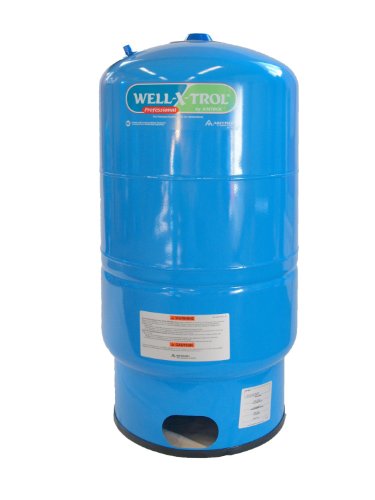
Steel-shell well tank with a virgin polypropylene liner and hoop ring diaphragm seal, backed by a 7-year warranty.
Check price on Amazon$327.99 as of Nov 10, 2026 10:37 pm GMT+0000 — prices change; see Amazon for current price.Why we like it
- Longest warranty stated, 7 years
- Liner rated not to crack or flake
- Hoop ring seal secures the diaphragm
- Well-known Well-X-Trol line
| Specification | Details |
|---|---|
| Build | High-strength steel shell, virgin polypropylene liner |
| Diaphragm seal | Positive hoop ring seal |
| Size | About 31 x 15 in; 23 lb |
| Volume / drawdown | Not stated in listing |
| Certification | Not stated in listing |
| Warranty | 7 years |
Amtrol WX-202 — steel shell, polypropylene liner, hoop ring seal, ~31 x 15 in, 7-yr warranty
The Longest Warranty, With the Thinnest Spec Sheet
Two Amtrol listings state a 7-year warranty, the longest on the shelf; WaterWorker states 5. A long warranty on a pressure tank matters because a failed diaphragm usually means replacing the whole tank.
The listing itself is sparse. It does not state the gallon size, drawdown, precharge or a certification. Amtrol’s model numbers map to tank sizes in its catalog, and the stated dimensions suggest a mid-size tank, but confirm volume and drawdown from the spec sheet before ordering.
Pros
- 7-year warranty
- Durable liner and seal design
- Compact, light tank
Cons
- Volume and drawdown not stated
- No certification named
- Precharge not stated
Check Amtrol WX-202 price on Amazon
4. Amtrol WX-203 Well-X-Trol — Best for Aggressive Water

Stand-type well tank with a steel system connection rated for aggressive water and deep-drawn steel domes.
Check price on Amazon$588.00 as of Nov 11, 2026 10:26 am GMT+0000 — prices change; see Amazon for current price.Why we like it
- Only listing naming aggressive-water connection
- Deep-drawn domes for strength
- Hoop ring diaphragm seal
- 7-year warranty
| Specification | Details |
|---|---|
| Type | Stand-type vertical well tank |
| Build | Steel shell, deep-drawn steel domes, virgin polypropylene liner |
| Connection | Steel system connection that withstands aggressive water |
| Size | About 47 in tall; 31 lb |
| Volume / drawdown | Not stated in listing |
| Warranty | 7 years |
Amtrol WX-203 — stand tank, aggressive-water steel connection, deep-drawn domes, ~47 in tall, 7-yr warranty
The Only Listing That Addresses Corrosive Water at the Connection
The water connection is where many tanks fail first. Amtrol’s WX-203 listing is the only one on the shelf that says its connection is built to withstand aggressive water, meaning water that is acidic or corrosive. Red Lion uses a 304 stainless connection, which also resists corrosion, but does not frame it that way.
Aggressive water is worth knowing about on a well. The CDC notes that water with pH too low or too high can damage pipes and let metals like lead leach into water. Test pH before choosing equipment.
Like the WX-202, the listing omits volume, drawdown and certification.
Pros
- Aggressive-water connection
- Deep-drawn steel domes
- 7-year warranty
Cons
- Volume and drawdown not stated
- No certification named
- Tall 47-inch tank
Check Amtrol WX-203 price on Amazon
5. Amtrol WX-302 — Best for Large Homes

86-gallon steel well tank with a polypropylene liner, 200 F maximum operating temperature, made in the USA.
Check price on Amazon$1,272.61 as of Nov 11, 2026 10:26 am GMT+0000 — prices change; see Amazon for current price.Why we like it
- Largest tank on the shelf, 86 gallons
- Fewer pump starts in high-demand homes
- States 200 F maximum temperature
- Made in the USA per listing
| Specification | Details |
|---|---|
| Size | 86 gallons; about 55 x 35 in |
| Build | Steel shell, virgin polypropylene liner, hoop ring seal |
| Maximum temperature | 200 F (93 C) |
| Weight | 143 lb |
| Drawdown / precharge | Not stated in listing |
| Origin | United States |
Amtrol WX-302 — 86 gal, steel shell, polypropylene liner, 200 F max, 143 lb, made in USA
The Biggest Tank, for Homes Where the Pump Runs Constantly
At 86 gallons the WX-302 is more than twice the size of the next-largest pick. Large homes, irrigation from the well, or a high-output pump all benefit from more drawdown, because every pump start adds wear and a bigger tank means fewer starts.
The size has costs. At 143 lb and 35 inches wide, it needs floor space, a solid base and help to move. The listing does not state drawdown or precharge, so ask for the spec sheet. Many installers would size a tank this big only after checking pump flow rate.
Pros
- Largest capacity here
- Reduces pump cycling in big homes
- Made in the USA
Cons
- Heavy and wide
- Drawdown not stated
- No certification named
Check Amtrol WX-302 price on Amazon
6. Red Lion RL20A (604682) — Best for Smaller Homes

20-gallon vertical tank with 7.2 gallons of drawdown at 30/50 psi, handling about 6 fixtures, NSF/ANSI 61 and 372.
Check price on Amazon$259.99 as of Nov 11, 2026 10:26 am GMT+0000 — prices change; see Amazon for current price.Why we like it
- Drawdown and fixture count stated
- NSF/ANSI 61 and 372 certified
- Short 27-inch height
- Same build as the RL34A
| Specification | Details |
|---|---|
| Size | 20 gallons, vertical; about 27.3 x 17 in |
| Drawdown | 7.2 gallons at 30/50 psi; about 6 fixtures |
| Certification | NSF/ANSI/CAN 61 and 372; tested by WQA |
| Build | 20-gauge steel, butyl diaphragm, propylene liner |
| Precharge | 20 psi shipped; set 2 psi below cut-in |
| Connection | 1-inch FNPT elbow |
Red Lion RL20A — 20 gal, 7.2 gal drawdown @ 30/50, ~6 fixtures, NSF/ANSI 61 + 372, 1-in FNPT
A Certified Small Tank With a Usable Drawdown Number
Several 20-gallon tanks are on the shelf, from WaterWorker and Reliance as well as Red Lion. The RL20A is the only one that states drawdown, 7.2 gallons at 30/50, and a fixture count. For a cabin, small house or a tight utility closet, that lets you judge whether it is enough for your pump.
It is also certified to NSF/ANSI 61 and 372. If your home is larger or your pump output is high, step up to the RL34A instead.
Pros
- Drawdown stated
- NSF 61 and 372 certified
- Compact height
Cons
- Small drawdown for larger homes
- Warranty not stated
- Precharge needs adjusting
Check Red Lion RL20A price on Amazon
7. Red Lion 6AH (604629) — Best for Pump-Mounted Shallow Systems

6-gallon horizontal tank with a pump mounting bracket and stand, 1.9 gallons of drawdown, NSF/ANSI 61 and 372.
Check price on Amazon$121.80 as of Nov 11, 2026 10:26 am GMT+0000 — prices change; see Amazon for current price.Why we like it
- Bracket lets a pump sit on the tank
- Only horizontal tank among the picks
- NSF/ANSI 61 and 372 certified
- Stand lifts it off the floor
| Specification | Details |
|---|---|
| Size | 6 gallons, horizontal |
| Drawdown | 1.9 gallons at 30/50 psi; about 2 fixtures |
| Certification | NSF/ANSI/CAN 61 and 372 |
| Mounting | Pump mounting bracket and stand included |
| Connection | 3/4-inch MNPT straight |
| Weight | 9.9 lb |
Red Lion 6AH — 6 gal horizontal, 1.9 gal drawdown, pump bracket, NSF 61 + 372, 3/4-in MNPT
The Small Tank Built to Carry a Jet Pump
The EPA notes that jet pumps are the most common pumps for shallow wells, about 25 feet or less, and are mounted above ground. The 6AH includes a bracket so a jet pump can sit directly on the tank, a compact arrangement for a well house or crawlspace.
Its 1.9-gallon drawdown and two-fixture rating are small. That suits a cabin, a shop or a booster setup, not a whole family house. On a full-size home it would cause frequent pump starts.
Pros
- Pump mounting bracket included
- NSF 61 and 372 certified
- Light and compact
Cons
- Small drawdown
- Only for light-demand systems
- Warranty not stated
Check Red Lion 6AH price on Amazon
Vertical, horizontal and stand tanks
Most of the tanks on this shelf are vertical, standing on their own base with the water connection at the bottom. Vertical tanks use the least floor space for their volume and are the default for basements and utility rooms. Red Lion’s RL-series tanks add a thermoplastic base that lifts the shell off the floor, which the listing says prevents condensation from staining the floor. That is a small detail with a real benefit: cold well water sweats on steel in a humid basement, and a tank sitting directly on concrete rusts from the bottom up.
Horizontal tanks, like the 6AH, lie on their side and often carry the pump on top. They suit low-clearance spaces such as crawlspaces and well houses. Stand-type tanks such as the Amtrol WX-203 are vertical tanks built on an integral stand. Whatever the shape, leave room around the tank for the tee, gauge, switch and relief valve, and enough clearance to read the gauge and reach the air valve on top.
Front Range well considerations
Private wells are common across Elbert County, eastern Douglas and El Paso counties, and the foothills west of Denver and Boulder. A few local factors affect pressure tank choice and upkeep:
- Deep wells and submersible pumps. The EPA notes submersible pumps are the most common choice for deep private wells. Many foothills wells are deep, which means a submersible pump and a full-size vertical tank in the house rather than a pump-mounted unit.
- Low-yield wells. Some fractured-rock wells produce only a few gallons per minute. A larger tank will not create water the well cannot supply, and some low-yield systems add a storage cistern ahead of the pressure tank. Ask a well contractor before upsizing.
- Water chemistry. Hardness, iron and low pH all affect tank connections and switches. The EPA lists rapid wear of water treatment equipment as a reason to test pH and corrosion, which is worth doing before replacing a tank that failed early.
- Cold snaps. Even an insulated well house can drop below freezing during a hard Front Range cold spell. A thermostatically controlled heater or heat tape on exposed lines protects the tank, switch and gauge.
Listings to read carefully
Two VEVOR tanks on the shelf state in their own bullets that they are not suitable for drinking water and are not frost-proof. That is unusual honesty, and it rules them out for a household well. A stainless “bladder-free” tank lists a 42 psi maximum working pressure, below a common 40/60 switch’s cut-out, which makes it a poor fit for many home systems. One Reliance listing titled as a 20-gallon pressure tank describes a 128-gallon lawn sprayer in its bullets. When a listing contradicts itself, skip it.
How to size a well pressure tank
The goal is enough drawdown that the pump runs for a reasonable minimum time each cycle. Pump manufacturers usually specify a minimum run time, often around one minute, to keep the motor from overheating on frequent starts. A common rule of thumb is roughly one gallon of drawdown per gallon per minute of pump output. Check your pump’s manual for its actual requirement.
- Find your pump’s flow rate in gallons per minute from its label or installer records.
- Find your pressure switch setting, commonly 30/50 or 40/60 psi.
- Compare drawdown at that setting. Drawdown drops at higher settings, so a tank’s 30/50 figure overstates what you get at 40/60.
Only the Red Lion listings give drawdown. For the others, ask for the spec sheet. Our well pressure tank guide explains the math in more detail.
Precharge: the step most installs get wrong
A diaphragm tank has an air side and a water side. The air side must be set, with no water pressure in the system, to about 2 psi below the pressure switch cut-in, the rule Red Lion states in its listing. Factory precharges on this shelf range from 20 to 38 psi, so almost every tank needs adjusting. Too low and drawdown suffers; too high and the tank may never fill properly.
Check precharge once a year: shut off the pump, open a faucet to drain pressure, and read the air valve with a tire gauge. Water coming out of the air valve means the diaphragm has failed.
Signs your tank is failing
- Short cycling. The pump clicks on and off every few seconds when a tap runs. This is the classic sign of a waterlogged tank or lost precharge.
- Pressure swings. Shower pressure surges and drops repeatedly.
- Water at the air valve. The diaphragm is ruptured.
- Rust or sweating. Corrosion at the base or connection, or condensation pooling on the floor.
A running toilet or hidden leak also makes the pump cycle when nobody is using water. The EPA says worn flappers are common culprits; a dye test in the toilet tank will reveal one.
Installation and safety points
- Relief valve. A pressure relief valve protects the tank if the switch sticks. Two VEVOR listings and a tee kit on the shelf mention one; tank tee kits bundle the switch, gauge, relief and drain valves.
- Certified materials. Choose a tank that names NSF/ANSI 61 for anything touching drinking water.
- Freeze protection. Front Range well houses and unheated garages freeze. A frozen tank or switch tube can crack. The EPA notes pitless adapters keep the supply pipe below the frost line; the tank itself still needs heat.
- Electrical. Pump wiring and pressure switches carry line voltage. A licensed electrician or well contractor should handle them.
- Test after the work. The EPA recommends testing your well water right after any part of the well system is replaced or repaired.
A pressure tank is not the same as a water heater expansion tank, which absorbs thermal expansion on the hot side. They look similar but are not interchangeable.
When to call a well professional
Replacing a tank is within reach of an experienced DIYer, but pump problems, wiring, sediment and repeated diaphragm failures need a licensed well contractor. The EPA recommends using bonded, insured and, where required, licensed and certified well professionals. Homes on a well often also have a septic system; our septic tank inspection guide covers that side. The plumbing and water hub links our related guides.
Buying a rural or foothills property on a well? An inspection can check the tank, pressure switch, gauge and visible plumbing and help you plan water testing. Get in touch here to connect with a vetted Front Range inspector.
Frequently asked questions
What size well pressure tank do I need?
Size by drawdown, not total gallons. A common rule of thumb is about one gallon of drawdown per gallon per minute of pump output, so the pump runs long enough each cycle. Check your pump's minimum run time and compare drawdown at your actual switch setting; only the Red Lion listings on this shelf state drawdown.
What should the air pressure be in a well pressure tank?
Set the precharge to about 2 psi below the pressure switch cut-in, with the system drained of water pressure. For a 30/50 switch that is about 28 psi, and for 40/60 about 38 psi. Factory precharges vary, so almost every tank needs adjusting at install.
Is a diaphragm or bladder tank better?
Both separate air from water. Diaphragm tanks use a flexible membrane fixed in the tank, which some makers say flexes rather than creasing like a bag-style bladder. Either works if sized correctly; certification for drinking water and a sound warranty matter more.
How long does a well pressure tank last?
Lifespan depends on water chemistry, precharge maintenance and pump cycling. Warranties on this shelf run 5 to 7 years where stated. Checking precharge yearly and fixing leaks that cause extra pump starts helps a tank last longer.
Do I need to test my water after replacing a pressure tank?
Yes. The EPA recommends testing your well immediately after replacing or repairing any part of the well system. At minimum test for total coliform bacteria, and keep up annual tests for nitrates, total dissolved solids and pH.
References
- Protect Your Home’s Water — U.S. Environmental Protection Agency
- Learn About Private Water Wells — U.S. Environmental Protection Agency
- Guidelines for Testing Well Water — Centers for Disease Control and Prevention
- Fix a Leak Week — U.S. Environmental Protection Agency